
IELTS TUTOR cung cấp A Review of Helen Thomson's Book, Unthinkable: An Extraordinary Journey Through the World's Strangest Brains: Đề thi thật IELTS READING (IELTS Reading Recent Actual Test) - Làm bài online format computer-based, , kèm đáp án, dịch & giải thích từ vựng - cấu trúc ngữ pháp khó & GIẢI ĐÁP ÁN VỚI LOCATION
I. Kiến thức liên quan
II. Làm bài online (kéo xuống cuối bài blog để xem giải thích từ vựng & cấu trúc cụ thể hơn)
📩 MN AI CHƯA CÓ ĐÁP ÁN FORECAST QUÝ MỚI PART 1-2-3 NHẮN ZL 0905834420 IELTS TUTOR GỬI FREE HẾT NHA
III. A Review of Helen Thomson's Book, Unthinkable: An Extraordinary Journey Through the World's Strangest Brains: Đề thi thật IELTS READING (IELTS Reading Recent Actual Test)
A Review of Helen Thomson's Book, Unthinkable: An Extraordinary Journey Through the World's Strangest Brains
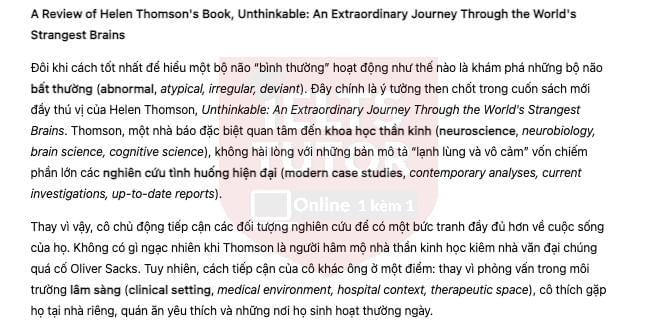
Sometimes the best way to understand how a 'normal' brain works is to explore those that are abnormal. Such is the insight in Helen Thomson's enjoyable new book, Unthinkable: An Extraordinary Journey Through the World's Strangest Brains. Thomson, a journalist with a particular interest in neuroscience, is dissatisfied with the 'cold and impersonal' accounts that make up the bulk of modem case studies. Instead, she reaches out to her research subjects to get a fuller picture of their lives. It should come as no surprise that Thomson is a fan of the late neuroscientist and popular writer Oliver Sacks. Yet her approach differs from his in one respect: instead of interviewing her subjects in a clinical setting, she prefers to meet them in their own homes, favourite restaurants and other haunts of regular life.
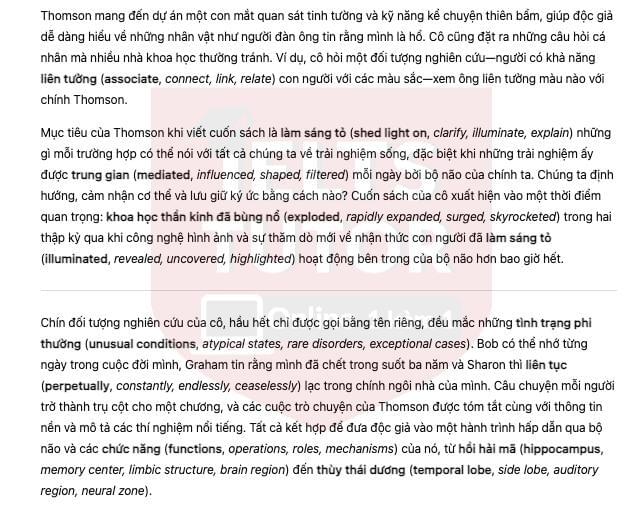
Thomson brings to the project an eye for detail and the skills of a natural storyteller, which allow us to comprehend more readily some of her subjects, such as the man who thinks he's a tiger. She also asks the sort of personal questions scientists might avoid. For instance, she queries one subject, who strongly associates people with colours, what colour he associates with Thomson herself. Thomson's aim in writing the book is to shed light on what each case can tell all of us about our own life experiences, particularly as they are mediated every day by our brains. How do we find our way around, perceive our bodies and record our memories? And her book comes at a significant time. Neuroscience has exploded in the last two decades as imaging technology and a renewed exploration of human cognition have illuminated the inner workings of our minds like never before.>> Form đăng kí giải đề thi thật IELTS 4 kĩ năng kèm bài giải bộ đề 100 đề PART 2 IELTS SPEAKING quý đang thi (update hàng tuần) từ IELTS TUTOR
Her nine subjects, mostly called only by their first names, all have decidedly unusual conditions. Bob can remember every single day of his life, Graham believed he was dead for three years and Sharon is perpetually lost in her own home. Each person's story anchors a chapter and Thomson's conversations with her subjects are summarised alongside background information and accounts of famous experiments. Together they take the reader on an engaging tour of the brain and its functions, from the hippocampus to the temporal lobe.
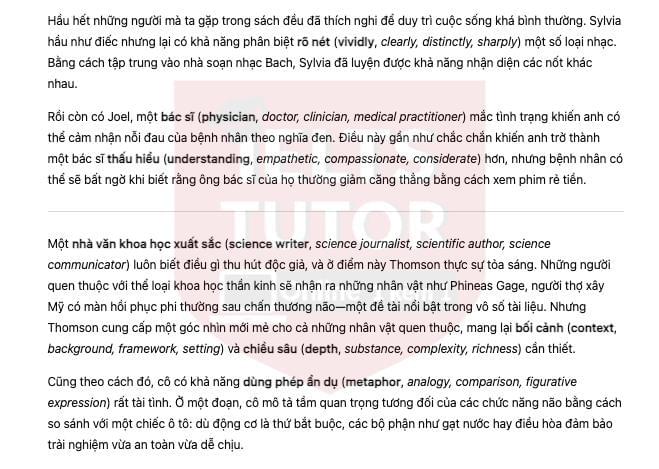
Most of the individuals we meet have adapted to maintain fairly ordinary lives. Sylvia is nearly deaf but is able to vividly distinguish some music. By concentrating on the classical composer Bach, Sylvia has trained herself to identify different notes. Then there is Joel, a physician whose condition means he can literally feel his patients' pain. While this almost certainly makes him a more understanding doctor, his patients might be surprised that their physician relieves stress at home by watching cheap movies.
A great science writer knows what is interesting to the reader, and here Thomson shines. Those familiar with the neuroscience genre will recognise figures like Phineas Gage, the American construction foreman whose remarkable recovery from a brain injury is a frequent case study in such volumes. But Thomson is able to provide a fresh account of even these well-known figures, bringing much-needed context and depth. In the same way, she has a gift for metaphor. At one point she describes the relative importance of different functions of the brain by comparing it to a car. While you absolutely must have an engine to make it run, parts like windshield wipers and air conditioning ensure that the experience is safe and pleasurable.
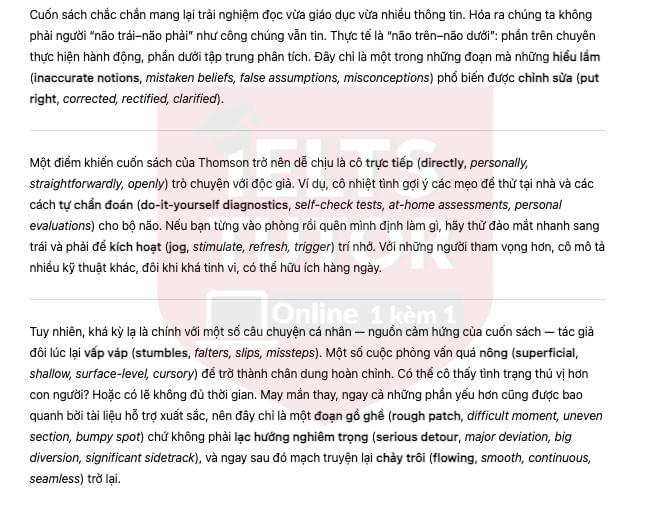
The book certainly makes for educational and informative reading. It turns out we aren't left-and right-brained, as so often believed by the general public. It's more a case of being top- and bottom-brained with, roughly speaking, the top part of the brain specializing in taking action and the bottom part doing analysis. This is just one of several passages in the book where widely held but inaccurate notions are put right.
One of the most enjoyable features of Thomson's book is that she addresses the reader directly. For example, she enthusiastically suggests tips to try at home and do-it-yourself diagnostics for your brain. If you have ever walked into a room and forgotten what you planned to do, try quickly looking left and right to help jog your memory. For the more ambitious, she outlines several other, sometimes quite sophisticated, techniques that might be of everyday use.
Oddly enough, it is with some of the personal stories-the inspiration for her book-that the author occasionally stumbles. Some of the interviews feel too superficial to be regarded as fully fleshed-out profiles. Perhaps she found the condition more interesting than the person? Or more likely, there wasn't enough time. Fortunately, even the weaker profiles are surrounded by excellent supporting material, so this is more of a rough patch in the road than a serious detour and soon enough the narrative is flowing again.
Perhaps the most moving chapter is the story of Tommy McHugh, whose personality completely changed after he suffered a stroke. He goes from being an emotionless, slightly menacing figure with a criminal record to a sensitive character with a deep appreciation for life. He also has become a compulsive painter, an activity from which he derives great fulfillment. It is transformations and revelations such as these that make the book so rewarding.
Questions
Questions 27 - 31
Do the following statements agree with the information given in the reading passage?
Write:
YES - if the statement agrees with the views of the writer
NO - if the statement contradicts the views of the writer
NOT GIVEN - if it is impossible to say what the writer thinks about this
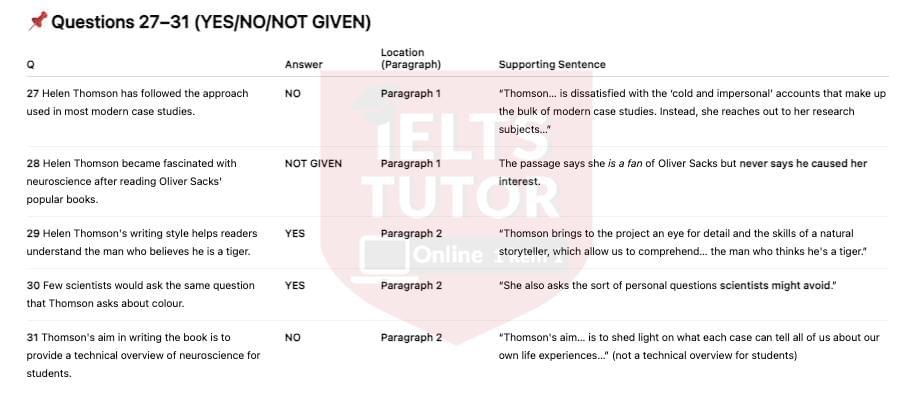
Helen Thomson has followed the approach used in most modern case studies.
Helen Thomson became fascinated with neuroscience after reading Oliver Sacks' popular books.
Helen Thomson's writing style helps readers understand the man who believes he is a tiger.
Few scientists would ask the same question that Thomson asks about colour.
Thomson's aim in writing the book is to provide a technical overview of neuroscience for students.
Questions 32 - 35
Choose the correct letter, A, B, C, or D.
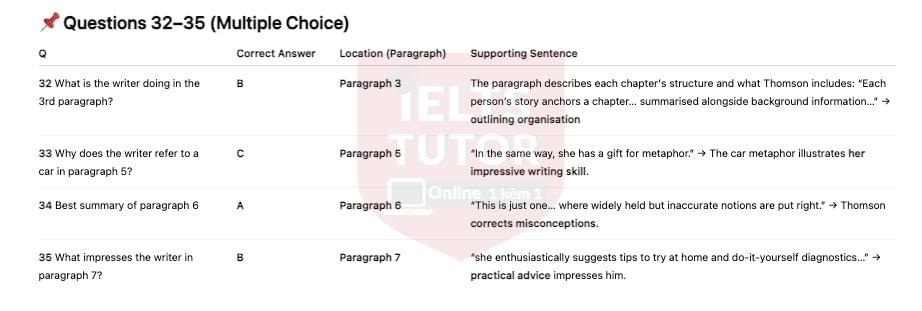
What is the writer doing in the third paragraph?
A. claiming that Thomson's book is unique
B. outlining how Thomson's book is organised
C. explaining why Thomson excluded certain material
D. identifying who Thomson's most interesting subject isThe writer refers to a car in the fifth paragraph in order to
A. highlight one factual error in Thomson's book.
B. contrast the complexity of humans and machines.
C. illustrate an impressive feature of Thomson's writing.
D. exemplify the way some brains develop in unusual ways.Which of the following best summarises the writer's argument in the sixth paragraph?
A. Thomson corrects some common misconceptions about the brain.
B. No two brains are likely to be exactly the same in every respect.
C. Thomson recognises that further research into brains is necessary.
D. Ordinary people cannot be expected to fully understand the brain.What impresses the writer about Thomson's book in the seventh paragraph?
A. her sympathy for people suffering from brain issues
B. her inclusion of practical advice about certain situations
C. her ability to describe complex problems in simple language
D. her humorous approach to describing some serious conditions>> IELTS TUTOR gợi ý tham khảo CẦN VIẾT & THU ÂM BAO NHIÊU BÀI ĐỂ ĐẠT 8.0 SPEAKING & 7.0 WRITING?
Questions 36 - 40
Complete each sentence with the correct ending, A-H, below.
The late neuroscientist and popular writer Oliver Sacks
Sylvia shows that she
The research subject named Joel
The American construction foreman Phineus Gage
List of Endings
A. is a research subject who has been described in many different publications.
B. is thought to be the only person who has reacted to treatment in this particular way.
C. can successfully manipulate one sense that usually functions imperfectly.
D. has been critical of the approach taken by Helen Thomson.
E. changed to become a nicer individual with a satisfying hobby.
F. used a research environment that was rejected by Helen Thomson.
G. is a medical professional whose unusual condition affects his emotional experience.
H. is a successful professional whose relaxation technique might appear unconventional.
IV. Dịch bài A Review of Helen Thomson's Book, Unthinkable: An Extraordinary Journey Through the World's Strangest Brains
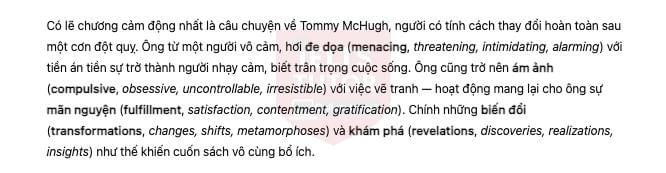
V. Giải thích từ vựng A Review of Helen Thomson's Book, Unthinkable: An Extraordinary Journey Through the World's Strangest Brains
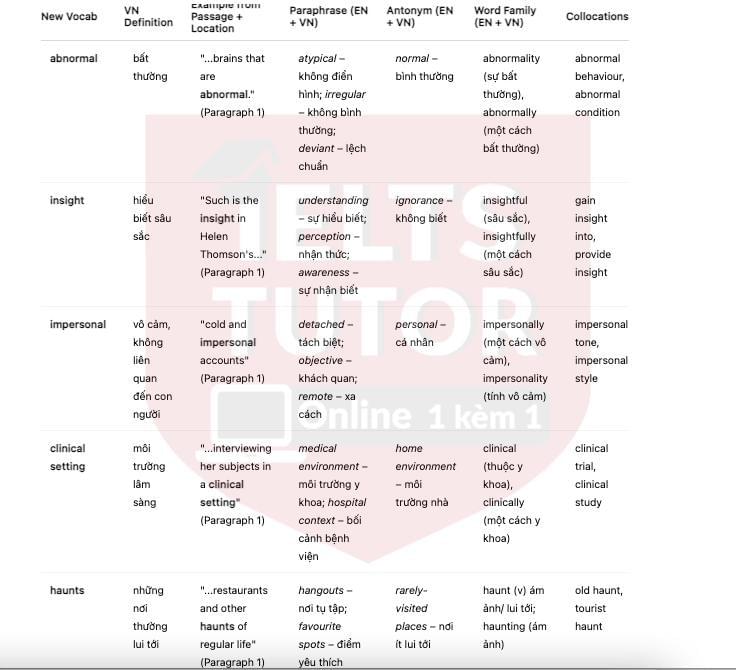
VI. Giải thích cấu trúc ngữ pháp khó A Review of Helen Thomson's Book, Unthinkable: An Extraordinary Journey Through the World's Strangest Brains

VII. Đáp án A Review of Helen Thomson's Book, Unthinkable: An Extraordinary Journey Through the World's Strangest Brains
27. NO
28. NOT GIVEN
29. YES
30. YES
31. NO
32. B
33. C
34. A
35. B
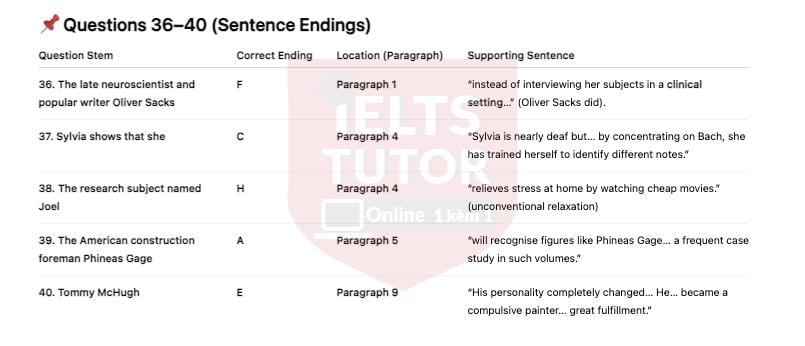
36. F
37. C
38. H
39. A
40. E
📩 MN AI CHƯA CÓ ĐÁP ÁN FORECAST QUÝ MỚI PART 1-2-3 NHẮN ZL 0905834420 IELTS TUTOR GỬI FREE HẾT NHA

Các khóa học IELTS online 1 kèm 1 - 100% cam kết đạt target 6.0 - 7.0 - 8.0 - Đảm bảo đầu ra - Thi không đạt, học lại FREE
>> Thành tích học sinh IELTS TUTOR với hàng ngàn feedback được cập nhật hàng ngày
