
IELTS TUTOR cung cấp Can You Catch Obesity? Đề luyện tập IELTS READING (IELTS Reading Practice Test) - Làm bài online format computer-based, kèm đáp án, dịch & giải thích từ vựng - cấu trúc ngữ pháp khó & GIẢI ĐÁP ÁN VỚI LOCATION
I. Kiến thức liên quan
II. Làm bài online (kéo xuống cuối bài blog để xem giải thích từ vựng & cấu trúc cụ thể hơn)
IELTS Reading Test - Can You Catch Obesity?
You should spend about 20 minutes on Questions 1-13
For most of human history, being fat was a sign of success. Obesity meant you had the money, and the time, to consume excess food. It also meant that your pampered and privileged body was not troubled with the rigours of too much exercise.
How different it is now. Fatness is a sign of poverty, obesity marks you as a member of the underclass. The overweight are perceived as lazy, slovenly, even stupid. The fat are shunned socially and professionally. The obese, like the short and the ugly, earn less, have less sex, fewer children, worse jobs and are more likely to be unhealthy and die younger than their more svelte brethren.
But what if being fat had nothing to do with sloth, gluttony or even bad genes? What if obesity were caused not by behaviour but by a viral infection that you could catch like the common cold? Would society treat the super-overweight differently if it were shown that it was, quite definitely, not their 'fault'?
A couple of years ago, a maverick Indian scientist hit the headlines with his theory that the American obesity epidemic was caused by a virus sweeping across the United States. His claims were dismissed by experts, but he persisted with his research. Now, with publications in respected scientific journals under his belt, he is being taken more seriously. Next week, in a major TV investigation, it will be claimed that this virus may have crossed the Atlantic and gained a foothold in the UK. If so, the days of laughing at those gross Americans with their 100-inch waists, comedy trousers and broken furniture, are over.
One thing all experts agree is that obesity is an epidemic that is sweeping the world. More than one-in-three people in the US—that is 90 million people—are obese. Despite a national obsession with the perfect body, low-fat diets (54 million Americans are actively trying to lose weight at any one time) and exercise, America just keeps on growing. And where America leads, Britain follows. One in five Britons is now obese, and this country has now overtaken the United States in the rate at which obesity is increasing. Experts say the reasons for the fat plague are straightforward: we eat too much, and do too little exercise. Added to that there is a genetic disposition among some people to become overweight.
But some facts about the obesity epidemic simply don't add up. We eat a little more and exercise much less than our grandparents, but poor diets and sloth have not increased notably in the past 20 years—the period in which the obesity epidemic has taken off. In the Seventies, Americans ate roughly as much as they do today, yet, as a nation, the US was but a shadow of its future self. Many experts acknowledge that they must be overlooking some important factor. Dr Nikhil Dhurandhar certainly thinks so. Dr Dhurandhar, now a researcher at Wayne State University in Detroit, Michigan, is the brains behind one of the most controversial medical theories to emerge for years. It is he who believes that many cases of obesity are caused by a virus, which affects the body's ability to use energy, persuading ordinary cells to turn into fat—in effect preventing those who carry the virus from burning off excess calories.
If Dr Dhurandhar is right, it is bad news. For the obese whose condition is caused by the virus, it is too late. The damage is done. For the rest, the as-yet uninfected, they can hope only to avoid catching it until a vaccine is developed.
The story of how a virus might be causing a fat plague began in the sweltering heat of a Bombay afternoon. It was here, during the hot monsoon of 1968, that Dr Dhurandhar first came across the microbe that would change the course of his life. Back then, he had a flourishing practice as a doctor specialising in obesity. Vinod, his father, had pioneered the study of the problem in India. To date, Nikhil has treated more than 65,000 cases—including himself and his family, who until relatively recently all had a tendency to be overweight.
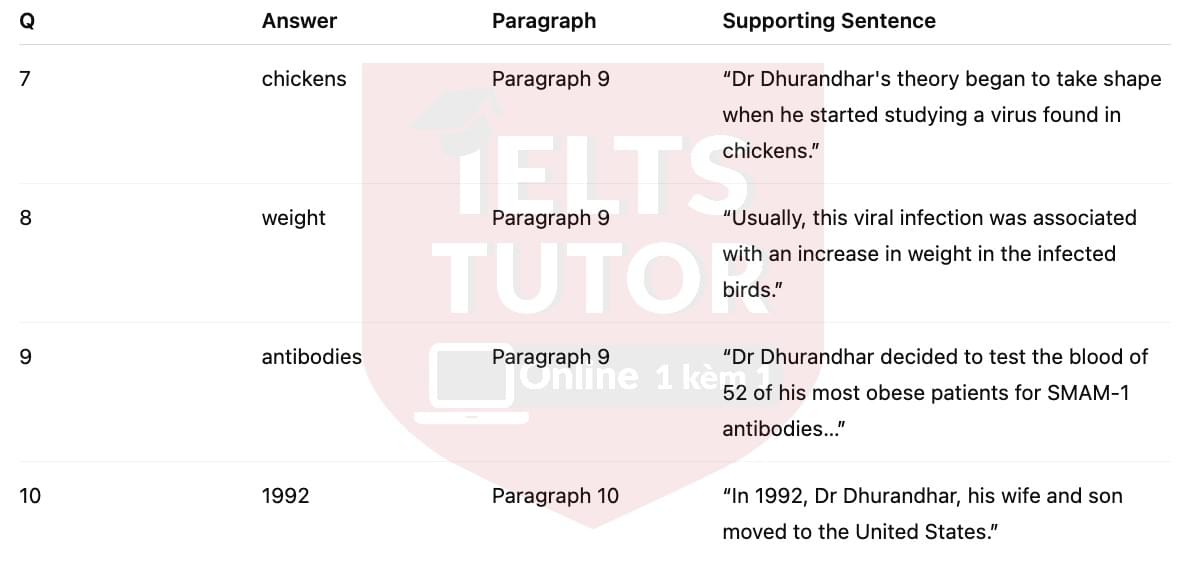
Dr Dhurandhar's theory began to take shape when he started studying a virus found in chickens. During the Eighties, Indian poultry sellers were losing money as their birds caught a mysterious disease, which killed hundreds of thousands of birds. At the Bombay veterinary college the culprit was eventually identified as a virus and given the name SMAM-1. Usually, this viral infection was associated with an increase in weight in the infected birds. Dr Dhurandhar was puzzled. How could birds ill enough to die of a virus actually be overweight? "There should be little or no fat," he says. "They should have been wasting away." The fatter chickens, amazingly, also had higher cholesterol in their blood than uninfected birds. This is because raised cholesterol levels and obesity often go hand in hand. Intrigued, Dr Dhurandhar decided to test the blood of 52 of his most obese patients for SMAM-1 antibodies—their presence would show exposure to this virus, which was thought to be harmless to humans. Amazingly, the antibodies turned up in 10 of the 52 patients—the heaviest of all, as it turned out. They also had lowered cholesterol levels.
It soon became clear to Dr Dhurandhar that he had neither the facilities nor the funds to continue his research in Bombay. If he was to prove that fat could be caused by a virus, he had to go to America. In 1992, Dr Dhurandhar, his wife and son moved to the United States. He took up a research job in Fargo, North Dakota. He suspected that America's obesity epidemic might, at least in part, be triggered by a virus. After all, the spread pattern of obesity across the United States, from the populated coasts into the interior, exactly mirrored the spread of more conventional epidemics such as influenza and even HIV/AIDS.
Richard Atkinson, an obesity researcher at the University of Wisconsin in Madison, knew that three other viruses—including canine distemper virus—had been shown to cause obesity in animals. In his lectures, he'd often joked about the possibility that fat could be contagious in humans. "I'd tell the audience you get on an elevator, somebody sneezes on you, and you catch obesity. I always got a good laugh." Dr Atkinson was convinced that Dr Dhurandhar was on to something and was on the verge of buying his plane tickets to Bombay. This could be an answer to an epidemic that causes around 250,000 deaths in the US each year.
The research job wasn't related to his theory but a necessary means to getting a work permit and access to American academia. Dr Atkinson, meanwhile, had been writing letters to scientists all over the world trying to drum up support for a study into viruses and obesity. Most ended up in the bin, but one of his letters ended up on Dr Dhurandhar's desk. He needed to work with the American.
Originally, the two men wanted to import SMAM-1—the chicken virus—into the US so they could study it. But permission was refused. The possibility that this obscure microbe could potentially devastate chicken numbers in the US, and perhaps make people fat, was too much to risk.
He hoped that before long he would interest someone in the link he believed he'd found between a virus and obesity, and that funding would follow. After two miserable winters in Fargo (which have Siberian-like weather) and still no takers for his obesity-virus theory, Dr Dhurandhar was ready to give up and return to India. In despair, the two men turned to a related virus called Ad-36, which was already present in the US.
This belongs to a group of viruses called adenoviruses, which cause colds, diarrhoea and conjunctivitis. The logical thing would have been to test it on animals first. But Dr Atkinson's lab wasn't set up for animal experiments. So they decided to test it on humans.
Do the following statements agree with the views of the writer? Write:
YES if the statement agrees with the views of the writer
NO if the statement contradicts the views of the writer
NOT GIVEN if it is impossible to say what the writer thinks about this
Complete the summary below. Choose NO MORE THAN TWO WORDS from the passage for each answer.
Dr Nikhil Dhurandhar first encountered the virus SMAM-1 in 7 during the 1980s. Infected chickens were found to have increased 8 and higher cholesterol. When he tested obese patients, some had 9 to SMAM-1. To continue his research, he moved to the United States in 10.
Choose the correct letter, A, B, C, or D.




📩 MN AI CHƯA CÓ ĐÁP ÁN FORECAST QUÝ MỚI PART 1-2-3 NHẮN ZL 0905834420 IELTS TUTOR GỬI FREE HẾT NHA
III. Can You Catch Obesity?: Đề luyện tập IELTS READING (IELTS Reading Practice Test)
Can You Catch Obesity?
For most of human history, being fat was a sign of success. Obesity meant you had the money, and the time, to consume excess food. It also meant that your pampered and privileged body was not troubled with the rigours of too much exercise.
How different it is now. Fatness is a sign of poverty, obesity marks you as a member of the underclass. The overweight are perceived as lazy, slovenly, even stupid. The fat are shunned socially and professionally. The obese, like the short and the ugly, earn less, have less sex, fewer children, worse jobs and are more likely to be unhealthy and die younger than their more svelte brethren.
But what if being fat had nothing to do with sloth, gluttony or even bad genes? What if obesity were caused not by behaviour but by a viral infection that you could catch like the common cold? Would society treat the super-overweight differently if it were shown that it was, quite definitely, not their 'fault'?
A couple of years ago, a maverick Indian scientist hit the headlines with his theory that the American obesity epidemic was caused by a virus sweeping across the United States. His claims were dismissed by experts, but he persisted with his research. Now, with publications in respected scientific journals under his belt, he is being taken more seriously. Next week, in a major TV investigation, it will be claimed that this virus may have crossed the Atlantic and gained a foothold in the UK. If so, the days of laughing at those gross Americans with their 100-inch waists, comedy trousers and broken furniture, are over.
One thing all experts agree is that obesity is an epidemic that is sweeping the world. More than one-in-three people in the US—that is 90 million people—are obese. Despite a national obsession with the perfect body, low-fat diets (54 million Americans are actively trying to lose weight at any one time) and exercise, America just keeps on growing. And where America leads, Britain follows. One in five Britons is now obese, and this country has now overtaken the United States in the rate at which obesity is increasing. Experts say the reasons for the fat plague are straightforward: we eat too much, and do too little exercise. Added to that there is a genetic disposition among some people to become overweight.
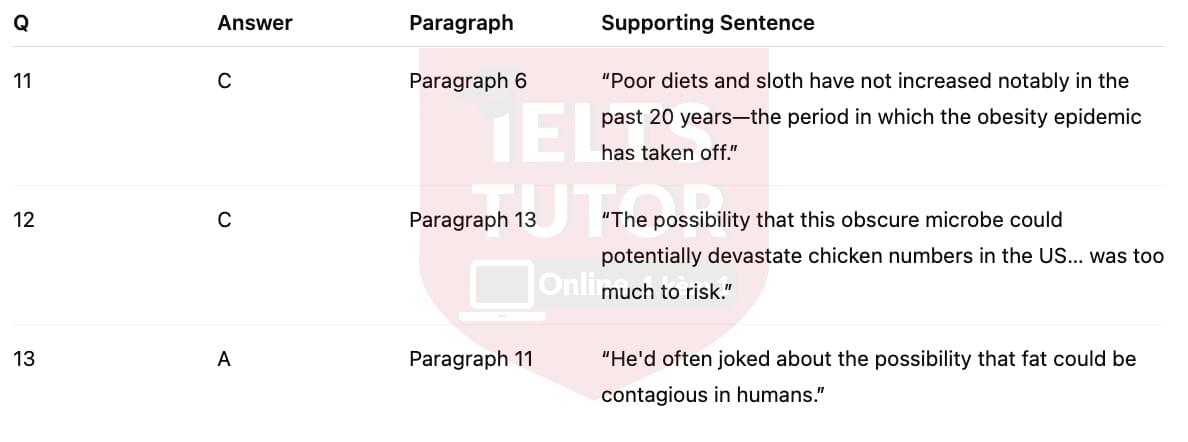
But some facts about the obesity epidemic simply don't add up. We eat a little more and exercise much less than our grandparents, but poor diets and sloth have not increased notably in the past 20 years—the period in which the obesity epidemic has taken off. In the Seventies, Americans ate roughly as much as they do today, yet, as a nation, the US was but a shadow of its future self. Many experts acknowledge that they must be overlooking some important factor. Dr Nikhil Dhurandhar certainly thinks so. Dr Dhurandhar, now a researcher at Wayne State University in Detroit, Michigan, is the brains behind one of the most controversial medical theories to emerge for years. It is he who believes that many cases of obesity are caused by a virus, which affects the body's ability to use energy, persuading ordinary cells to turn into fat—in effect preventing those who carry the virus from burning off excess calories. >> 🔥 Form đăng kí giải đề thi thật IELTS 4 kĩ năng kèm bài giải bộ đề 100 đề PART 2 IELTS SPEAKING quý đang thi (update hàng tuần) từ IELTS TUTOR
If Dr Dhurandhar is right, it is bad news. For the obese whose condition is caused by the virus, it is too late. The damage is done. For the rest, the as-yet uninfected, they can hope only to avoid catching it until a vaccine is developed.
The story of how a virus might be causing a fat plague began in the sweltering heat of a Bombay afternoon. It was here, during the hot monsoon of 1968, that Dr Dhurandhar first came across the microbe that would change the course of his life. Back then, he had a flourishing practice as a doctor specialising in obesity. Vinod, his father, had pioneered the study of the problem in India. To date, Nikhil has treated more than 65,000 cases—including himself and his family, who until relatively recently all had a tendency to be overweight.
Dr Dhurandhar's theory began to take shape when he started studying a virus found in chickens. During the Eighties, Indian poultry sellers were losing money as their birds caught a mysterious disease, which killed hundreds of thousands of birds. At the Bombay veterinary college the culprit was eventually identified as a virus and given the name SMAM-1. Usually, this viral infection was associated with an increase in weight in the infected birds. Dr Dhurandhar was puzzled. How could birds ill enough to die of a virus actually be overweight? "There should be little or no fat," he says. "They should have been wasting away." The fatter chickens, amazingly, also had higher cholesterol in their blood than uninfected birds. This is because raised cholesterol levels and obesity often go hand in hand. Intrigued, Dr Dhurandhar decided to test the blood of 52 of his most obese patients for SMAM-1 antibodies—their presence would show exposure to this virus, which was thought to be harmless to humans. Amazingly, the antibodies turned up in 10 of the 52 patients—the heaviest of all, as it turned out. They also had lowered cholesterol levels.
It soon became clear to Dr Dhurandhar that he had neither the facilities nor the funds to continue his research in Bombay. If he was to prove that fat could be caused by a virus, he had to go to America. In 1992, Dr Dhurandhar, his wife and son moved to the United States. He took up a research job in Fargo, North Dakota. He suspected that America's obesity epidemic might, at least in part, be triggered by a virus. After all, the spread pattern of obesity across the United States, from the populated coasts into the interior, exactly mirrored the spread of more conventional epidemics such as influenza and even HIV/AIDS.
Richard Atkinson, an obesity researcher at the University of Wisconsin in Madison, knew that three other viruses—including canine distemper virus—had been shown to cause obesity in animals. In his lectures, he'd often joked about the possibility that fat could be contagious in humans. "I'd tell the audience you get on an elevator, somebody sneezes on you, and you catch obesity. I always got a good laugh." Dr Atkinson was convinced that Dr Dhurandhar was on to something and was on the verge of buying his plane tickets to Bombay. This could be an answer to an epidemic that causes around 250,000 deaths in the US each year.
The research job wasn't related to his theory but a necessary means to getting a work permit and access to American academia. Dr Atkinson, meanwhile, had been writing letters to scientists all over the world trying to drum up support for a study into viruses and obesity. Most ended up in the bin, but one of his letters ended up on Dr Dhurandhar's desk. He needed to work with the American.
Originally, the two men wanted to import SMAM-1—the chicken virus—into the US so they could study it. But permission was refused. The possibility that this obscure microbe could potentially devastate chicken numbers in the US, and perhaps make people fat, was too much to risk.
He hoped that before long he would interest someone in the link he believed he'd found between a virus and obesity, and that funding would follow. After two miserable winters in Fargo (which have Siberian-like weather) and still no takers for his obesity-virus theory, Dr Dhurandhar was ready to give up and return to India. In despair, the two men turned to a related virus called Ad-36, which was already present in the US.
This belongs to a group of viruses called adenoviruses, which cause colds, diarrhoea and conjunctivitis. The logical thing would have been to test it on animals first. But Dr Atkinson's lab wasn't set up for animal experiments. So they decided to test it on humans. >> 🔥 Nhắn zalo 0905834420 join group zalo Hóng đề thi máy 4 skills để cập nhật đề thi thật 4 kĩ năng hằng ngày [Kèm giải & đề làm online]
Questions 1–6
Do the following statements agree with the views of the writer in Reading Passage 1?
Write:
YES if the statement agrees with the views of the writer
NO if the statement contradicts the views of the writer
NOT GIVEN if it is impossible to say what the writer thinks about this
In the past, being overweight was considered a sign of wealth and leisure.
Today, obese people are generally admired in society.
Some scientists believe obesity could be caused by a virus similar to the common cold.
Dr Dhurandhar’s theory was immediately accepted by the scientific community.
Obesity rates in Britain are currently lower than in the United States.
The virus SMAM-1 was first discovered in American chickens.
Questions 7–10
Complete the summary below.
Choose NO MORE THAN TWO WORDS from the passage for each answer.
Dr Nikhil Dhurandhar first encountered the virus SMAM-1 in 7 ________ during the 1980s. Infected chickens were found to have increased 8 ________ and higher cholesterol. When he tested obese patients, some had 9 ________ to SMAM-1. To continue his research, he moved to the United States in 10 ________. >> 🔥 IELTS TUTOR gợi ý tham khảo CẦN VIẾT & THU ÂM BAO NHIÊU BÀI ĐỂ ĐẠT 8.0 SPEAKING & 7.0 WRITING?
Questions 11–13
Choose the correct letter, A, B, C, or D.
What is one reason why traditional explanations for obesity may be incomplete?
A. People today eat far more than in the 1970s.
B. Exercise levels have dramatically increased in the last 20 years.
C. Diet and activity changes do not fully explain the rapid rise in obesity.
D. Genetic factors are now considered irrelevant.Why was permission refused to import SMAM-1 into the United States?
A. It was already present in the country.
B. It was considered too expensive to study.
C. There were fears it could harm the poultry industry.
D. Dr Dhurandhar did not have the correct qualifications.What did Richard Atkinson often joke about in his lectures?
A. The idea that obesity could be contagious.
B. The poor diet of Americans.
C. The laziness of overweight people.
D. The genetic causes of obesity.
IV. Dịch bài đọc Can You Catch Obesity?
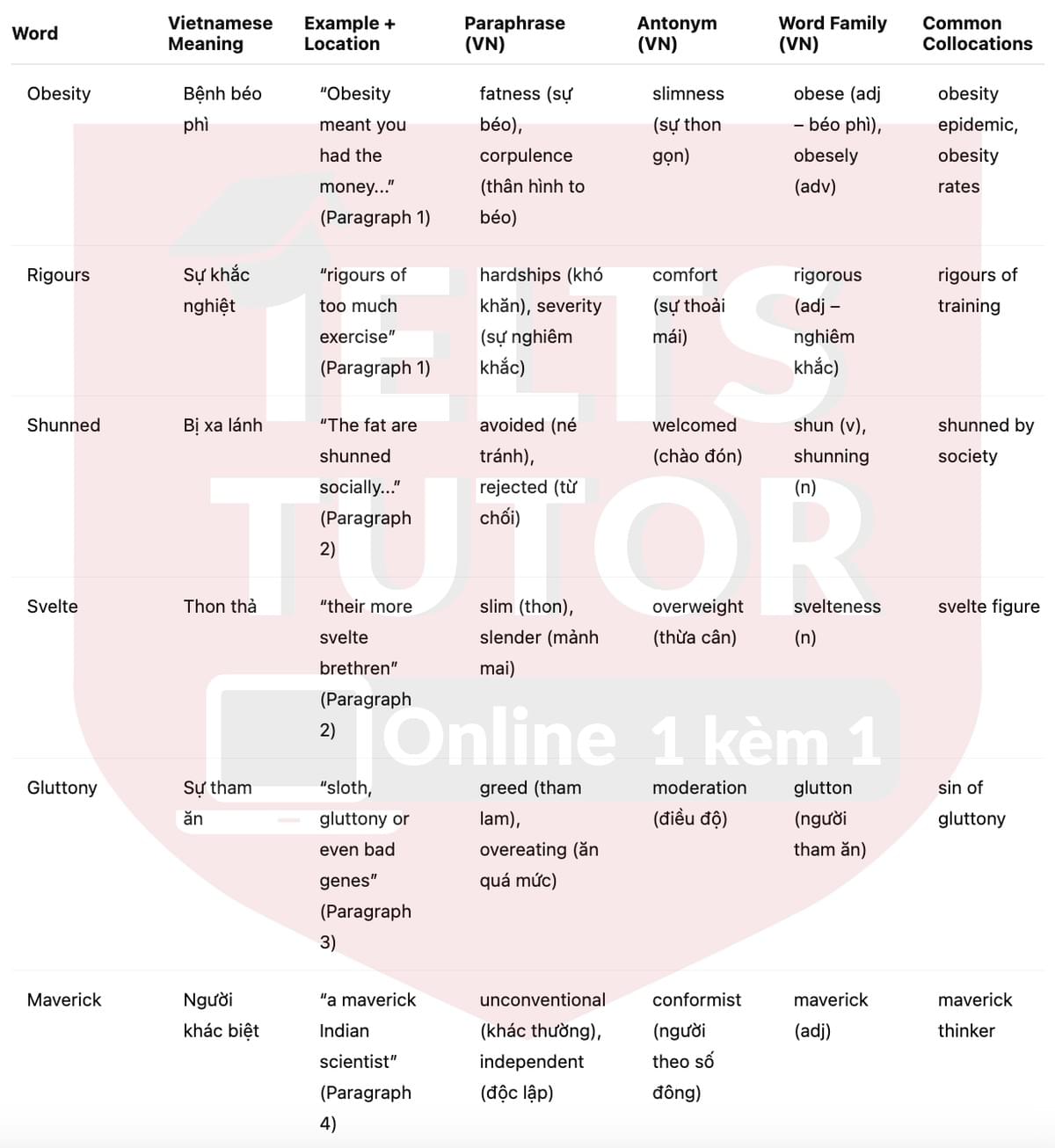
V. Giải thích từ vựng Can You Catch Obesity?
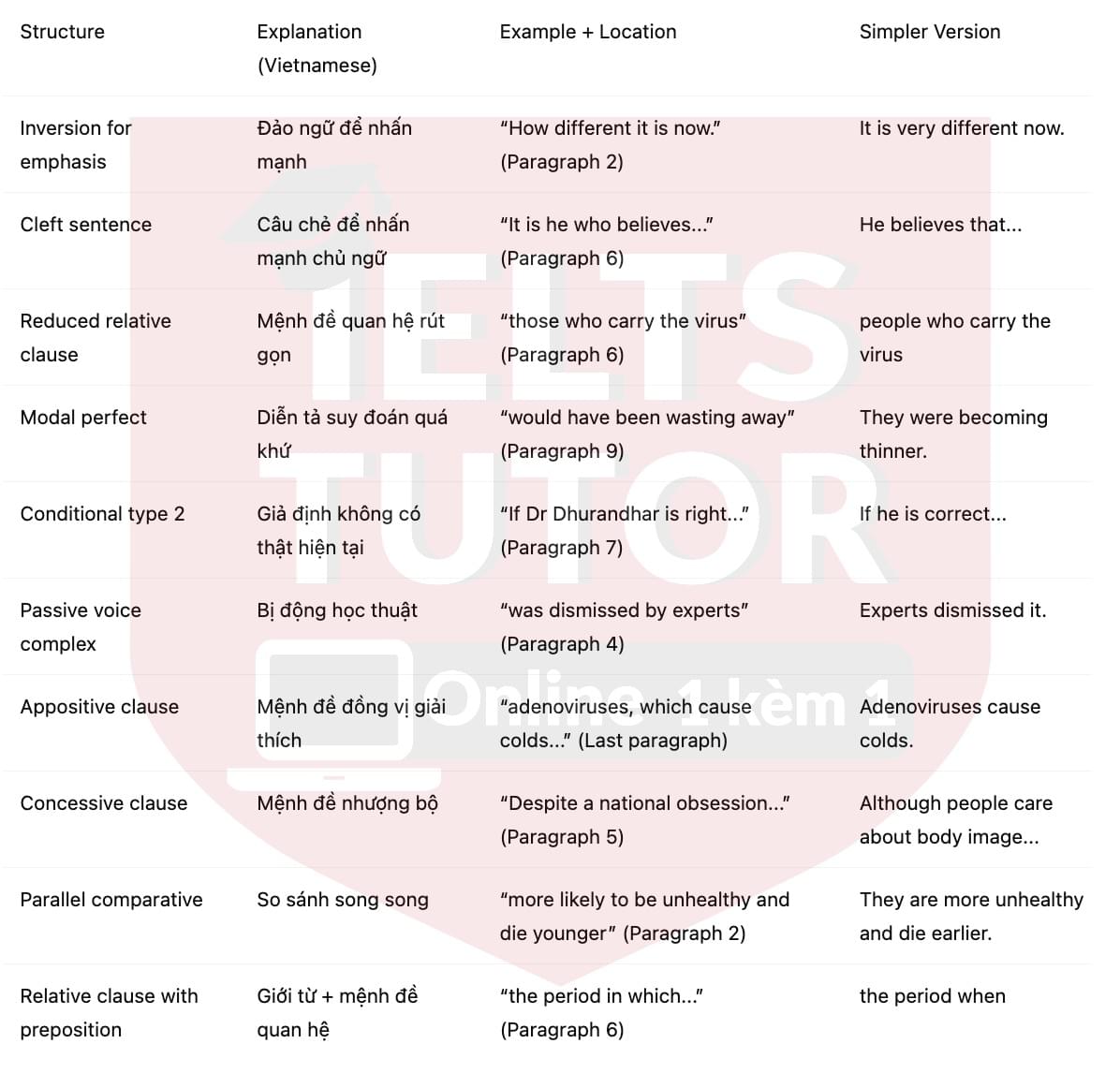
VI. Giải thích cấu trúc ngữ pháp khó Can You Catch Obesity?
VII. Đáp án Can You Catch Obesity?
1. YES
2. NO
3. YES
4. NO
5. NOT GIVEN
6. NO
7. chickens
8. weight
9. antibodies
10. 1992
11. C
12. C
13. A
📩 MN AI CHƯA CÓ ĐÁP ÁN FORECAST QUÝ MỚI PART 1-2-3 NHẮN ZL 0905834420 IELTS TUTOR GỬI FREE HẾT NHA

Các khóa học IELTS online 1 kèm 1 - 100% cam kết đạt target 6.0 - 7.0 - 8.0 - Đảm bảo đầu ra - Thi không đạt, học lại FREE
>> Thành tích học sinh IELTS TUTOR với hàng ngàn feedback được cập nhật hàng ngày
