
IELTS TUTOR cung cấp DEEP SEA DISCOVERY: Đề thi thật IELTS READING (IELTS Reading Recent Actual Test) - Làm bài online format computer-based, , kèm đáp án, dịch & giải thích từ vựng - cấu trúc ngữ pháp khó & GIẢI ĐÁP ÁN VỚI LOCATION
I. Kiến thức liên quan
II. Làm bài online (kéo xuống cuối bài blog để xem giải thích từ vựng & cấu trúc cụ thể hơn)
IELTS Reading Test - Deep Sea Discovery
ĐỀ THI THẬT IELTS READING
Recent research has provided new insights into how fish communicate
Nico Michiels is an ecologist from the University of Tubingen in Germany who spends part of each year in Egypt, where he dives in the Red Sea, observing fish life and gathering data on its coral reefs. In September 2007 he decided to find out how far red light could penetrate the ocean depths. Seawater absorbs different colours at different depths, and as an experienced diver, Michiels was aware that red light is extinguished not far below the surface whereas blue-green light penetrates deeper. To find out the depth at which red disappeared in this particular ocean, however, he attached a special plastic filter to his dive mask which was designed to block out all colours except red. Then he began to descend. In theory, once he reached about 15 metres, he should have been plunged into darkness. Instead, something totally unexpected happened. Sure enough, 20 metres down it was as dark as night. 'All the fish disappeared. With no light from the surface, they were effectively black and had become invisible,' he says. But it didn't stay black for long. Then I saw a group of goby fish with bright red eyes lit up against the background. After that red spots began to show up all over the reef.
Even with the red filter removed, Michiels could pick them out without much trouble once his eyes grew accustomed to the gloom. It seems strange that no diver or researcher had spotted all this red before, but as Michiels points out, no one saw it because no one expected to see it. On that one dive Michiels discovered three fish species with prominent red markings, and has found many others since.
C
But how can fish appear red where there's no red light? Ordinary red pigments look red because they reflect red light while absorbing all other wavelengths. At 20 metres down, there had to be some other explanation for the red Michiels was seeing. He suspected fluorescence. Fluorescent pigments behave differently from ordinary ones: they receive incoming light of one wavelength, for example blue, and emit light of a longer wavelength, in this case red. On the reef in the Red Sea during daytime, the most likely explanation was that the predominantly blue and green wavelengths at depth triggered the emission of fluorescent red in the fish.
D
With only a week left in Egypt, and lacking the equipment to confirm that the fish were fluorescent, Michiels photographed as many of them as he could. Then once back in Germany, he bought an assortment of tropical fish and installed them in his lab. Here he confirmed that the fish did indeed fluoresce. In most of the fish he looked at, the fluorescence could be traced to specialised pigment cells that lie in the skin beneath the scales. These cells contain guanine crystals, which scatter light to give fish their silvery sheen. However, Michiels says they are still not sure exactly what is fluorescing. It's not the crystals themselves. It's probably a fluorescent protein built into the crystals, and we have a suspicion that it might be made by bacteria.
E
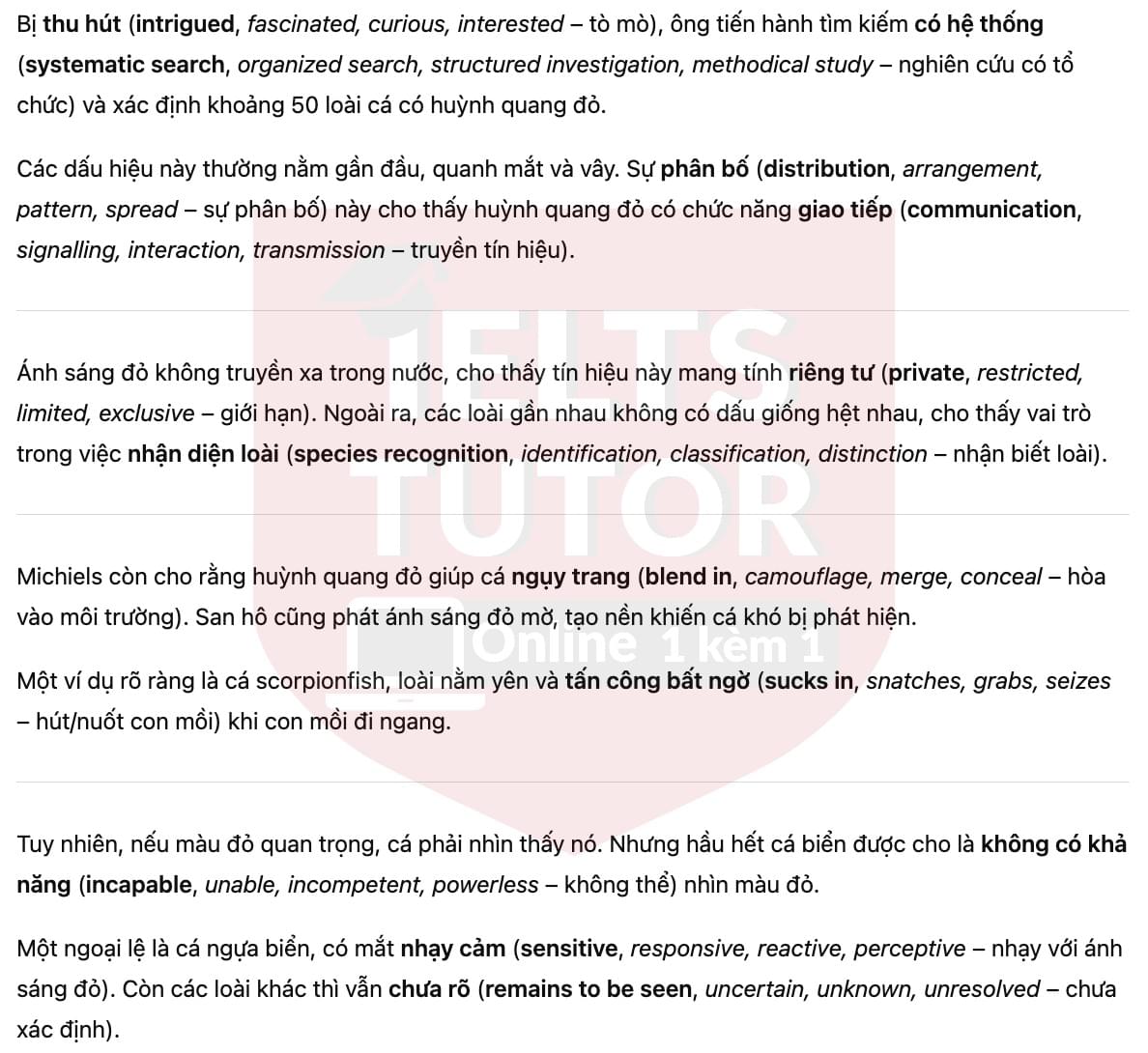
Intrigued, Michiels began a systematic search for red fluorescence in reef fish. He and his colleagues, Nils Anthes and Dennis Sprenger, have identified some 50 species with red fluorescence. The most common markings tend to be on the body towards the head and to a lesser extent around the eyes, and then the fins. To Michiels, the distribution of these markings is one of the strongest indications that red fluorescence has a very particular function: communication with other members of the species. According to several recent studies, a whole range of animals employ fluorescence as a natural highlighter to boost the visibility of body parts they use to signal, for example to ward off enemies. In reef fish, the red tends to be confined to parts of the body used to signal, suggesting those markings serve a similar function. But instead of highlighting an existing colour, the fluorescence gives the fish a colour that otherwise wouldn't exist. For example, fish commonly use eye rings to signal that they are present and their direction of gaze, and Michiels suspects that red-eyed gobies use signals to indicate their location and keep their group together.
F
Red light, whatever its source, doesn't travel far through water, which suggests signals are intended to be private, seen only by nearby fish of the right species. There are several lines of evidence to support this, says Michiels. And closely related species do not have completely identical markings, which suggests they might be important in species recognition.
G
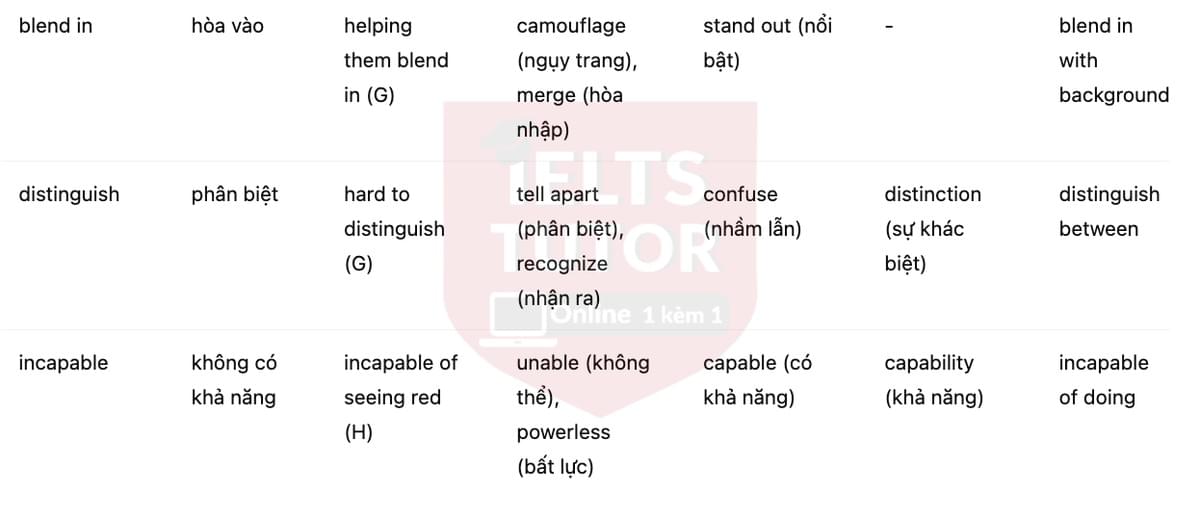
Michiels suspects red fluorescence has another important role for some reef fish: helping them blend in. During his first dive with the red filter, he noticed corals glow a dark but faint red too. Against this irregular red background, a fish that glows red all over would be hard to distinguish. More compelling for Michiels is the case of the scorpionfish, which lies perfectly still until food swims past which it then sucks in.
H
Yet if red plays any part in a fish's life then it must be able to see it. Fish that live in a world dominated by blue-green light are assumed to have eyes tuned to those wavelengths, and most marine fish that have been studied are thought incapable of seeing red. One exception is the seahorse, whose eyes are sensitive to red. As for the other fish, it remains to be seen.
*pigments: a pigment is a substance that gives something a particular colour
Do the following statements agree with the information given in Reading Passage 1?
In boxes 1-6 on your answer sheet, write:
TRUE if the statement agrees with the information given in the text
FALSE if the statement contradicts the information
NOT GIVEN if there is no information on this
Complete the notes below.
Write ONE WORD ONLY from the passage for each answer
Michiel's findings
Some of Michiels beliefs are that
Other benefits of red fluorescence:
The ability to see red amongst fish





📩 MN AI CHƯA CÓ ĐÁP ÁN FORECAST QUÝ MỚI PART 1-2-3 NHẮN ZL 0905834420 IELTS TUTOR GỬI FREE HẾT NHA
III. DEEP SEA DISCOVERY: Đề thi thật IELTS READING (IELTS Reading Recent Actual Test)
DEEP SEA DISCOVERY
ĐỀ THI THẬT IELTS READING
Recent research has provided new insights into how fish communicate
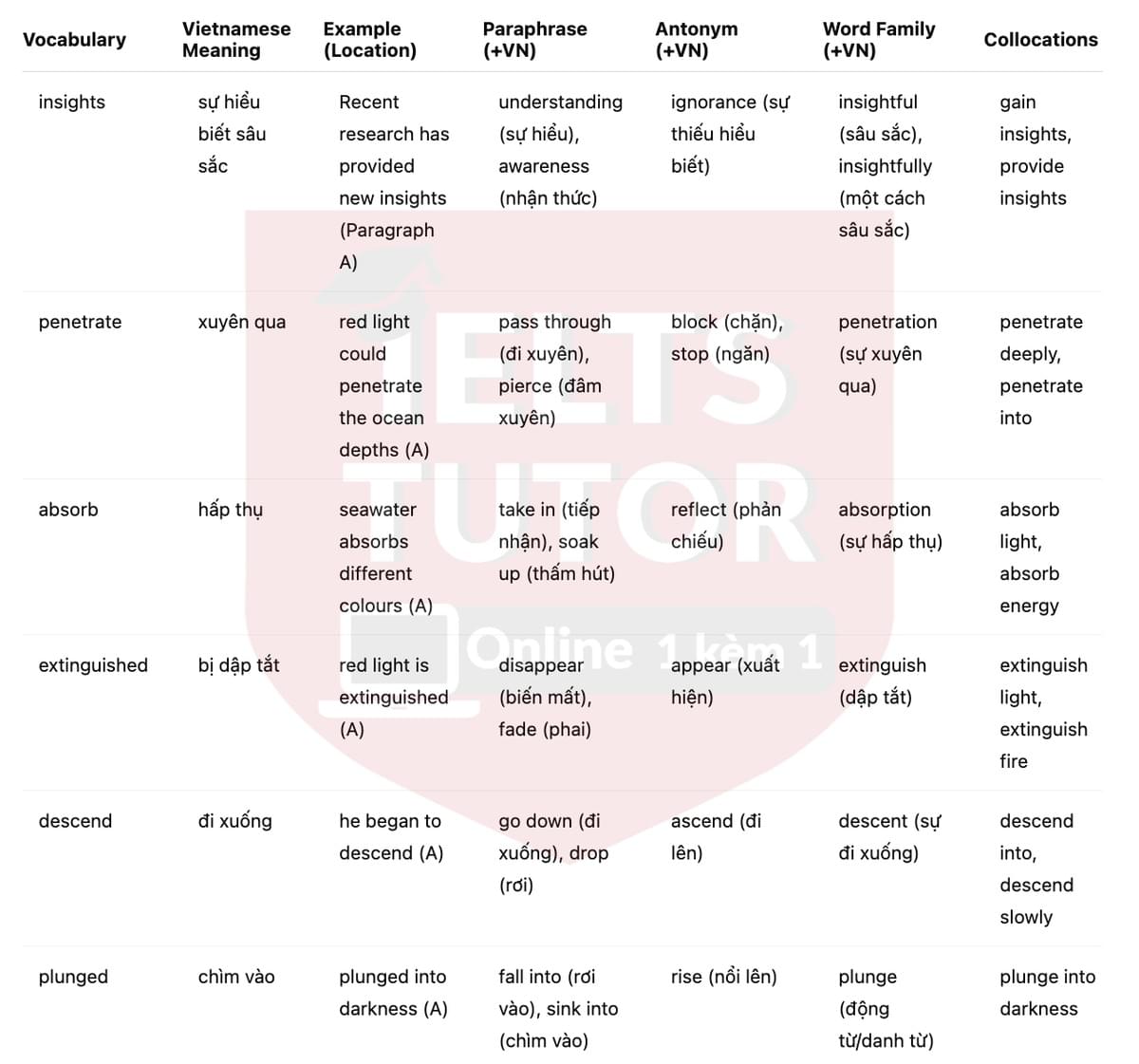
Nico Michiels is an ecologist from the University of Tubingen in Germany who spends part of each year in Egypt, where he dives in the Red Sea, observing fish life and gathering data on its coral reefs. In September 2007 he decided to find out how far red light could penetrate the ocean depths. Seawater absorbs different colours at different depths, and as an experienced diver, Michiels was aware that red light is extinguished not far below the surface whereas blue-green light penetrates deeper. To find out the depth at which red disappeared in this particular ocean, however, he attached a special plastic filter to his dive mask which was designed to block out all colours except red. Then he began to descend. In theory, once he reached about 15 metres, he should have been plunged into darkness. Instead, something totally unexpected happened. Sure enough, 20 metres down it was as dark as night. 'All the fish disappeared. With no light from the surface, they were effectively black and had become invisible,' he says. But it didn't stay black for long. Then I saw a group of goby fish with bright red eyes lit up against the background. After that red spots began to show up all over the reef.
Even with the red filter removed, Michiels could pick them out without much trouble once his eyes grew accustomed to the gloom. It seems strange that no diver or researcher had spotted all this red before, but as Michiels points out, no one saw it because no one expected to see it. On that one dive Michiels discovered three fish species with prominent red markings, and has found many others since. >> 🔥 Form đăng kí giải đề thi thật IELTS 4 kĩ năng kèm bài giải bộ đề 100 đề PART 2 IELTS SPEAKING quý đang thi (update hàng tuần) từ IELTS TUTOR
C
But how can fish appear red where there's no red light? Ordinary red pigments look red because they reflect red light while absorbing all other wavelengths. At 20 metres down, there had to be some other explanation for the red Michiels was seeing. He suspected fluorescence. Fluorescent pigments behave differently from ordinary ones: they receive incoming light of one wavelength, for example blue, and emit light of a longer wavelength, in this case red. On the reef in the Red Sea during daytime, the most likely explanation was that the predominantly blue and green wavelengths at depth triggered the emission of fluorescent red in the fish.
D
With only a week left in Egypt, and lacking the equipment to confirm that the fish were fluorescent, Michiels photographed as many of them as he could. Then once back in Germany, he bought an assortment of tropical fish and installed them in his lab. Here he confirmed that the fish did indeed fluoresce. In most of the fish he looked at, the fluorescence could be traced to specialised pigment cells that lie in the skin beneath the scales. These cells contain guanine crystals, which scatter light to give fish their silvery sheen. However, Michiels says they are still not sure exactly what is fluorescing. It's not the crystals themselves. It's probably a fluorescent protein built into the crystals, and we have a suspicion that it might be made by bacteria.
E
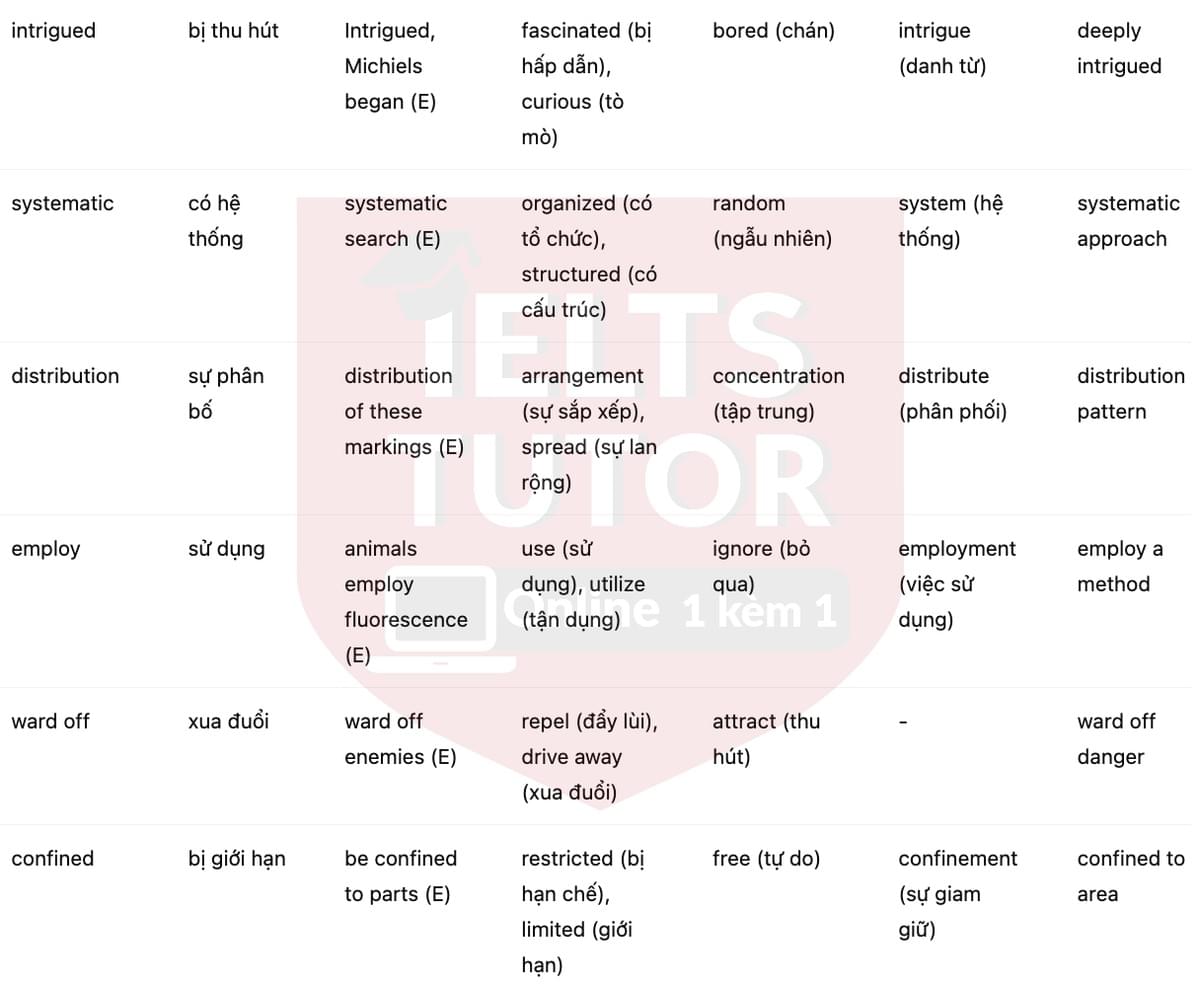
Intrigued, Michiels began a systematic search for red fluorescence in reef fish. He and his colleagues, Nils Anthes and Dennis Sprenger, have identified some 50 species with red fluorescence. The most common markings tend to be on the body towards the head and to a lesser extent around the eyes, and then the fins. To Michiels, the distribution of these markings is one of the strongest indications that red fluorescence has a very particular function:
communication with other members of the species. According to several recent studies, a whole range of animals employ fluorescence as a natural highlighter to boost the visibility of body parts they use to signal, for example to ward off enemies. In reef fish, the red tends to be confined to parts of the body used to signal, suggesting those markings serve a similar function. But instead of highlighting an existing colour, the fluorescence gives the fish a colour that otherwise wouldn't exist. For example, fish commonly use eye rings to signal that they are present and their direction of gaze, and Michiels suspects that red-eyed gobies use signals to indicate their location and keep their group together.
F
Red light, whatever its source, doesn't travel far through water, which suggests signals are intended to be private, seen only by nearby fish of the right species. There are several lines of evidence to support this, says Michiels. And closely related species do not have completely identical markings, which suggests they might be important in species recognition. >> 🔥 Nhắn zalo 0905834420 join group zalo Hóng đề thi máy 4 skills để cập nhật đề thi thật 4 kĩ năng hằng ngày [Kèm giải & đề làm online]
G
Michiels suspects red fluorescence has another important role for some reef fish: helping them blend in. During his first dive with the red filter, he noticed corals glow a dark but faint red too. Against this irregular red background, a fish that glows red all over would be hard to distinguish. More compelling for Michiels is the case of the scorpionfish, which lies perfectly still until food swims past which it then sucks in.
H
Yet if red plays any part in a fish's life then it must be able to see it. Fish that live in a world dominated by blue-green light are assumed to have eyes tuned to those wavelengths, and most marine fish that have been studied are thought incapable of seeing red. One exception is the seahorse, whose eyes are sensitive to red. As for the other fish, it remains to be seen.
*pigments: a pigment is a substance that gives something a particular colour
Do the following statements agree with the information given in Reading Passage 1?
In boxes 1-6 on your answer sheet, write
TRUE if the statement agrees with the information given in the text, choose
FALSE if the statement contradicts the information, or choose
NOT GIVEN if there is no information on this.
During his 2007 dive, Michiels expected to encounter total darkness at about 15 metres.
Michiels could see the red markings on fish without the aid of the red filter.
Other divers had assumed they would see fish with red markings.
All the fish with red markings that Michiels found during his diving expeditions came from the Red Sea.
Michiels first thought of the possibility that fish could fluoresce while he was in Germany.
Michiels remains uncertain as to what creates fluorescence in fish. >> 🔥 IELTS TUTOR gợi ý tham khảo CẦN VIẾT & THU ÂM BAO NHIÊU BÀI ĐỂ ĐẠT 8.0 SPEAKING & 7.0 WRITING?
Complete the notes below.
Write ONE WORD ONLY from the passage for each answer
Michiel's findings
⚫ 50 types of fish with red fluorescence in total
⚫ markings mainly near the 7. __________________
Some of Michels beliefs are that
• red fluorescence is used specifically for 8. __________________ purposes
• fish, like some animals, use fluorescence to keep 9. __________________ away
⚫ gobies depend on red fluorescence to show their 10. __________________
⚫ there are variations in the markings of fish among those 11. __________________ similar
Other benefits of red fluorescence:
⚫ fish cannot easily be seen near backgrounds of 12. __________________ which give off a red light
⚫ helps some fish catch their prey
The ability to see red amongst fish
⚫ the only fish proven to have this ability is the 13. __________________
IV. Dịch bài đọc DEEP SEA DISCOVERY
V. Giải thích từ vựng DEEP SEA DISCOVERY
VI. Giải thích cấu trúc ngữ pháp khó DEEP SEA DISCOVERY
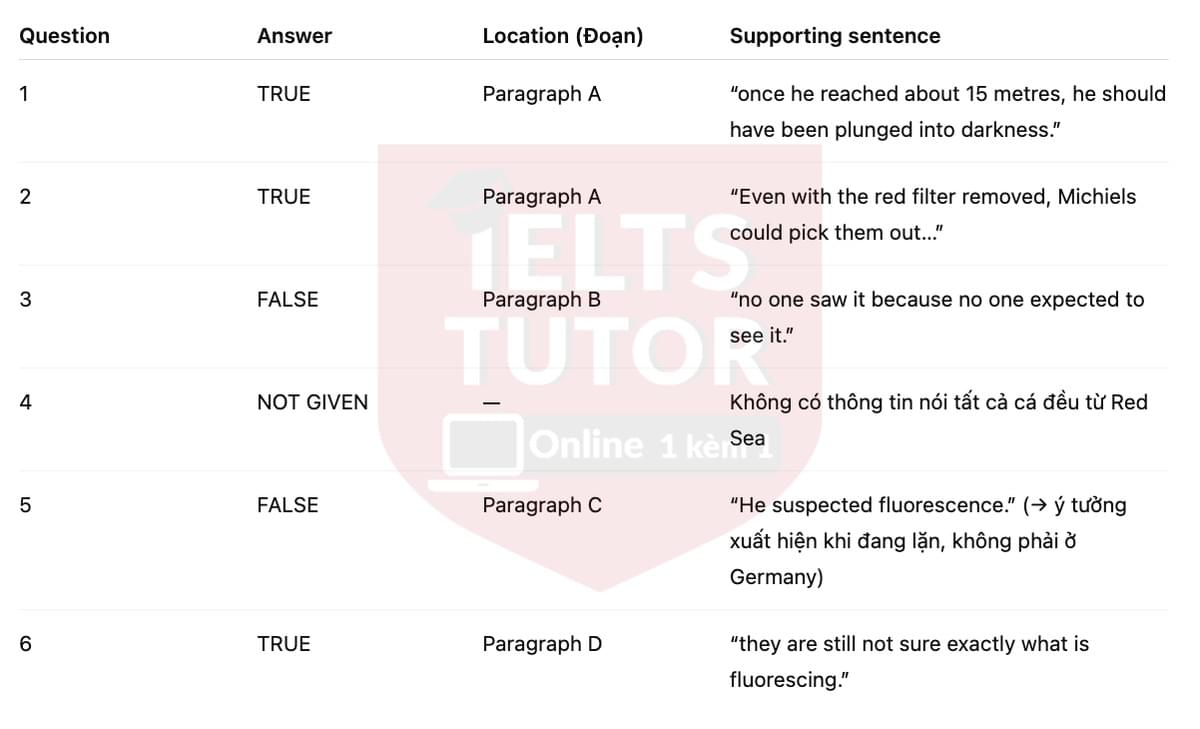
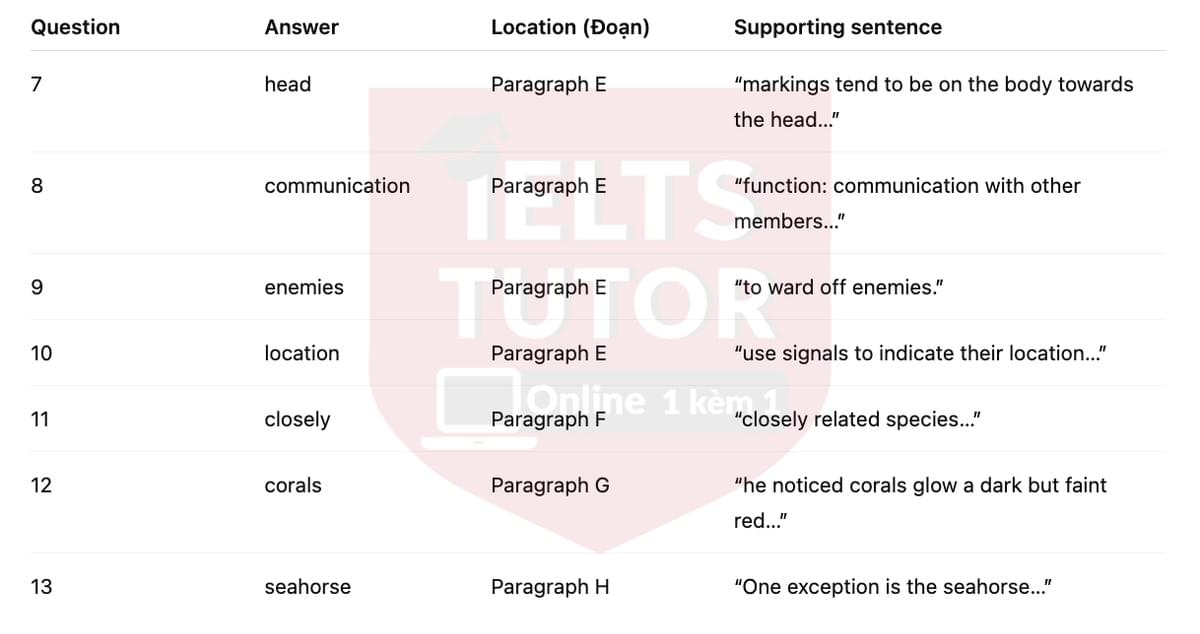
VII. Đáp án DEEP SEA DISCOVERY
1. TRUE
2. TRUE
3. FALSE
4. NOT GIVEN
5. FALSE
6. TRUE
7. head
8. communication
9. enemies
10. location
11. closely
12. corals
13. seahorse
📩 MN AI CHƯA CÓ ĐÁP ÁN FORECAST QUÝ MỚI PART 1-2-3 NHẮN ZL 0905834420 IELTS TUTOR GỬI FREE HẾT NHA

Các khóa học IELTS online 1 kèm 1 - 100% cam kết đạt target 6.0 - 7.0 - 8.0 - Đảm bảo đầu ra - Thi không đạt, học lại FREE
>> Thành tích học sinh IELTS TUTOR với hàng ngàn feedback được cập nhật hàng ngày
