
IELTS TUTOR cung cấp Evolution of the Calculator Đề luyện tập IELTS READING (IELTS Reading Practice Test) - Làm bài online format computer-based, kèm đáp án, dịch & giải thích từ vựng - cấu trúc ngữ pháp khó & GIẢI ĐÁP ÁN VỚI LOCATION
I. Kiến thức liên quan
📩 MN AI CHƯA CÓ ĐÁP ÁN FORECAST QUÝ MỚI PART 1-2-3 NHẮN ZL 0905834420 IELTS TUTOR GỬI FREE HẾT NHA
II. Làm bài online (kéo xuống cuối bài blog để xem giải thích từ vựng & cấu trúc cụ thể hơn)
Evolution of the Calculator
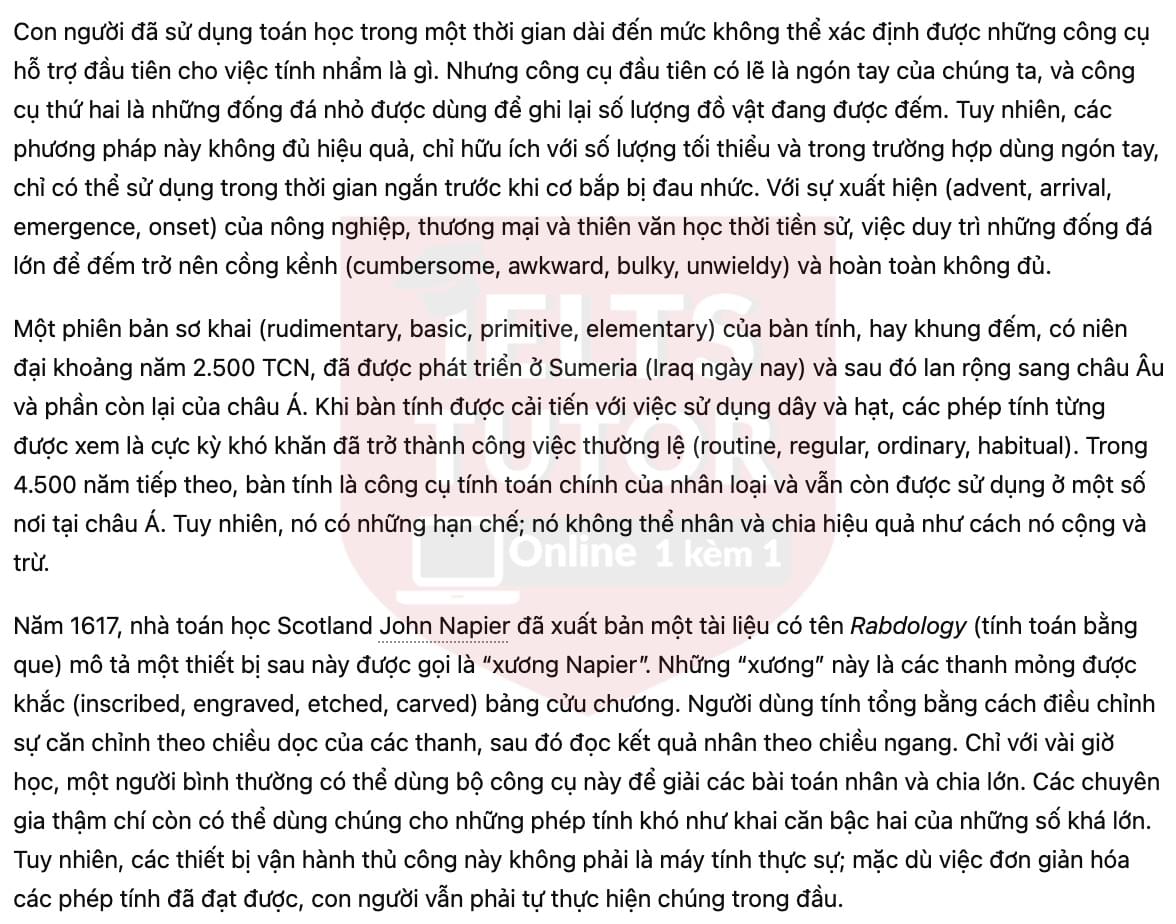
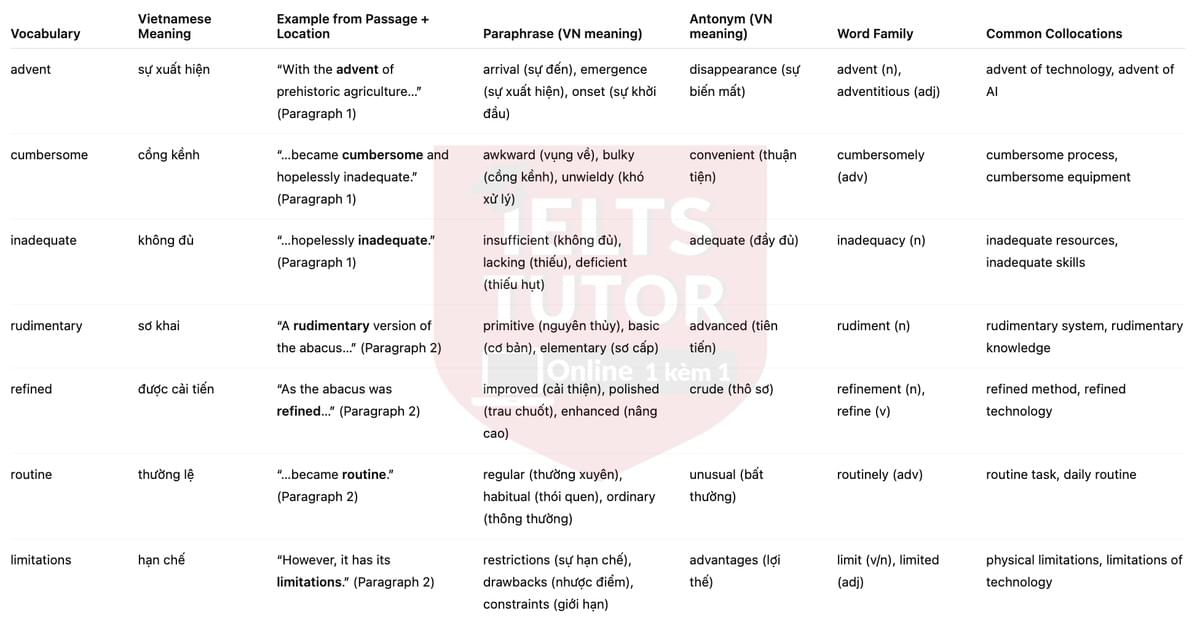
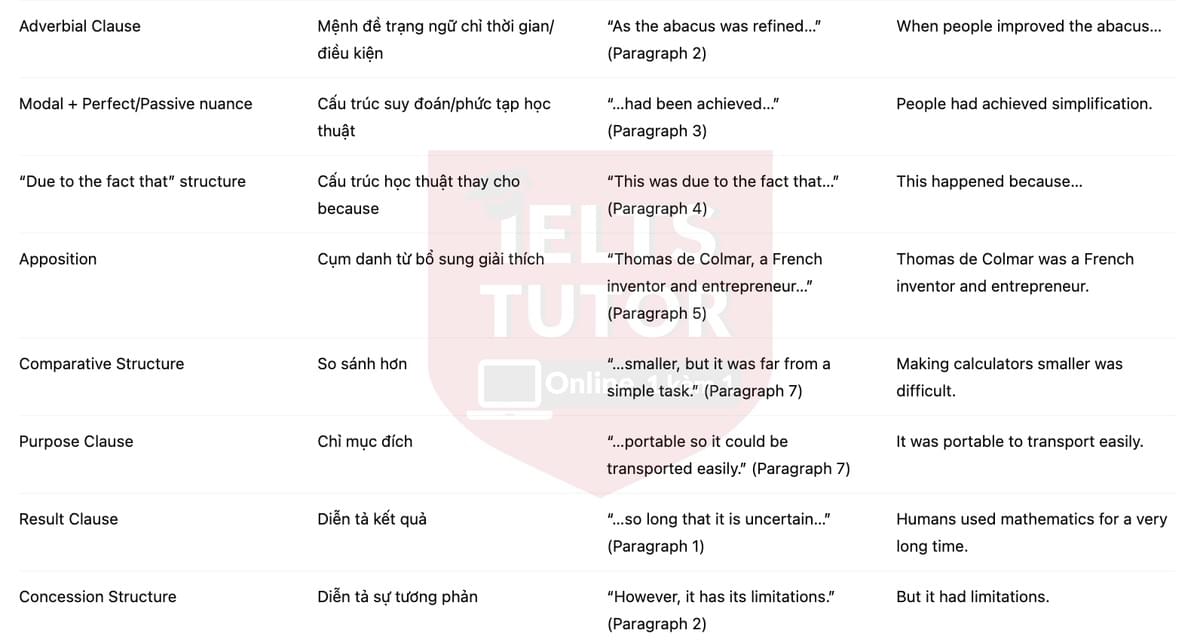
Humans have been using mathematics for so long that it is uncertain what the earliest aids to mental arithmetic were. But the first was probably our fingers, and the second was small piles of stones which were used to keep a record of the objects being counted. However, these methods were insufficient, only useful for minimal amounts and, in the case of fingers, could only be employed for short periods before sore muscles set in. With the advent of prehistoric agriculture, commerce and astronomy, maintaining large piles of stones for counting became cumbersome and hopelessly inadequate.
A rudimentary version of the abacus, or counting frame, dating to around 2,500 BCE, was developed in Sumeria (present day Iraq) and subsequently spread to Europe and the rest of Asia. As the abacus was refined with the use of string and beads, calculations that had been considered extremely difficult became routine. For the next 4,500 years, the abacus was humanity's main counting tool and is still used in parts of Asia. However, it has its limitations; it is unable to multiply and divide as efficiently as it adds and subtracts.
In 1617, Scottish mathematician John Napier published a document entitled Rabdology (calculation with rods) describing a device that came to be known as Napier's bones. The 'bones' are thin rods, inscribed with multiplication tables. The user calculates the sum by adjusting the rods' vertical alignment, and then reads off the multiplication totals horizontally. With a few hours of study, the average person can use a set to solve large multiplication and division problems. Experts can even use them for difficult calculations such as extracting square roots from fairly large numbers. However, these manually operated devices were not calculators; although the simplification of the sums had been achieved, a human operator still had to perform them mentally.
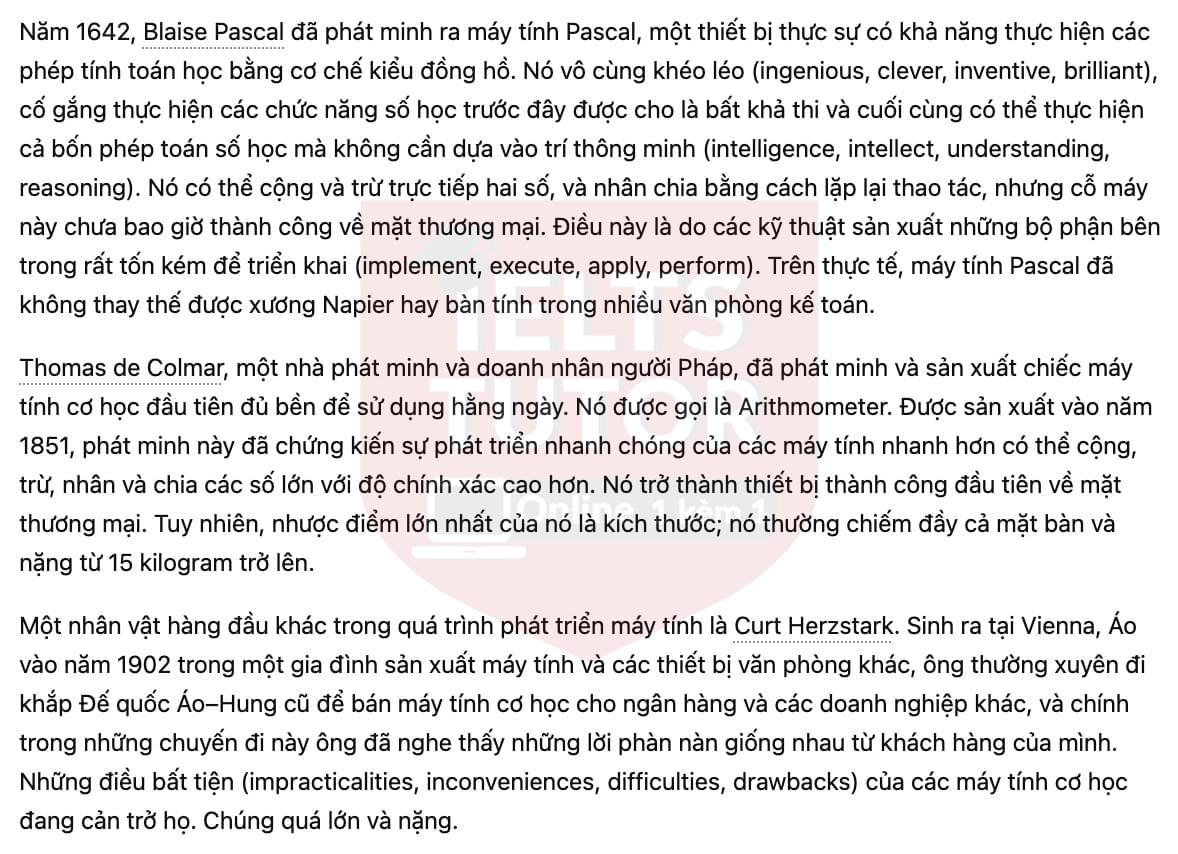
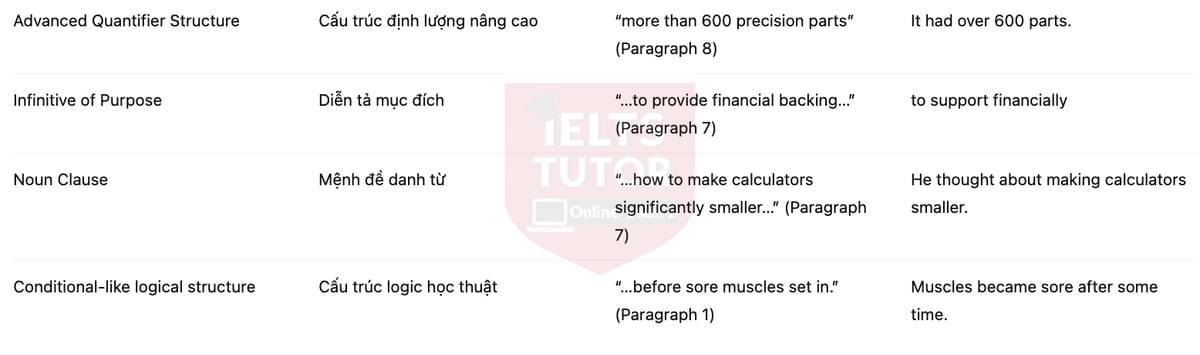
In 1642, Blaise Pascal invented the Pascal calculator, a device truly capable of performing mathematical calculations by means of a clockwork-type mechanism. It was ingenious, attempting arithmetic functions previously thought impossible and it eventually performed all four arithmetic operations without relying on intelligence. It could add and subtract two numbers directly, and multiply and divide by repetition, but the machine was never a commercial success. This was due to the fact that the techniques for producing the interior parts were expensive to implement. In truth, the Pascal calculator did not replace Napier's bones or the abacus in many accountants' offices.
Thomas de Colmar, a French inventor and entrepreneur, invented and produced the first mechanical calculator robust enough for everyday use. It was known as the Arithmometer. Manufactured in 1851, this invention saw the rapid rise of faster calculating machines that could add, subtract, multiply and divide large numbers with greater accuracy. It became the first commercially successful unit. However, its biggest disadvantage was its size; it often filled a desktop and weighed 15 kilograms or more.
Another leading figure in the development of the calculator was Curt Herzstark. Born in Vienna, Austria, in 1902 into a family that produced calculators and other office machines, he regularly travelled through the former Austro-Hungarian Empire selling mechanical calculators to banks and other businesses and it was on these travels that he heard the same complaints from his customers. The impracticalities of the mechanical calculators in use was hindering them. They were large and heavy.
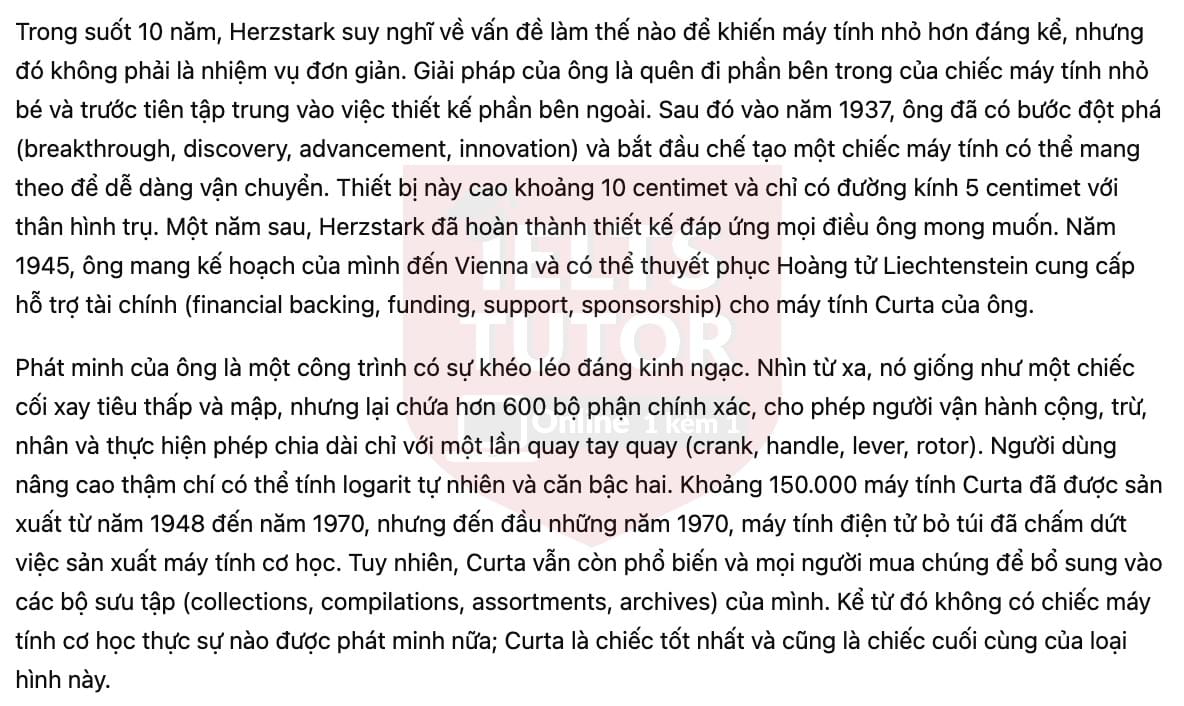
For 10 years, Herzstark thought about the problem of how to make calculators significantly smaller, but it was far from a simple task. His answer was to forget about the inside of his tiny calculator and concentrate first on designing the outside. Then in 1937, he had a breakthrough and began work on a calculator that was portable so it could be transported easily. The unit was approximately 10 centimetres high and only five centimetres in diameter with a cylindrical body. A year later, Herzstark had a finished design that achieved everything he wanted. In 1945, he took his plans to Vienna and was able to convince the Prince of Liechtenstein to provide financial backing for his Curta calculator.
His invention was a work of staggering ingenuity. From a distance, it resembles a short, stocky pepper grinder, yet it contains more than 600 precision parts, allowing the operator to add, subtract, multiply and perform long division with a mere turn of the crank. Advanced users could even calculate natural logs and square roots. Approximately 150,000 Curta calculators were made between 1948 and 1970, but by the early 1970s electronic pocket calculators ended the manufacture of mechanical calculators. However, the Curta still remains popular and people buy them to add to their collections. No truly mechanical calculators have been invented since; the Curta was the best and the last of its kind.
III. Evolution of the Calculator: Đề luyện tập IELTS READING (IELTS Reading Practice Test)
Evolution of the Calculator
Select text to highlight and tap on it to clear
Humans have been using mathematics for so long that it is uncertain what the earliest aids to mental arithmetic were. But the first was probably our fingers, and the second was small piles of stones which were used to keep a record of the objects being counted. However, these methods were insufficient, only useful for minimal amounts and, in the case of fingers, could only be employed for short periods before sore muscles set in. With the advent of prehistoric agriculture, commerce and astronomy, maintaining large piles of stones for counting became cumbersome and hopelessly inadequate.
A rudimentary version of the abacus, or counting frame, dating to around 2,500 BCE, was developed in Sumeria (present day Iraq) and subsequently spread to Europe and the rest of Asia. As the abacus was refined with the use of string and beads, calculations that had been considered extremely difficult became routine. For the next 4,500 years, the abacus was humanity's main counting tool and is still used in parts of Asia. However, it has its limitations; it is unable to multiply and divide as efficiently as it adds and subtracts.
In 1617, Scottish mathematician John Napier published a document entitled Rabdology (calculation with rods) describing a device that came to be known as Napier's bones. The 'bones' are thin rods, inscribed with multiplication tables. The user calculates the sum by adjusting the rods' vertical alignment, and then reads off the multiplication totals horizontally. With a few hours of study, the average person can use a set to solve large multiplication and division problems. Experts can even use them for difficult calculations such as extracting square roots from fairly large numbers. However, these manually operated devices were not calculators; although the simplification of the sums had been achieved, a human operator still had to perform them mentally. >> 🔥 Form đăng kí giải đề thi thật IELTS 4 kĩ năng kèm bài giải bộ đề 100 đề PART 2 IELTS SPEAKING quý đang thi (update hàng tuần) từ IELTS TUTOR
In 1642, Blaise Pascal invented the Pascal calculator, a device truly capable of performing mathematical calculations by means of a clockwork-type mechanism. It was ingenious, attempting arithmetic functions previously thought impossible and it eventually performed all four arithmetic operations without relying on intelligence. It could add and subtract two numbers directly, and multiply and divide by repetition, but the machine was never a commercial success. This was due to the fact that the techniques for producing the interior parts were expensive to implement. In truth, the Pascal calculator did not replace Napier's bones or the abacus in many accountants' offices.
Thomas de Colmar, a French inventor and entrepreneur, invented and produced the first mechanical calculator robust enough for everyday use. It was known as the Arithmometer. Manufactured in 1851, this invention saw the rapid rise of faster calculating machines that could add, subtract, multiply and divide large numbers with greater accuracy. It became the first commercially successful unit. However, its biggest disadvantage was its size; it often filled a desktop and weighed 15 kilograms or more.
Another leading figure in the development of the calculator was Curt Herzstark. Born in Vienna, Austria, in 1902 into a family that produced calculators and other office machines, he regularly travelled through the former Austro-Hungarian Empire selling mechanical calculators to banks and other businesses and it was on these travels that he heard the same complaints from his customers. The impracticalities of the mechanical calculators in use was hindering them. They were large and heavy.
For 10 years, Herzstark thought about the problem of how to make calculators significantly smaller, but it was far from a simple task. His answer was to forget about the inside of his tiny calculator and concentrate first on designing the outside. Then in 1937, he had a breakthrough and began work on a calculator that was portable so it could be transported easily. The unit was approximately 10 centimetres high and only five centimetres in diameter with a cylindrical body. A year later, Herzstark had a finished design that achieved everything he wanted. In 1945, he took his plans to Vienna and was able to convince the Prince of Liechtenstein to provide financial backing for his Curta calculator.
His invention was a work of staggering ingenuity. From a distance, it resembles a short, stocky pepper grinder, yet it contains more than 600 precision parts, allowing the operator to add, subtract, multiply and perform long division with a mere turn of the crank. Advanced users could even calculate natural logs and square roots. Approximately 150,000 Curta calculators were made between 1948 and 1970, but by the early 1970s electronic pocket calculators ended the manufacture of mechanical calculators. However, the Curta still remains popular and people buy them to add to their collections. No truly mechanical calculators have been invented since; the Curta was the best and the last of its kind.
Questions 1-6 >> 🔥 Nhắn zalo 0905834420 join group zalo Hóng đề thi máy 4 skills để cập nhật đề thi thật 4 kĩ năng hằng ngày [Kèm giải & đề làm online]
Do the following statements agree with the information given in Reading Passage 1?
Write TRUE if the statement agrees with the information, FALSE if the statement contradicts the information, or NOT GIVEN if there is no information on this.
Counting methods before the abacus were limited to small quantities.
O TRUE O FALSE O NOT GIVENDevelopment of trade helped spread the use of the abacus to Europe.
O TRUE O FALSE O NOT GIVENFor 4,500 years, the abacus was constantly being improved.
O TRUE O FALSE O NOT GIVENThe abacus can carry out some calculation tasks better than other tasks.
O TRUE O FALSE O NOT GIVENA complex knowledge of arithmetic was essential when using Napier's bones.
O TRUE O FALSE O NOT GIVENNapier's bones were automated counting devices.
O TRUE O FALSE O NOT GIVEN
>> 🔥 IELTS TUTOR gợi ý tham khảo CẦN VIẾT & THU ÂM BAO NHIÊU BÀI ĐỂ ĐẠT 8.0 SPEAKING & 7.0 WRITING?
Questions 7-16
Complete the notes below.
Choose ONE WORD ONLY from the passage for each answer.
Pascal Calculator (Blaise Pascal)
___________ was not needed to carry out calculations
high price was due to manufacturing ___________
Arithmometer (Thomas de Colmar)
the first of several devices with improved ___________
Curta (Curt Herzstark)
___________ was impractical
people's ___________ about previous devices led to its invention
his design initially focused on the ___________ of the device
because it was so small, it was ___________
the device received ___________ from a royal
it was operated by moving a ___________
Curta calculators can be found today in ___________
IV. Dịch bài đọc Evolution of the Calculator
V. Giải thích từ vựng Evolution of the Calculator
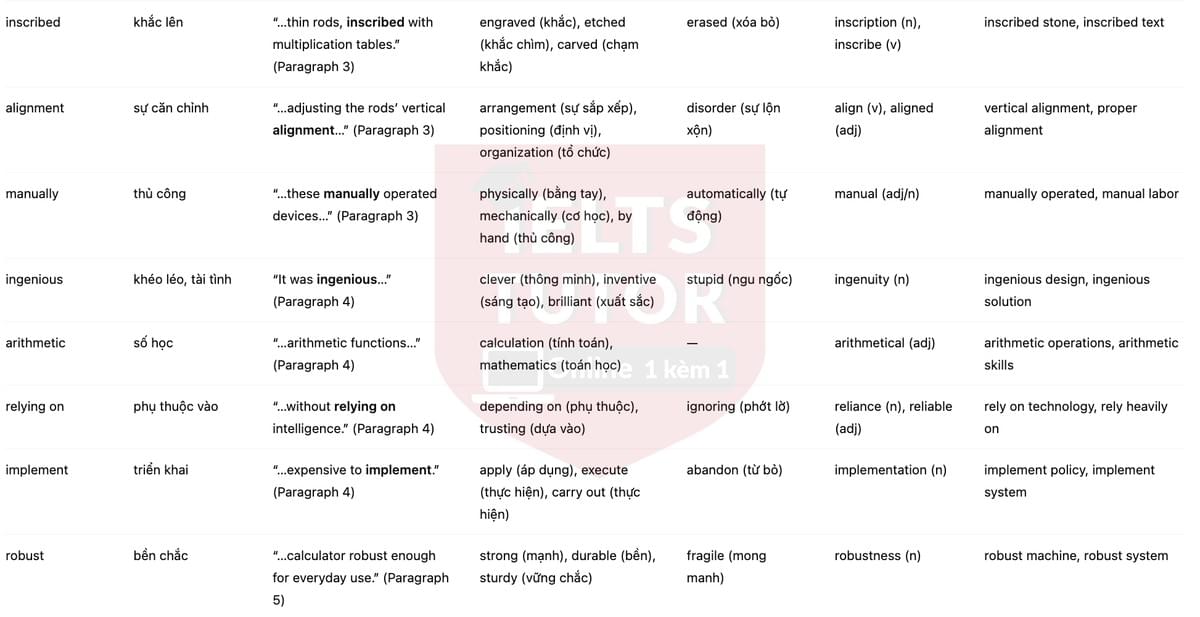
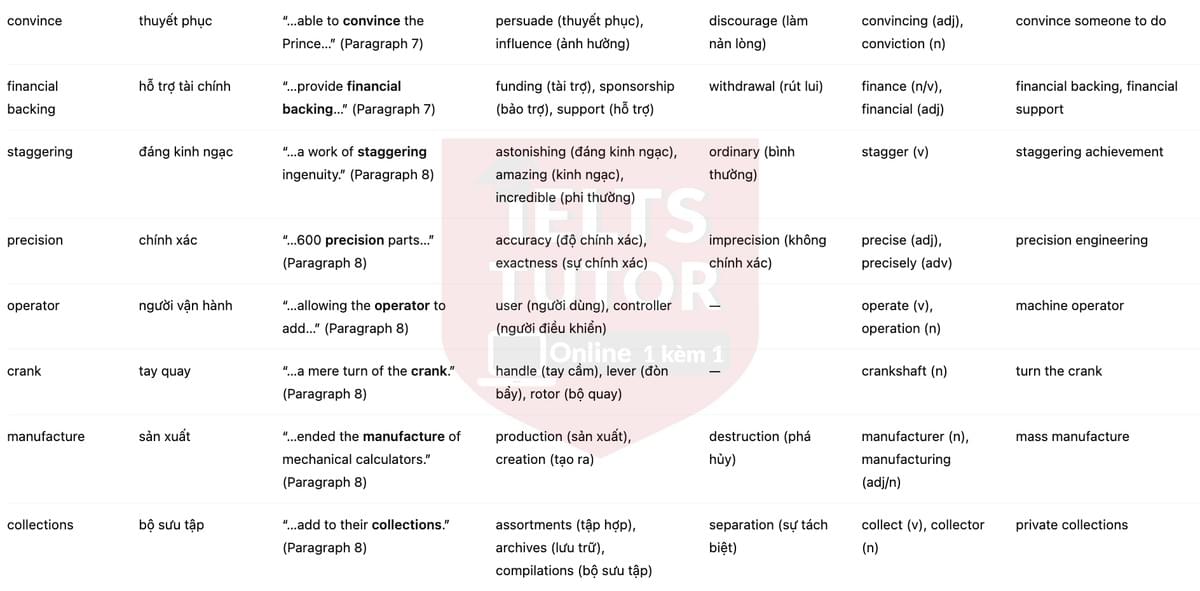
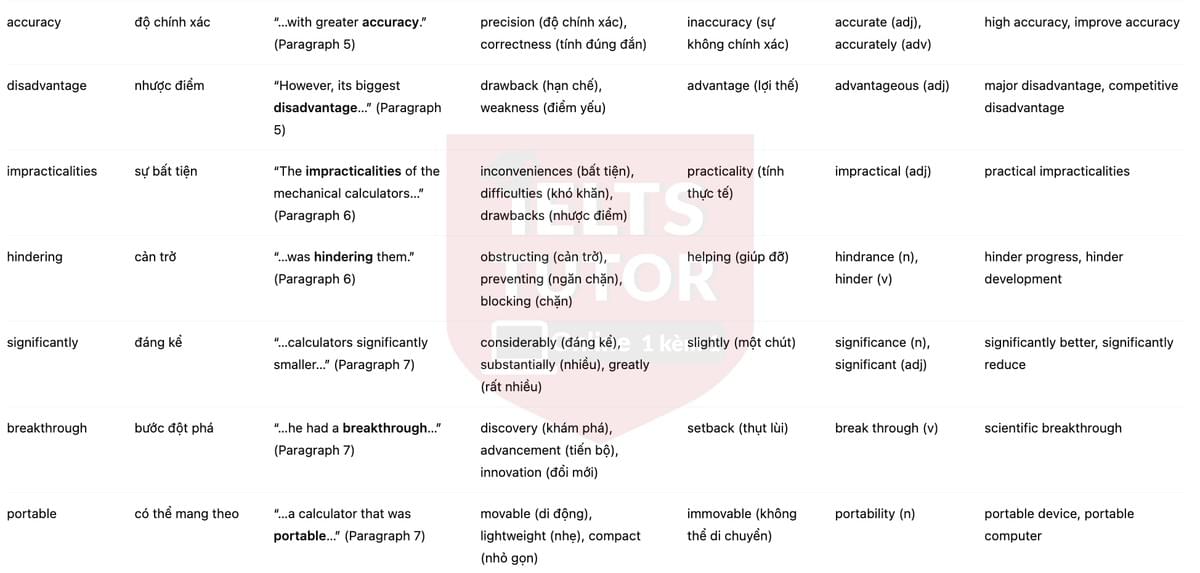
VI. Giải thích cấu trúc ngữ pháp khó Evolution of the Calculator
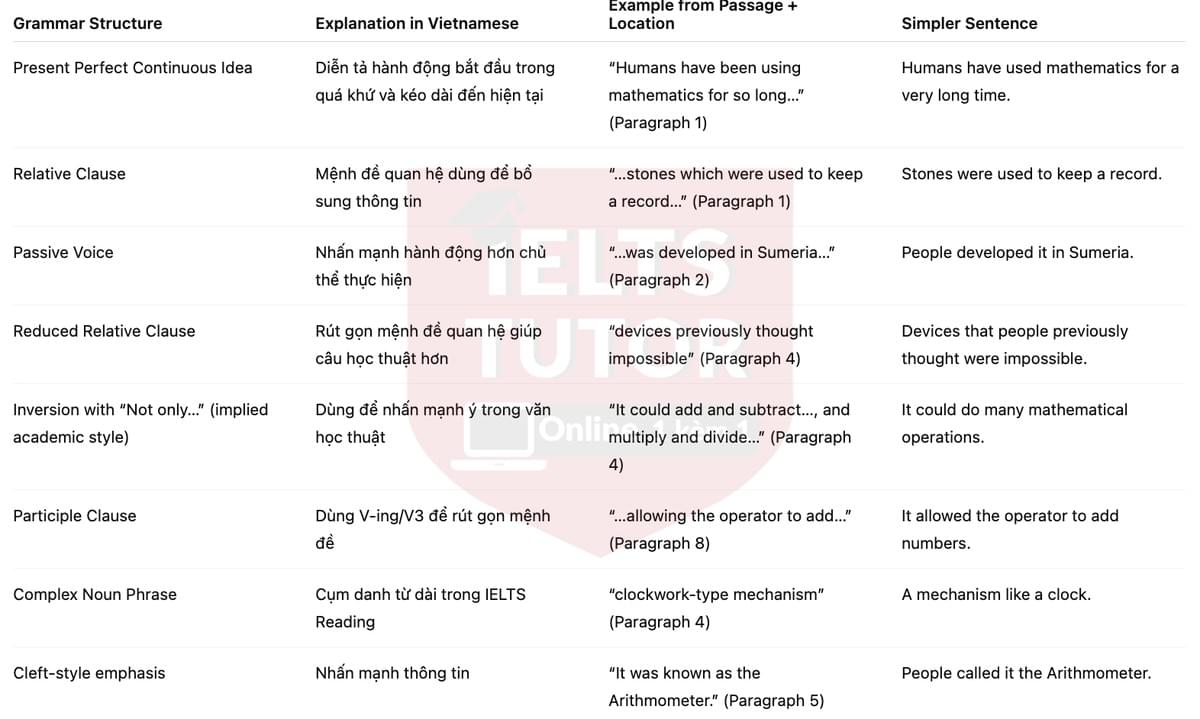
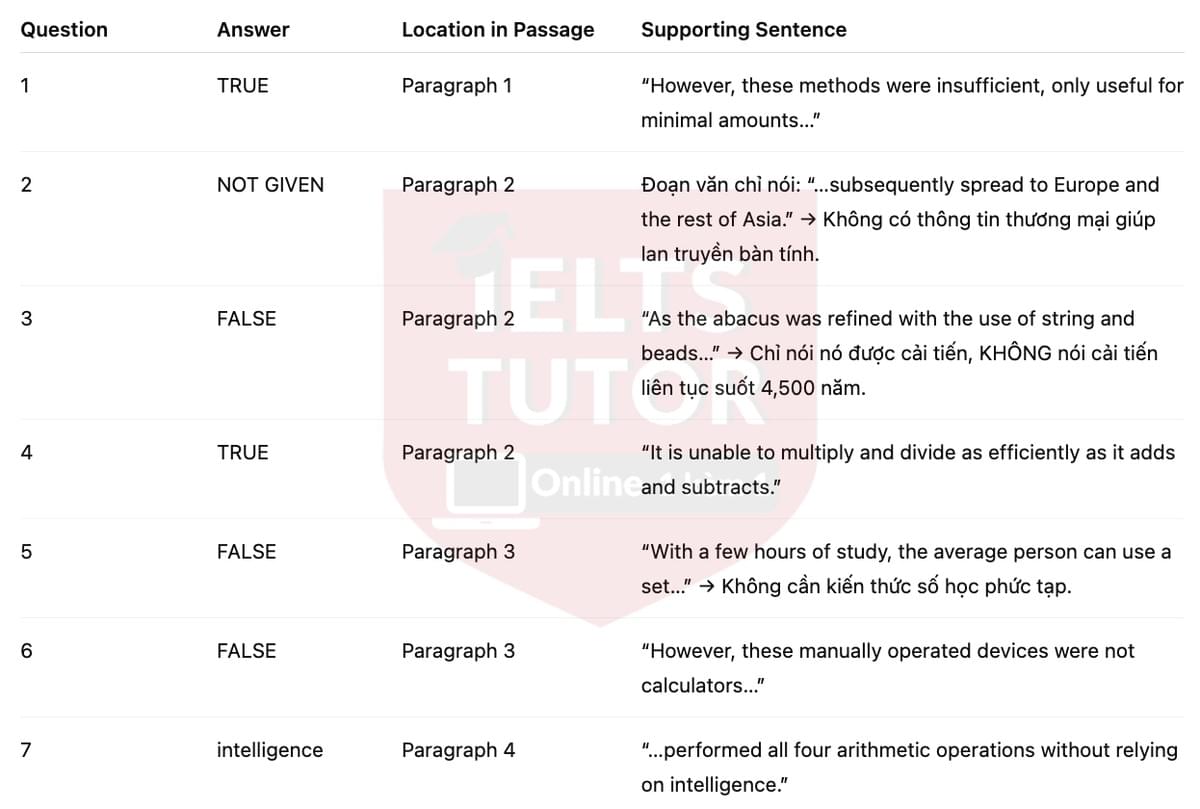
VII. Đáp án Evolution of the Calculator
1. TRUE
2. NOT GIVEN
3. FALSE
4. TRUE
5. FALSE
6. FALSE
7. intelligence
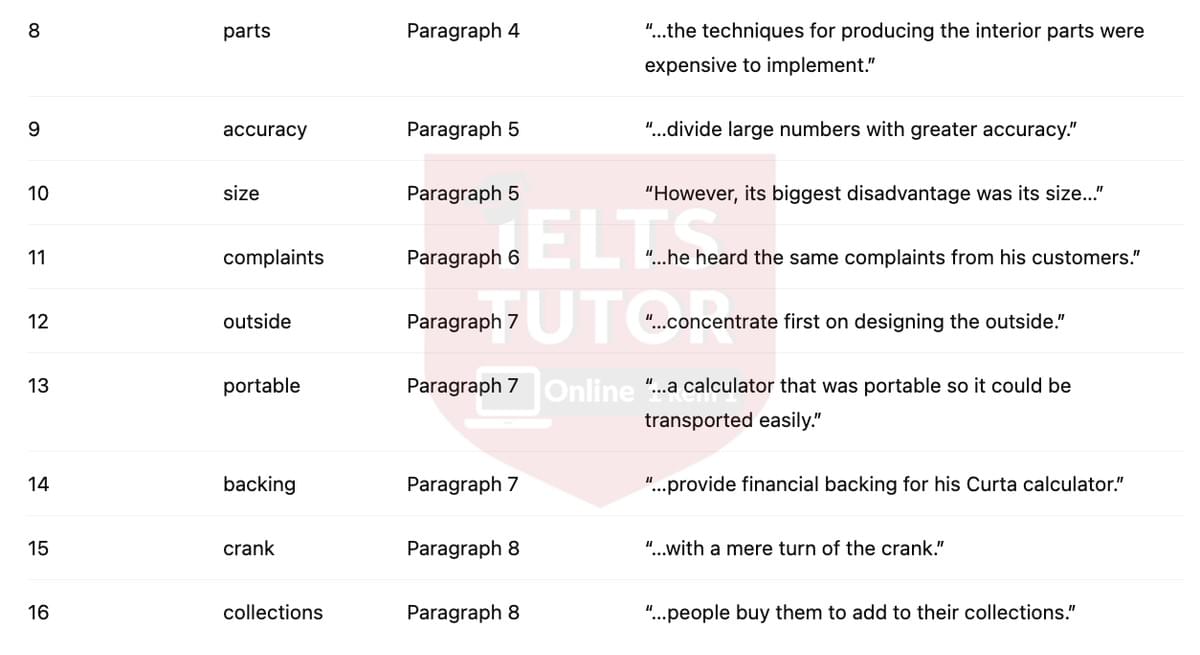
8. parts
9. accuracy
10. size
11. complaints
12. outside
13. portable
14. backing
15. crank
16. collections
📩 MN AI CHƯA CÓ ĐÁP ÁN FORECAST QUÝ MỚI PART 1-2-3 NHẮN ZL 0905834420 IELTS TUTOR GỬI FREE HẾT NHA

Các khóa học IELTS online 1 kèm 1 - 100% cam kết đạt target 6.0 - 7.0 - 8.0 - Đảm bảo đầu ra - Thi không đạt, học lại FREE
>> Thành tích học sinh IELTS TUTOR với hàng ngàn feedback được cập nhật hàng ngày
