
IELTS TUTOR cung cấp Growing food in cities - Đề luyện tập IELTS READING (IELTS Reading Practice Test) - Làm bài online format computer-based, kèm đáp án, dịch & giải thích từ vựng - cấu trúc ngữ pháp khó & GIẢI ĐÁP ÁN VỚI LOCATION
I. Kiến thức liên quan
II. Làm bài online (kéo xuống cuối bài blog để xem giải thích từ vựng & cấu trúc cụ thể hơn)
📩 MN AI CHƯA CÓ ĐÁP ÁN FORECAST QUÝ MỚI PART 1-2-3 NHẮN ZL 0905834420 IELTS TUTOR GỬI FREE HẾT NHA
III. Growing food in cities: Đề luyện tập IELTS READING (IELTS Reading Practice Test)
📖 IELTS READING · Growing food in cities
Growing food in cities
An overview of a book that looks at the future of urban food systems—the ways food is provided for residents of cities.
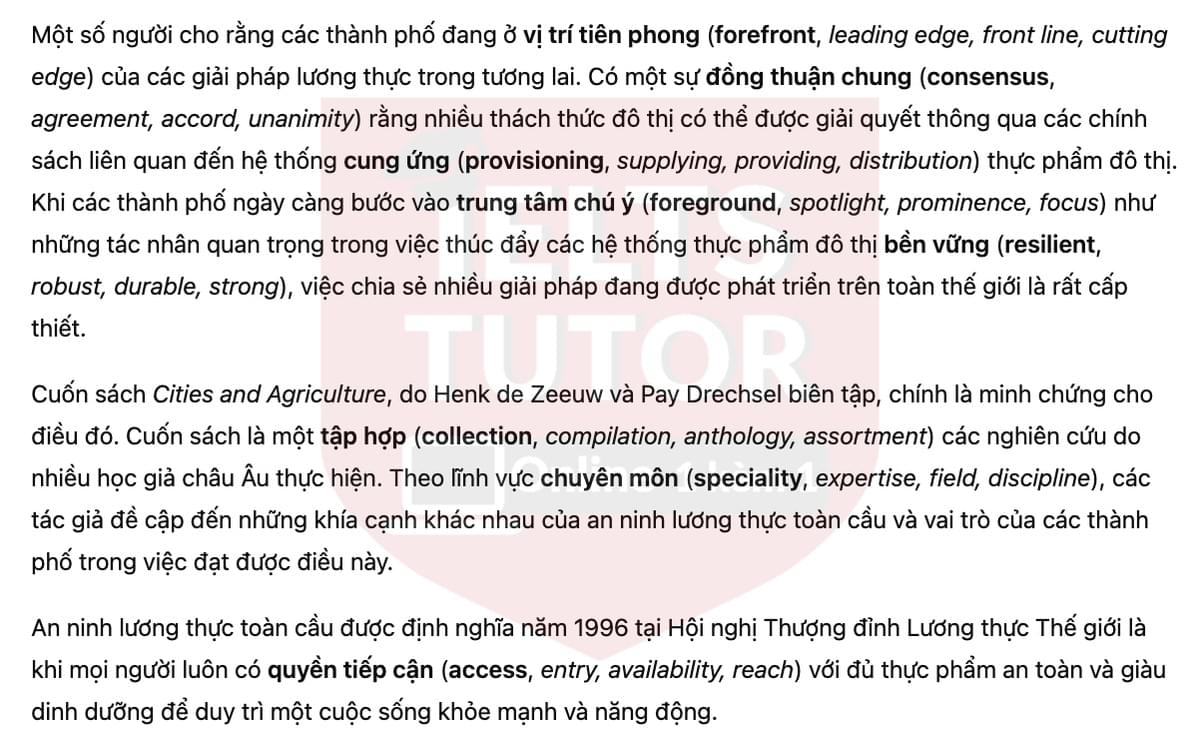
A. Some consider that cities are at the forefront of future food solutions. There is an overall consensus that a lot of urban challenges can be addressed through policies linked to urban systems of food provisioning. Considering cities are increasingly stepping into the foreground as important actors in the advancement of resilient urban food systems (UFS), it is urgent that the many solutions being advanced throughout the world are shared. This is exactly what the book Cities and Agriculture, edited by Henk de Zeeuw and Pay Drechsel, accomplishes. The book is a collection of studies, written by a range of European academics. According to their areas of speciality, these contributors address different aspects of global food security and the role that cities have to play in achieving this. Global food security was defined in 1996 by the World Food Summit as "when all people at all times have access to sufficient, safe, nutritious food to maintain a healthy and active life".
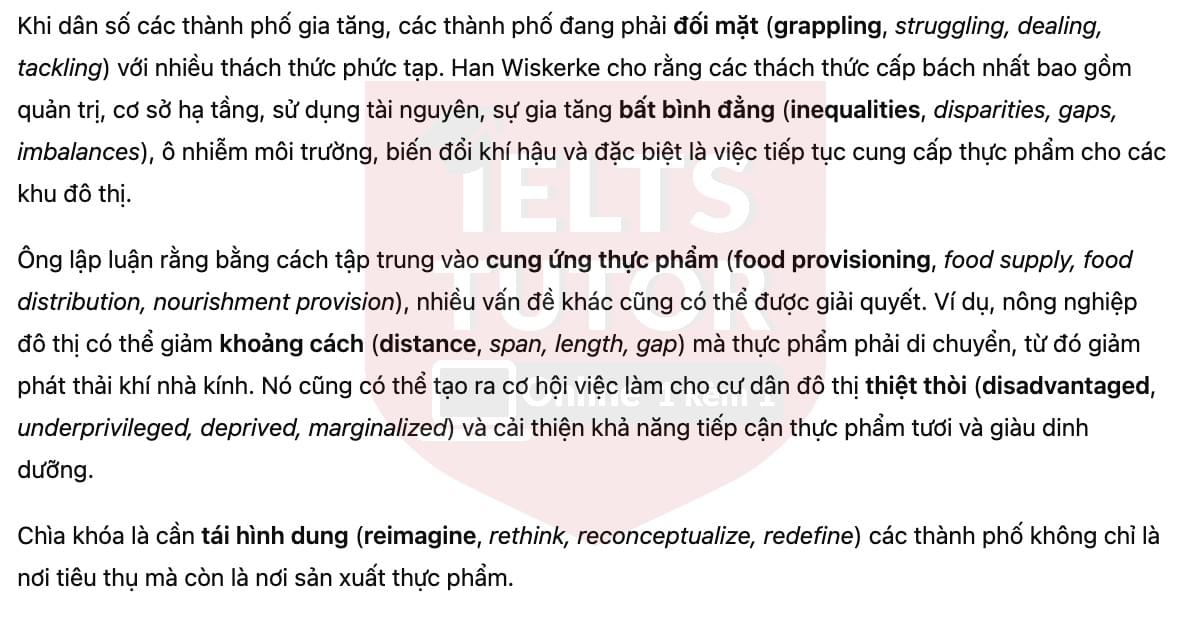
B. As the populations of many cities expand, cities are grappling with a number of complex challenges. In the opening chapter of this book, Han Wiskerke notes that the most pressing challenges include governance and infrastructure; resource use; growing inequalities between rich and poor; environmental pollution; climate change; and most importantly, the continuing provision of food to urban centres. Wiskerke argues that by focusing on food provisioning, many of the other challenges can also be addressed. For example, urban agriculture can reduce the distance food travels, thereby cutting greenhouse gas emissions. It can also create employment opportunities for disadvantaged urban residents and improve access to fresh, nutritious food in neighbourhoods that currently lack such provision. The key, according to Wiskerke, is to reimagine cities not as centres of food consumption alone but as potential sites of food production as well.
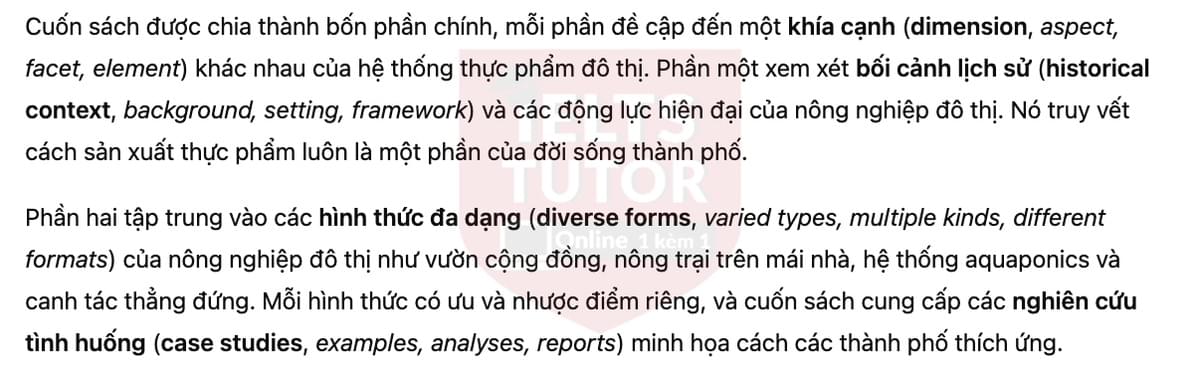
C. The book is divided into four main parts, each dealing with a different dimension of urban food systems. Part one examines the historical context and contemporary drivers of urban agriculture. It traces the ways in which food production has always been part of city life in many parts of the world, from the allotment gardens of nineteenth-century Europe to the intensive vegetable production on the outskirts of modern Asian megacities. Part two focuses on the diverse forms that urban agriculture can take, including community gardens, rooftop farms, aquaponics systems, and vertical farming. Each form has its own advantages and challenges, and the book provides case studies illustrating how different cities have adapted these approaches to their particular circumstances.
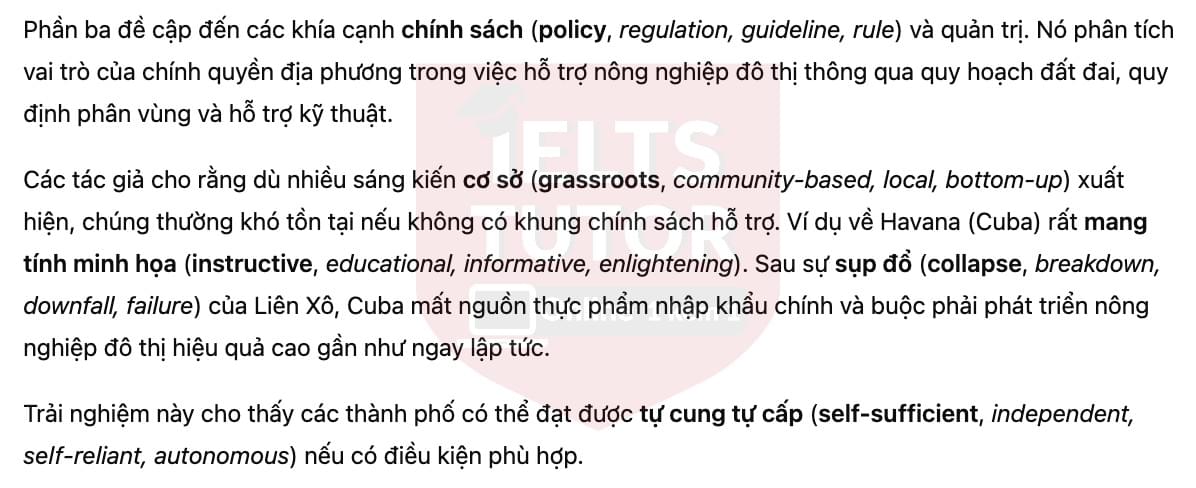
D. Part three addresses the policy and governance dimensions of urban food systems. It examines the role that local governments can play in supporting urban agriculture through land-use planning, zoning regulations, and the provision of technical assistance. The contributors argue that while many innovative projects emerge from grassroots initiatives, they often struggle to survive without supportive policy frameworks. The chapter on Havana, Cuba, is particularly instructive. Following the collapse of the Soviet Union, Cuba lost its main source of imported food and fuel, forcing the country to develop a highly productive urban agriculture sector virtually overnight. The Cuban experience demonstrates that with political will and appropriate support, cities can become remarkably self-sufficient in food.
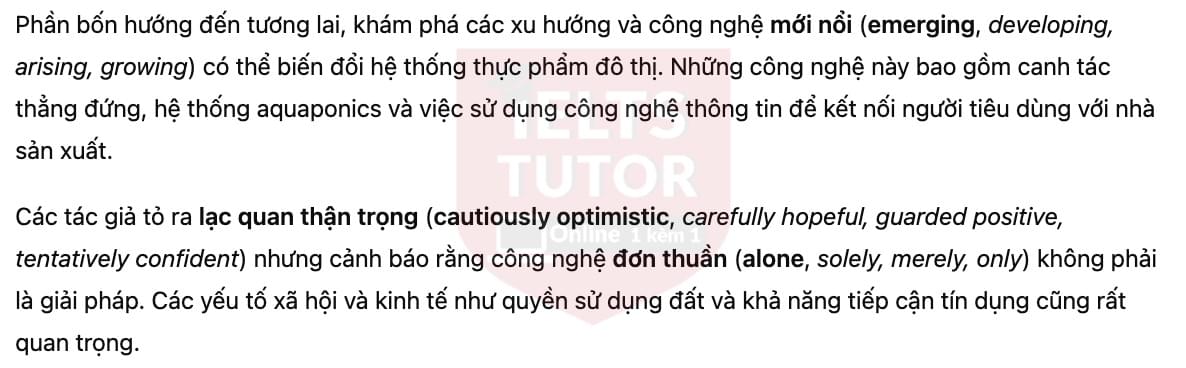
E. Part four looks to the future, exploring emerging trends and technologies that could transform urban food systems. These include vertical farming in climate-controlled high-rise buildings, aquaponics systems that combine fish farming with vegetable production, and the use of information technology to connect urban consumers directly with nearby producers. The contributors are cautiously optimistic about these innovations but warn that technology alone is not a solution. They emphasise that social and economic factors—such as land tenure, access to credit, and the inclusion of marginalised groups—are equally important to the success of urban agriculture.
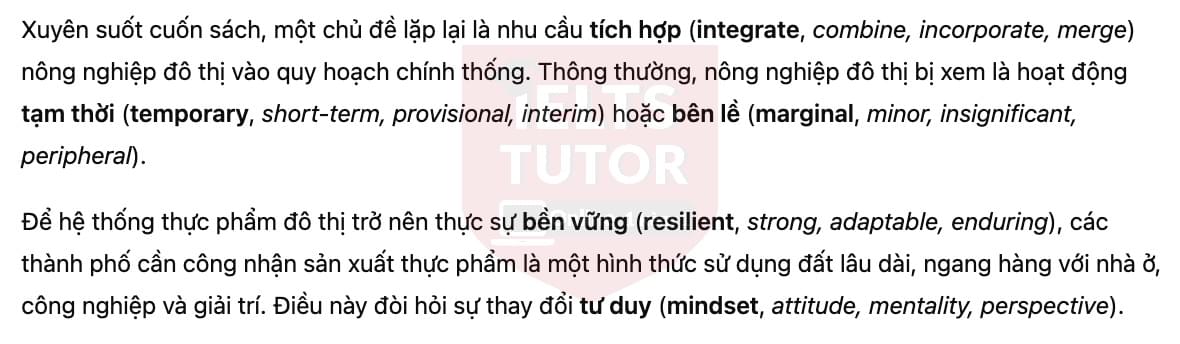
F. Throughout the book, a recurring theme is the need to integrate urban agriculture into mainstream urban planning and policy. Too often, the contributors argue, urban agriculture is treated as a temporary or marginal activity, tolerated on vacant land until a more profitable use comes along. For urban food systems to become truly resilient, cities must recognise food production as a permanent and valued land use, on par with housing, industry, and recreation. This requires a shift in mindset among planners, policymakers, and the public alike.
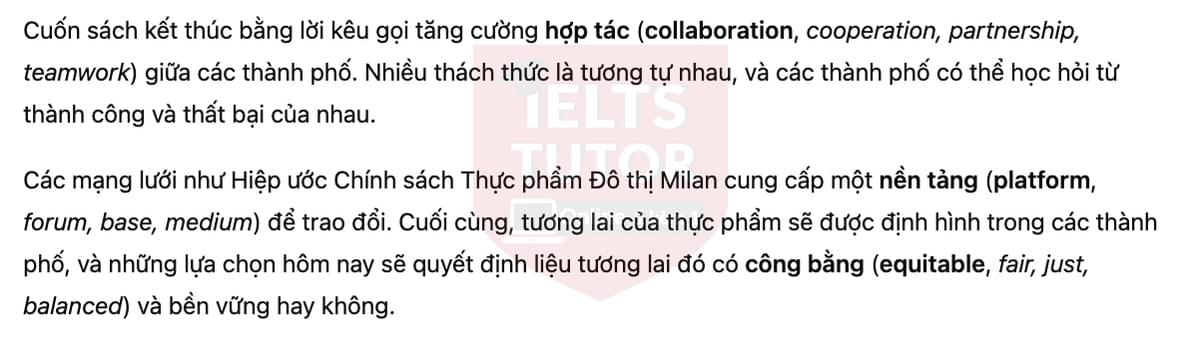
G. The book concludes with a call for greater collaboration between cities, both within and across national boundaries. Many of the challenges facing urban food systems are similar from one city to another, and cities can learn valuable lessons from each other's successes and failures. Networks such as the Milan Urban Food Policy Pact, which brings together cities from around the world committed to developing sustainable food systems, offer a platform for such exchange. In the end, the editors argue, the future of food will be shaped in cities, and the choices we make today will determine whether that future is sustainable and equitable for all.
Which section (A–G) contains the following information?
Write the correct letter, A–G.
Complete the sentences with NO MORE THAN TWO WORDS from the passage.
Choose the correct letter, A, B, C, or D.
READING PASSAGE 2
You should spend about 20 minutes on Questions 14-26, which are based on Reading Passage 2 on pages 6 and 7.
Growing food in cities
An overview of a book that looks at the future of urban food systems—the ways food is provided for residents of cities
A. Some consider that cities are at the forefront of future food solutions. There is an overall consensus that a lot of urban challenges can be addressed through policies linked to urban systems of food provisioning. Considering cities are increasingly stepping into the foreground as important actors in the advancement of resilient urban food systems (UFS), it is urgent that the many solutions being advanced throughout the world are shared. This is exactly what the book Cities and Agriculture, edited by Henk de Zeeuw and Pay Drechsel, accomplishes. The book is a collection of studies, written by a range of European academics. According to their areas of speciality, these contributors address different aspects of global food security and the role that cities have to play in achieving this. Global food security was defined in 1996 by the World Food Summit as "when all people at all times have access to sufficient, safe, nutritious food to maintain a healthy and active life".
B. As the populations of many cities expand, cities are grappling with a number of complex challenges. In the opening chapter of this book, Han Wiskerke notes that the most pressing challenges include governance and infrastructure; resource use; growing inequalities between rich and poor; environmental pollution; climate change; and most importantly, the continuing provision of food to urban centres. Wiskerke argues that by focusing on food provisioning, many of the other challenges can also be addressed. For example, urban agriculture can reduce the distance food travels, thereby cutting greenhouse gas emissions. It can also create employment opportunities for disadvantaged urban residents and improve access to fresh, nutritious food in neighbourhoods that currently lack such provision. The key, according to Wiskerke, is to reimagine cities not as centres of food consumption alone but as potential sites of food production as well. >> 🔥 Form đăng kí giải đề thi thật IELTS 4 kĩ năng kèm bài giải bộ đề 100 đề PART 2 IELTS SPEAKING quý đang thi (update hàng tuần) từ IELTS TUTOR
C. The book is divided into four main parts, each dealing with a different dimension of urban food systems. Part one examines the historical context and contemporary drivers of urban agriculture. It traces the ways in which food production has always been part of city life in many parts of the world, from the allotment gardens of nineteenth-century Europe to the intensive vegetable production on the outskirts of modern Asian megacities. Part two focuses on the diverse forms that urban agriculture can take, including community gardens, rooftop farms, aquaponics systems, and vertical farming. Each form has its own advantages and challenges, and the book provides case studies illustrating how different cities have adapted these approaches to their particular circumstances.
D. Part three addresses the policy and governance dimensions of urban food systems. It examines the role that local governments can play in supporting urban agriculture through land-use planning, zoning regulations, and the provision of technical assistance. The contributors argue that while many innovative projects emerge from grassroots initiatives, they often struggle to survive without supportive policy frameworks. The chapter on Havana, Cuba, is particularly instructive. Following the collapse of the Soviet Union, Cuba lost its main source of imported food and fuel, forcing the country to develop a highly productive urban agriculture sector virtually overnight. The Cuban experience demonstrates that with political will and appropriate support, cities can become remarkably self-sufficient in food.
E. Part four looks to the future, exploring emerging trends and technologies that could transform urban food systems. These include vertical farming in climate-controlled high-rise buildings, aquaponics systems that combine fish farming with vegetable production, and the use of information technology to connect urban consumers directly with nearby producers. The contributors are cautiously optimistic about these innovations but warn that technology alone is not a solution. They emphasise that social and economic factors—such as land tenure, access to credit, and the inclusion of marginalised groups—are equally important to the success of urban agriculture.
F. Throughout the book, a recurring theme is the need to integrate urban agriculture into mainstream urban planning and policy. Too often, the contributors argue, urban agriculture is treated as a temporary or marginal activity, tolerated on vacant land until a more profitable use comes along. For urban food systems to become truly resilient, cities must recognise food production as a permanent and valued land use, on par with housing, industry, and recreation. This requires a shift in mindset among planners, policymakers, and the public alike. >> 🔥 Nhắn zalo 0905834420 join group zalo Hóng đề thi máy 4 skills để cập nhật đề thi thật 4 kĩ năng hằng ngày [Kèm giải & đề làm online]
G. The book concludes with a call for greater collaboration between cities, both within and across national boundaries. Many of the challenges facing urban food systems are similar from one city to another, and cities can learn valuable lessons from each other's successes and failures. Networks such as the Milan Urban Food Policy Pact, which brings together cities from around the world committed to developing sustainable food systems, offer a platform for such exchange. In the end, the editors argue, the future of food will be shaped in cities, and the choices we make today will determine whether that future is sustainable and equitable for all.
Questions 14–19
Reading Passage 2 has seven sections, A–G.
Which section contains the following information?
Write the correct letter, A–G, in boxes 14–19 on your answer sheet.
NB You may use any letter more than once.
a reference to the official definition of global food security
examples of different forms that urban agriculture can take
the argument that urban agriculture should be recognised as a permanent land use
a case study showing how one country achieved food self-sufficiency in cities
the suggestion that cities can learn from each other through international networks
an explanation of how focusing on food can help address other urban challenges
Questions 20–23
Complete the sentences below.
Choose NO MORE THAN TWO WORDS from the passage for each answer.
Write your answers in boxes 20–23 on your answer sheet. >> 🔥 IELTS TUTOR gợi ý tham khảo CẦN VIẾT & THU ÂM BAO NHIÊU BÀI ĐỂ ĐẠT 8.0 SPEAKING & 7.0 WRITING?
Han Wiskerke argues that urban agriculture can reduce the __________ food travels, helping to cut greenhouse gas emissions.
Part two of the book provides __________ illustrating how different cities have adapted urban agriculture approaches.
The chapter on Havana shows how Cuba developed a highly productive urban agriculture sector after losing its main source of imported __________.
The contributors warn that __________ alone is not enough; social and economic factors are also important.
Questions 24–26
Choose the correct letter, A, B, C, or D.
Write your answers in boxes 24–26 on your answer sheet.
According to section C, what does part one of the book examine?
A. The future of vertical farming in Asian megacities
B. The historical background of urban agriculture
C. The policy frameworks supporting urban farming
D. The technological innovations in food productionWhat does the Cuban example in section D demonstrate?
A. Urban agriculture requires imported fuel to be productive.
B. Grassroots initiatives cannot survive without government support.
C. Cities can become highly self-sufficient in food under the right conditions.
D. The collapse of the Soviet Union had no impact on Cuban food systems.What is the main purpose of the Milan Urban Food Policy Pact mentioned in section G?
A. To promote vertical farming in European cities
B. To provide funding for urban agriculture projects
C. To create a network for cities to share sustainable food system strategies
D. To establish international regulations for food trade between cities
IV. Dịch bài đọc Growing food in cities
V. Giải thích từ vựng Growing food in cities
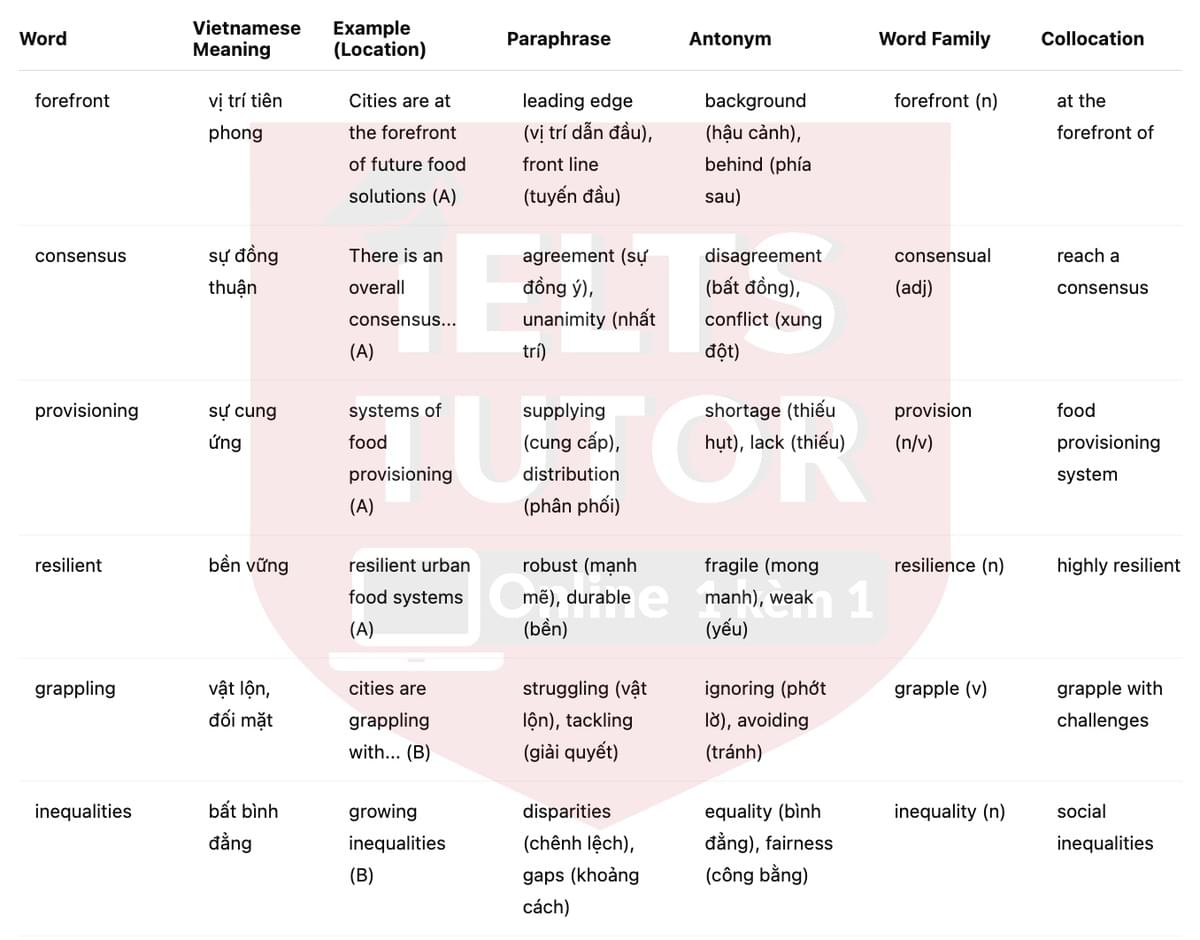
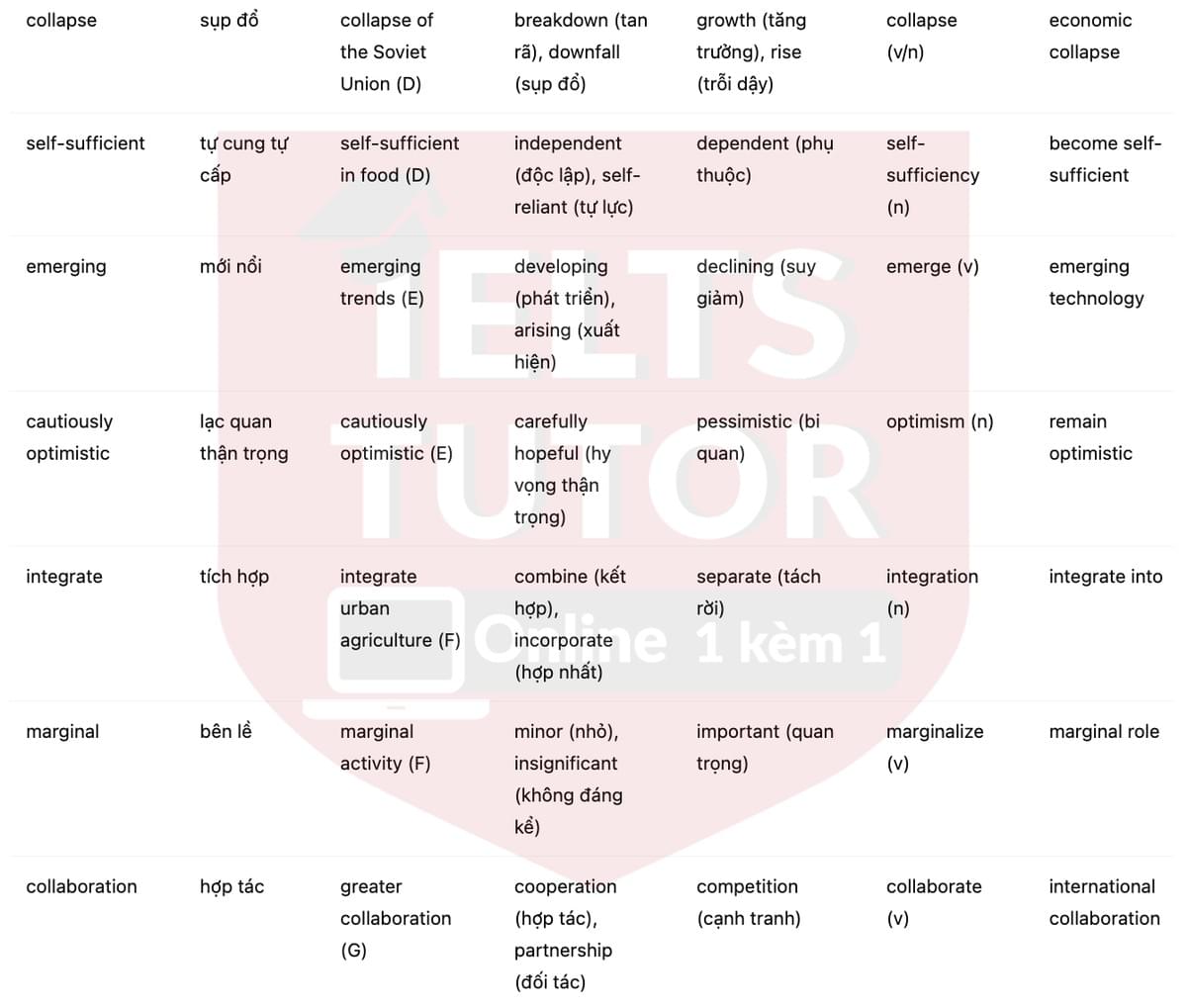
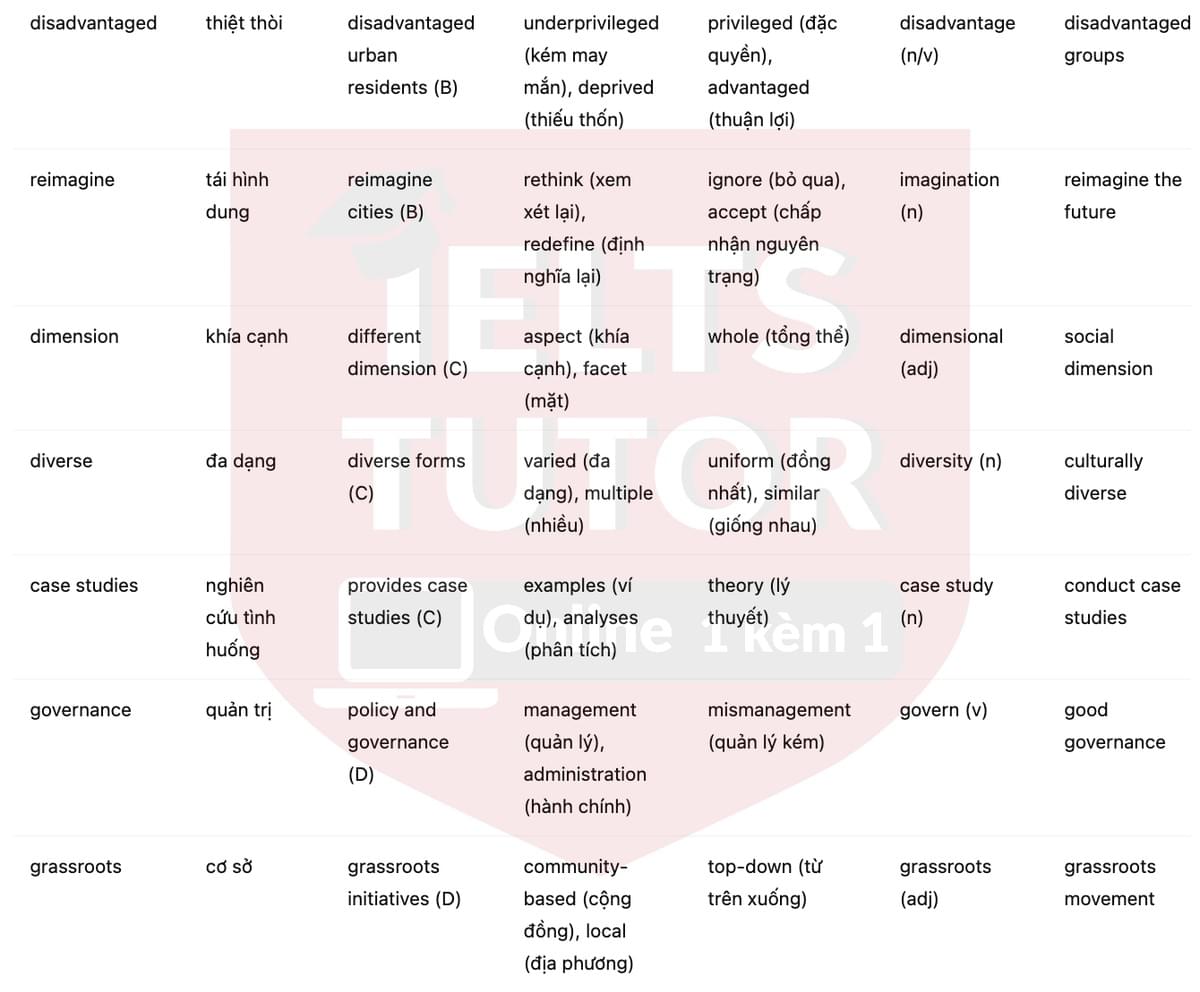
VI. Giải thích cấu trúc ngữ pháp khó Growing food in cities
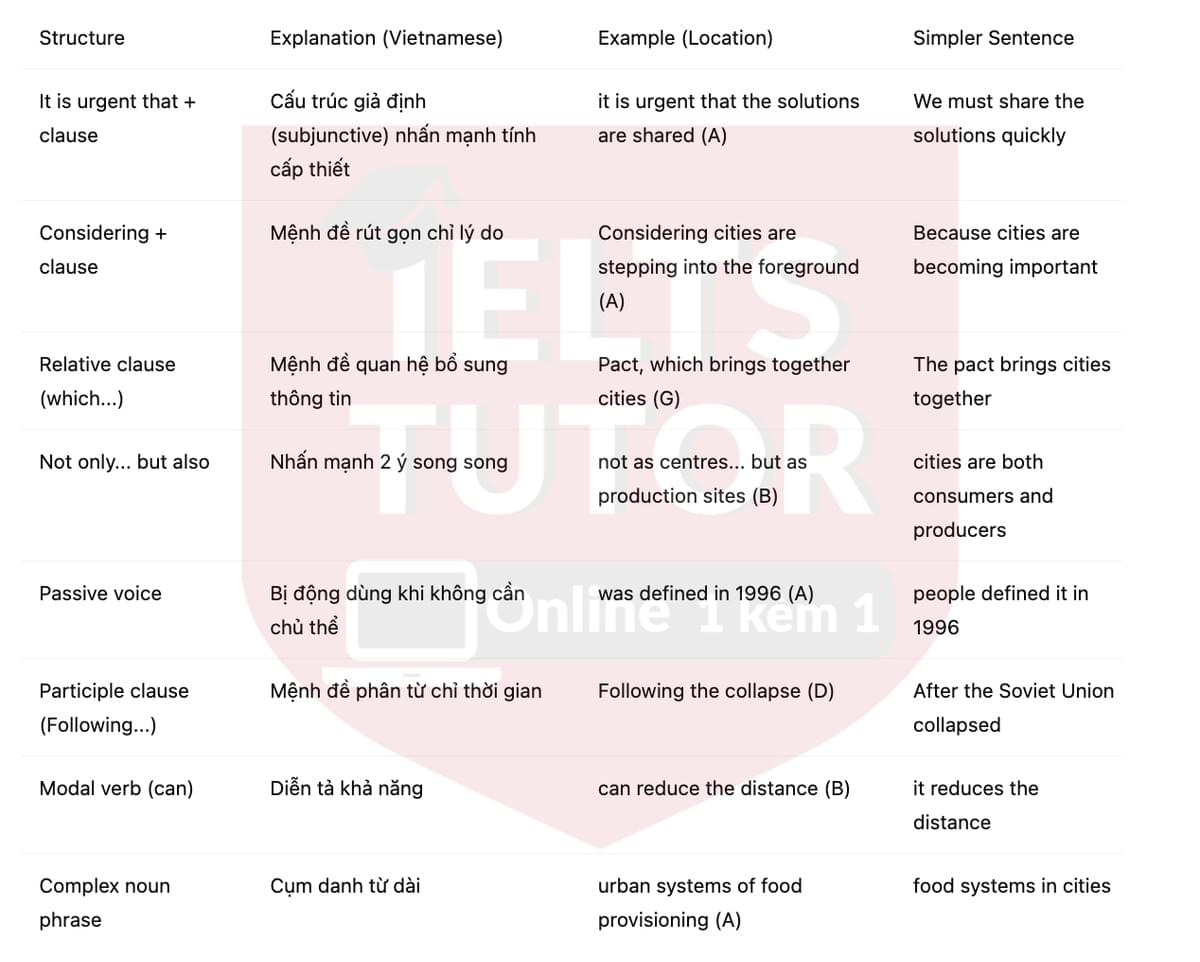
VII. Đáp án Growing food in cities
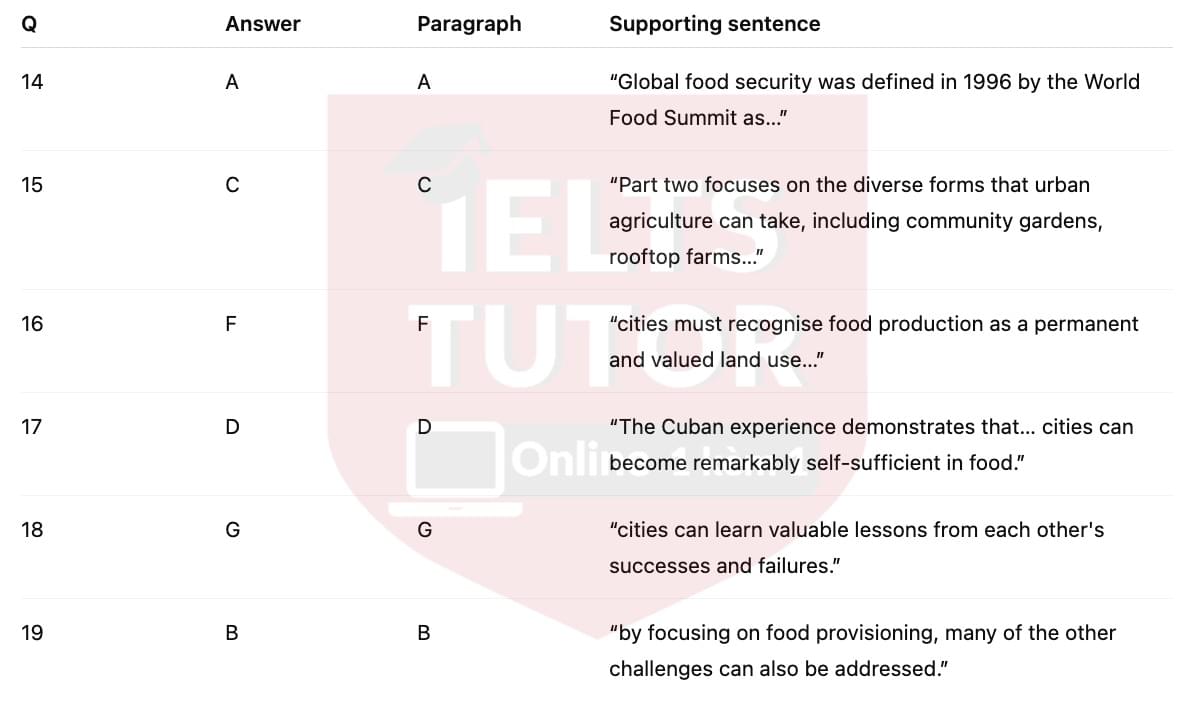
14. A
15. C
16. F
17. D
18. G
19. B
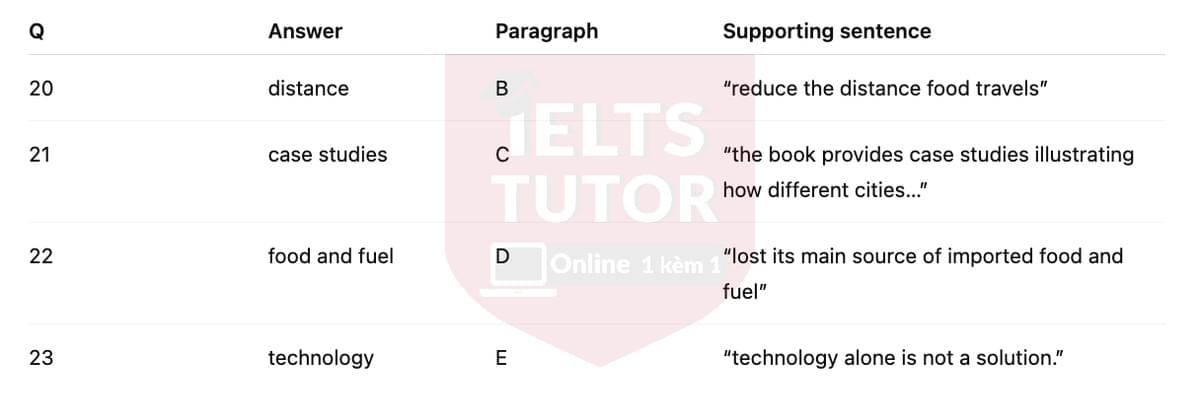
20. distance
21. case studies
22. food and fuel
23. technology
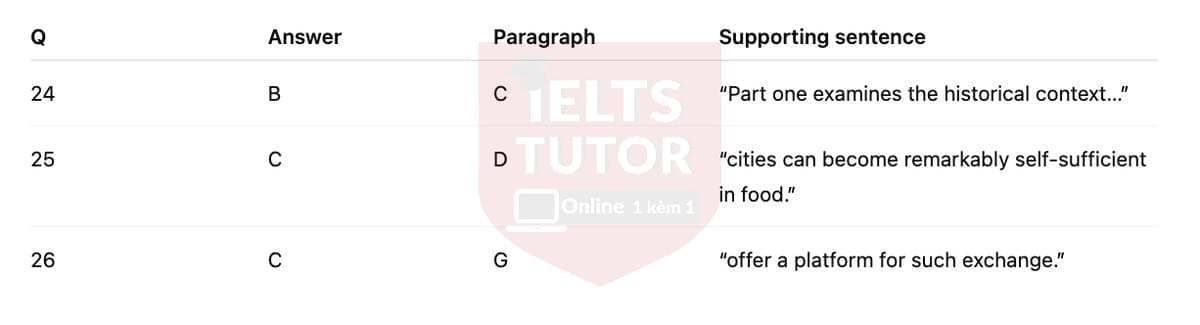
24. B
25. C
26. C
📩 MN AI CHƯA CÓ ĐÁP ÁN FORECAST QUÝ MỚI PART 1-2-3 NHẮN ZL 0905834420 IELTS TUTOR GỬI FREE HẾT NHA

Các khóa học IELTS online 1 kèm 1 - 100% cam kết đạt target 6.0 - 7.0 - 8.0 - Đảm bảo đầu ra - Thi không đạt, học lại FREE
>> Thành tích học sinh IELTS TUTOR với hàng ngàn feedback được cập nhật hàng ngày
