
IELTS TUTOR cung cấp The lost animals of Australia: Đề thi thật IELTS READING (IELTS Reading Recent Actual Test) - Làm bài online format computer-based, kèm đáp án, dịch & giải thích từ vựng - cấu trúc ngữ pháp khó & GIẢI ĐÁP ÁN VỚI LOCATION
I. Kiến thức liên quan
II. Làm bài online (kéo xuống cuối bài blog để xem giải thích từ vựng & cấu trúc cụ thể hơn)
📩 MN AI CHƯA CÓ ĐÁP ÁN FORECAST QUÝ MỚI PART 1-2-3 NHẮN ZL 0905834420 IELTS TUTOR GỬI FREE HẾT NHA
III. The lost animals of Australia: Đề thi thật IELTS READING (IELTS Reading Recent Actual Test)
Reading Passage
You should spend about 20 minutes on Questions 27-40, which are based on the reading passage below.
The lost animals of Australia
The history of Australia's animals over the past 50,000 years has been largely one of extinction. The time has been too short for new species of large animals to evolve and, over this period, nearly one-third of Australia's mammal species have become extinct, along with nearly all the large reptiles and many of the flightless birds. The cause of these extinctions is still hotly debated. One school of thought suggests that humans caused the extinctions, and another that they were due to changes in climate. The greatest problem in evaluating these theories is that we do not know exactly when these animals became extinct. Fossils from a number of well-dated cave and lakeside sites suggest that all the now-extinct species had already vanished 35,000 years ago, but a few other sites suggest that giant marsupials might have survived until 25,000 years ago, or even as late as 6,000 years ago. One certainty is that Australia's climate has changed greatly over the past 40,000 years. Between 25,000 and 15,000 years ago, the sea level dropped by more than 100 metres and the continent experienced an extremely arid phase. Clearly, the timing of the extinctions is of critical importance. If they can be shown to coincide with the arrival of humans, about 50,000 years ago, then circumstantial evidence would point to humans as the cause. If, however, the giant marsupials survived until 25,000 years ago, the increased aridity would seem to be the more likely cause.
Before these extinctions, Australia was a very different place. Naturally occurring fires were probably less frequent than they are now, because large marsupial herbivores (of which there were about forty species) reduced the standing crop of vegetation.
Rainforest plants were widespread in the parts of Australia which are now very dry. The largest marsupial species was the diprotodon, which, like other Australian marsupial giants, was about one-third the weight of its ecological equivalent elsewhere. It probably weighed between 1,000 and 2,000 kilograms, while the elephant of Afro-Asia weighed about 5,000 kilograms. The relatively small size of the Australian marsupial giants has been attributed to Australia's extraordinarily poor soils and erratic climate, both factors which typically limit plant growth.>> Form đăng kí giải đề thi thật IELTS 4 kĩ năng kèm bài giải bộ đề 100 đề PART 2 IELTS SPEAKING quý đang thi (update hàng tuần) từ IELTS TUTOR
Judging by the teeth of extinct species, there were many specialist grazers and browsers, paralleling the great mammal communities of Africa today. But the Australian carnivores were very different from their African equivalents. For example, the Australian marsupial lion was only about the size of a leopard; there was no equivalent of the large group of cat- and dog-like carnivores of Africa. The marsupial lion was Australia's only cat-like species; there was one dog-like species, the thylacine, which vanished from mainland Australia 3,000 years ago, but seems to have survived on the Australian island of Tasmania until the 1930s, and one scavenger/carnivore, the Tasmanian devil. The larger Australian carnivores were all reptiles. The largest of these, the gigantic snakes of the genus Wonambi, were more than 8 metres long, and together with the 7-metre goanna and the 3-metre land crocodile, were the main predators. There were never vast numbers of most species. Large, warm-blooded creatures were at a disadvantage, their prey being limited by the nature of the soil and climate. The cold-blooded reptilian carnivores, which required less energy, were therefore able to dominate.
There is strong evidence to support the theory that humans were responsible for the decline of large animals in Australia. In their Afro-Eurasian homeland, humans were medium-sized members of a very large community of carnivores and omnivores. But by 40,000 years ago, they were taking a very broad range of prey, including mammals much larger than themselves. Studies have shown that when humans or other predators arrive in areas where there have previously been no ecologically equivalent species, they invariably have a profound impact. For example, over the past 1,000 years, Polynesians in Hawaii have destroyed more than 70% of the bird species, and during the 1800s, hunters on islands close to Antarctica severely depleted many seal species.
Australian animals were particularly vulnerable to the impact of humans. Marsupial herbivores were adapted only to avoiding predation by large but relatively unintelligent reptiles, while humans are the most efficient predators that have ever existed. From the mountain rainforests to the desert centre, extinctions emptied landscape after landscape, until finally the largest surviving mammals were humans themselves. Medium-sized animal species weighing between 10 and 100 kilograms either also became extinct or became smaller over thousands of years. Grey kangaroos are now only half the size they once were, while koalas and Tasmanian devils weigh, on average, one-third less than they once did.
In general, in Australia, the larger the species, the more it has reduced in size, with the exception of humans and wombats; the latter may have been protected by their burrowing habits. This shrinking may also be attributable to human hunting practices. If hunters claimed the largest individuals of these species, fast-maturing small specimens would have been more likely to survive to maturity. Increasingly, they would have produced smaller offspring. Only the smallest mammals, those weighing less than 10 kilograms, survived unaltered, although some may have been restricted to a smaller number of areas. This extinction pattern changed with the arrival of Europeans towards the end of the 18th century. As a result of this, a large number of smaller species also became extinct over the course of the following century, together with 21 medium-sized mammals and one large mammal species.
Questions
Questions 27-32
Choose the correct letter, A, B, C or D.
The writer states that it is difficult to decide why prehistoric Australian animals became extinct because
A. relevant fossils are scarce.
B. fossil evidence has been destroyed.
C. the evidence is somewhat contradictory.
D. there has not been enough time to carry out research.The writer suggests that Australia's larger mammals were smaller than those of Africa and Asia because
A. there was an insufficient supply of food.
B. the country was covered with thick forest.
C. smaller animals escaped predators more easily.
D. they had difficulty digesting the available food.According to the writer, large Australian carnivores were mostly reptiles because
A. mammals were less skillful at hunting.
B. reptiles had faster breeding rates.
C. reptiles were more suited to the environment.
D. mammals had to compete for territory.According to the writer, the effect of the first humans in Australia was particularly great because Australian animals
A. were stow and awkward.
B. had skins that could be used for several purposes.
C. had little experience in escaping from such skillful hunters.
D. were attracted towards human settlements because of the food available there.What, according to the writer, does the wombat have in common with humans?
A. Its size has remained the same.
B. Its diet was similar to the human diet.
C. It made shelters to protect itself.
D. It was able to evade reptiles easily.The writer suggests that Australian mammals have become smaller because
A. they were able to live underground.
B. they were vulnerable to human diseases.
C. bigger examples of the species were killed.
D. their territories expanded in size.
Questions 33-36
Write the correct letter, A-F, in boxes 33-36 on your answer sheet.
| First invented or used by | |
|---|---|
| A | is due to the fact that not enough time has passed. |
| B | is evidenced by the remains of their teeth. |
| C | is responsible for the disappearance of habitat. |
| D | is often responsible for a significant number of extinctions. |
| E | is theoretically based on a large herbivore population. |
| F | is a crucial factor that has yet to be resolved. |
The failure of a new species of large mammals to evolve
The extinction date of the large Australian
A reduction in the number of forest fires
The arrival of humans in a previously uninhabited>> IELTS TUTOR gợi ý tham khảo CẦN VIẾT & THU ÂM BAO NHIÊU BÀI ĐỂ ĐẠT 8.0 SPEAKING & 7.0 WRITING?
Questions 37-40
Do the following statements agree with the information given in the reading passage?
Write:
YES if the statement agrees with the claims of the writer
NO if the statement contradicts the claims of the writer
NOT GIVEN if it is impossible to say what the writer thinks about this
Mass extinction in Australia was limited to giant mammals.
A. YES
B. NO
C. NOT GIVENAustralia's climate became cooler about 50,000 years ago.
A. YES
B. NO
C. NOT GIVENThe Wonambi snake was the biggest Australian carnivore.
A. YES
B. NO
C. NOT GIVENEuropeans the extinction of some smaller Australian mammals.
A. YES
B. NO
C. NOT GIVEN
IV. Dịch bài đọc The lost animals of Australia


V. Giải thích từ vựng The lost animals of Australia


VI. Giải thích cấu trúc ngữ pháp khó The lost animals of Australia

VII. Đáp án The lost animals of Australia
C
A
C
C
A
C
A
F
E
D
B
C
A
A


📩 MN AI CHƯA CÓ ĐÁP ÁN FORECAST QUÝ MỚI PART 1-2-3 NHẮN ZL 0905834420 IELTS TUTOR GỬI FREE HẾT NHA
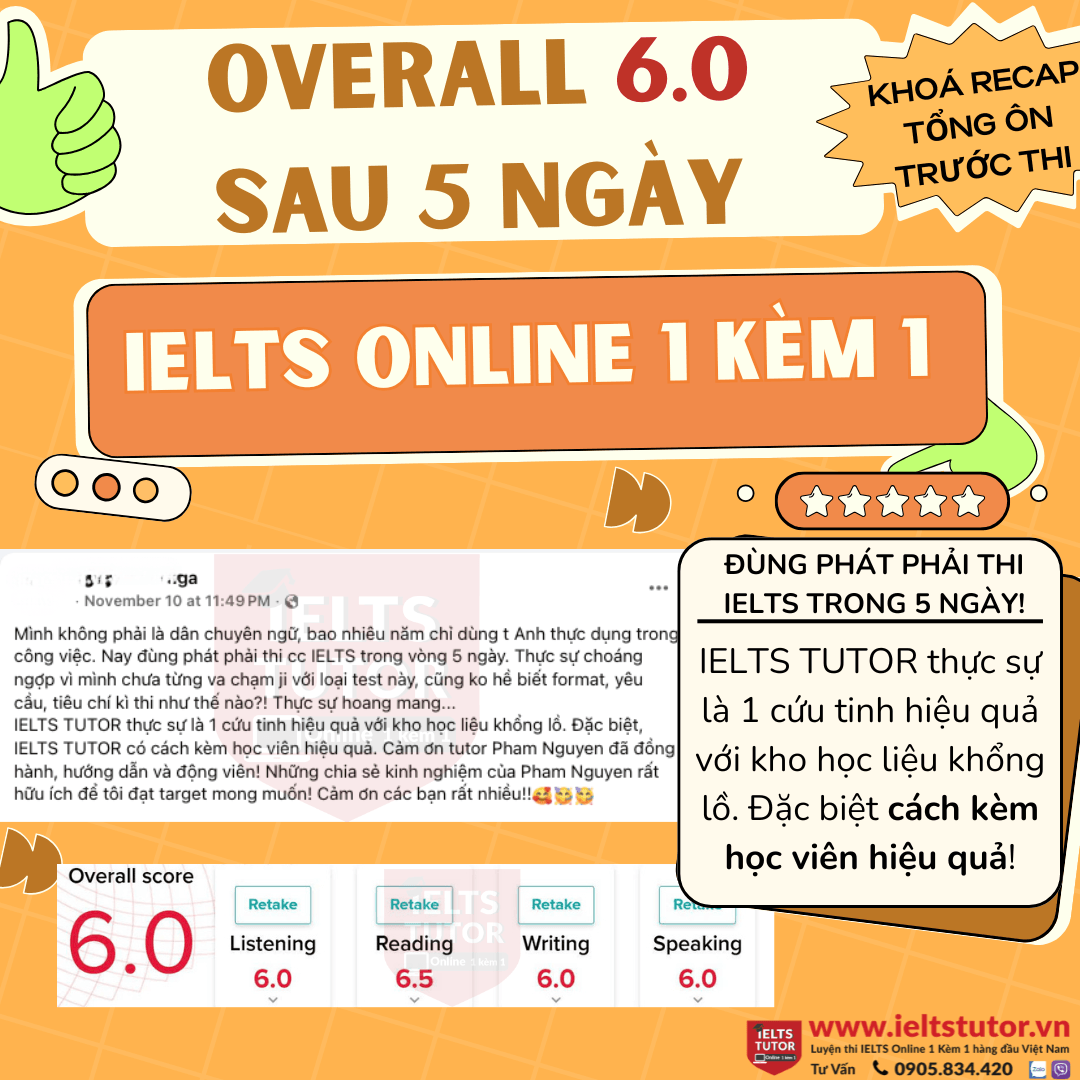
Các khóa học IELTS online 1 kèm 1 - 100% cam kết đạt target 6.0 - 7.0 - 8.0 - Đảm bảo đầu ra - Thi không đạt, học lại FREE
>> Thành tích học sinh IELTS TUTOR với hàng ngàn feedback được cập nhật hàng ngày
