
IELTS TUTOR cung cấp The Origins of Weather Forecasting Đề luyện tập IELTS READING (IELTS Reading Practice Test) - Làm bài online format computer-based, kèm đáp án, dịch & giải thích từ vựng - cấu trúc ngữ pháp khó & GIẢI ĐÁP ÁN VỚI LOCATION
I. Kiến thức liên quan
📩 MN AI CHƯA CÓ ĐÁP ÁN FORECAST QUÝ MỚI PART 1-2-3 NHẮN ZL 0905834420 IELTS TUTOR GỬI FREE HẾT NHA
II. Làm bài online (kéo xuống cuối bài blog để xem giải thích từ vựng & cấu trúc cụ thể hơn)
📘 IELTS Reading · The Origins of Weather Forecasting
You should spend about 20 minutes on Questions 1–13, which are based on Reading Passage 1 below.
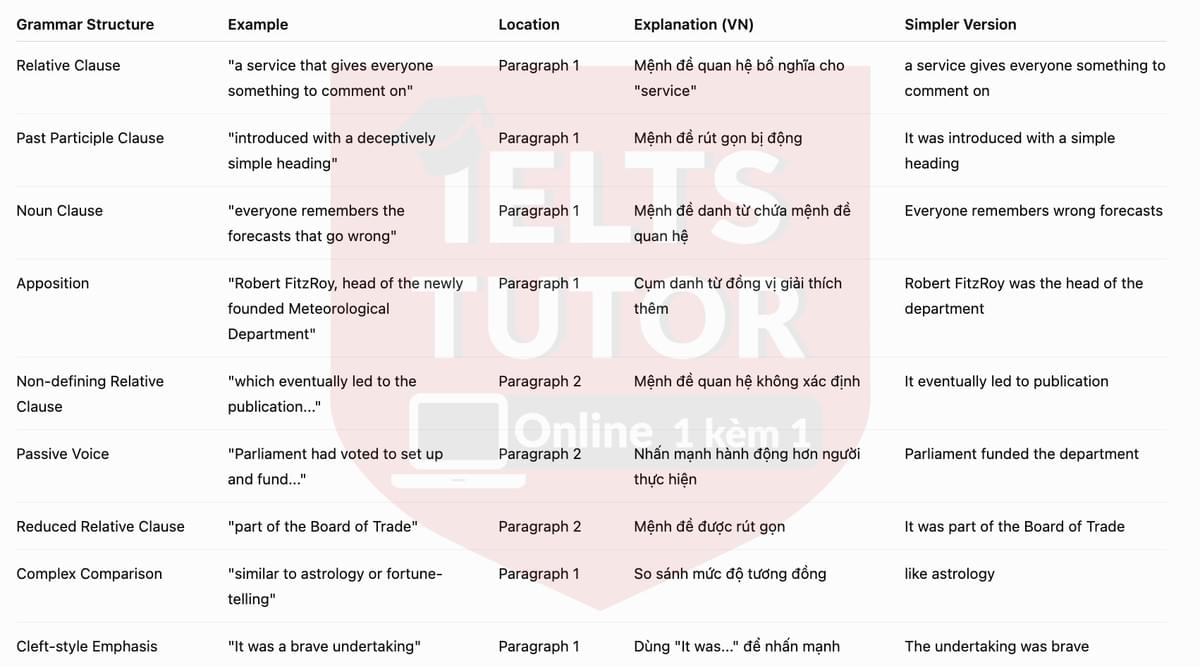
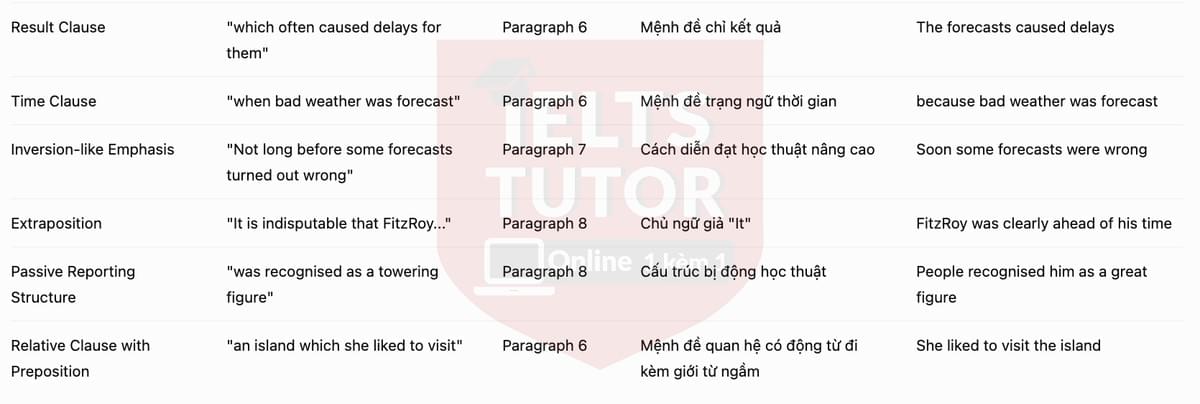
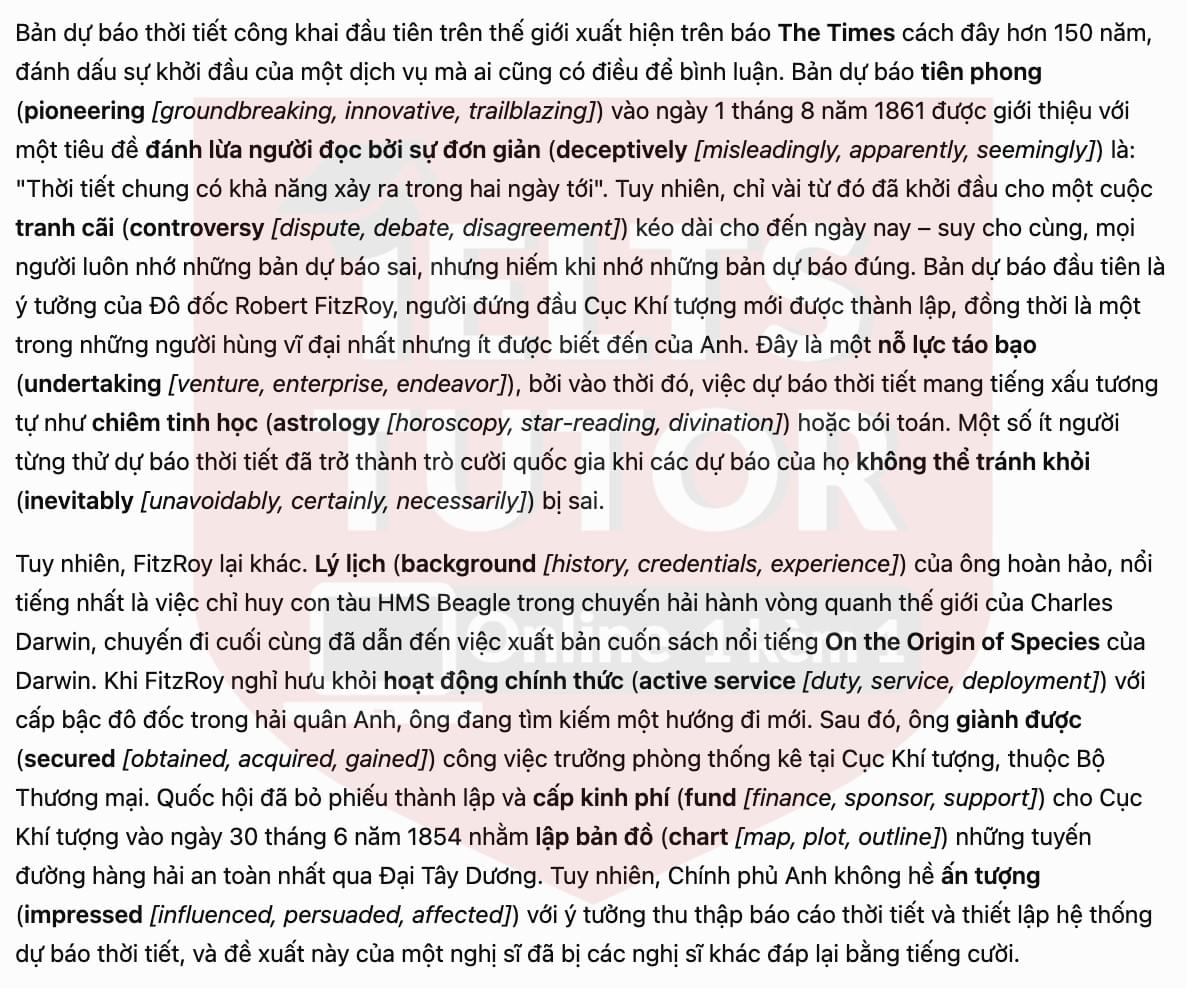
The world's first public weather forecast appeared in The Times newspaper over 150 years ago: the beginning of a service that gives everyone something to comment on. The pioneering forecast on August 1, 1861, was introduced with a deceptively simple heading: 'General weather probable during next two days.' But those few words started an ongoing controversy that still continues today – after all, everyone remembers the forecasts that go wrong, but rarely the ones that are right. The first forecast was the idea of Admiral Robert FitzRoy, head of the newly founded Meteorological Department, and one of Britain's greatest but least-known heroes. It was a brave undertaking, because in those days predicting the weather had gained a reputation similar to astrology or fortune-telling. The few people who attempted it had become a national joke when their forecasts inevitably went wrong.
FitzRoy was different, though. His background was faultless, most famously his captaining of the ship HMS Beagle on Charles Darwin's voyage around the world, which eventually led to the publication of Darwin's well-known book On the Origin of Species. When FitzRoy retired from active service as an admiral in Britain's navy, he was looking for a new direction. He subsequently secured a job as chief statistician at the Meteorological Department, part of the Board of Trade. Parliament had voted to set up and fund the Meteorological Department on June 30, 1854, to chart the safest sailing routes across the Atlantic Ocean. However, the British Government was not impressed with the idea of collecting weather reports and establishing a weather forecast, and the suggestion by one Member of Parliament for this was met with laughter from the other MPs.
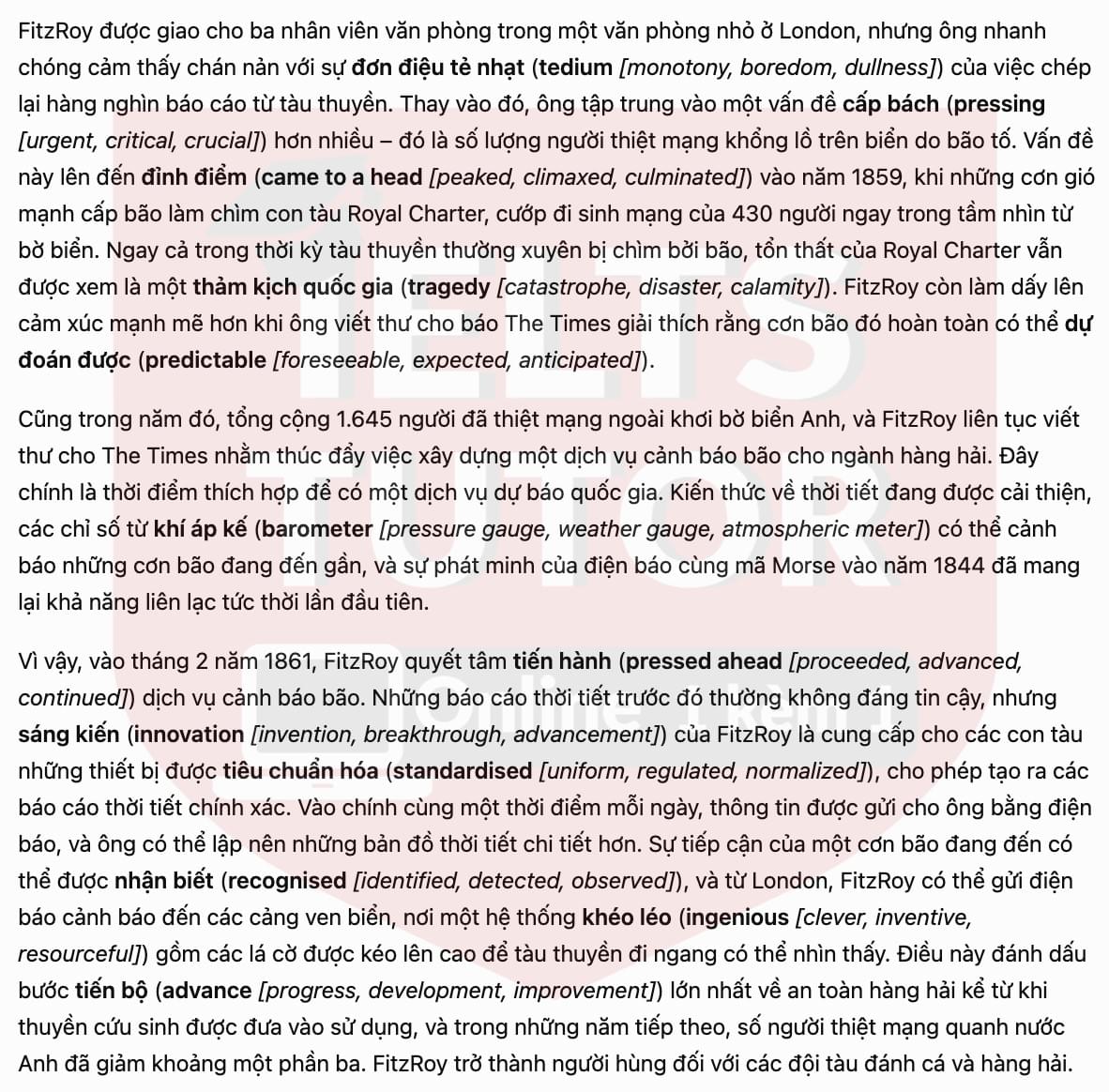
FitzRoy was given a staff of three clerks in a small office in London, but he soon grew bored with the tedium of transcribing thousands of ships' reports. Instead, he focused on a much more pressing issue – the huge loss of life at sea from storms. This problem came to a head in 1859, when gale-force winds sank the ship named Royal Charter, with the loss of 430 lives, within sight of the shore. Even in those days when ships regularly sank in storms, the loss of the Royal Charter was considered a national tragedy. FitzRoy stirred up feelings even further when he wrote a letter to The Times newspaper explaining that the storm had been entirely predictable.
That same year, a total of 1,645 lives were lost off the British coast, and FitzRoy wrote repeatedly to The Times pushing for a storm-warning service for shipping. This was just the right moment for a national forecasting service. Knowledge of the weather was improving, barometer readings gave warning of approaching storms, and the invention of the electric telegraph and Morse code in 1844 gave instant communication for the first time.
So in February 1861, FitzRoy pressed ahead with a storm-warning service. Previous weather reports had been unreliable, but FitzRoy's innovation was to issue ships with standardised instruments which allowed for accurate weather reports. At exactly the same time each day the information was sent to him by telegraph, and he was able to draw up more detailed weather maps. The approach of an incoming storm could be recognised, and from London, FitzRoy could telegraph warnings to ports on the coast, where an ingenious system of flags was hoisted up high for passing ships to read. This represented the biggest advance in shipping safety after the introduction of the lifeboat, and in subsequent years the number of lives lost around Britain fell by about a third. FitzRoy became a hero to the fishing and maritime fleets.
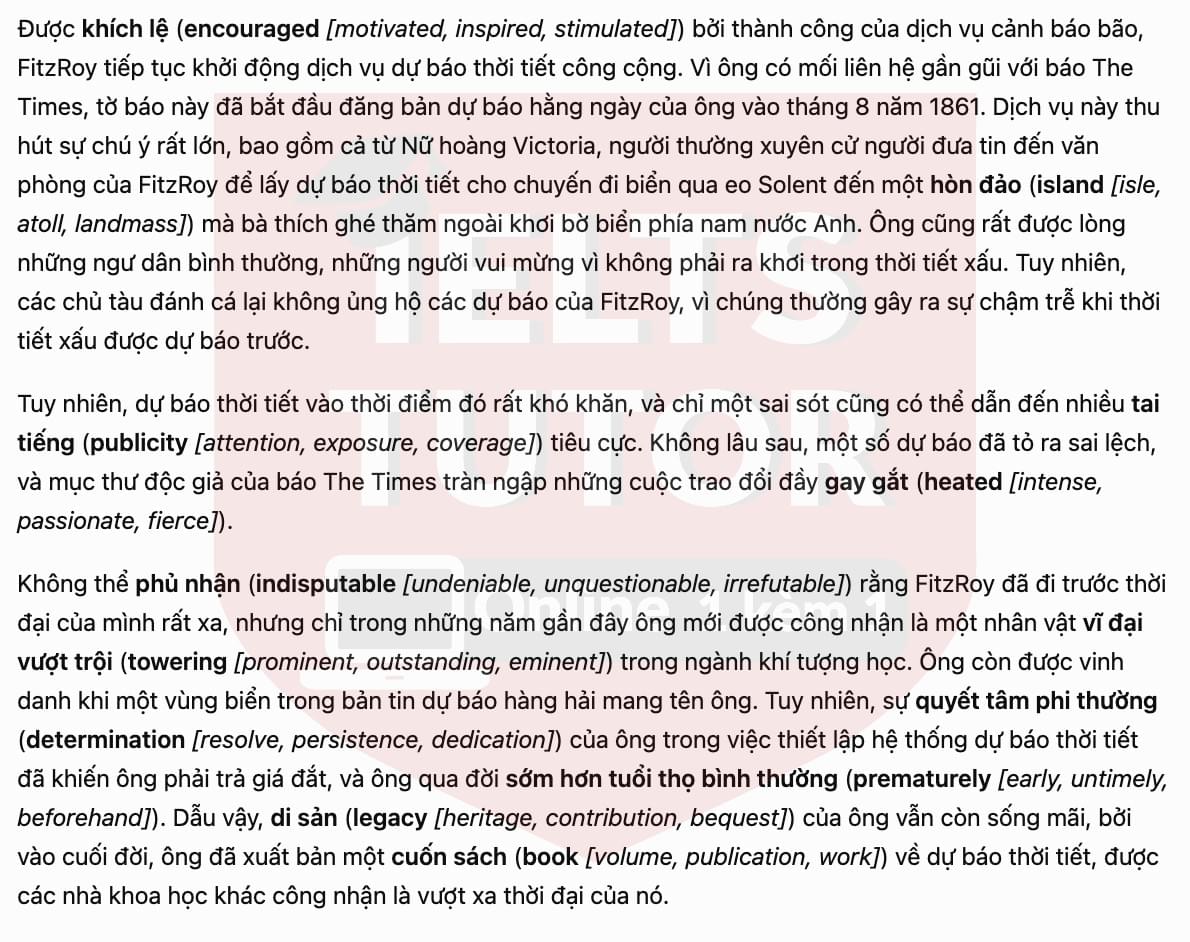
Encouraged by his storm-warning success, FitzRoy then started a public weather forecasting service. As he had a close connection with The Times, this newspaper introduced his daily forecast in August 1861. It attracted huge attention, including from Queen Victoria, who regularly sent messengers to FitzRoy's office to get a forecast for the sea crossing over the Solent to an island which she liked to visit off the south coast of England. He was also popular with ordinary fishermen, who were happy not to be out at sea in bad weather. The owners of fishing vessels, however, were not supportive of FitzRoy's forecasts, which often caused delays for them when bad weather was forecast.
Nevertheless, weather forecasting at that time was very difficult, and one mistake could result in much bad publicity. It wasn't long before some forecasts turned out wrong, and the letters pages of The Times were full of heated correspondence.
It is indisputable that FitzRoy was way ahead of his time, but it is only in recent years that he has been recognised as a towering figure in meteorology, with the honour of an area of sea being given his name in the shipping forecast (a radio broadcast of weather reports for the seas around Britain). His extraordinary determination to get forecasting established cost him dearly though, and he died prematurely. But his legacy lives on, because late in his life he published a book about weather forecasting which was recognised by other scientists to be well ahead of its time.
Do the following statements agree with the information given in Reading Passage 1?
In boxes 1–5 write TRUE / FALSE / NOT GIVEN
Complete the notes below. Choose ONE WORD ONLY from the passage for each answer.

III. The Origins of Weather Forecasting: Đề luyện tập IELTS READING (IELTS Reading Practice Test)
READING PASSAGE 1
You should spend about 20 minutes on Questions 1–13, which are based on Reading Passage 1 below.
The Origins of Weather Forecasting
The world's first public weather forecast appeared in The Times newspaper over 150 years ago: the beginning of a service that gives everyone something to comment on. The pioneering forecast on August 1, 1861, was introduced with a deceptively simple heading: 'General weather probable during next two days.' But those few words started an ongoing controversy that still continues today – after all, everyone remembers the forecasts that go wrong, but rarely the ones that are right. The first forecast was the idea of Admiral Robert FitzRoy, head of the newly founded Meteorological Department, and one of Britain's greatest but least-known heroes. It was a brave undertaking, because in those days predicting the weather had gained a reputation similar to astrology or fortune-telling. The few people who attempted it had become a national joke when their forecasts inevitably went wrong.
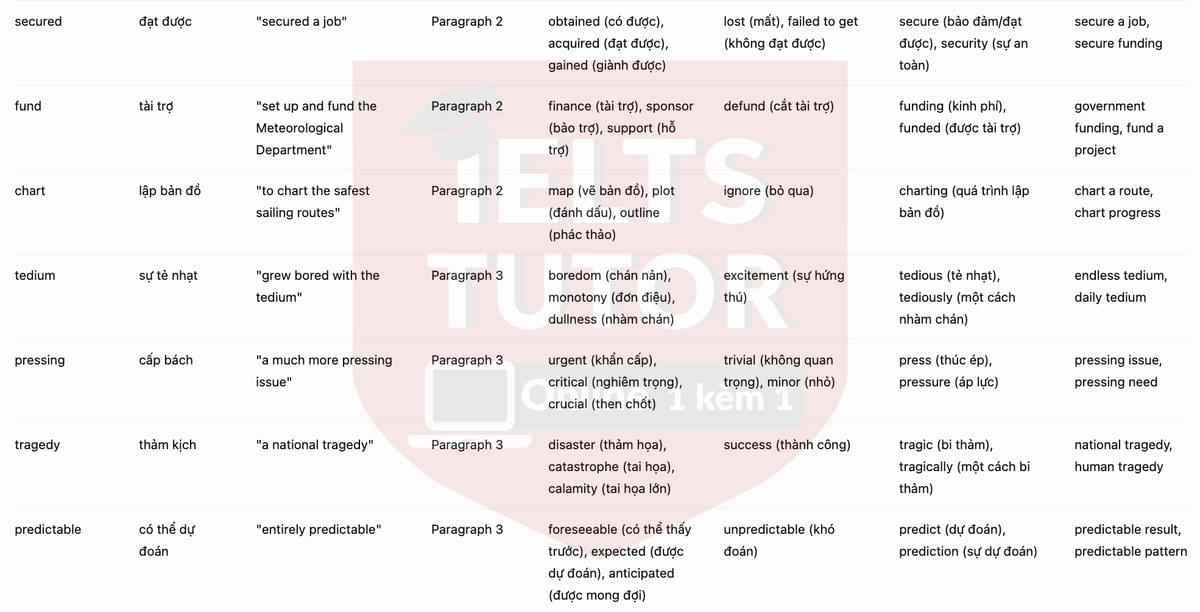
FitzRoy was different, though. His background was faultless, most famously his captaining of the ship HMS Beagle on Charles Darwin's voyage around the world, which eventually led to the publication of Darwin's well-known book On the Origin of Species. When FitzRoy retired from active service as an admiral in Britain's navy, he was looking for a new direction. He subsequently secured a job as chief statistician at the Meteorological Department, part of the Board of Trade. Parliament had voted to set up and fund the Meteorological Department on June 30, 1854, to chart the safest sailing routes across the Atlantic Ocean. However, the British Government was not impressed with the idea of collecting weather reports and establishing a weather forecast, and the suggestion by one Member of Parliament for this was met with laughter from the other MPs.
>> 🔥 Form đăng kí giải đề thi thật IELTS 4 kĩ năng kèm bài giải bộ đề 100 đề PART 2 IELTS SPEAKING quý đang thi (update hàng tuần) từ IELTS TUTOR
FitzRoy was given a staff of three clerks in a small office in London, but he soon grew bored with the tedium of transcribing thousands of ships' reports. Instead, he focused on a much more pressing issue – the huge loss of life at sea from storms. This problem came to a head in 1859, when gale-force winds sank the ship named Royal Charter, with the loss of 430 lives, within sight of the shore. Even in those days when ships regularly sank in storms, the loss of the Royal Charter was considered a national tragedy. FitzRoy stirred up feelings even further when he wrote a letter to The Times newspaper explaining that the storm had been entirely predictable.
That same year, a total of 1,645 lives were lost off the British coast, and FitzRoy wrote repeatedly to The Times pushing for a storm-warning service for shipping. This was just the right moment for a national forecasting service. Knowledge of the weather was improving, barometer readings gave warning of approaching storms, and the invention of the electric telegraph and Morse code in 1844 gave instant communication for the first time.
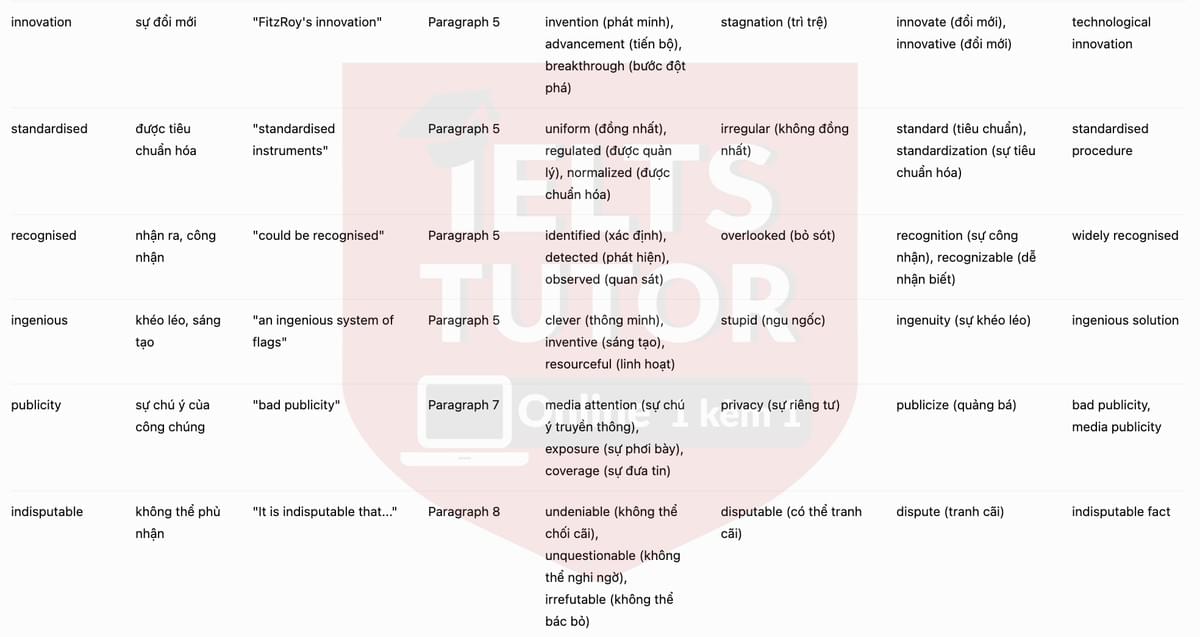
So in February 1861, FitzRoy pressed ahead with a storm-warning service. Previous weather reports had been unreliable, but FitzRoy's innovation was to issue ships with standardised instruments which allowed for accurate weather reports. At exactly the same time each day the information was sent to him by telegraph, and he was able to draw up more detailed weather maps. The approach of an incoming storm could be recognised, and from London, FitzRoy could telegraph warnings to ports on the coast, where an ingenious system of flags was hoisted up high for passing ships to read. This represented the biggest advance in shipping safety after the introduction of the lifeboat, and in subsequent years the number of lives lost around Britain fell by about a third. FitzRoy became a hero to the fishing and maritime fleets.
Encouraged by his storm-warning success, FitzRoy then started a public weather forecasting service. As he had a close connection with The Times, this newspaper introduced his daily forecast in August 1861. It attracted huge attention, including from Queen Victoria, who regularly sent messengers to FitzRoy's office to get a forecast for the sea crossing over the Solent to an island which she liked to visit off the south coast of England. He was also popular with ordinary fishermen, who were happy not to be out at sea in bad weather. The owners of fishing vessels, however, were not supportive of FitzRoy's forecasts, which often caused delays for them when bad weather was forecast.
Nevertheless, weather forecasting at that time was very difficult, and one mistake could result in much bad publicity. It wasn't long before some forecasts turned out wrong, and the letters pages of The Times were full of heated correspondence.
It is indisputable that FitzRoy was way ahead of his time, but it is only in recent years that he has been recognised as a towering figure in meteorology, with the honour of an area of sea being given his name in the shipping forecast (a radio broadcast of weather reports for the seas around Britain). His extraordinary determination to get forecasting established cost him dearly though, and he died prematurely. But his legacy lives on, because late in his life he published a book about weather forecasting which was recognised by other scientists to be well ahead of its time. >> 🔥 Nhắn zalo 0905834420 join group zalo Hóng đề thi máy 4 skills để cập nhật đề thi thật 4 kĩ năng hằng ngày [Kèm giải & đề làm online]
Questions 1–5
Do the following statements agree with the information given in Reading Passage 1?
In boxes 1–5 on your answer sheet, write:
| TRUE | if the statement agrees with the information |
| FALSE | if the statement contradicts the information |
| NOT GIVEN | if there is no information on this |
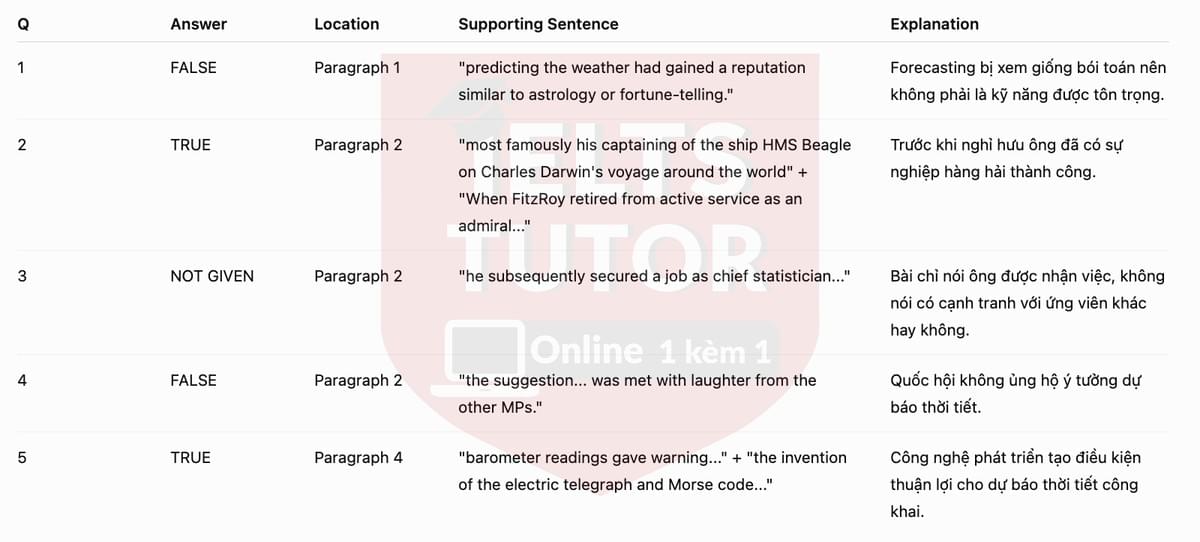
1 In Robert FitzRoy's time, weather forecasting was a respected skill.
2 When FitzRoy retired from the navy, he had already had a successful career at sea.
3 FitzRoy faced competition from other applicants for the chief statistician's job.
4 The British Parliament supported the idea of regular weather forecasts in 1854.
5 Progress in technology made it a good time for publicly available weather forecasting to begin. >> 🔥 IELTS TUTOR gợi ý tham khảo CẦN VIẾT & THU ÂM BAO NHIÊU BÀI ĐỂ ĐẠT 8.0 SPEAKING & 7.0 WRITING?
Questions 6–13
Complete the notes below.
Choose ONE WORD ONLY from the passage for each answer.
Write your answers in boxes 6–13 on your answer sheet.
February 1861: Storm warning service
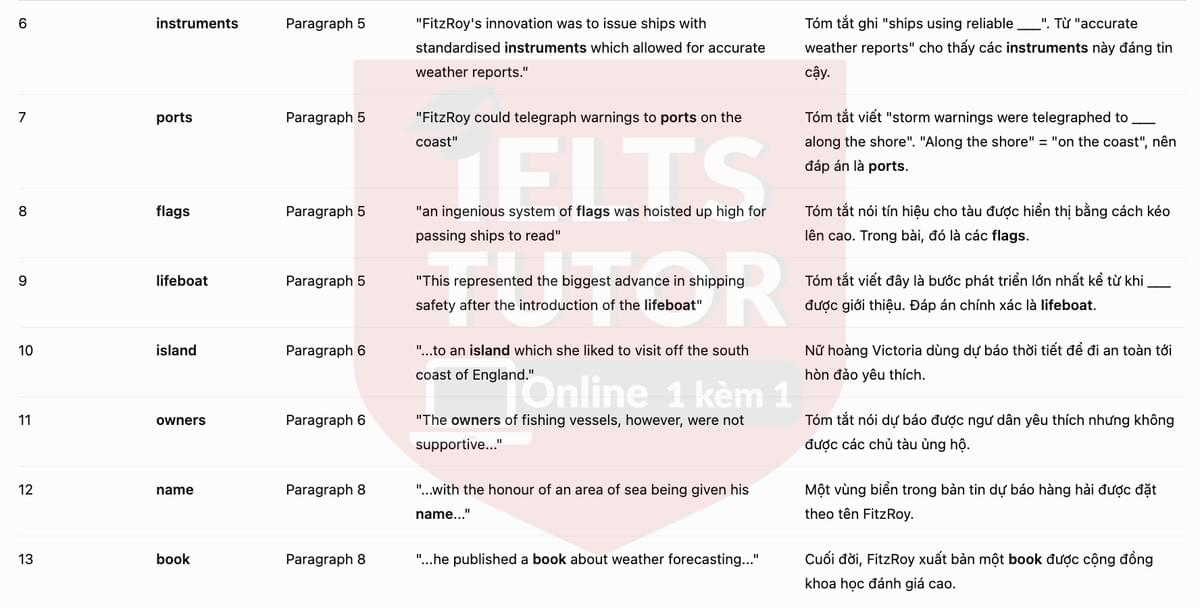
• FitzRoy received weather reports produced by ships using reliable 6 _______________.
• simultaneous weather reports were taken daily
• storm warnings were telegraphed to 7 _______________ along the shore
• signals for ships were displayed using raised 8 _______________
• the storm warning service was the greatest development in sea safety since the 9 _______________ was introduced
August 1861: Public weather forecasting service
• very popular in The Times newspaper
• frequently used by the English Queen for safe trips to a favourite 10 _______________
• FitzRoy's forecasts were popular with fishermen but not with boat 11 _______________
• in modern times FitzRoy's 12 _______________ is used for a marine area
• FitzRoy produced a 13 _______________ which was respected by the scientific community
IV. Dịch bài đọc The Origins of Weather Forecasting
V. Giải thích từ vựng The Origins of Weather Forecasting
VI. Giải thích cấu trúc ngữ pháp khó The Origins of Weather Forecasting
VII. Đáp án The Origins of Weather Forecasting
1. FALSE
2. TRUE
3. NOT GIVEN
4. FALSE
5. TRUE
6. instruments
7. ports
8. flags
9. lifeboat
10. island
11. owners
12. name
13. book
📩 MN AI CHƯA CÓ ĐÁP ÁN FORECAST QUÝ MỚI PART 1-2-3 NHẮN ZL 0905834420 IELTS TUTOR GỬI FREE HẾT NHA

Các khóa học IELTS online 1 kèm 1 - 100% cam kết đạt target 6.0 - 7.0 - 8.0 - Đảm bảo đầu ra - Thi không đạt, học lại FREE
>> Thành tích học sinh IELTS TUTOR với hàng ngàn feedback được cập nhật hàng ngày
