
IELTS TUTOR cung cấp The Power of Smell - Đề luyện tập IELTS READING (IELTS Reading Practice Test) - Làm bài online format computer-based, kèm đáp án, dịch & giải thích từ vựng - cấu trúc ngữ pháp khó & GIẢI ĐÁP ÁN VỚI LOCATION
I. Kiến thức liên quan
II. Làm bài online (kéo xuống cuối bài blog để xem giải thích từ vựng & cấu trúc cụ thể hơn)
IELTS Reading Test - The Power of Smell
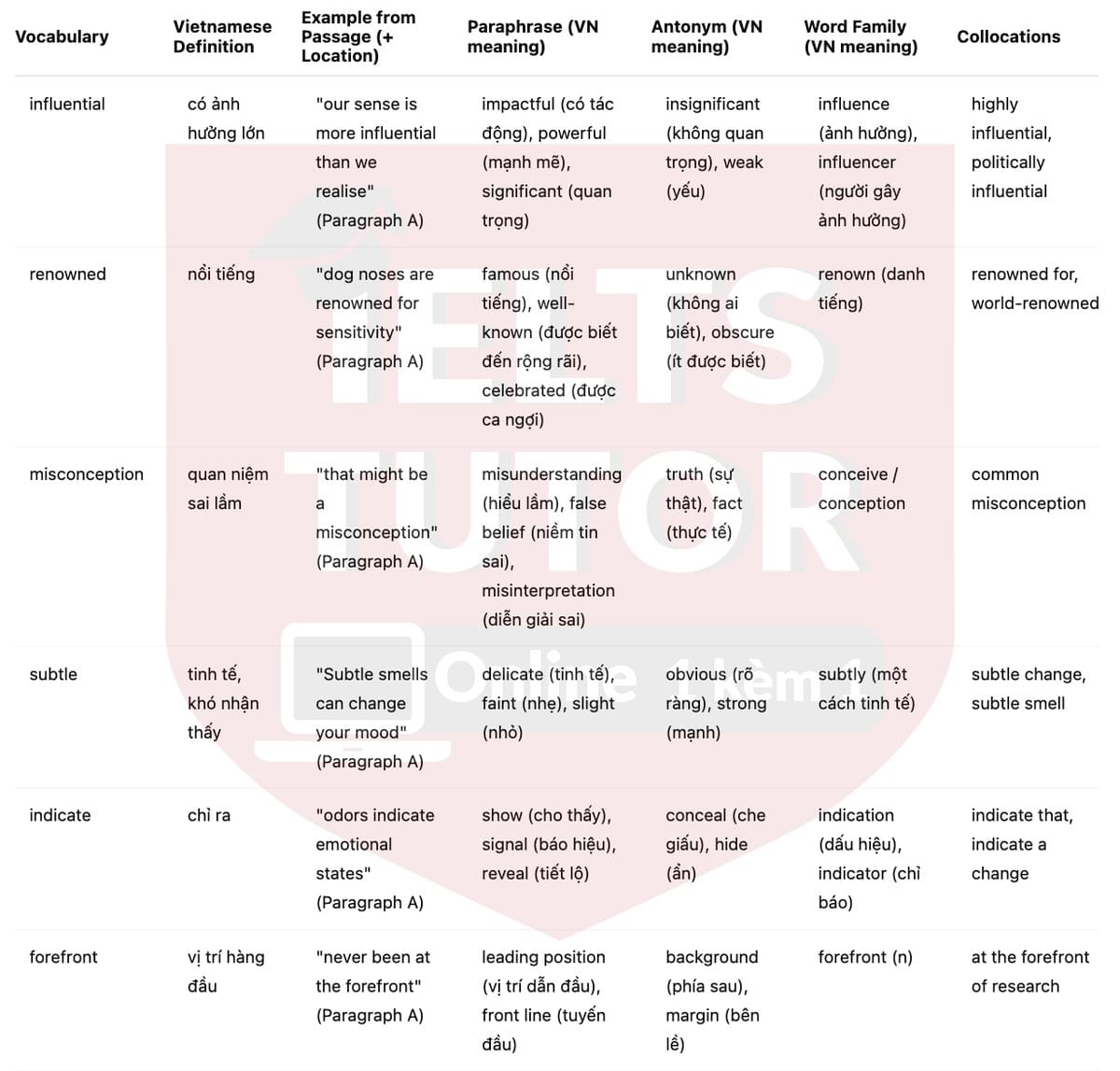
Research shows that our olfactory sense is more influential than we realise.
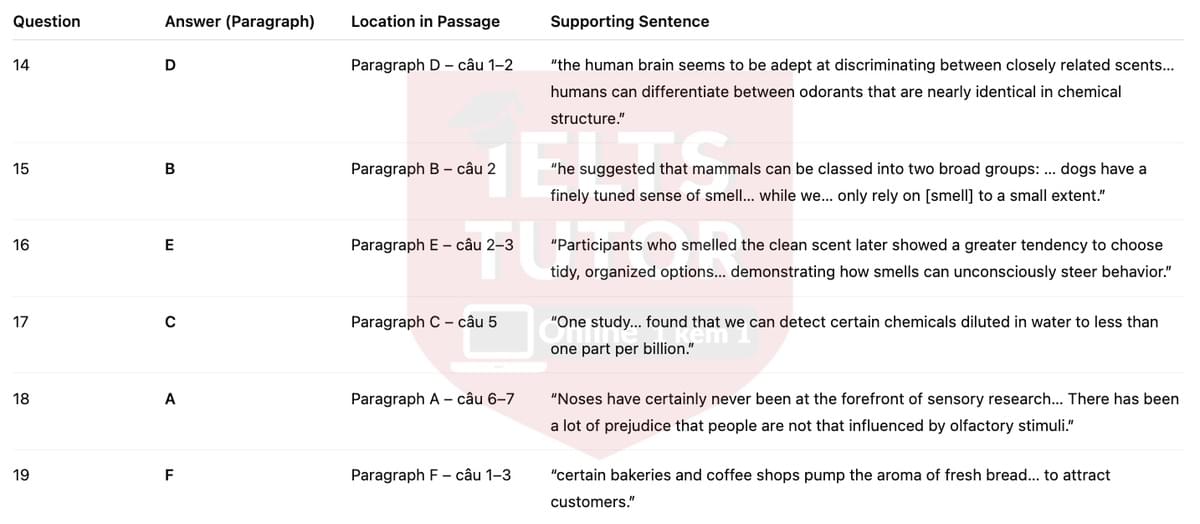
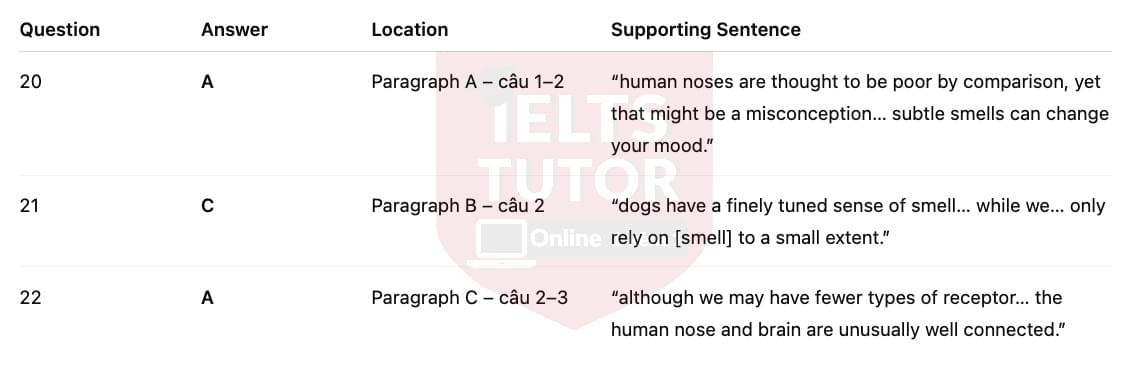
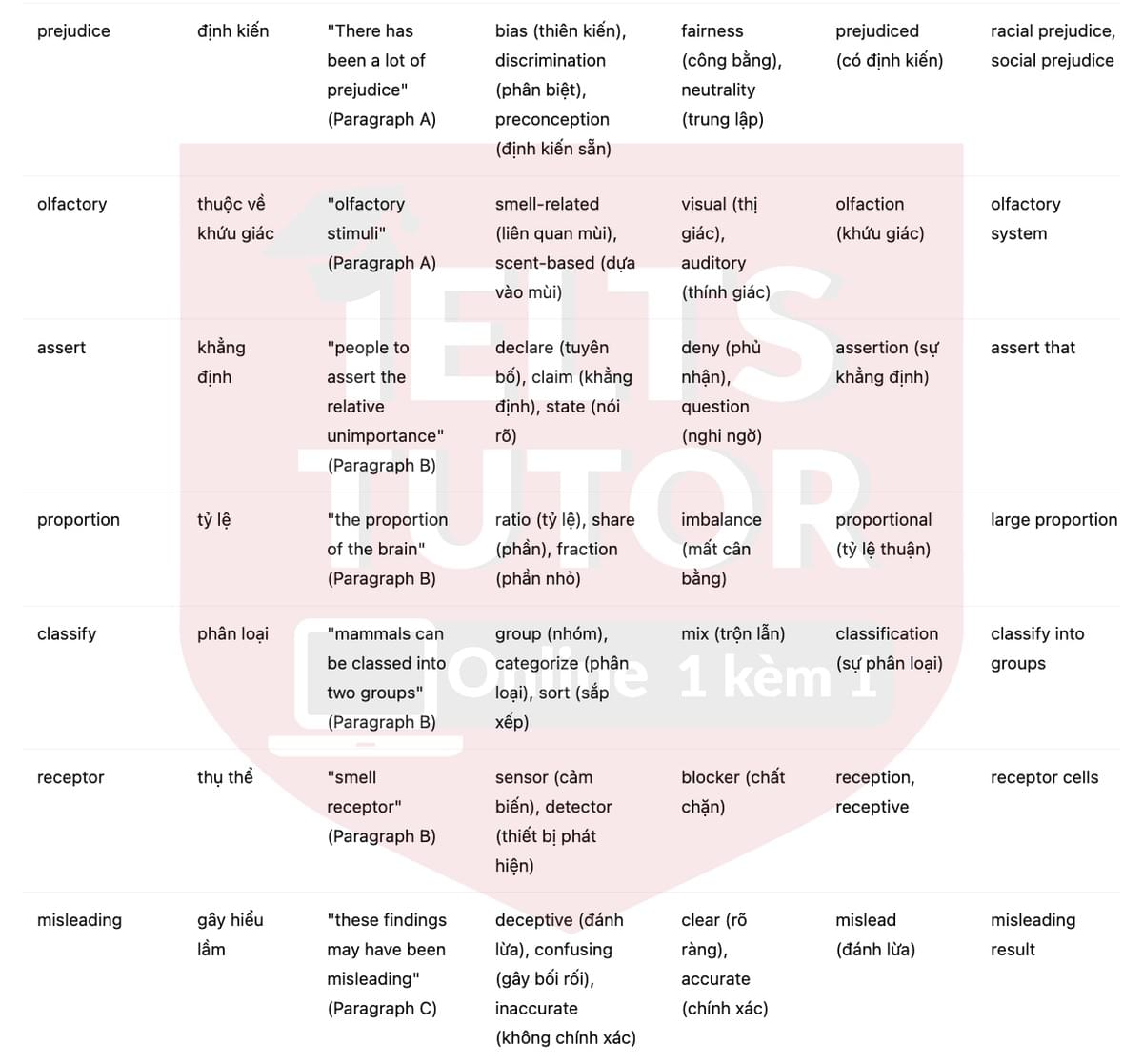
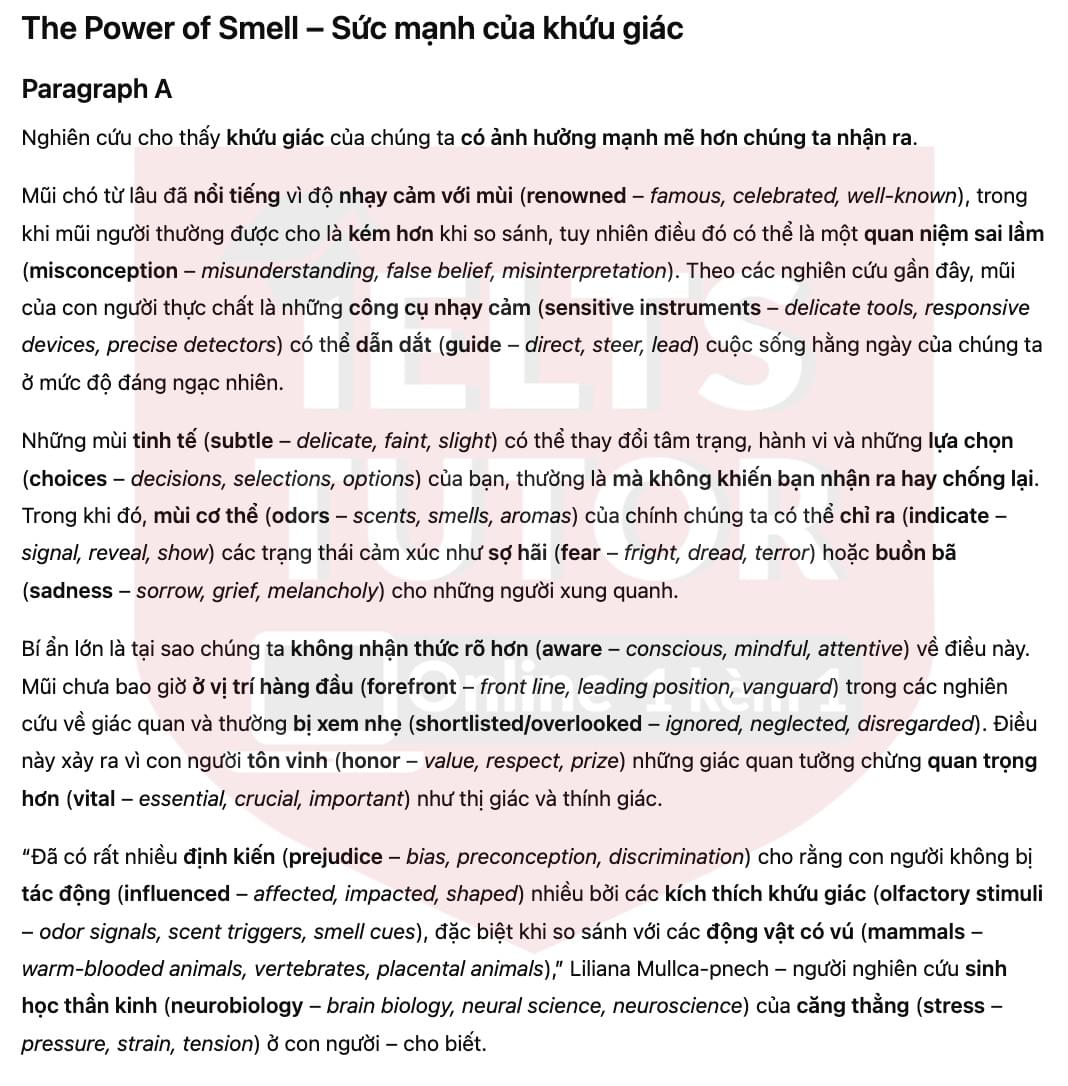
A. Dog noses are renowned for sensitivity to smells, while human noses are thought to be poor by comparison, yet that might be a misconception. According to recent studies, our noses are in fact exquisitely sensitive instruments that guide our everyday life to a surprising extent. Subtle smells can change your mood, behaviour and the choices you make, often without you realising it. Our own odours, meanwhile, indicate emotional states such as fear or sadness to those around us. The big mystery is why we aren't more aware of our noses' abilities. Noses have certainly never been at the forefront of sensory research, and were overlooked until recently in favour of the seemingly more vital senses of sight and hearing. 'There has been a lot of prejudice that people are not that influenced by olfactory stimuli, especially compared to other mammals,' says Lilianne Mujica-Parodi, who studies the neurobiology of human stress at Stony Brook University in New York, in the United States.
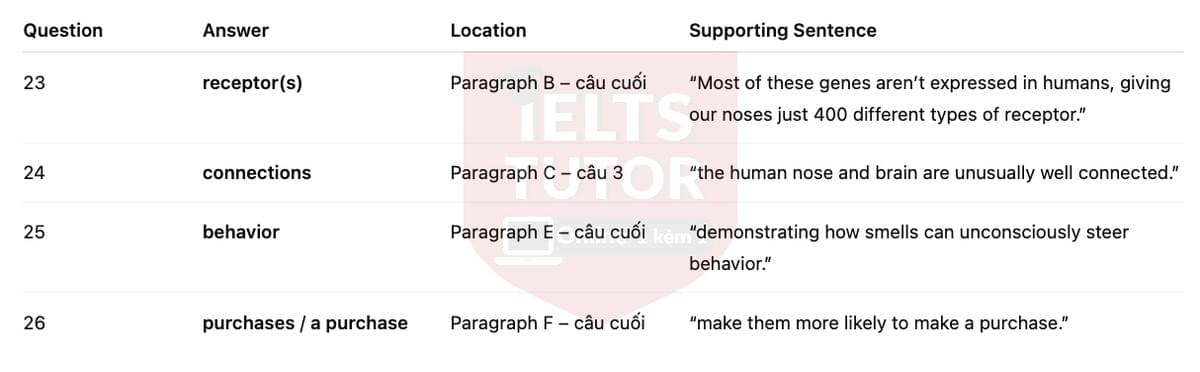
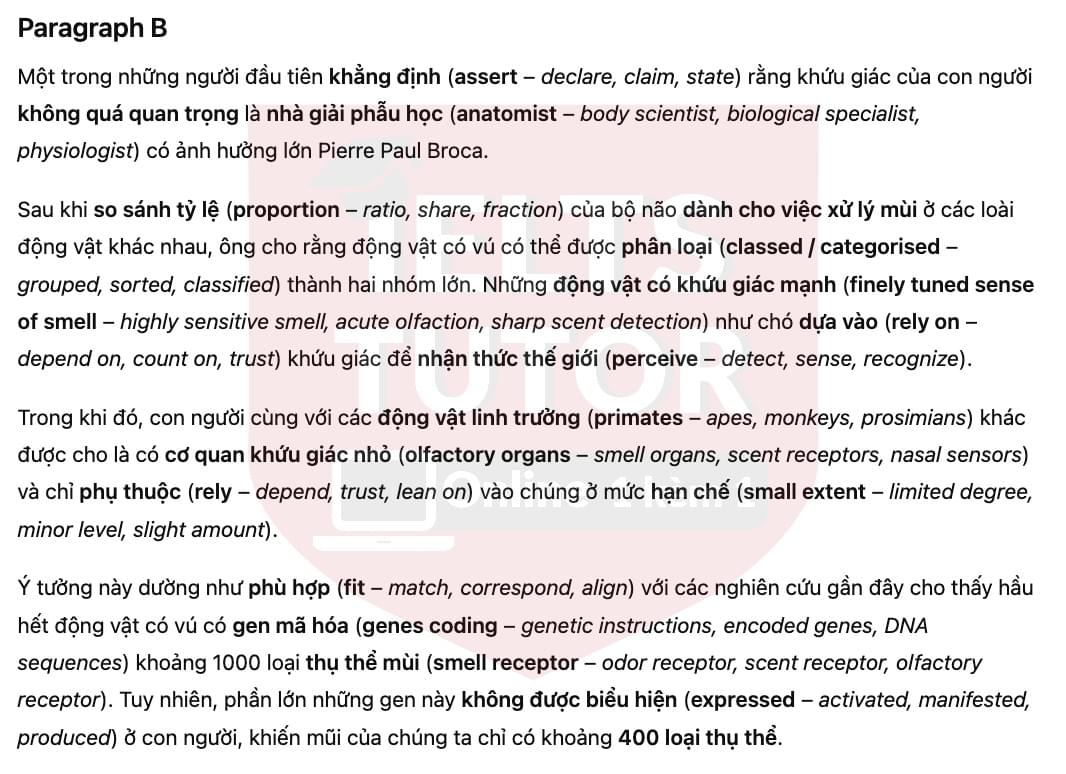
B. One of the first people to assert the relative unimportance of human smelling was Pierre Paul Broca, an influential 19th-century anatomist. After comparing the proportion of the brain devoted to smell in different animals, he suggested that mammals can be classed into two broad groups: macrosmatic mammals, such as dogs, have a finely tuned sense of smell which they rely on to perceive the world; while we, along with other primates and the aquatic mammals, are microsmatic – so dependent on our other senses that smell only plays a minor role. That idea seemed to fit with more recent studies which found that the majority of mammals have genes coding for about 1000 different types of smell receptor. Most of these genes aren't expressed in humans, giving our noses just 400 different types of receptor.
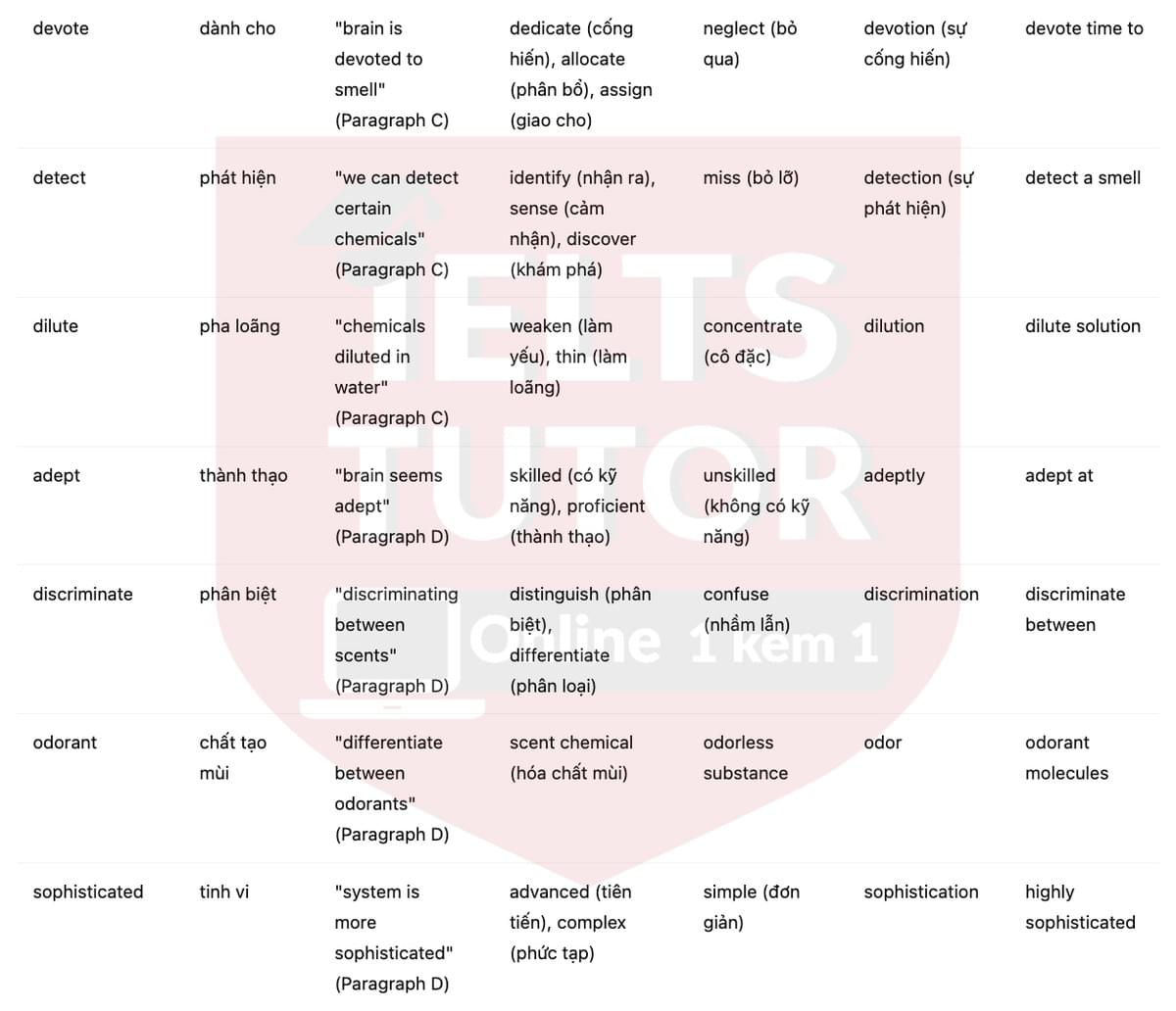
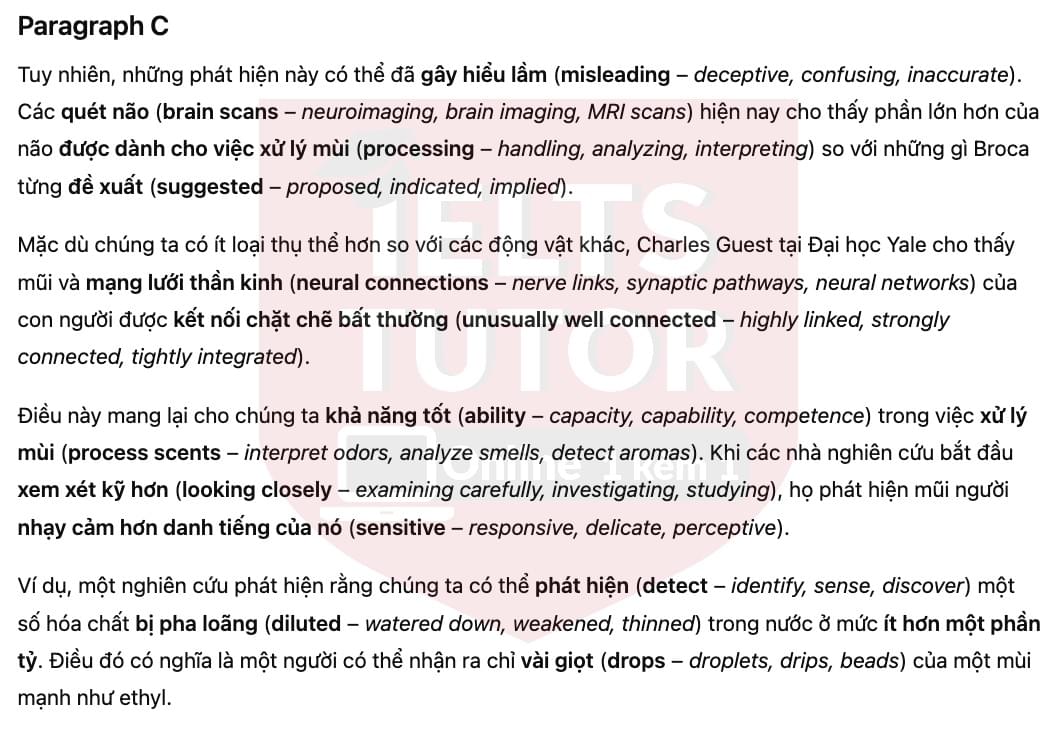
C. Yet these findings may have been misleading. Brain scans now show that more of the brain is devoted to smell processing than Broca's anatomic studies suggested. And although we may have fewer types of receptor than other mammals, Charles Zuker at Columbia University in the United States has shown that the human nose and brain are unusually well connected, with each group of receptors linking to many more neurons than is the case in other animals. That should give us a good ability to process incoming scents. Once researchers began looking, they found the nose to be far more sensitive than its reputation suggested. One study, for instance, found that we can detect certain chemicals diluted in water to less than one part per billion. That means that a person can detect just a few drops of a strong smell like ethyl mercaptan in an Olympic-sized swimming pool.
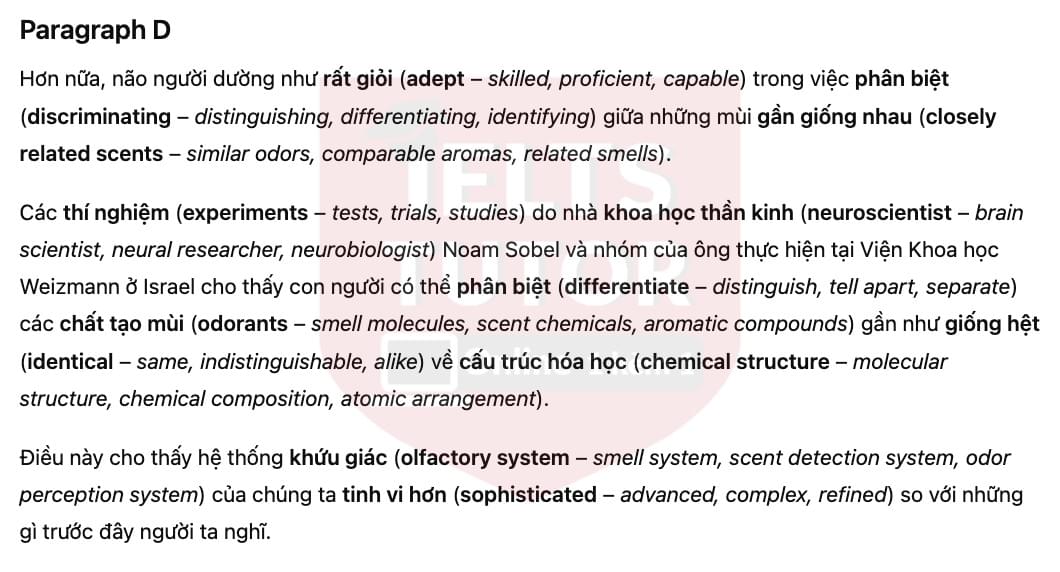
D. Moreover, the human brain seems to be adept at discriminating between closely related scents. Experiments conducted by neuroscientist Noam Sobel and his team at the Weizmann Institute of Science in Israel revealed that humans can differentiate between odorants that are nearly identical in chemical structure. This suggests that our olfactory system is more sophisticated than previously credited.
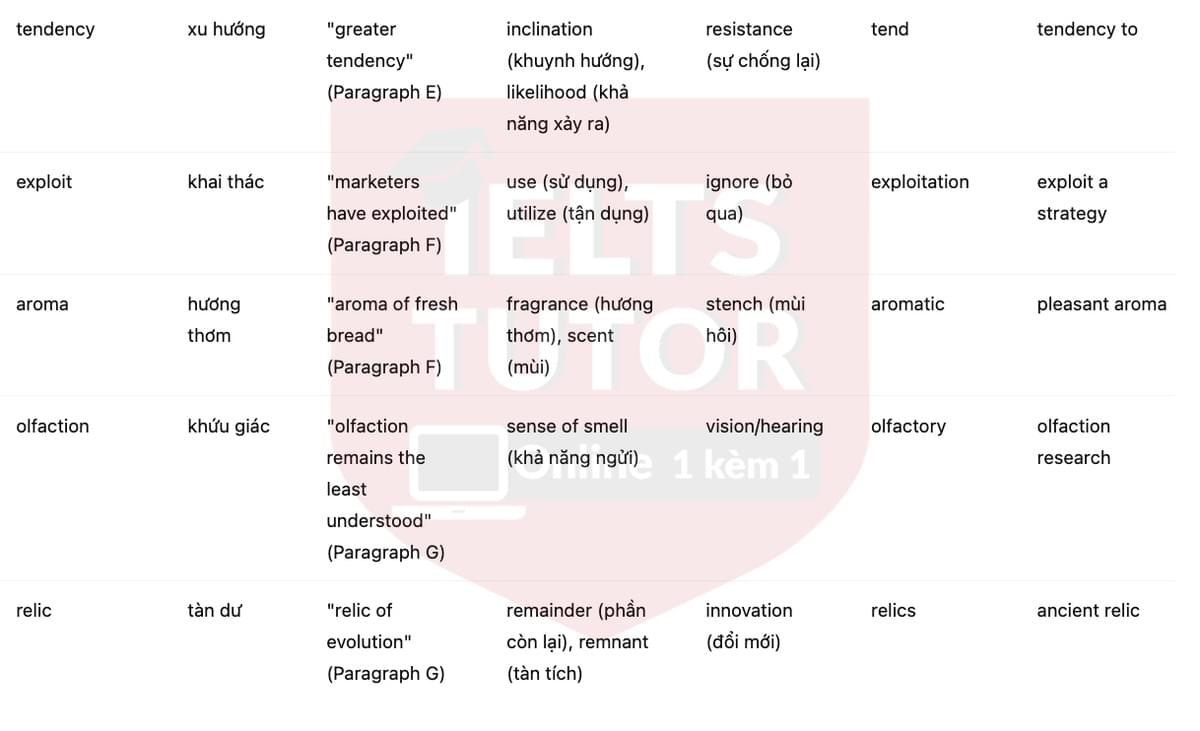
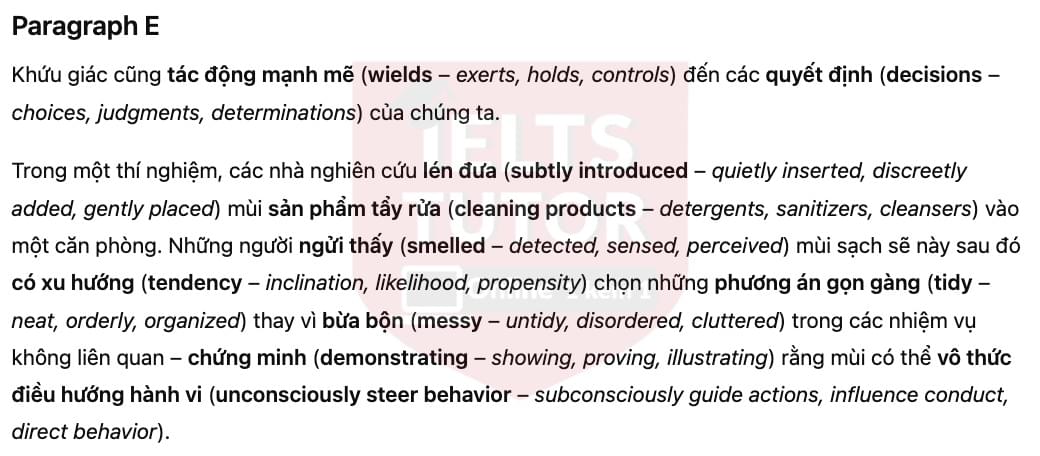
E. Smell also wields subtle power over our decisions. In one experiment, researchers subtly introduced the scent of cleaning products into a room. Participants who smelled the clean scent later showed a greater tendency to choose tidy, organized options over messy ones in unrelated tasks – demonstrating how smells can unconsciously steer behavior. Interestingly, in some cases, certain smells could negatively affect choices by creating discomfort or distraction.
F. Marketers have long exploited this link between smell and psychology. For instance, certain bakeries and coffee shops pump the aroma of fresh bread or roasted coffee beans into the air near their entrances to attract customers. The pleasant smell not only draws people in but can also make them more likely to make a purchase, proving scent's role as a silent salesperson.
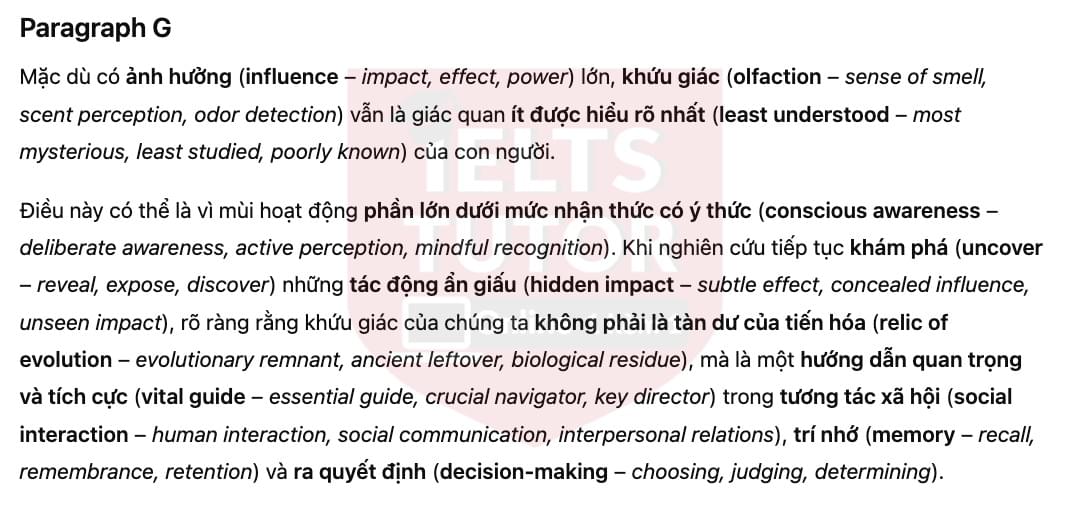
G. Despite its influence, olfaction remains the least understood of the human senses. This may be because smell operates largely below the level of conscious awareness. As research continues to uncover its hidden impact, it becomes clear that our sense of smell is not a relic of evolution, but a vital, active guide in social interaction, memory, and decision-making.
Reading Passage 2 has seven paragraphs, A-G. Which paragraph contains the following information? Choose the correct letter, A-G, in boxes 14-19.
* Write the paragraph letter (A, B, C, D, E, F, or G)
Choose the correct letter, A, B, C, or D.
Complete the summary below. Choose NO MORE THAN TWO WORDS from the passage for each answer.
* Write your answers exactly as they appear in the passage
📩 MN AI CHƯA CÓ ĐÁP ÁN FORECAST QUÝ MỚI PART 1-2-3 NHẮN ZL 0905834420 IELTS TUTOR GỬI FREE HẾT NHA
III. The Power of Smell: Đề luyện tập IELTS READING (IELTS Reading Practice Test)
PASSAGE 2
Read the text and answer questions 14-26
The Power of Smell
Research shows that our directory sense is more influential than we realise.
A dog noses are renowned for sensitivity to smells, which human noses are thought to be poor by comparison, yet that might be a misconception. According to recent studies, dog noses are in fact easily sensitive instruments that guide our everyday life to a surprising extent. Subtle smells can change your mood, behaviour and the choices you make, often without you resisting it. Our own odorss meanwhile, indicate emotional states such as fear or sadness to those around us. The big mystery is why we aren’t more aware of our nests differently. Noses have certainly never been at the forefront of sensory reasons, and were shortlisted asked until recently. In honor of the seemingly more vital senses of adults and hearth: ‘There has been a lot of prejudice that people are not that influenced by olfactory stimuli, especially compared to other mammals,’ says Liliana Mullca-pnech, who studies the neurobiology of human stress at Story Book University in New York, in the United States.
B One of the first people to assert the relative unimportance of human sensing was Pierre Paul Broca, an influential 1801-century anatomist. After comparing the proportion of the brain devoted to smell in different animals, he suggested that mammals can be classed into two broad groups: monoclinic mammals, such as dogs, have a finely tuned sense of smell which they rely on to perceive the world while we, along with other primates and the mature animals, are interconnected to these small olfactory organs that we only rely on to a small extent. That idea seemed to fit with more recent studies which found that the majority of mammals have genes coding for about 1000 different types of smell receptor. Most of these genes aren’t expressed in humans, giving our noses just 400 different types of receptor.
>> 🔥 Form đăng kí giải đề thi thật IELTS 4 kĩ năng kèm bài giải bộ đề 100 đề PART 2 IELTS SPEAKING quý đang thi (update hàng tuần) từ IELTS TUTOR
C Yet these findings may have been misleading. Brain scans now show that more of the brain is devoted to smell processing than Broca’s anatomic studies suggested. And although we may have fewer types of receptor than other mammals, Charles Guest et Yale University in the United States has shown that the human nose and strain are unusually well connected, with each group of receptors linking to many more enzymes that is the case in other animals. That should give us a good ability to process incoming scents. Once researchers began looking, they found the nose to be far more sensitive than its reputation suggested. One study, for example, found that we can detect certain chemicals diluted in water to less than one part per billion. That means that a person can detect just a few drops of a strong smell like ethyl.
D
Moreover, the human brain seems to be adept at discriminating between closely related scents. Experiments conducted by neuroscientist Noam Sobel and his team at the Weizmann Institute of Science in Israel revealed that humans can differentiate between odorants that are nearly identical in chemical structure. This suggests that our olfactory system is more sophisticated than previously credited.
E
Smell also wields subtle power over our decisions. In one experiment, researchers subtly introduced the scent of cleaning products into a room. Participants who smelled the clean scent later showed a greater tendency to choose tidy, organized options over messy ones in unrelated tasks—demonstrating how smells can unconsciously steer behavior.
F
Marketers have long exploited this link between smell and psychology. For instance, certain bakeries and coffee shops pump the aroma of fresh bread or roasted coffee beans into the air near their entrances to attract customers. The pleasant smell not only draws people in but can also make them more likely to make a purchase, proving scent’s role as a silent salesperson. >> 🔥 Nhắn zalo 0905834420 join group zalo Hóng đề thi máy 4 skills để cập nhật đề thi thật 4 kĩ năng hằng ngày [Kèm giải & đề làm online]
G
Despite its influence, olfaction remains the least understood of the human senses. This may be because smell operates largely below the level of conscious awareness. As research continues to uncover its hidden impact, it becomes clear that our sense of smell is not a relic of evolution, but a vital, active guide in social interaction, memory, and decision-making.
Questions 14-19
Reading Passage 2 has seven paragraphs, A-G. Which paragraph contains the following information? Choose the correct letter, A-G, in boxes 14-19.
a finding that humans can distinguish between two extremely similar substances
a categorisation of species according to their sensitivity to smell
an instance where smell negatively affected people’s ability to make choices
a study that proved humans could perceive a tiny quantity of a substance
an observation that studies of the sense of smell have been undervalued
an example of using smell to prompt people to buy something
Questions 20–22
Choose the correct letter, A, B, C, or D.
What does the writer suggest about human and dog noses in Paragraph A?
A) Human noses are more sensitive than is commonly believed.
B) Dog noses are less sensitive than scientific studies show.
C) Human noses are poor compared to most mammals.
D) Dog noses are only good for detecting strong smells.According to Paragraph B, what did Broca believe about humans and smell?
A) Humans have more smell receptors than other primates.
B) Humans rely on smell as much as dogs do.
C) Humans’ sense of smell is less developed than that of many mammals.
D) Humans use smell primarily for emotional communication.What did Charles Zuker’s research reveal about human smell receptors?
A) Humans have fewer types but more neural connections per receptor group.
B) Human smell receptors are identical to those of other primates.
C) The human olfactory system is simpler than previously thought.
D) Humans cannot detect smells diluted to one part per billion. >> 🔥 IELTS TUTOR gợi ý tham khảo CẦN VIẾT & THU ÂM BAO NHIÊU BÀI ĐỂ ĐẠT 8.0 SPEAKING & 7.0 WRITING?
Questions 23–26
Complete the summary below.
Choose NO MORE THAN TWO WORDS from the passage for each answer.
Research shows that human smell is more powerful than traditionally thought. Although humans have fewer types of 23 .................... than many mammals, the brain areas for smell are larger than Broca assumed, and neural 24 .................... are more extensive. Humans can detect very diluted chemicals and distinguish between nearly identical odorants. Smells can unconsciously affect 25 ...................., as shown when the scent of cleaning products made people choose tidier options. Marketers use smells like fresh bread to encourage 26 .................... . Despite its influence, smell remains poorly understood because it often works below conscious awareness.
IV. Dịch bài đọc The Power of Smell
V. Giải thích từ vựng The Power of Smell
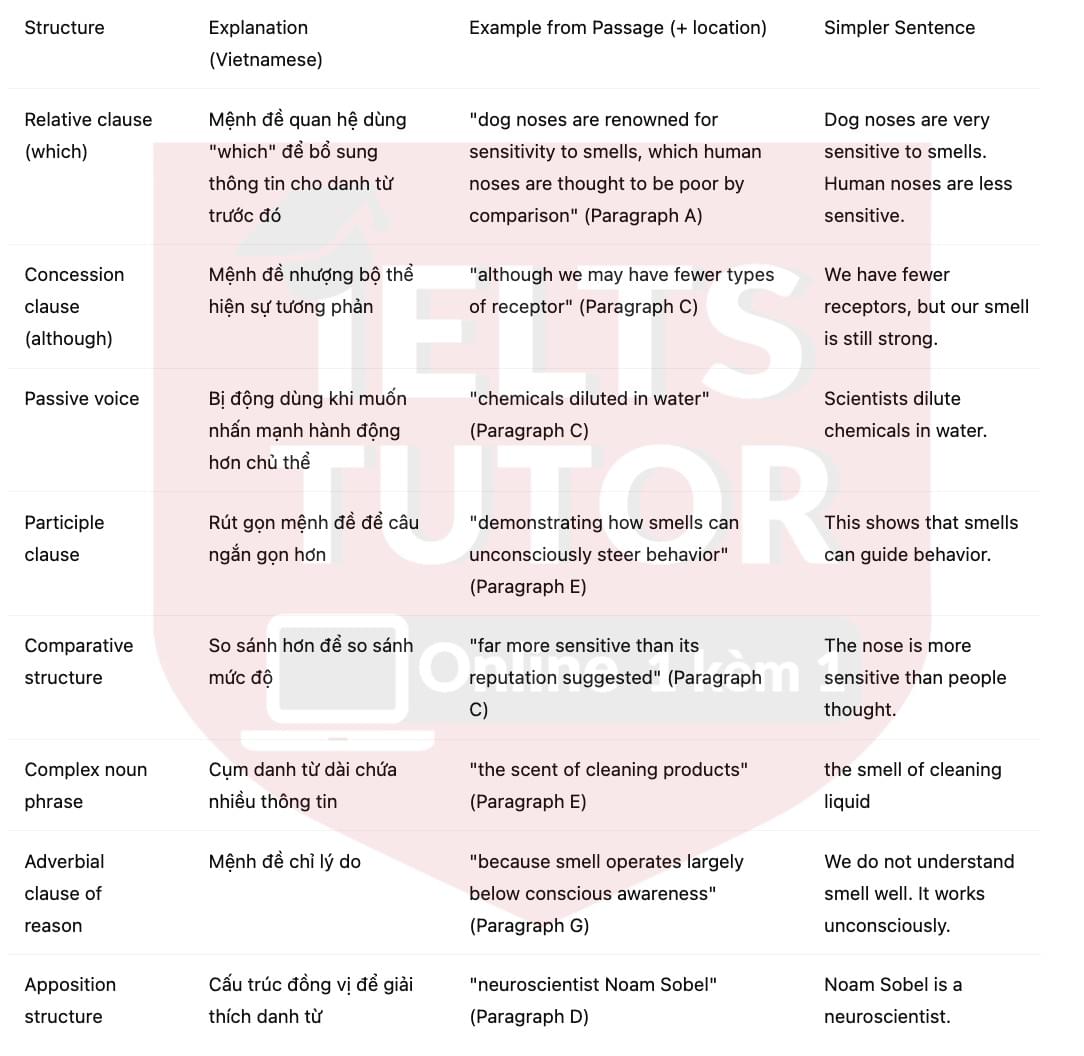
VI. Giải thích cấu trúc ngữ pháp khó The Power of Smell
VII. Đáp án The Power of Smell
14 D
15 B
16 E
17 C
18 A
19 F
20 A
21 C
22 A
23 receptors
24 connections
25 behavior
26 purchase
📩 MN AI CHƯA CÓ ĐÁP ÁN FORECAST QUÝ MỚI PART 1-2-3 NHẮN ZL 0905834420 IELTS TUTOR GỬI FREE HẾT NHA
Các khóa học IELTS online 1 kèm 1 - 100% cam kết đạt target 6.0 - 7.0 - 8.0 - Đảm bảo đầu ra - Thi không đạt, học lại FREE
>> Thành tích học sinh IELTS TUTOR với hàng ngàn feedback được cập nhật hàng ngày
