
IELTS TUTOR cung cấp The return of the black-footed ferret Đề luyện tập IELTS READING (IELTS Reading Practice Test) - Làm bài online format computer-based, kèm đáp án, dịch & giải thích từ vựng - cấu trúc ngữ pháp khó & GIẢI ĐÁP ÁN VỚI LOCATION
I. Kiến thức liên quan
📩 MN AI CHƯA CÓ ĐÁP ÁN FORECAST QUÝ MỚI PART 1-2-3 NHẮN ZL 0905834420 IELTS TUTOR GỬI FREE HẾT NHA
II. Làm bài online (kéo xuống cuối bài blog để xem giải thích từ vựng & cấu trúc cụ thể hơn)
📘 IELTS Reading Test — The return of the black-footed ferret
The return of the black-footed ferret
The rise, fall, and rise of one of North America's rarest mammals
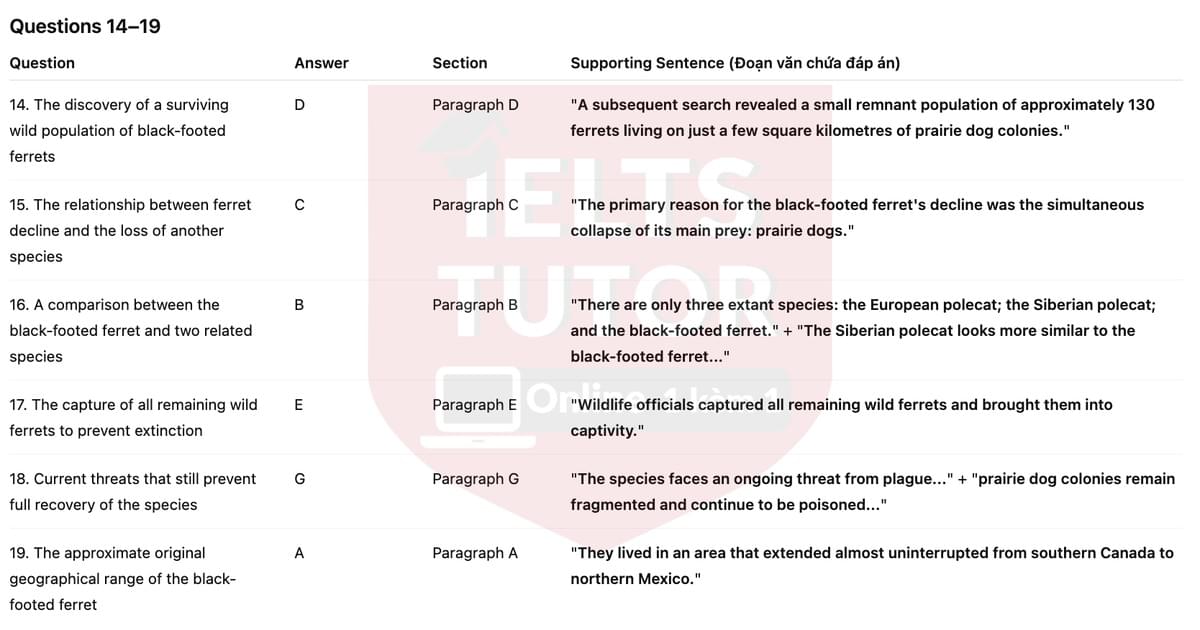
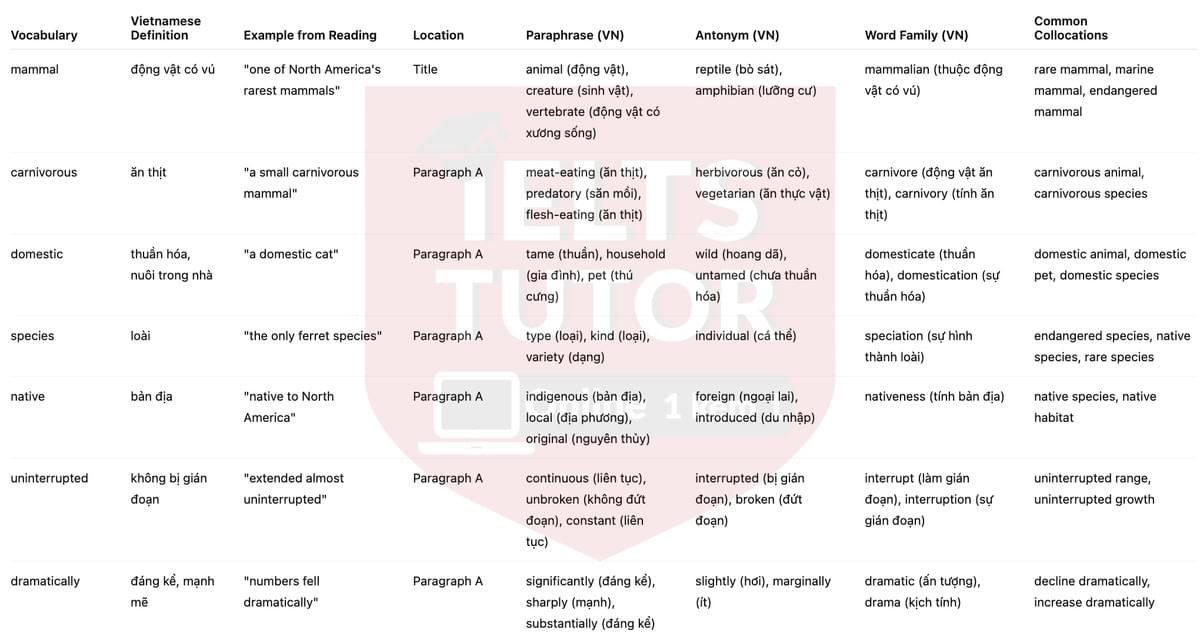
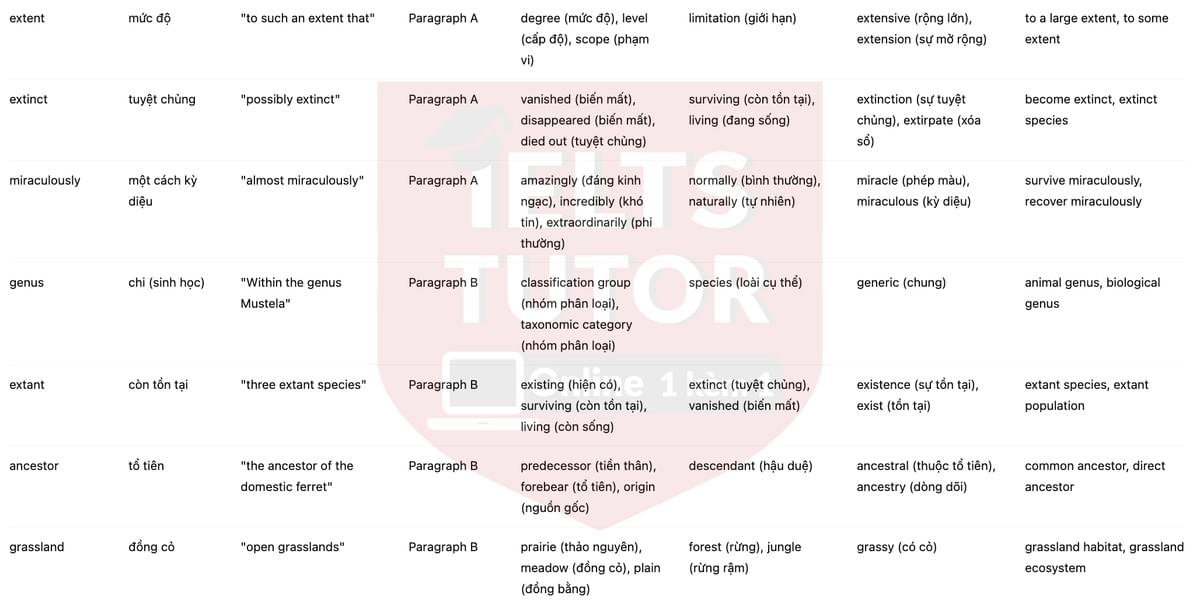
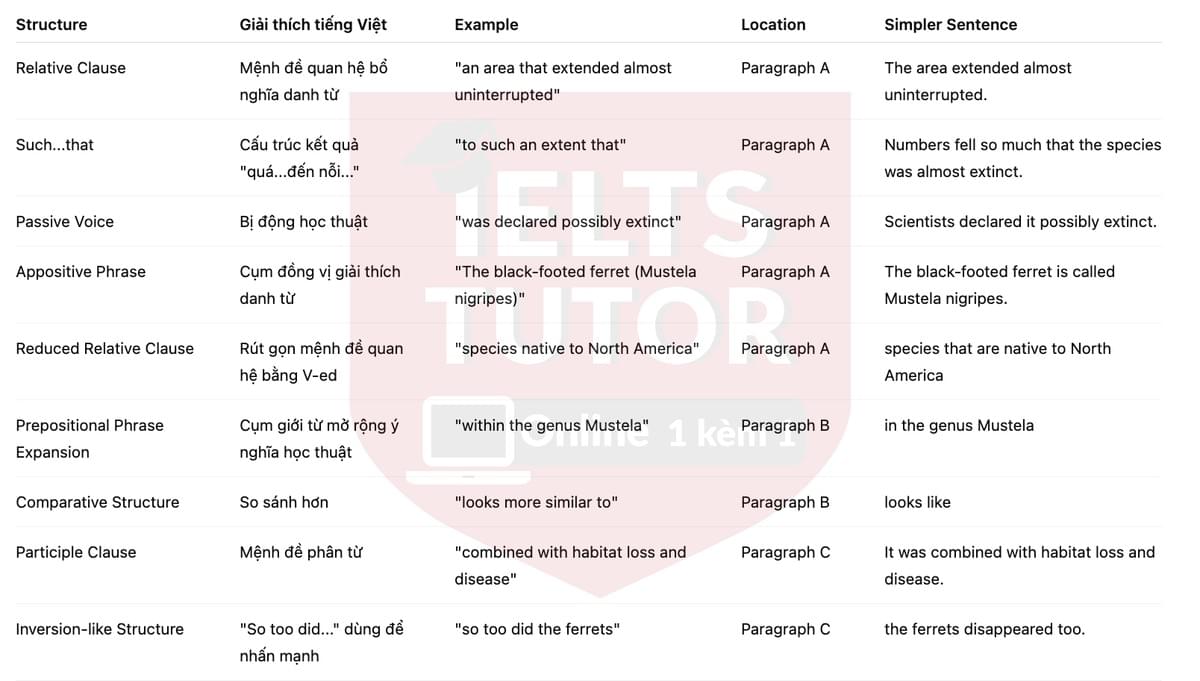
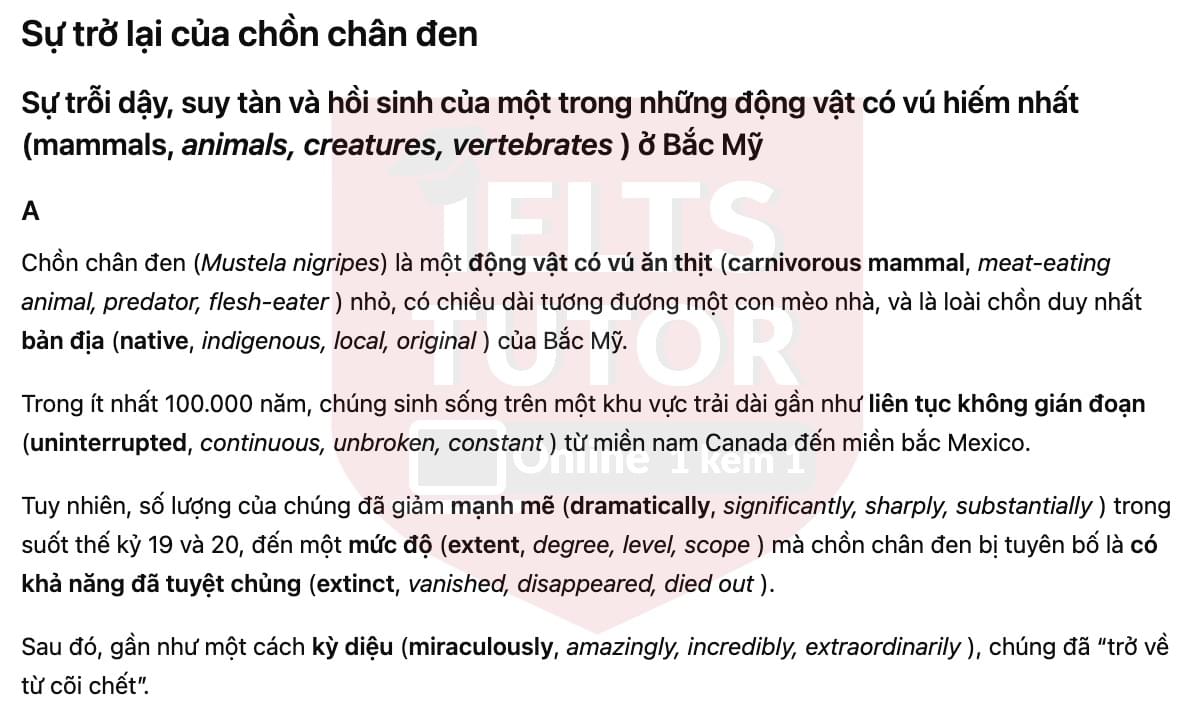
A The black-footed ferret (Mustela nigripes) is a small carnivorous mammal, similar in length to a domestic cat, and is the only ferret species native to North America. For at least 100,000 years they lived in an area that extended almost uninterrupted from southern Canada to northern Mexico. But numbers fell dramatically throughout the 19th and 20th centuries, to such an extent that the black-footed ferret was declared 'possibly extinct'. Then, almost miraculously, it returned from the dead.
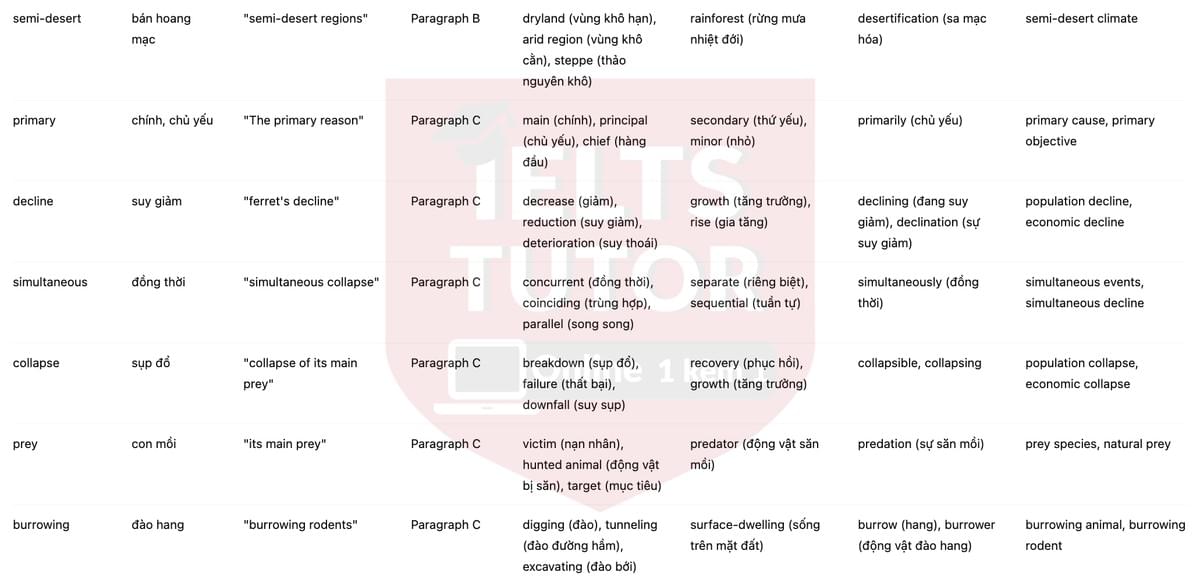
B Within the genus Mustela, the ferret belongs to the subgenus Putorius, of which there are only three extant species: the European polecat; the Siberian polecat; and the black-footed ferret. The European polecat lives in open forests and meadows, and is thought to be the ancestor of the domestic ferret. The Siberian polecat looks more similar to the black-footed ferret, and leads a similar life on open grasslands and semi-desert regions across Russia, China and Siberia.
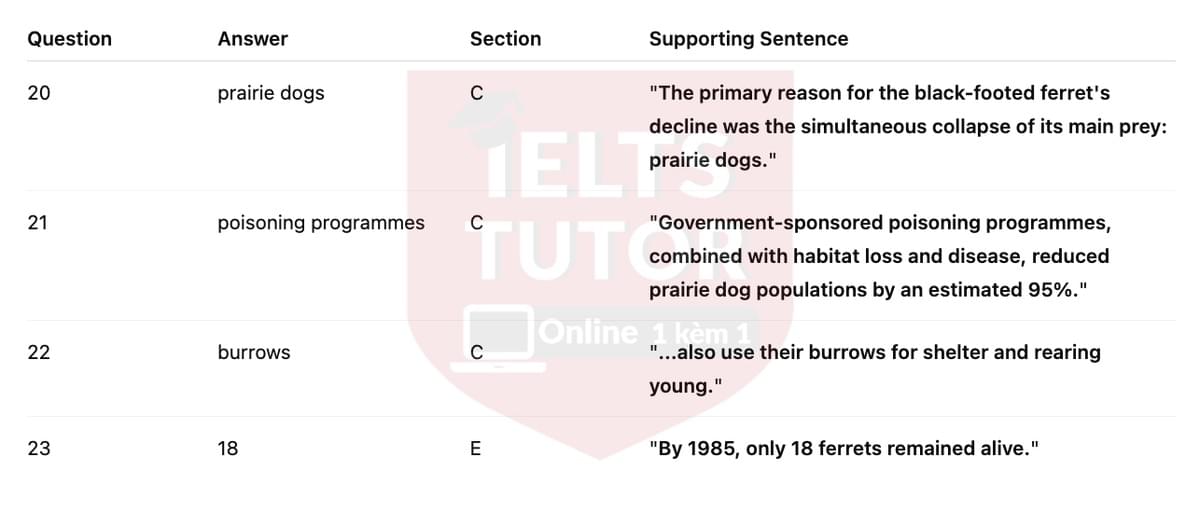
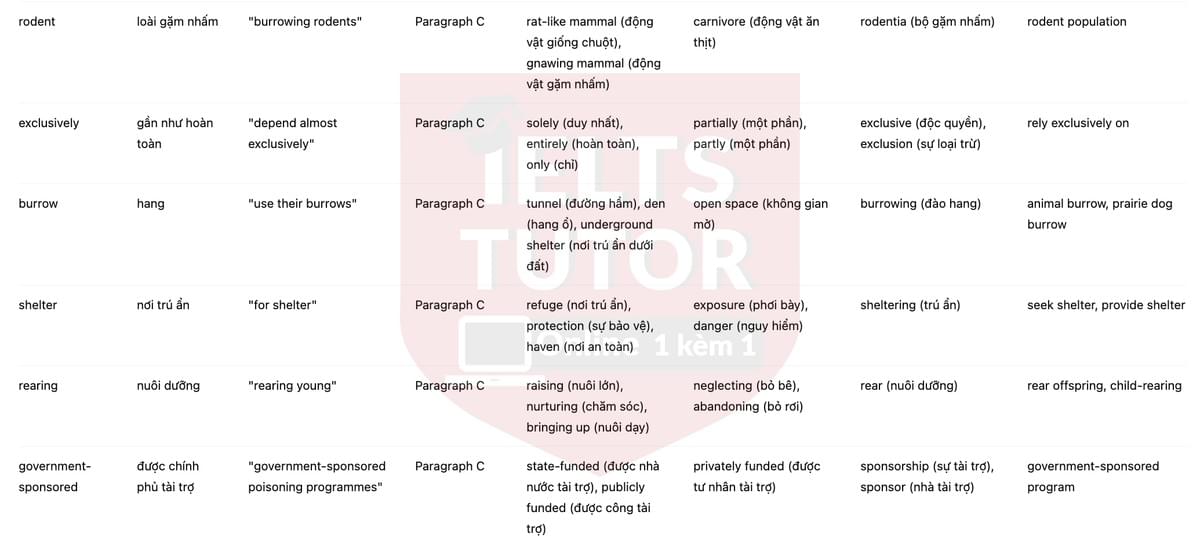
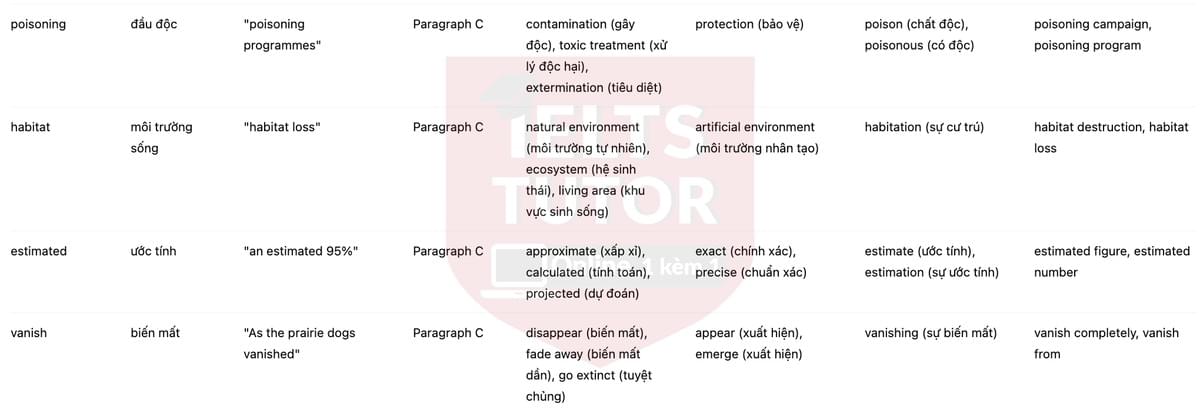
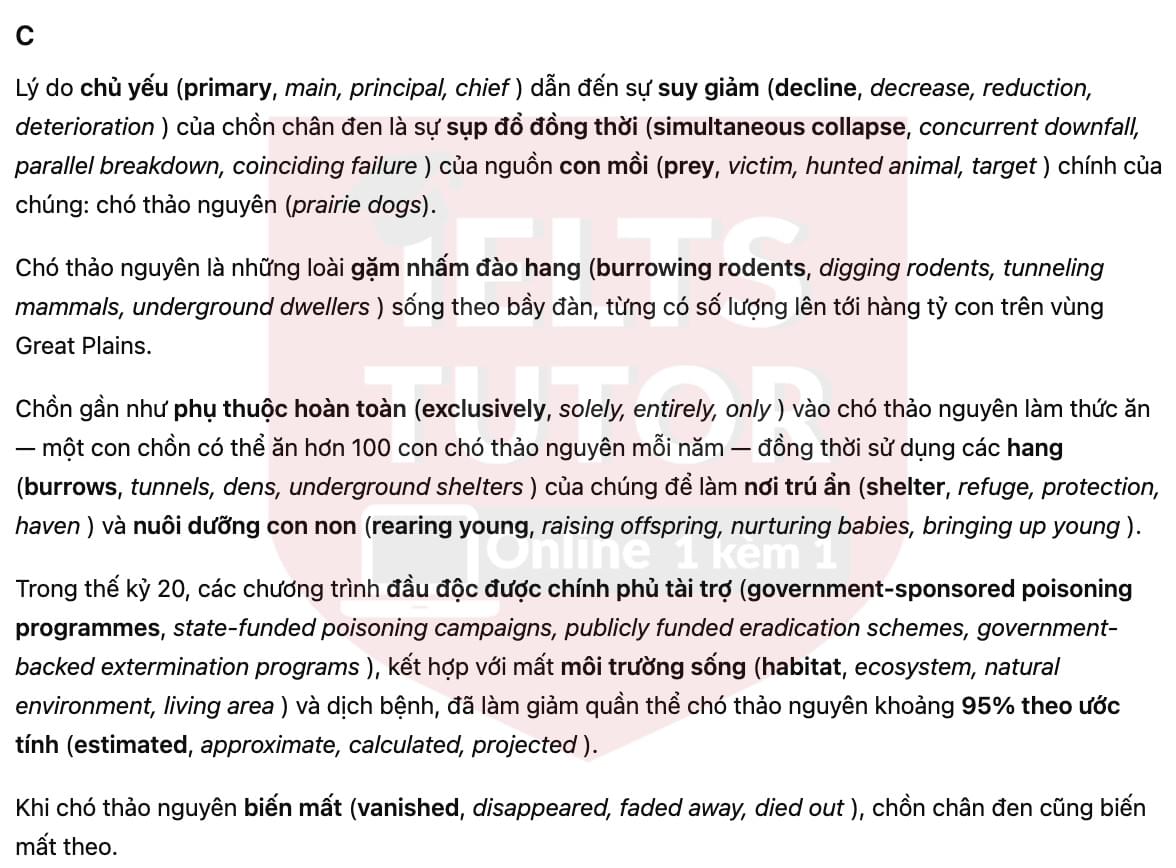
C The primary reason for the black-footed ferret's decline was the simultaneous collapse of its main prey: prairie dogs. Prairie dogs are social, burrowing rodents that once numbered in the billions across the Great Plains. Ferrets depend almost exclusively on prairie dogs for food – a single ferret may eat over 100 prairie dogs in a year – and also use their burrows for shelter and rearing young. During the 20th century, government-sponsored poisoning programmes, combined with habitat loss and disease, reduced prairie dog populations by an estimated 95%. As the prairie dogs vanished, so too did the ferrets.
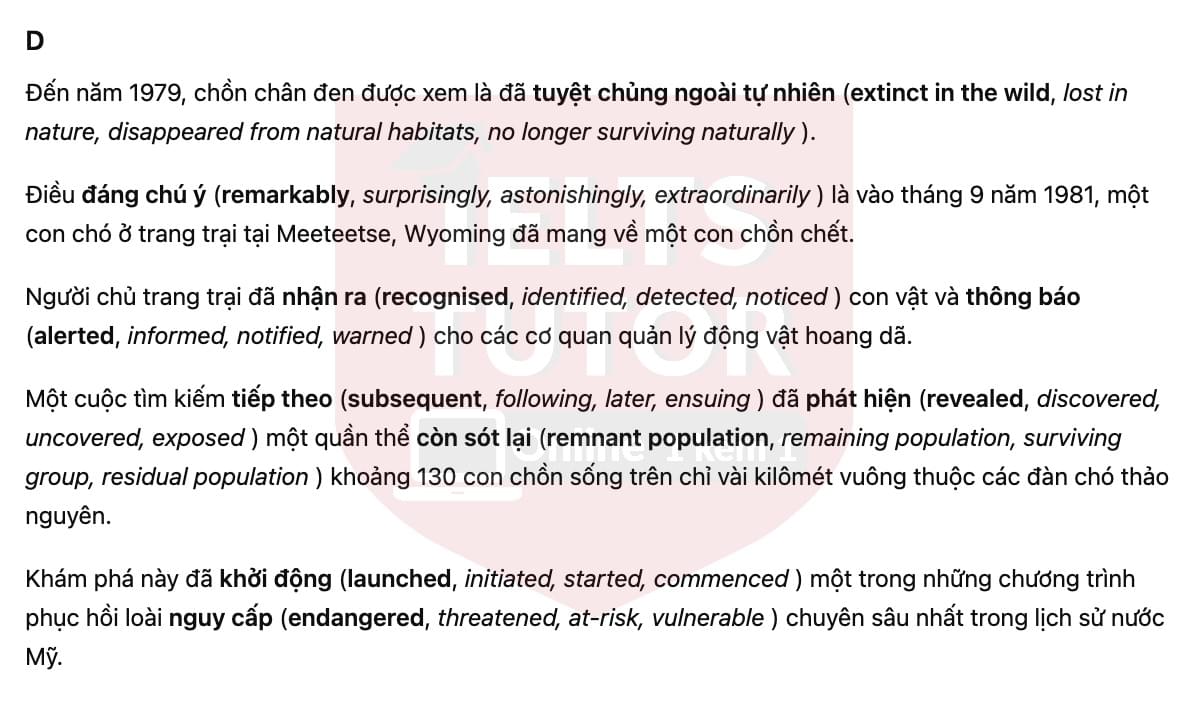
D By 1979, the black-footed ferret was widely considered extinct in the wild. Remarkably, in September 1981, a ranch dog in Meeteetse, Wyoming, brought home a dead ferret. The rancher recognised the animal and alerted wildlife authorities. A subsequent search revealed a small remnant population of approximately 130 ferrets living on just a few square kilometres of prairie dog colonies. This discovery launched one of the most intensive endangered species recovery programmes in American history.
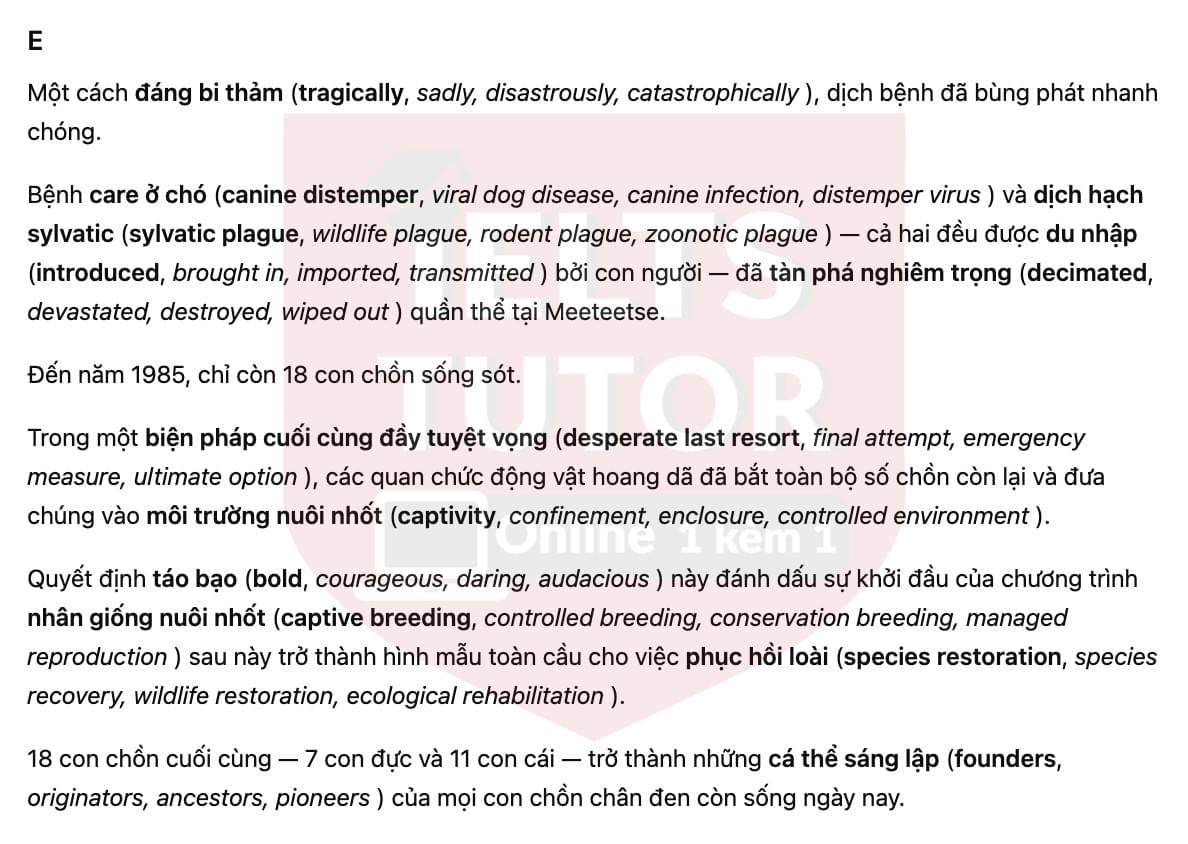
E Tragically, disease struck quickly. Canine distemper and sylvatic plague – both introduced by humans – decimated the Meeteetse population. By 1985, only 18 ferrets remained alive. In a desperate last resort, wildlife officials captured all remaining wild ferrets and brought them into captivity. This bold decision marked the beginning of a captive breeding programme that would become a global model for species restoration. The last 18 ferrets – seven males and eleven females – became the founders of every black-footed ferret alive today.
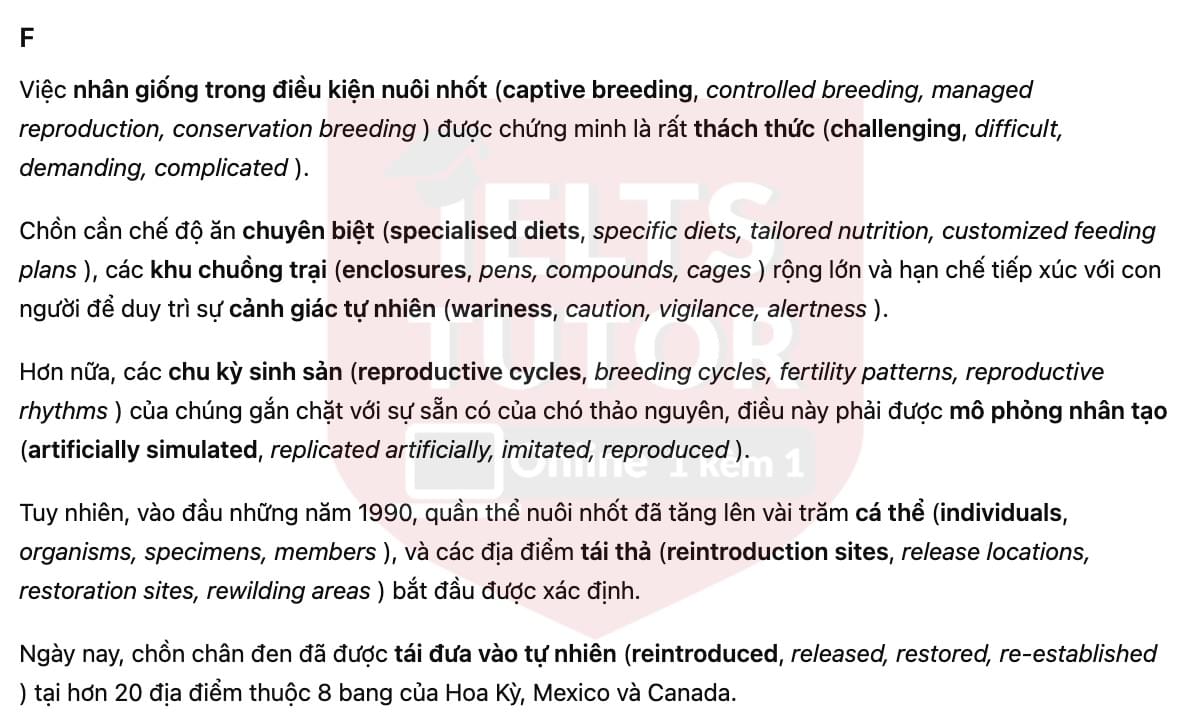
F Captive breeding proved challenging. Ferrets require specialised diets, large enclosures, and minimal human contact to retain their natural wariness. Moreover, their reproductive cycles are tightly linked to prairie dog availability, which had to be artificially simulated. By the early 1990s, however, the captive population had grown to several hundred individuals, and reintroduction sites began to be identified. Today, black-footed ferrets have been reintroduced to over 20 locations across eight US states, Mexico, and Canada, with a total wild population estimated at several hundred animals.
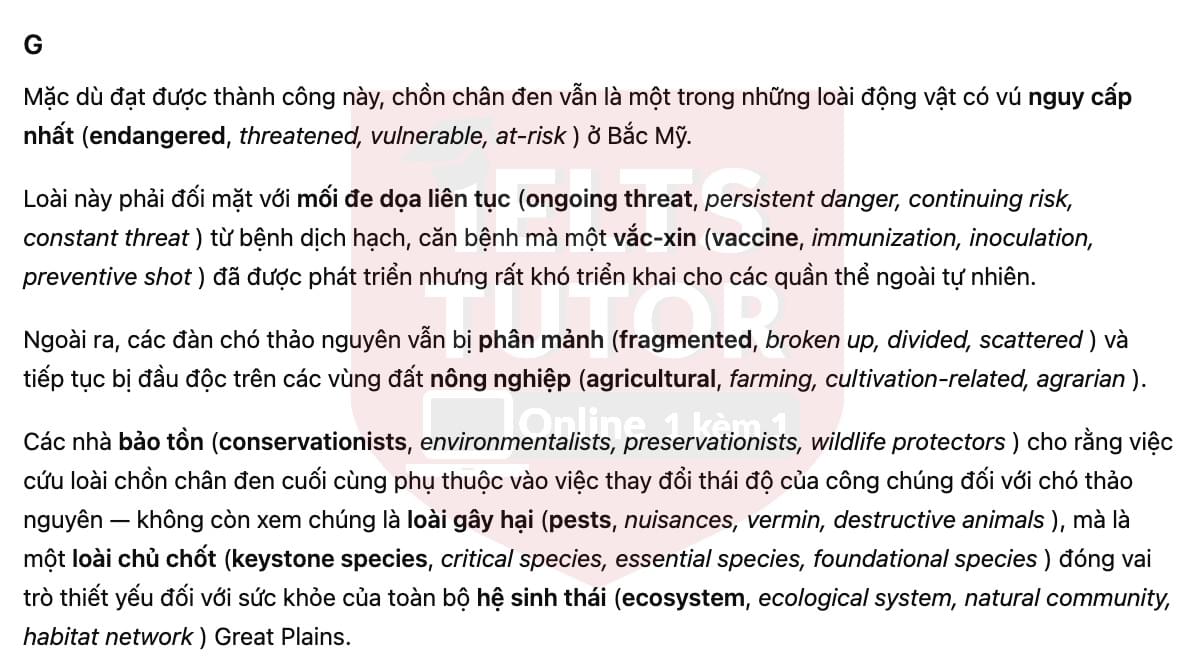
G Despite this success, the black-footed ferret remains one of the most endangered mammals in North America. The species faces an ongoing threat from plague, for which a vaccine has been developed but is difficult to deliver to wild populations. Additionally, prairie dog colonies remain fragmented and continue to be poisoned on agricultural land. Conservationists argue that saving the black-footed ferret ultimately depends on changing public attitudes towards prairie dogs – no longer viewing them as pests, but as a keystone species essential to the health of the Great Plains ecosystem.


III. The return of the black-footed ferret: Đề luyện tập IELTS READING (IELTS Reading Practice Test)
READING PASSAGE 2
You should spend about 20 minutes on Questions 14–26, which are based on Reading Passage 2 below.
The return of the black-footed ferret
The rise, fall, and rise of one of North America's rarest mammals
A The black-footed ferret (Mustela nigripes) is a small carnivorous mammal, similar in length to a domestic cat, and is the only ferret species native to North America. For at least 100,000 years they lived in an area that extended almost uninterrupted from southern Canada to northern Mexico. But numbers fell dramatically throughout the 19th and 20th centuries, to such an extent that the black-footed ferret was declared 'possibly extinct'. Then, almost miraculously, it returned from the dead.
B Within the genus Mustela, the ferret belongs to the subgenus Putorius, of which there are only three extant species: the European polecat; the Siberian polecat; and the black-footed ferret. The European polecat lives in open forests and meadows, and is thought to be the ancestor of the domestic ferret. The Siberian polecat looks more similar to the black-footed ferret, and leads a similar life on open grasslands and semi-desert regions across Russia, China and Siberia.
C The primary reason for the black-footed ferret's decline was the simultaneous collapse of its main prey: prairie dogs. Prairie dogs are social, burrowing rodents that once numbered in the billions across the Great Plains. Ferrets depend almost exclusively on prairie dogs for food – a single ferret may eat over 100 prairie dogs in a year – and also use their burrows for shelter and rearing young. During the 20th century, government-sponsored poisoning programmes, combined with habitat loss and disease, reduced prairie dog populations by an estimated 95%. As the prairie dogs vanished, so too did the ferrets.
D By 1979, the black-footed ferret was widely considered extinct in the wild. Remarkably, in September 1981, a ranch dog in Meeteetse, Wyoming, brought home a dead ferret. The rancher recognised the animal and alerted wildlife authorities. A subsequent search revealed a small remnant population of approximately 130 ferrets living on just a few square kilometres of prairie dog colonies. This discovery launched one of the most intensive endangered species recovery programmes in American history. >> 🔥 Form đăng kí giải đề thi thật IELTS 4 kĩ năng kèm bài giải bộ đề 100 đề PART 2 IELTS SPEAKING quý đang thi (update hàng tuần) từ IELTS TUTOR
E Tragically, disease struck quickly. Canine distemper and sylvatic plague – both introduced by humans – decimated the Meeteetse population. By 1985, only 18 ferrets remained alive. In a desperate last resort, wildlife officials captured all remaining wild ferrets and brought them into captivity. This bold decision marked the beginning of a captive breeding programme that would become a global model for species restoration. The last 18 ferrets – seven males and eleven females – became the founders of every black-footed ferret alive today.
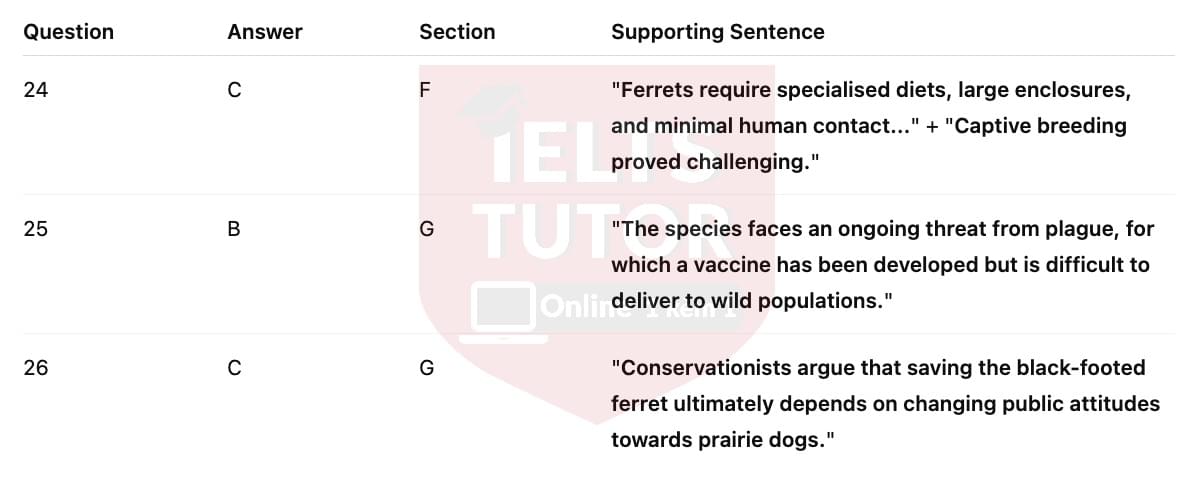
F Captive breeding proved challenging. Ferrets require specialised diets, large enclosures, and minimal human contact to retain their natural wariness. Moreover, their reproductive cycles are tightly linked to prairie dog availability, which had to be artificially simulated. By the early 1990s, however, the captive population had grown to several hundred individuals, and reintroduction sites began to be identified. Today, black-footed ferrets have been reintroduced to over 20 locations across eight US states, Mexico, and Canada, with a total wild population estimated at several hundred animals.
G Despite this success, the black-footed ferret remains one of the most endangered mammals in North America. The species faces an ongoing threat from plague, for which a vaccine has been developed but is difficult to deliver to wild populations. Additionally, prairie dog colonies remain fragmented and continue to be poisoned on agricultural land. Conservationists argue that saving the black-footed ferret ultimately depends on changing public attitudes towards prairie dogs – no longer viewing them as pests, but as a keystone species essential to the health of the Great Plains ecosystem.
Questions 14–19
Reading Passage 2 has seven sections, A–G.
Which section contains the following information?
Write the correct letter, A–G, in boxes 14–19 on your answer sheet.
The discovery of a surviving wild population of black-footed ferrets
The relationship between ferret decline and the loss of another species
A comparison between the black-footed ferret and two related species
The capture of all remaining wild ferrets to prevent extinction
Current threats that still prevent full recovery of the species
The approximate original geographical range of the black-footed ferret >> 🔥 Nhắn zalo 0905834420 join group zalo Hóng đề thi máy 4 skills để cập nhật đề thi thật 4 kĩ năng hằng ngày [Kèm giải & đề làm online]
Questions 20–23
Complete the summary below.
Choose NO MORE THAN TWO WORDS from the passage for each answer.
The black-footed ferret almost became extinct mainly because its primary food source, the (20) ………………… , was systematically destroyed. In the 20th century, programmes that involved (21) ………………… , together with habitat loss and disease, eliminated around 95% of these animals. Ferrets also depend on their prey's (22) ………………… for shelter and raising their young. After the Meeteetse population was discovered in 1981, disease outbreaks reduced it to just (23) ………………… individuals, all of which were taken into captivity.
Questions 24–26
Choose the correct letter, A, B, C, or D.
24. What is said about captive breeding of black-footed ferrets?
A) It was immediately successful without any difficulties.
B) Ferrets bred easily in small cages with frequent handling.
C) It required special conditions and careful management.
D) The programme failed to produce any offspring.
25. According to the passage, what is a major ongoing challenge for wild ferret populations?
A) Lack of suitable reintroduction sites
B) The disease plague, which is hard to vaccinate against in the wild
C) Competition with domestic ferrets
D) Overpopulation of prairie dogs
26. What do conservationists believe is necessary for the long-term survival of the species?
A) Killing more prairie dogs to reduce competition
B) Relocating all ferrets to zoos
C) Changing how people perceive prairie dogs
D) Introducing Siberian polecats to North America >> 🔥 IELTS TUTOR gợi ý tham khảo CẦN VIẾT & THU ÂM BAO NHIÊU BÀI ĐỂ ĐẠT 8.0 SPEAKING & 7.0 WRITING?
IV. Dịch bài đọc The return of the black-footed ferret
V. Giải thích từ vựng The return of the black-footed ferret
VI. Giải thích cấu trúc ngữ pháp khó The return of the black-footed ferret
VII. Đáp án The return of the black-footed ferret
14. D
15. C
16. B
17. E
18. G
19. A
20. prairie dogs
21. poisoning programmes
22. burrows
23. 18
24. C
25. B
26. C
📩 MN AI CHƯA CÓ ĐÁP ÁN FORECAST QUÝ MỚI PART 1-2-3 NHẮN ZL 0905834420 IELTS TUTOR GỬI FREE HẾT NHA

Các khóa học IELTS online 1 kèm 1 - 100% cam kết đạt target 6.0 - 7.0 - 8.0 - Đảm bảo đầu ra - Thi không đạt, học lại FREE
>> Thành tích học sinh IELTS TUTOR với hàng ngàn feedback được cập nhật hàng ngày
