
IELTS TUTOR cung cấp The Secret Language of Plants Đề luyện tập IELTS READING (IELTS Reading Practice Test) - Làm bài online format computer-based, kèm đáp án, dịch & giải thích từ vựng - cấu trúc ngữ pháp khó & GIẢI ĐÁP ÁN VỚI LOCATION
I. Kiến thức liên quan
II. Làm bài online (kéo xuống cuối bài blog để xem giải thích từ vựng & cấu trúc cụ thể hơn)
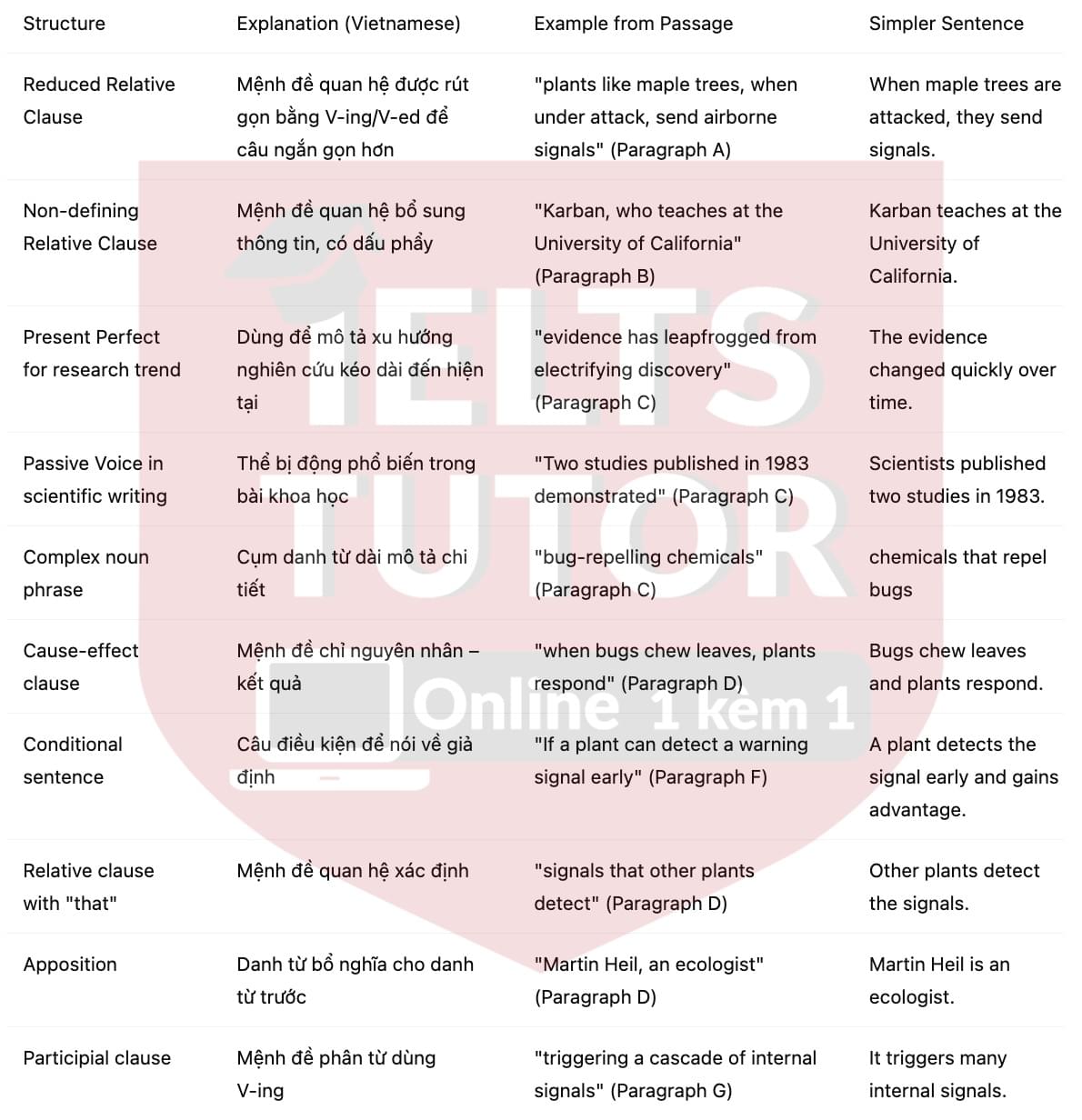
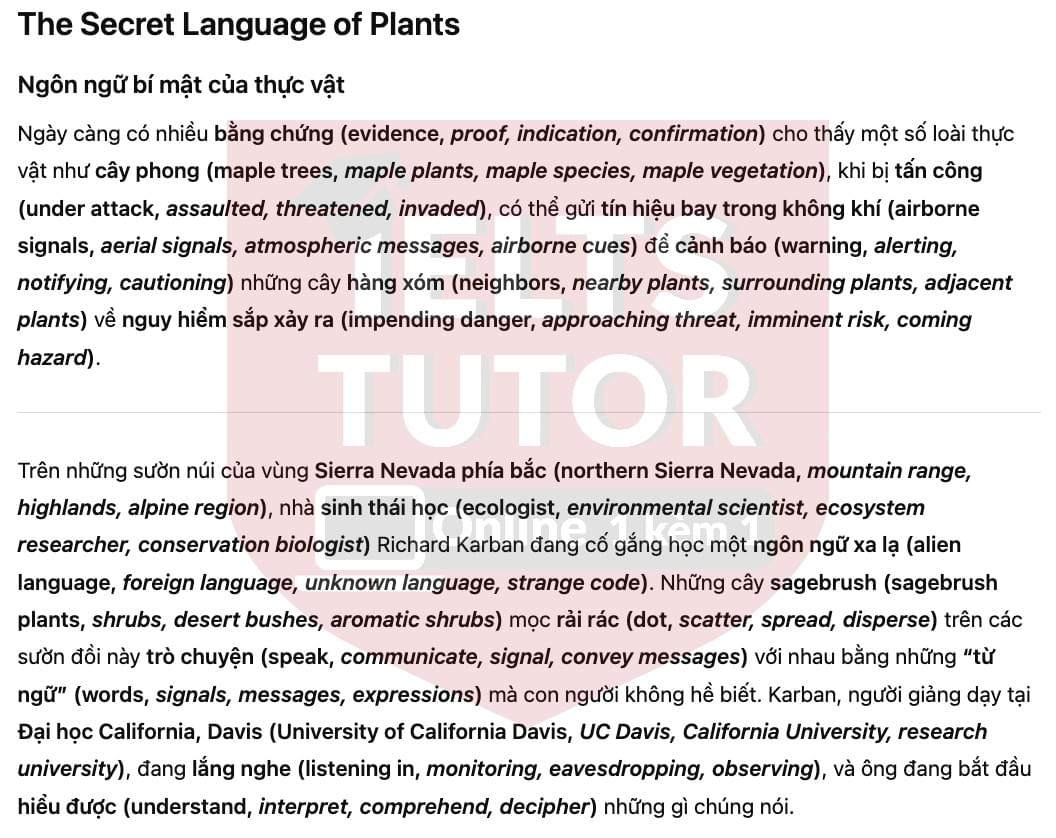
A Up in the northern Sierra Nevada, the ecologist Richard Karban is trying to learn an alien language. The sagebrush plants that dot these slopes speak to one another, using words no human knows. Karban, who teaches at the University of California, Davis, is listening in, and he's beginning to understand what they say.
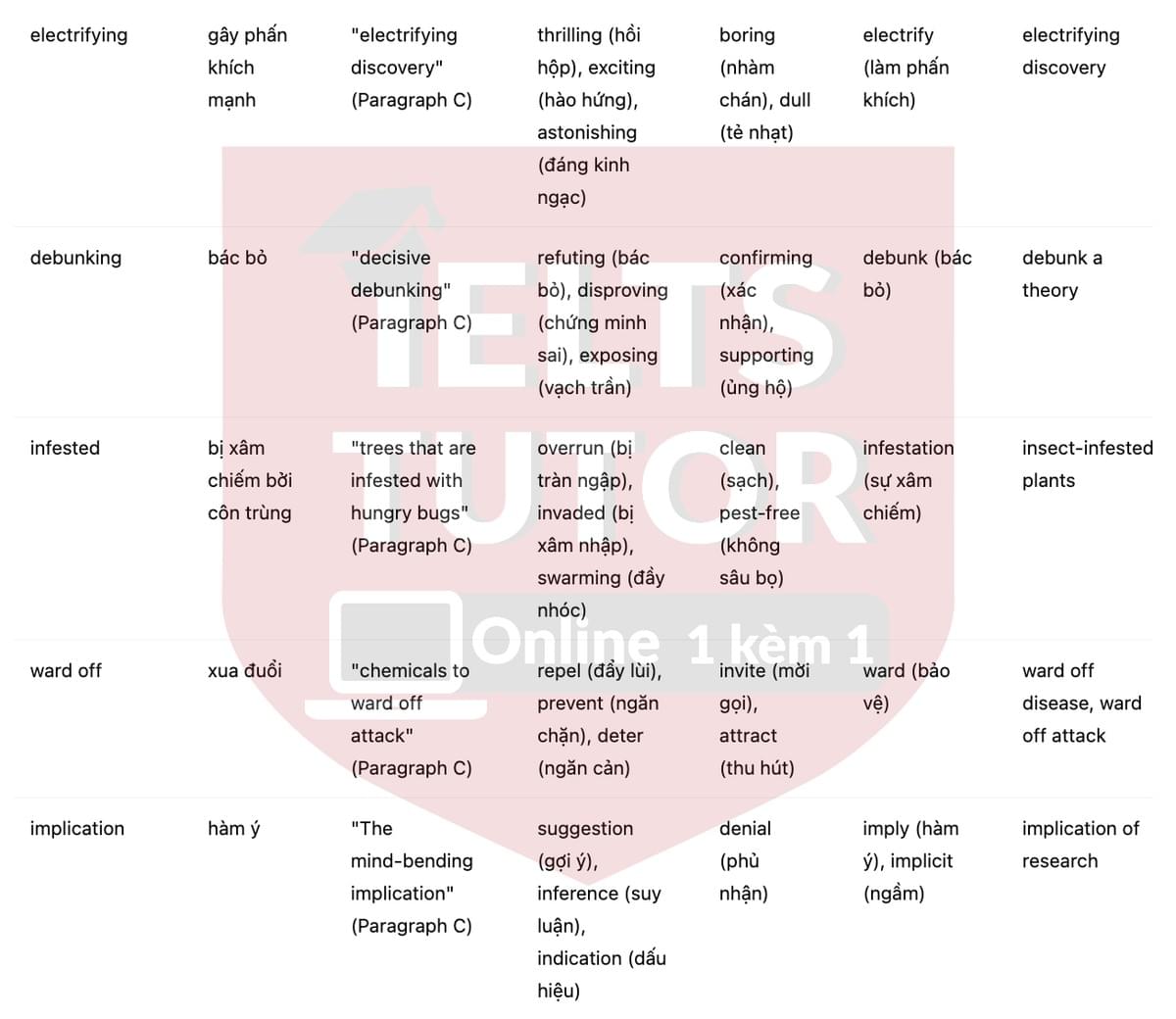
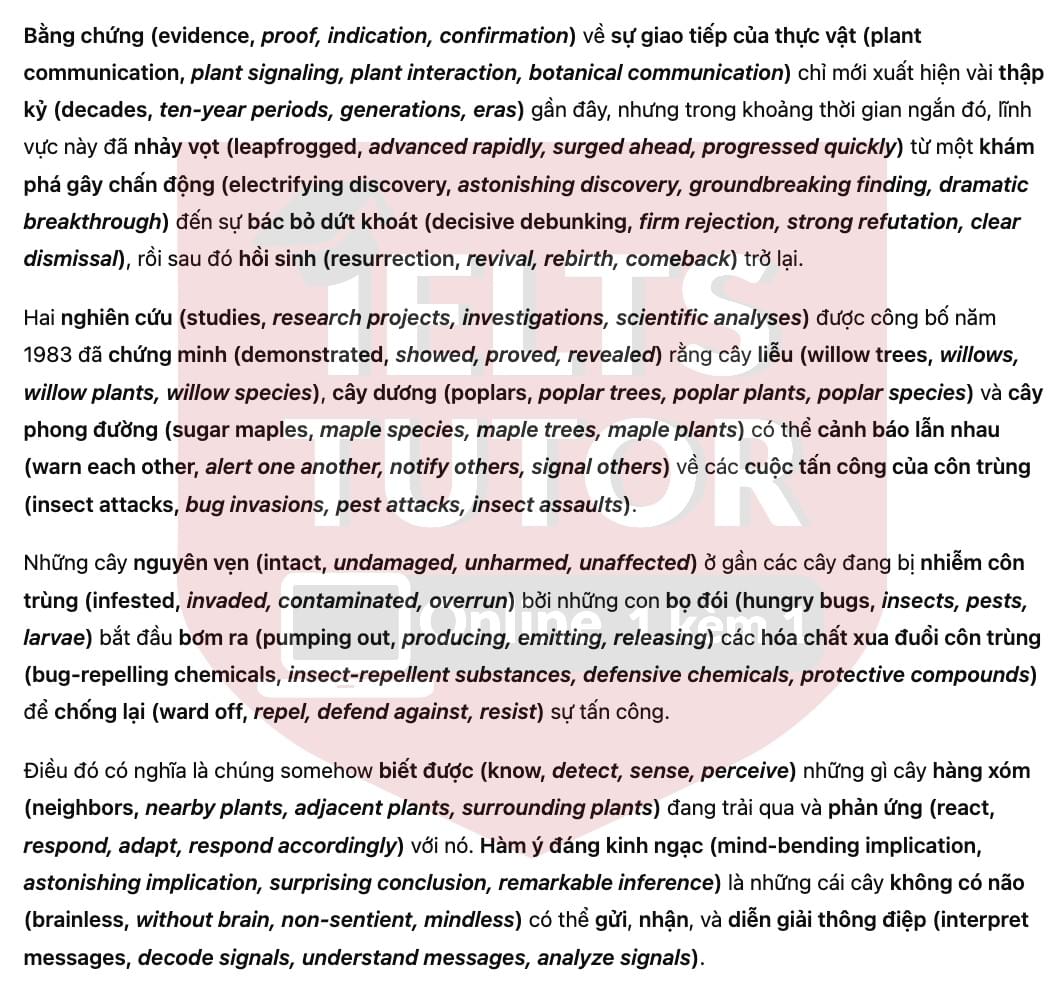
B The evidence for plant communication is only a few decades old, but in that short time it has leapfrogged from electrifying discovery to decisive debunking to resurrection. Two studies published in 1983 demonstrated that willow trees, poplars and sugar maples can warn each other about insect attacks: Intact, undamaged trees near ones that are infested with hungry bugs begin pumping out bug-repelling chemicals to ward off attack. They somehow know what their neighbors are experiencing, and react to it. The mind-bending implication was that brainless trees could send, receive and interpret messages.
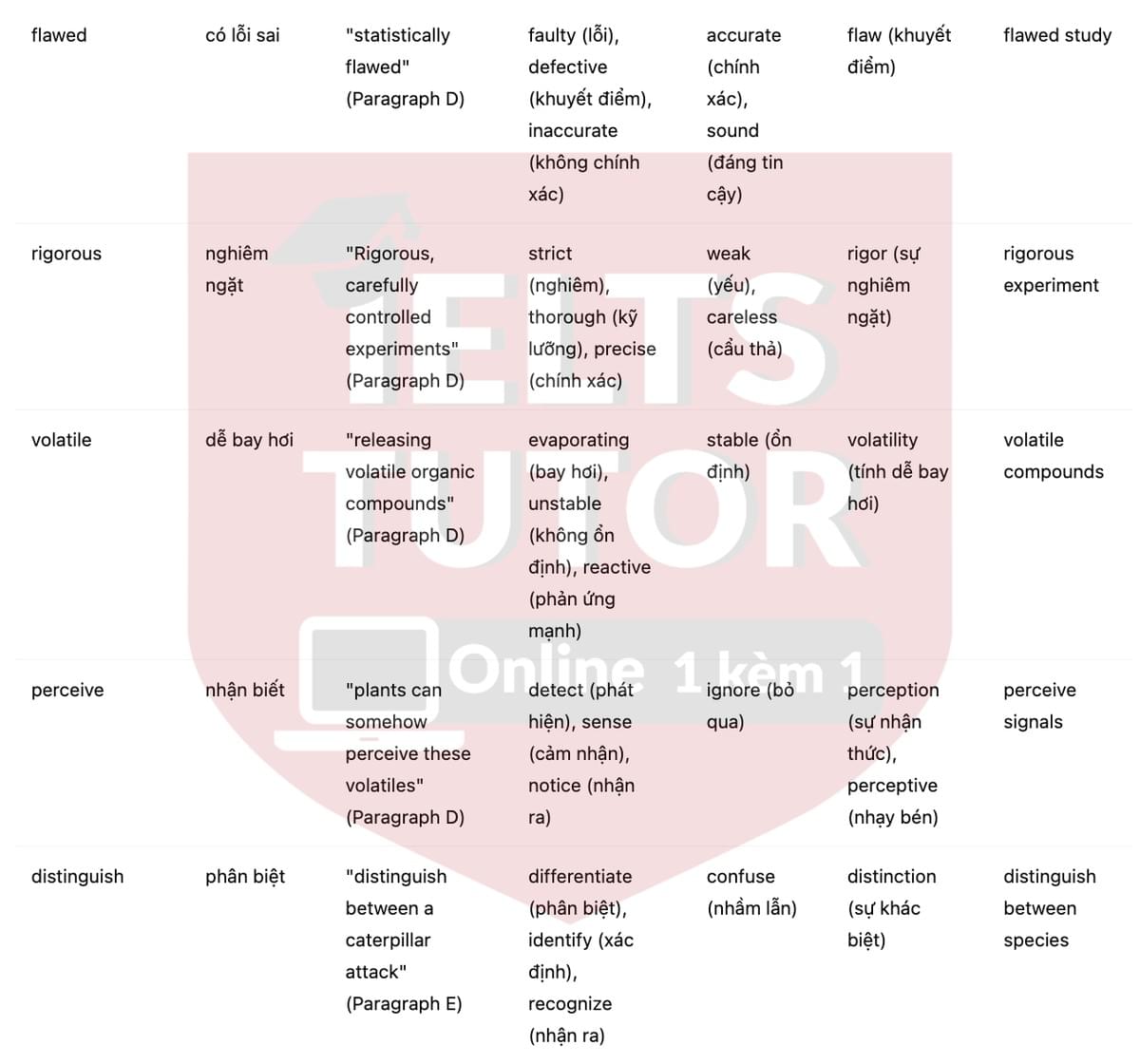
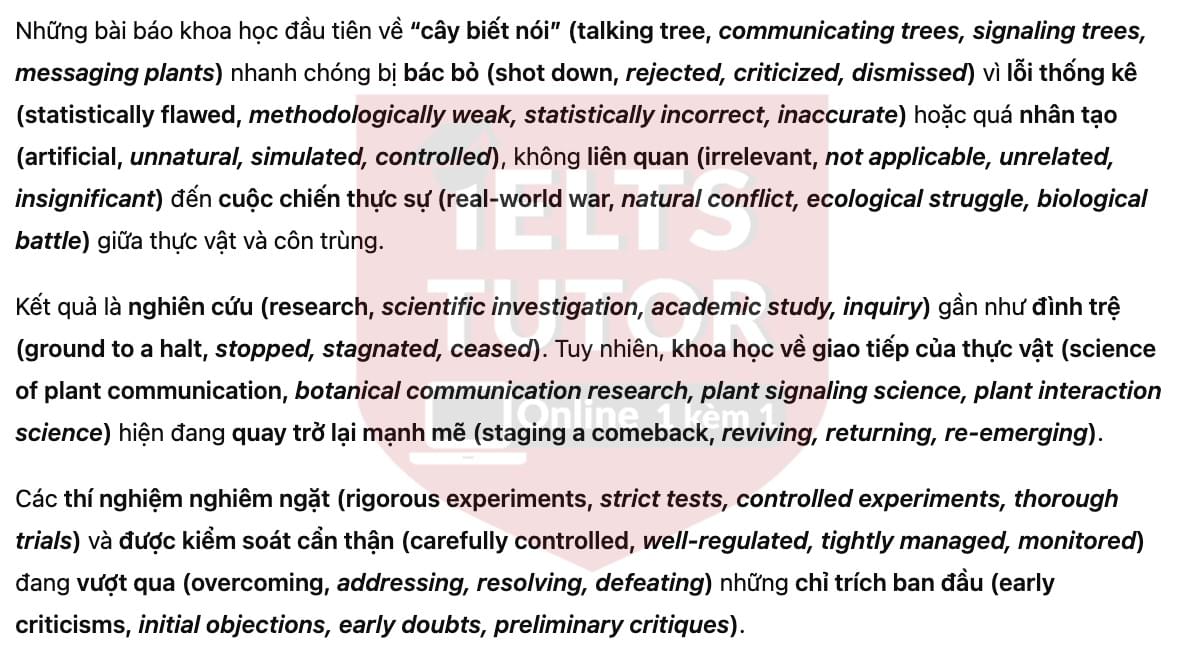
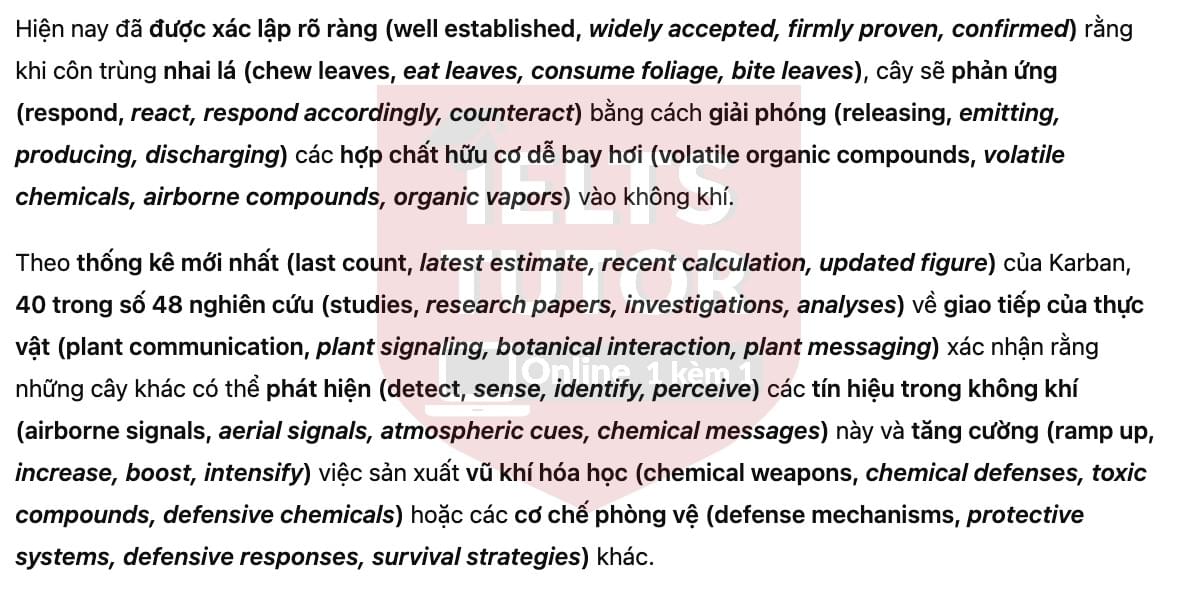
C The first few "talking tree" papers quickly were shot down as statistically flawed or too artificial, irrelevant to the real-world war between plants and bugs. Research ground to a halt. But the science of plant communication is now staging a comeback. Rigorous, carefully controlled experiments are overcoming those early criticisms with repeated testing in labs, forests and fields. It's now well established that when bugs chew leaves, plants respond by releasing volatile organic compounds into the air. By Karban's last count, 40 out of 48 studies of plant communication confirm that other plants detect these airborne signals and ramp up their production of chemical weapons or other defense mechanisms in response. "The evidence that plants release volatiles when damaged by herbivores is as sure as something in science can be," said Martin Heil, an ecologist at the Mexican research institute Cinvestav Irapuato. "The evidence that plants can somehow perceive these volatiles and respond with a defense response is also very good."
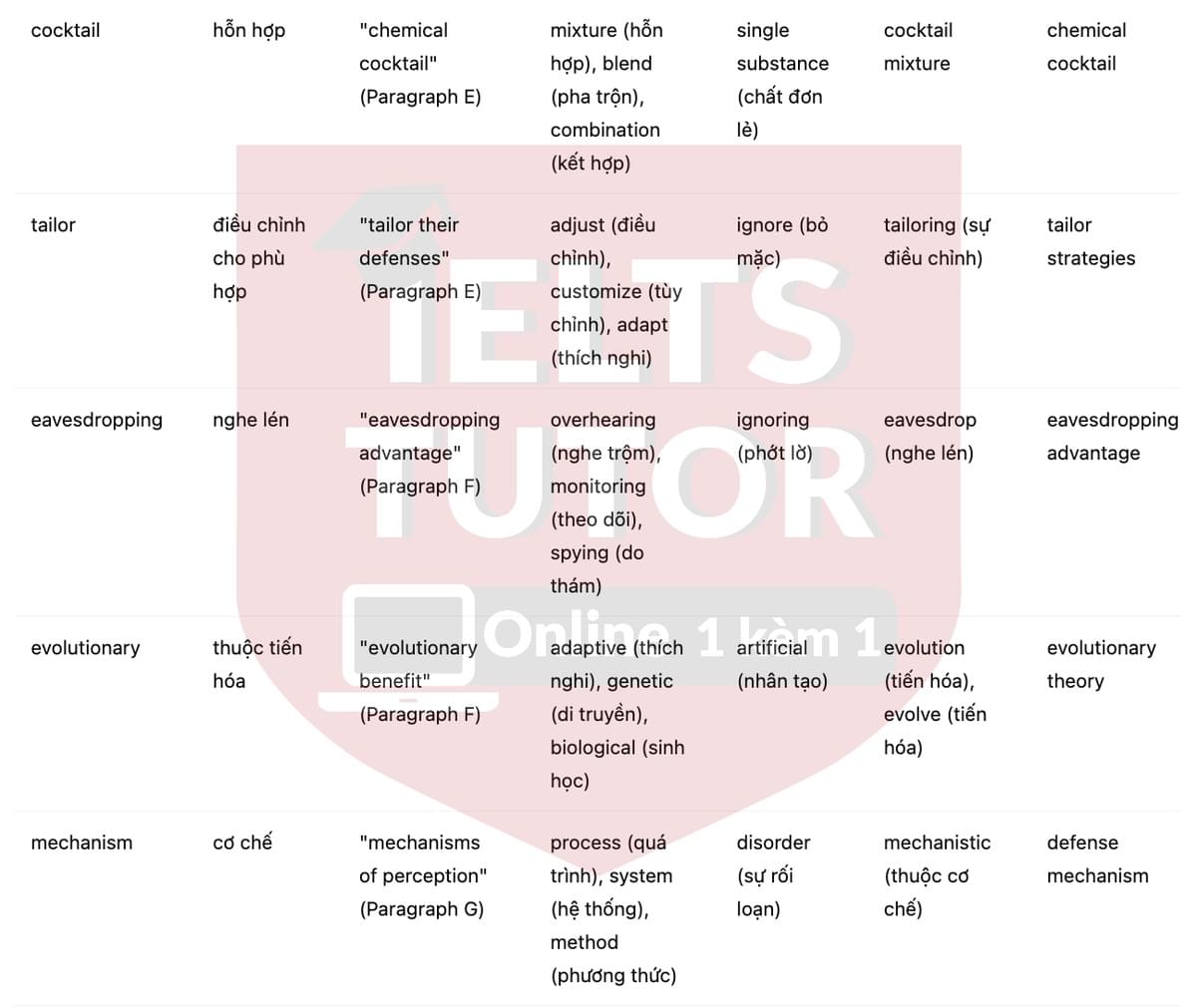
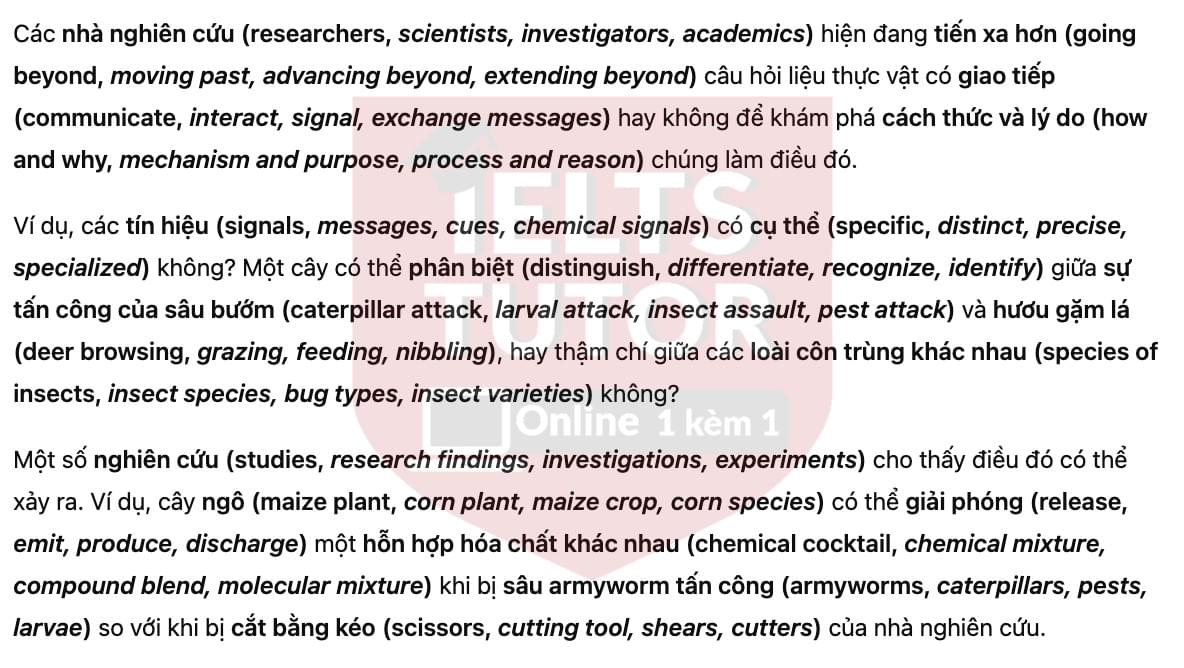
D Researchers are now going beyond the question of whether plants communicate to explore how and why they do it. For instance, are the signals specific? Can a plant distinguish between a caterpillar attack and a deer browsing, or even between different species of insects? Some studies suggest it can. A maize plant, for example, may release a different chemical cocktail when attacked by armyworms than when cut by a researcher's scissors. Neighboring plants might then tailor their defenses accordingly.
E This has led to the concept of an "eavesdropping" advantage in plant communities. If a plant can detect a warning signal early and activate its defenses before being attacked, it gains a significant survival edge. This also raises ecological questions about the evolutionary benefit of such communication. If warning your neighbors helps them survive, are you also helping potential competitors for sunlight, water, and nutrients? Some theories propose that the signals may primarily benefit close relatives, as plants in a dense stand are often genetically similar. Warning your kin could help ensure the survival of your shared genes—a concept known as kin selection.
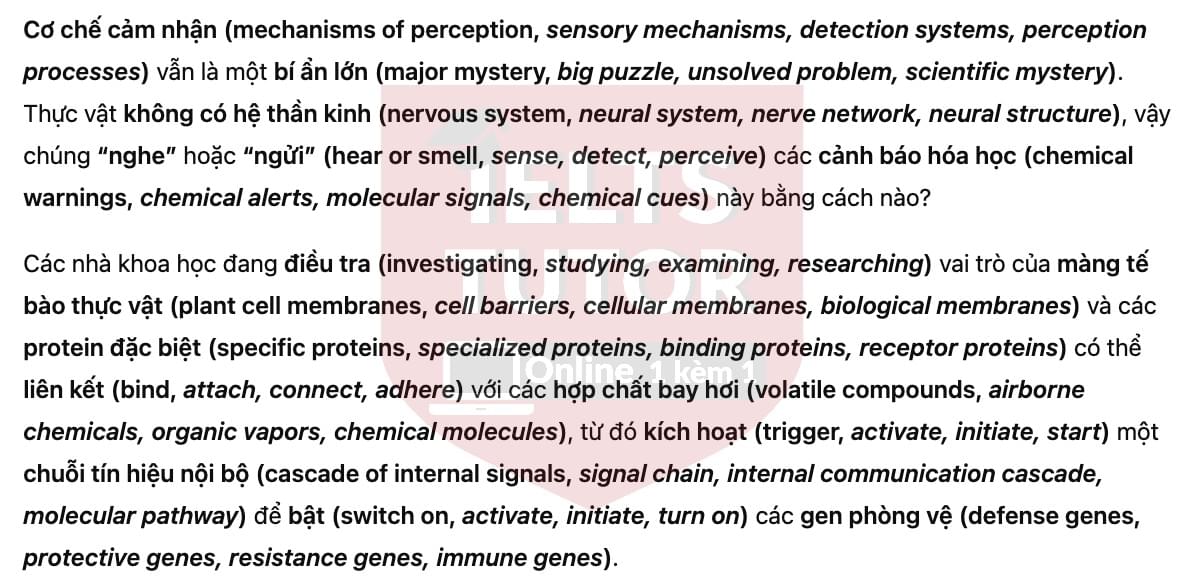
F The mechanisms of perception remain a major mystery. Plants lack a nervous system, so how do they "hear" or "smell" these chemical warnings? Scientists are investigating the role of plant cell membranes and specific proteins that might bind to volatile compounds, triggering a cascade of internal signals that switch on defense genes. Unlocking this process could have significant agricultural applications. Farmers might one day use synthetic plant signals to prime crops for pest resistance, reducing the need for chemical pesticides.
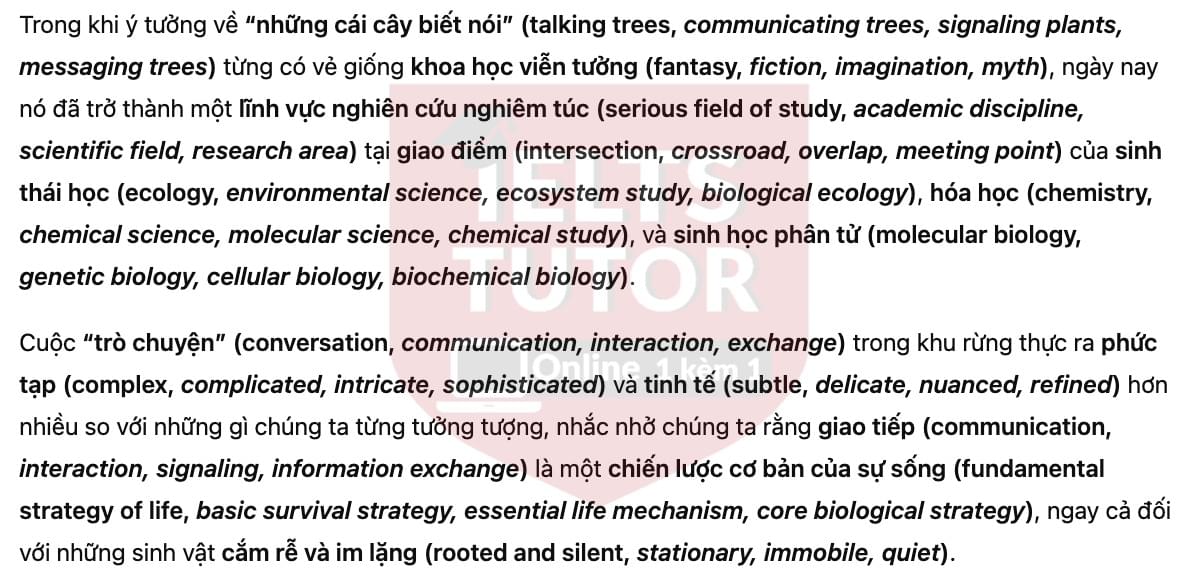
G While the idea of "talking trees" once seemed like fantasy, it is now a serious field of study at the intersection of ecology, chemistry, and molecular biology. The conversation in the forest is far more complex and subtle than we ever imagined, reminding us that communication is a fundamental strategy of life, even for the rooted and the silent.
Reading Passage 2 has seven paragraphs, A-G. Which paragraph contains the following information?
Complete the summary below. Choose NO MORE THAN TWO WORDS from the passage for each answer.
Do the following statements agree with the claims of the writer in Reading Passage 2? Write:
YES if the statement agrees with the claims of the writer
NO if the statement contradicts the claims of the writer
NOT GIVEN if it is impossible to say what the writer thinks about this
📩 MN AI CHƯA CÓ ĐÁP ÁN FORECAST QUÝ MỚI PART 1-2-3 NHẮN ZL 0905834420 IELTS TUTOR GỬI FREE HẾT NHA
III. The Secret Language of Plants: Đề luyện tập IELTS READING (IELTS Reading Practice Test)
READING PASSAGE 2
You should spend about 20 minutes on Questions 14–26, which are based on Reading Passage 2 below.
The Secret Language of Plants
Growing evidence suggests that certain plants like maple trees, when under attack, send airborne signals warning their neighbors of impending danger.
Up in the northern Sierra Nevada, the ecologist Richard Karban is trying to learn an alien language. The sagebrush plants that dot these slopes speak to one another, using words no human knows. Karban, who teaches at the University of California, Davis, is listening in, and he’s beginning to understand what they say.
The evidence for plant communication is only a few decades old, but in that short time it has leapfrogged from electrifying discovery to decisive debunking to resurrection. Two studies published in 1983 demonstrated that willow trees, poplars and sugar maples can warn each other about insect attacks: Intact, undamaged trees near ones that are infested with hungry bugs begin pumping out bug-repelling chemicals to ward off attack. They somehow know what their neighbors are experiencing, and react to it. The mind-bending implication was that brainless trees could send, receive and interpret messages. >> 🔥 Form đăng kí giải đề thi thật IELTS 4 kĩ năng kèm bài giải bộ đề 100 đề PART 2 IELTS SPEAKING quý đang thi (update hàng tuần) từ IELTS TUTOR
The first few “talking tree” papers quickly were shot down as statistically flawed or too artificial, irrelevant to the real-world war between plants and bugs. Research ground to a halt. But the science of plant communication is now staging a comeback. Rigorous, carefully controlled experiments are overcoming those early criticisms with repeated testing in labs, forests and fields. It’s now well established that when bugs chew leaves, plants respond by releasing volatile organic compounds into the air. By Karban’s last count, 40 out of 48 studies of plant communication confirm that other plants detect these airborne signals and ramp up their production of chemical weapons or other defense mechanisms in response. “The evidence that plants release volatiles when damaged by herbivores is as sure as something in science can be,” said Martin Heil, an ecologist at the Mexican research institute Cinvestav Irapuato. “The evidence that plants can somehow perceive these volatiles and respond with a defense response is also very good.”
Researchers are now going beyond the question of whether plants communicate to explore how and why they do it. For instance, are the signals specific? Can a plant distinguish between a caterpillar attack and a deer browsing, or even between different species of insects? Some studies suggest it can. A maize plant, for example, may release a different chemical cocktail when attacked by armyworms than when cut by a researcher's scissors. Neighboring plants might then tailor their defenses accordingly.
This has led to the concept of an "eavesdropping" advantage in plant communities. If a plant can detect a warning signal early and activate its defenses before being attacked, it gains a significant survival edge. This also raises ecological questions about the evolutionary benefit of such communication. If warning your neighbors helps them survive, are you also helping potential competitors for sunlight, water, and nutrients? Some theories propose that the signals may primarily benefit close relatives, as plants in a dense stand are often genetically similar. Warning your kin could help ensure the survival of your shared genes—a concept known as kin selection.
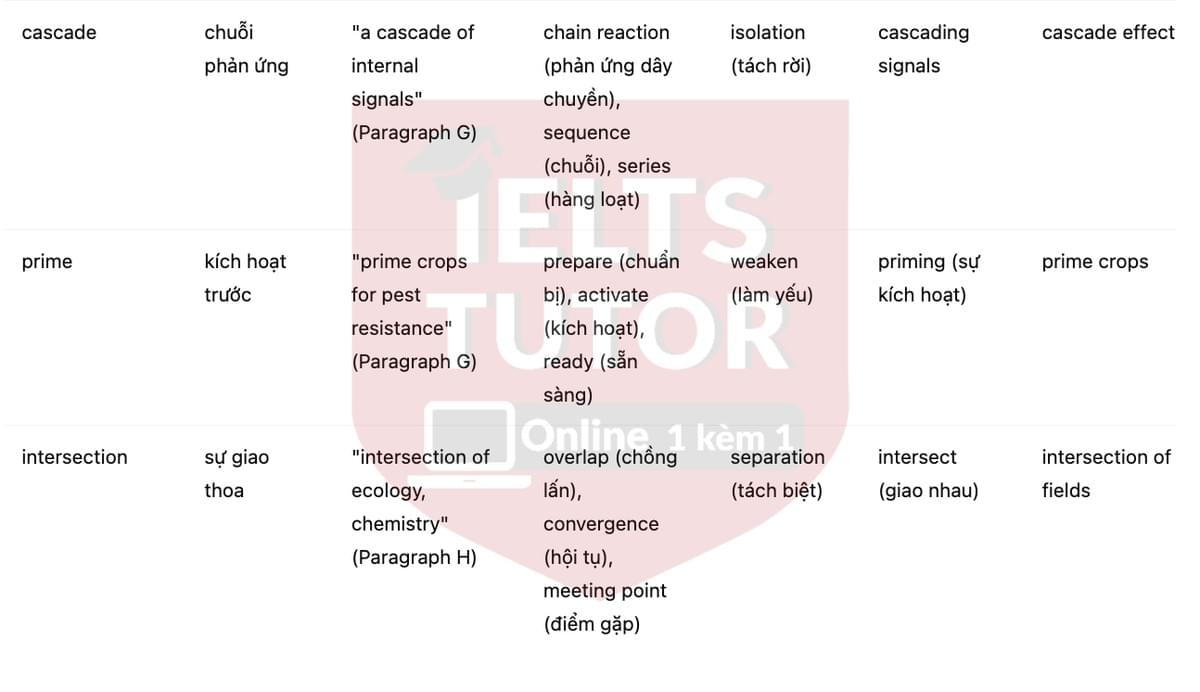
The mechanisms of perception remain a major mystery. Plants lack a nervous system, so how do they "hear" or "smell" these chemical warnings? Scientists are investigating the role of plant cell membranes and specific proteins that might bind to volatile compounds, triggering a cascade of internal signals that switch on defense genes. Unlocking this process could have significant agricultural applications. Farmers might one day use synthetic plant signals to prime crops for pest resistance, reducing the need for chemical pesticides. >> 🔥 Nhắn zalo 0905834420 join group zalo Hóng đề thi máy 4 skills để cập nhật đề thi thật 4 kĩ năng hằng ngày [Kèm giải & đề làm online]
While the idea of "talking trees" once seemed like fantasy, it is now a serious field of study at the intersection of ecology, chemistry, and molecular biology. The conversation in the forest is far more complex and subtle than we ever imagined, reminding us that communication is a fundamental strategy of life, even for the rooted and the silent.
Questions 14–19
Reading Passage 2 has seven paragraphs, A–G. Which paragraph contains the following information?
A description of the initial scientific reaction to early plant communication studies.
The number of studies that support the idea that plants respond to airborne signals.
A potential agricultural application of understanding plant communication.
The suggestion that plants might send different signals for different types of threats.
A possible evolutionary explanation for why plants would warn their neighbors.
The names of three types of trees involved in the landmark 1983 studies.
Questions 20–23
Complete the summary below. Choose NO MORE THAN TWO WORDS from the passage for each answer.
Research into plant communication began in earnest in the 20 ____________. Early studies were criticized for being 21 ____________ or not relevant to natural conditions. The current scientific consensus is strong regarding plants releasing 22 ____________ when eaten by insects. Plants that detect these signals may increase their production of 23 ____________ as a defense. >> 🔥 IELTS TUTOR gợi ý tham khảo CẦN VIẾT & THU ÂM BAO NHIÊU BÀI ĐỂ ĐẠT 8.0 SPEAKING & 7.0 WRITING?
Questions 24–26
Do the following statements agree with the claims of the writer in Reading Passage 2? Write:
YES if the statement agrees with the claims of the writer
NO if the statement contradicts the claims of the writer
NOT GIVEN if it is impossible to say what the writer thinks about this
Richard Karban has now fully decoded the warning signals used by sagebrush plants.
The concept of plants helping their relatives survive is mentioned as a possible explanation for their communication.
Scientists have completely understood the biological process by which plants perceive chemical signals.
IV. Dịch bài đọc The Secret Language of Plants
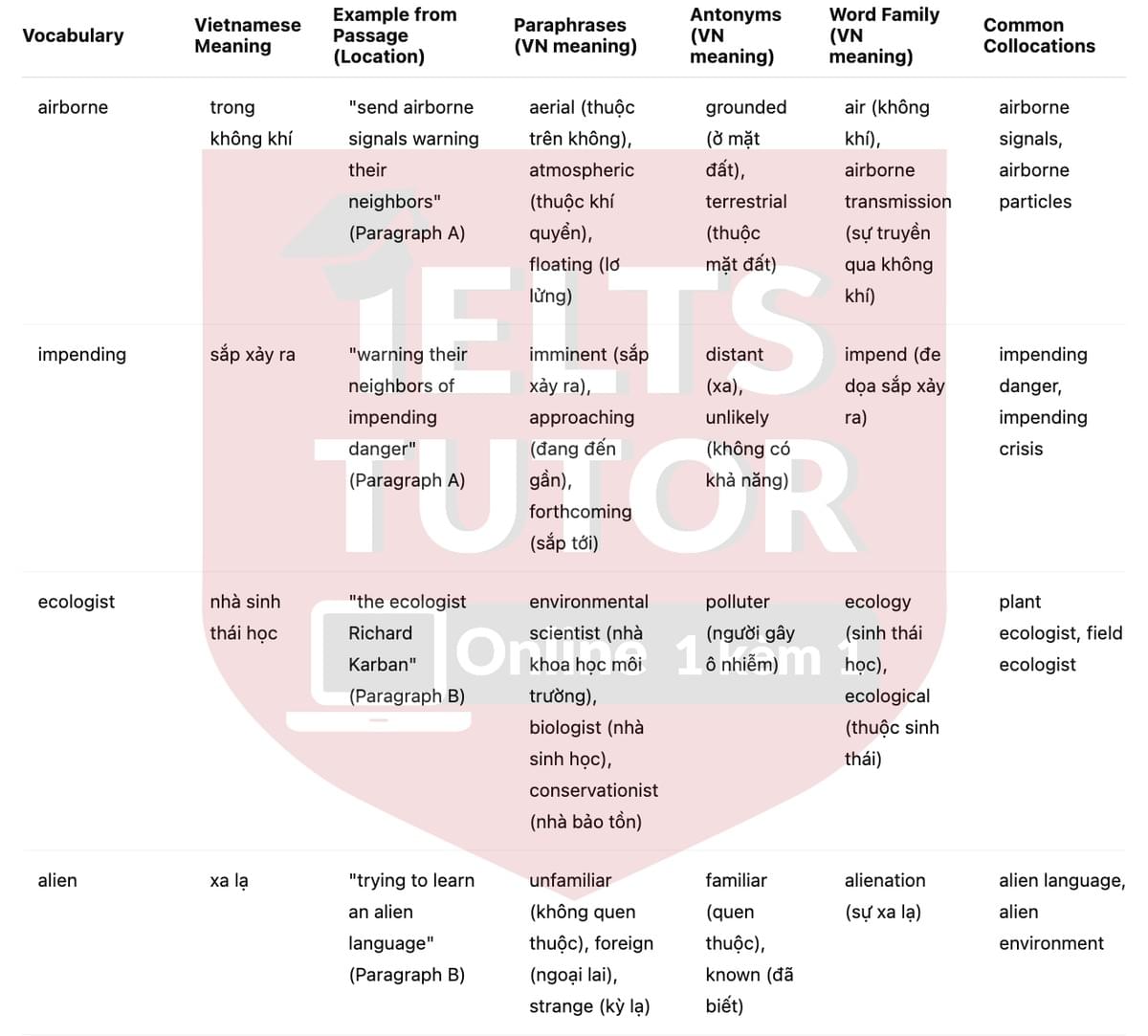
V. Giải thích từ vựng The Secret Language of Plants
VI. Giải thích cấu trúc ngữ pháp khó The Secret Language of Plants
VII. Đáp án The Secret Language of Plants
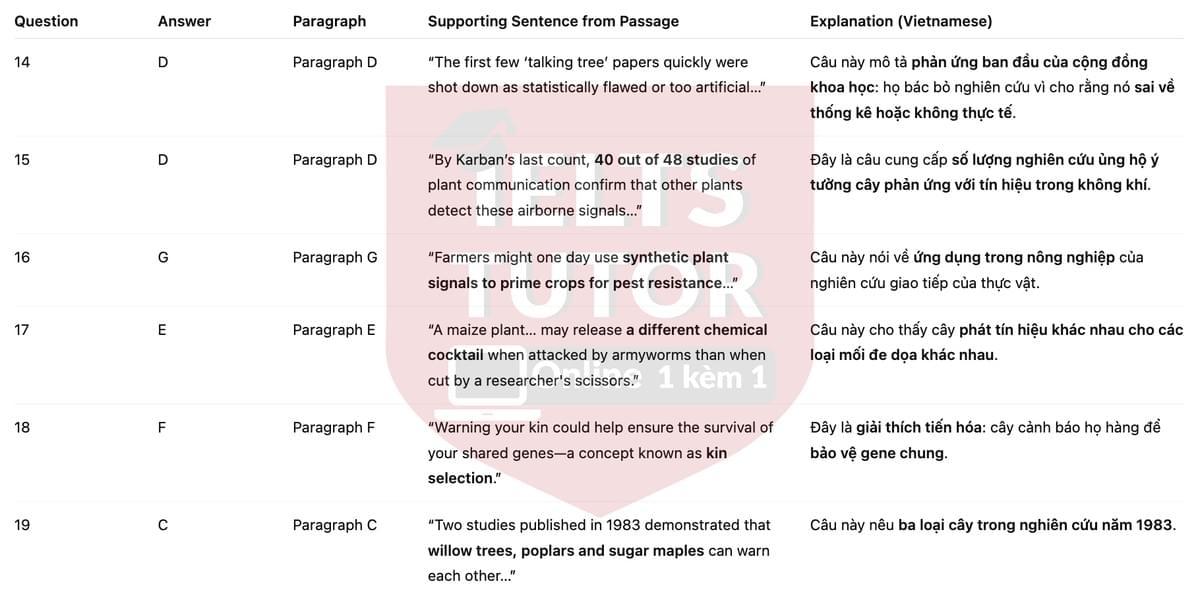
14 D
15 D
16 G
17 E
18 F
19 C
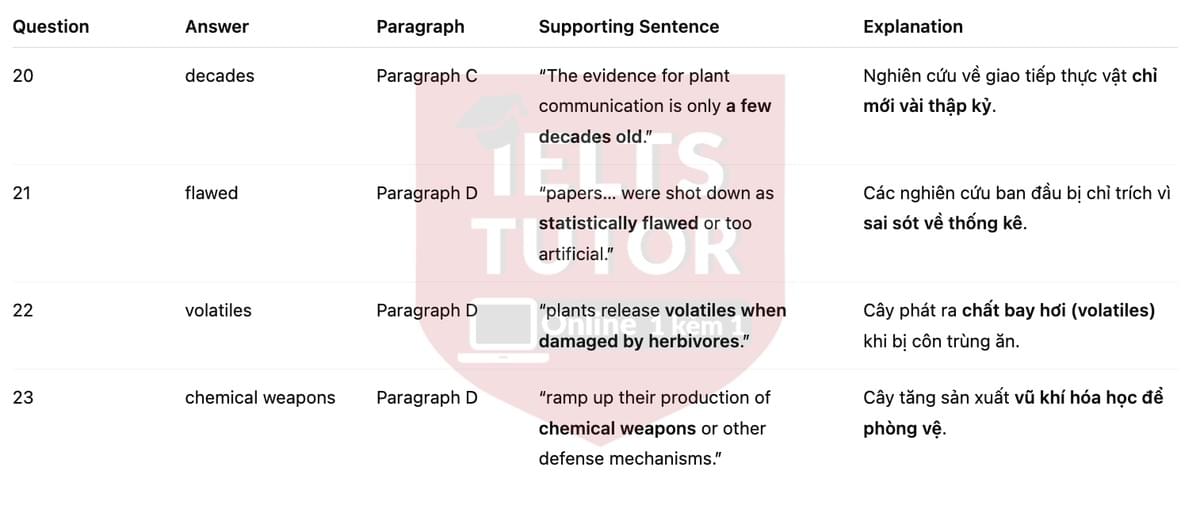
20 decades
21 flawed
22 volatiles
23 chemical weapons
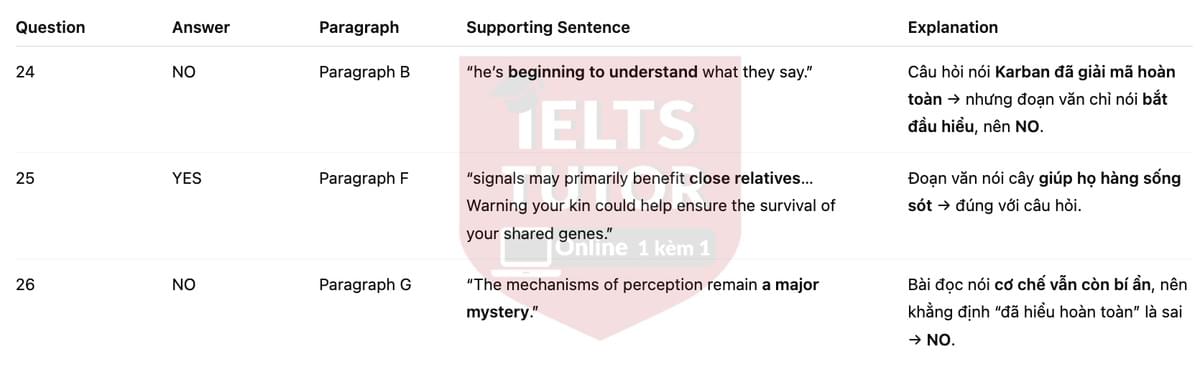
24 NO
25 YES
26 NO
📩 MN AI CHƯA CÓ ĐÁP ÁN FORECAST QUÝ MỚI PART 1-2-3 NHẮN ZL 0905834420 IELTS TUTOR GỬI FREE HẾT NHA
Các khóa học IELTS online 1 kèm 1 - 100% cam kết đạt target 6.0 - 7.0 - 8.0 - Đảm bảo đầu ra - Thi không đạt, học lại FREE
>> Thành tích học sinh IELTS TUTOR với hàng ngàn feedback được cập nhật hàng ngày
