
IELTS TUTOR cung cấp The Whale Goes to Court - Đề luyện tập IELTS READING (IELTS Reading Practice Test) - Làm bài online format computer-based, kèm đáp án, dịch & giải thích từ vựng - cấu trúc ngữ pháp khó & GIẢI ĐÁP ÁN VỚI LOCATION
I. Kiến thức liên quan
📩 MN AI CHƯA CÓ ĐÁP ÁN FORECAST QUÝ MỚI PART 1-2-3 NHẮN ZL 0905834420 IELTS TUTOR GỬI FREE HẾT NHA
II. Làm bài online (kéo xuống cuối bài blog để xem giải thích từ vựng & cấu trúc cụ thể hơn)
The Whale Goes to Court
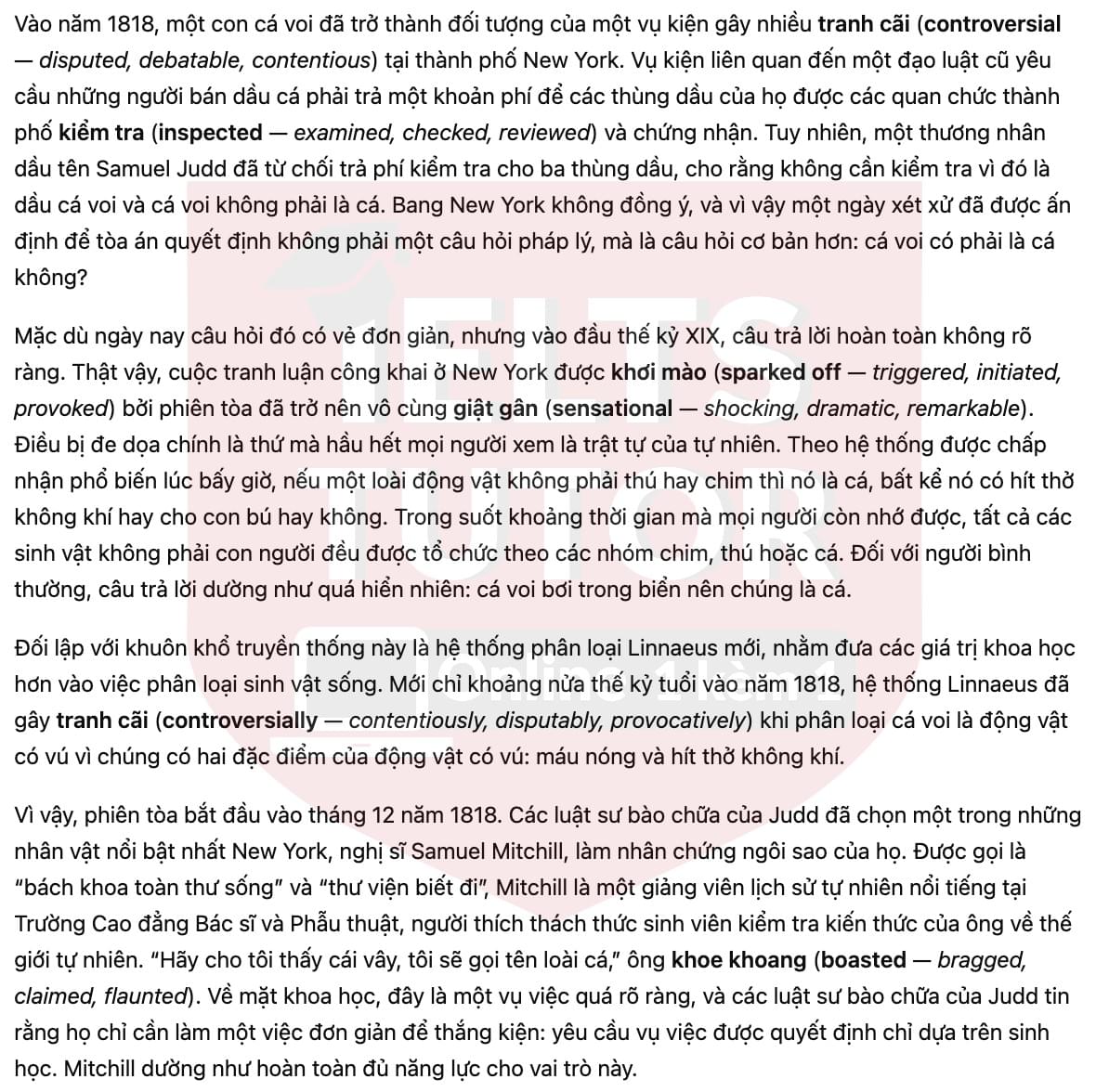
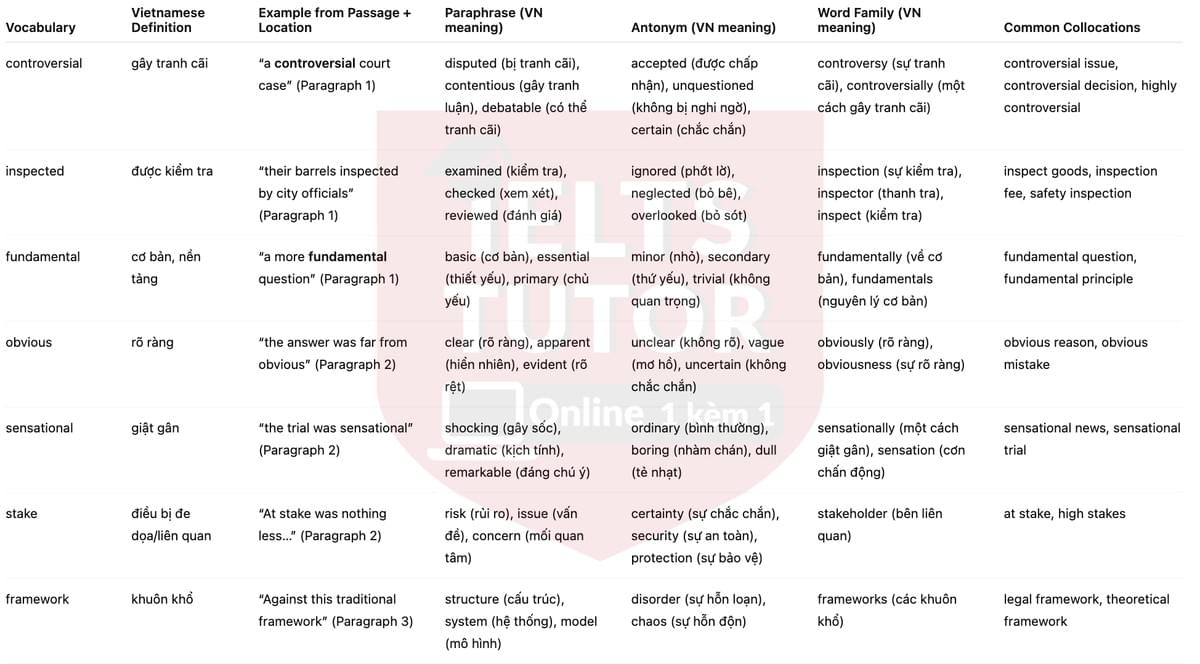
In 1818, a whale became the subject of a controversial court case in New York City. The case involved an old law requiring those who sold fish oil to pay a fee in order to have their barrels inspected by city officials and certified. However, an oil merchant named Samuel Judd refused to pay the inspection fee on three barrels of oil, claiming that no inspection was necessary because it was whale oil and whales were not fish. The state disagreed, and so a date was set for a court to decide not a question of law, but the answer to a more fundamental question: Is a whale a fish?
As simple as that question may appear today, the answer was far from obvious in the early nineteenth century. Indeed, the public debate in New York sparked off by the trial was sensational. At stake was nothing less than what most regarded as the order of nature. According to the commonly accepted scheme of things, if an animal was not a beast or a bird, it was a fish, regardless of whether it breathed air or suckled its young. For as long as anyone could remember, all non-human creatures had been organized according to the categories of birds, beasts, or fish. For the average person, the answer seemed perfectly obvious: whales swam in the sea and therefore they were fish.
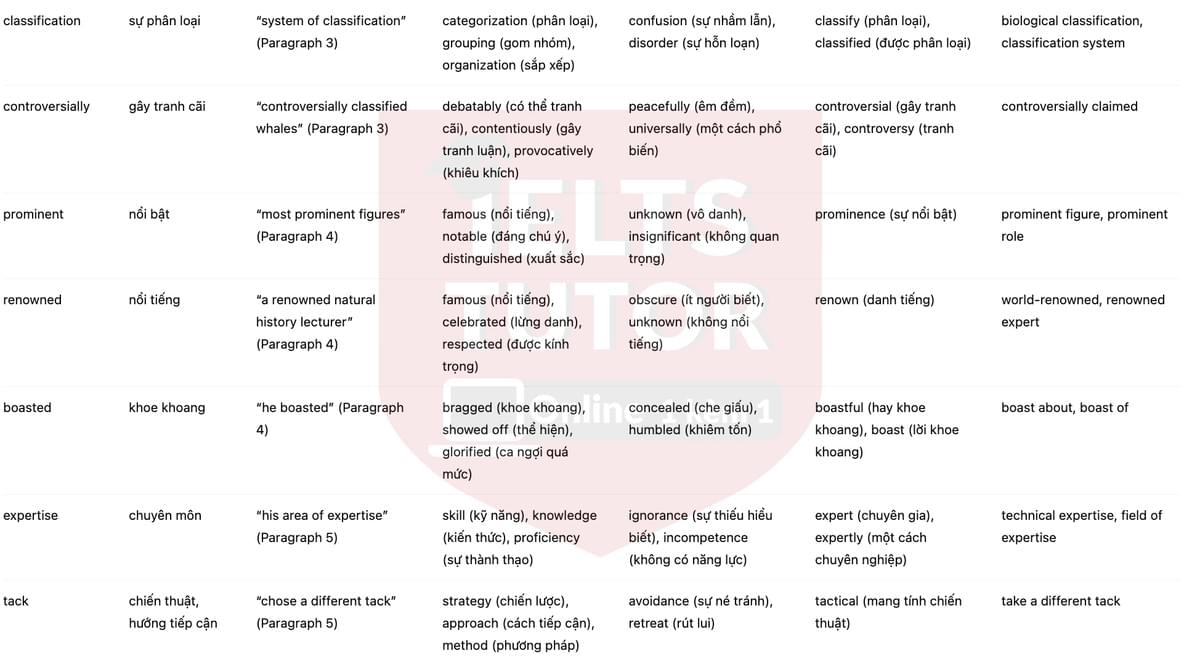
Against this traditional framework stood the new Linnaean system of classification, which sought to introduce more scientific values into the classification of living things. Barely half a century old in 1818, the Linnaean system controversially classified whales as mammals because they shared two mammalian characteristics: they were warm-blooded and breathed air.
So the trial began in December 1818. Judd’s defense lawyers chose as their star witness one of New York’s most prominent figures, the congressman Samuel Mitchill. Referred to as a “living encyclopedia” and a “walking library,” Mitchill was a renowned natural history lecturer at the College of Physicians and Surgeons who liked to dare his students to test his knowledge of the natural world. “Show me the fin, and I will name the fish,” he boasted. Scientifically, it was an open-and-shut case, and Judd’s defense lawyers believed they only had to do one simple thing to win the trial: insist that it be decided by biology alone. Mitchill seemed fully qualified for this role.
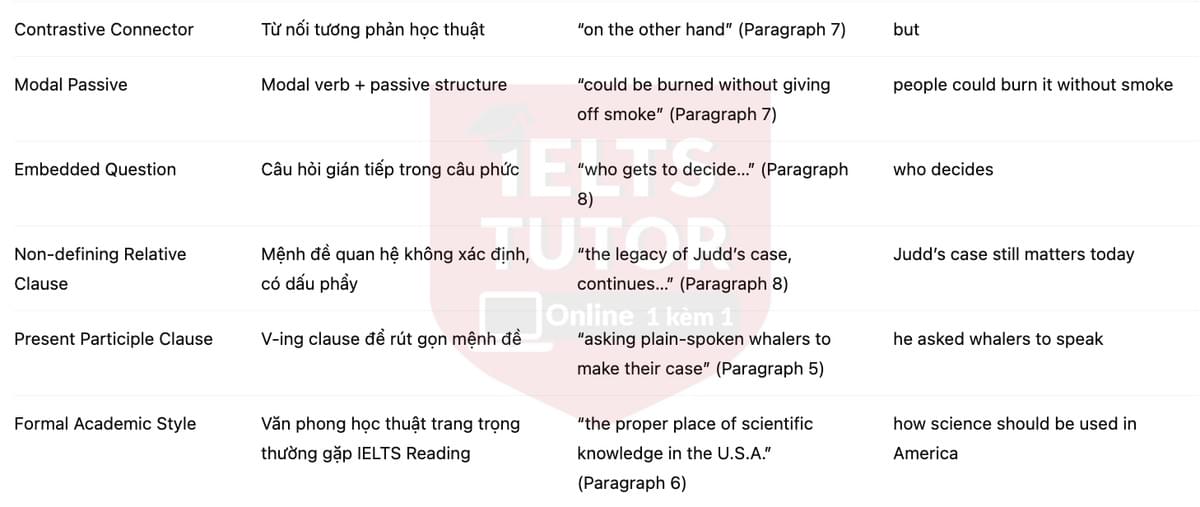
But this is where the case becomes interesting, and is the reason why the trial of the whale is not some dusty nineteenth-century obscurity. For rather than debate Mitchill on his area of expertise, lawyers for the New York City fish-oil inspectors chose a different tack. Lead counsel William Sampson turned the trial into a contest between scientific learning and common sense, by asking plain-spoken whalers to make their case before the jury.
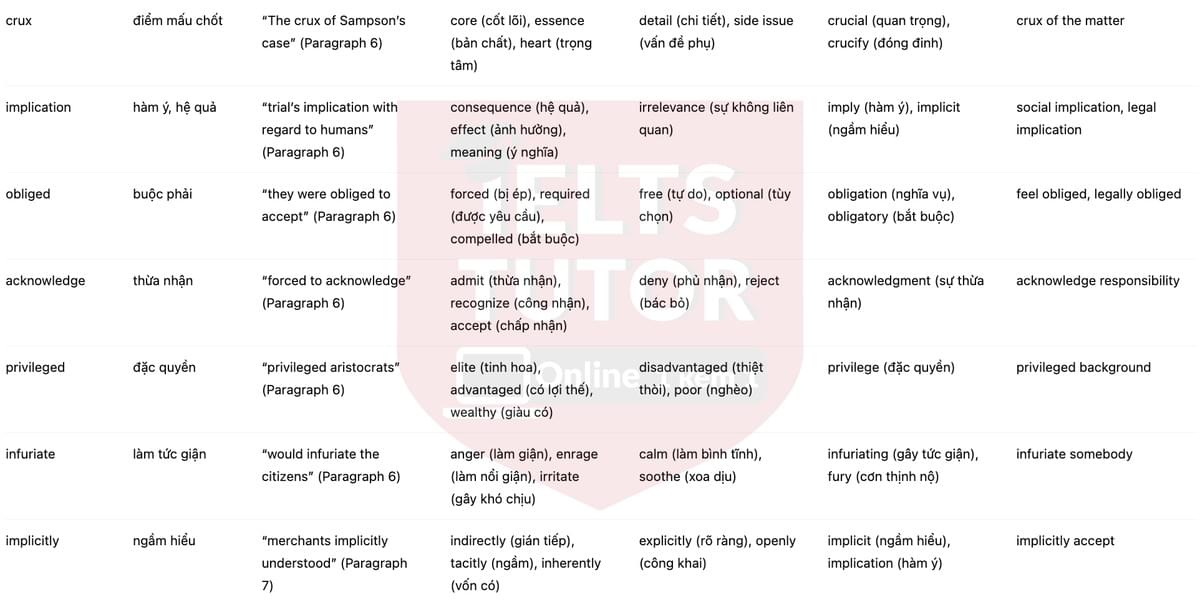
The crux of Sampson’s case was the trial’s implication with regard to humans: should Judd be found not guilty? Sampson told jury members that if they accepted Mitchill’s testimony on whales, they were obliged to accept a lower place for their own kind in the natural order. As a result, Mitchill’s day in court did not go smoothly, not least because he was forced to acknowledge serious disputes among his peers regarding exactly how to classify biological organisms. Sampson then took aim at Mitchill himself and what he represented: privileged aristocrats from the scientific community who had lost touch with reality. The smooth-talking Sampson then claimed Mitchill’s beliefs had their origin in Europe - something he rightly judged would infuriate the citizens of always-independent New York. This revolutionary new thinking, Sampson claimed, was something that honest working New Yorkers could do without. No longer was this a case about barrels of oil; but the proper place of scientific knowledge in the U.S.A.
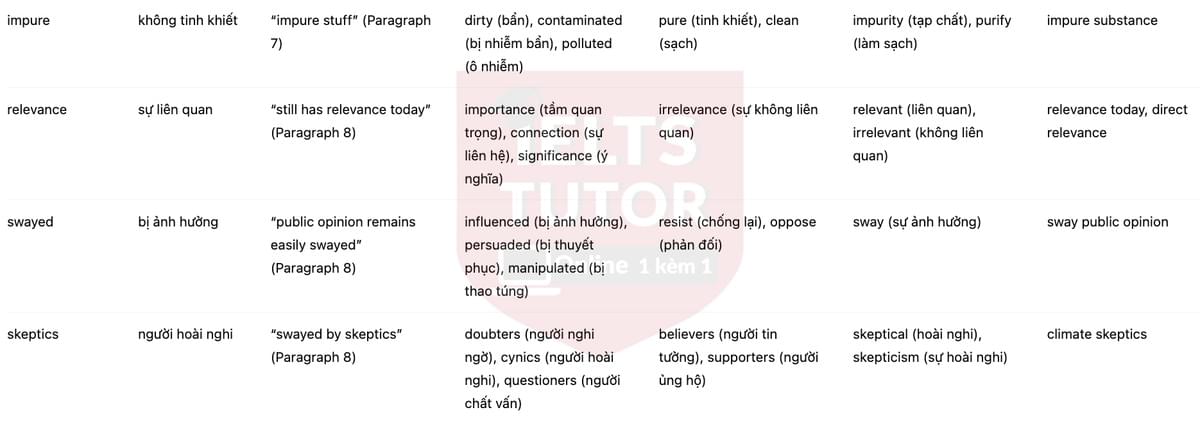
Ultimately, what won the case for Samuel Judd were not Mitchill’s scientific arguments, but testimony from a different sphere altogether. In New York’s markets, the merchants implicitly understood that whale oil and fish oil were not the same: whale oil could be used as a fuel for lamps because it could be burned without giving off smoke; fish oil, on the other hand, was nasty, impure stuff used primarily in tanning leather. In the end, it was this testimony that led to Judd’s victory.
The trial of the whale still has relevance today, when the court of public opinion remains easily swayed by skeptics. The 1818 trial was really about this question: who gets to decide on the place of the natural world in the human world - scientific experts or public opinion? Whether the issue today is the effects of human activity on the climate of this planet, or one of many other contemporary topics, the legacy of Judd’s case continues to be of relevance.
III. The Whale Goes to Court: Đề luyện tập IELTS READING (IELTS Reading Practice Test)
The Whale Goes to Court
In 1818, a whale became the subject of a controversial court case in New York City. The case involved an old law requiring those who sold fish oil to pay a fee in order to have their barrels inspected by city officials and certified. However, an oil merchant named Samuel Judd refused to pay the inspection fee on three barrels of oil, claiming that no inspection was necessary because it was whale oil and whales were not fish. The state disagreed, and so a date was set for a court to decide not a question of law, but the answer to a more fundamental question: Is a whale a fish?
As simple as that question may appear today, the answer was far from obvious in the early nineteenth century. Indeed, the public debate in New York sparked off by the trial was sensational. At stake was nothing less than what most regarded as the order of nature. According to the commonly accepted scheme of things, if an animal was not a beast or a bird, it was a fish, regardless of whether it breathed air or suckled its young. For as long as anyone could remember, all non-human creatures had been organized according to the categories of birds, beasts, or fish. For the average person, the answer seemed perfectly obvious: whales swam in the sea and therefore they were fish.
Against this traditional framework stood the new Linnaean system of classification, which sought to introduce more scientific values into the classification of living things. Barely half a century old in 1818, the Linnaean system controversially classified whales as mammals because they shared two mammalian characteristics: they were warm-blooded and breathed air.
So the trial began in December 1818. Judd’s defense lawyers chose as their star witness one of New York’s most prominent figures, the congressman Samuel Mitchill. Referred to as a “living encyclopedia” and a “walking library,” Mitchill was a renowned natural history lecturer at the College of Physicians and Surgeons who liked to dare his students to test his knowledge of the natural world. “Show me the fin, and I will name the fish,” he boasted. Scientifically, it was an open-and-shut case, and Judd’s defense lawyers believed they only had to do one simple thing to win the trial: insist that it be decided by biology alone. Mitchill seemed fully qualified for this role. >> 🔥 Form đăng kí giải đề thi thật IELTS 4 kĩ năng kèm bài giải bộ đề 100 đề PART 2 IELTS SPEAKING quý đang thi (update hàng tuần) từ IELTS TUTOR
But this is where the case becomes interesting, and is the reason why the trial of the whale is not some dusty nineteenth-century obscurity. For rather than debate Mitchill on his area of expertise, lawyers for the New York City fish-oil inspectors chose a different tack. Lead counsel William Sampson turned the trial into a contest between scientific learning and common sense, by asking plain-spoken whalers to make their case before the jury.
The crux of Sampson’s case was the trial’s implication with regard to humans: should Judd be found not guilty? Sampson told jury members that if they accepted Mitchill’s testimony on whales, they were obliged to accept a lower place for their own kind in the natural order. As a result, Mitchill’s day in court did not go smoothly, not least because he was forced to acknowledge serious disputes among his peers regarding exactly how to classify biological organisms. Sampson then took aim at Mitchill himself and what he represented: privileged aristocrats from the scientific community who had lost touch with reality. The smooth-talking Sampson then claimed Mitchill’s beliefs had their origin in Europe - something he rightly judged would infuriate the citizens of always-independent New York. This revolutionary new thinking, Sampson claimed, was something that honest working New Yorkers could do without. No longer was this a case about barrels of oil; but the proper place of scientific knowledge in the U.S.A.
Ultimately, what won the case for Samuel Judd were not Mitchill’s scientific arguments, but testimony from a different sphere altogether. In New York’s markets, the merchants implicitly understood that whale oil and fish oil were not the same: whale oil could be used as a fuel for lamps because it could be burned without giving off smoke; fish oil, on the other hand, was nasty, impure stuff used primarily in tanning leather. In the end, it was this testimony that led to Judd’s victory.
The trial of the whale still has relevance today, when the court of public opinion remains easily swayed by skeptics. The 1818 trial was really about this question: who gets to decide on the place of the natural world in the human world - scientific experts or public opinion? Whether the issue today is the effects of human activity on the climate of this planet, or one of many other contemporary topics, the legacy of Judd’s case continues to be of relevance. >> 🔥 Nhắn zalo 0905834420 join group zalo Hóng đề thi máy 4 skills để cập nhật đề thi thật 4 kĩ năng hằng ngày [Kèm giải & đề làm online]
Questions 1-7
Do the following statements agree with the information given in Reading Passage 1?
TRUE if the statement agrees with the information
FALSE if the statement contradicts the information
NOT GIVEN if there is no information on this
An inspection fee on fish oil was introduced in New York in 1818.
O TRUE
O FALSE
O NOT GIVENSamuel Judd argued that the inspection fee should exclude whale oil.
O TRUE
O FALSE
O NOT GIVENJudd had been in trouble with city officials before the inspection fee disagreement.
O TRUE
O FALSE
O NOT GIVENMany New Yorkers were interested in the court case at the time.
O TRUE
O FALSE
O NOT GIVENTraditionally, non-human creatures had been classified in one of three groups.
O TRUE
O FALSE
O NOT GIVENGenerally speaking, ordinary people thought fish were the lowest form of life.
O TRUE
O FALSE
O NOT GIVENWhales were excluded from the Linnaean system in 1818.
O TRUE
O FALSE
O NOT GIVEN >> 🔥 IELTS TUTOR gợi ý tham khảo CẦN VIẾT & THU ÂM BAO NHIÊU BÀI ĐỂ ĐẠT 8.0 SPEAKING & 7.0 WRITING?
Questions 8-13
Complete the notes below.
Write ONE WORD ONLY from the text for each answer.
The Personalities
The Trial of December 1818
Samuel Mitchill worked as a congressman and 8 _______
The defense wanted Mitchill to present the biology of the case.
William Sampson called 9 _______ as a witness to appeal to the common sense of the jury.
The Arguments
Sampson’s case was based on the consequences for humans if Judd won.
Mitchill admitted that scientists had 10 _______ about classification.
New Yorkers disliked Mitchill because his ideas came from 11 _______
Conclusions
In the end, it was 12 _______ not Mitchill’s testimony which helped Judd win.
Whale oil made a good 13 _______ because it was clean.
Judd’s case is relevant today, e.g., in the debate about Earth’s 14 _______
IV. Dịch bài đọc The Whale Goes to Court

V. Giải thích từ vựng The Whale Goes to Court
VI. Giải thích cấu trúc ngữ pháp khó The Whale Goes to Court

VII. Đáp án The Whale Goes to Court
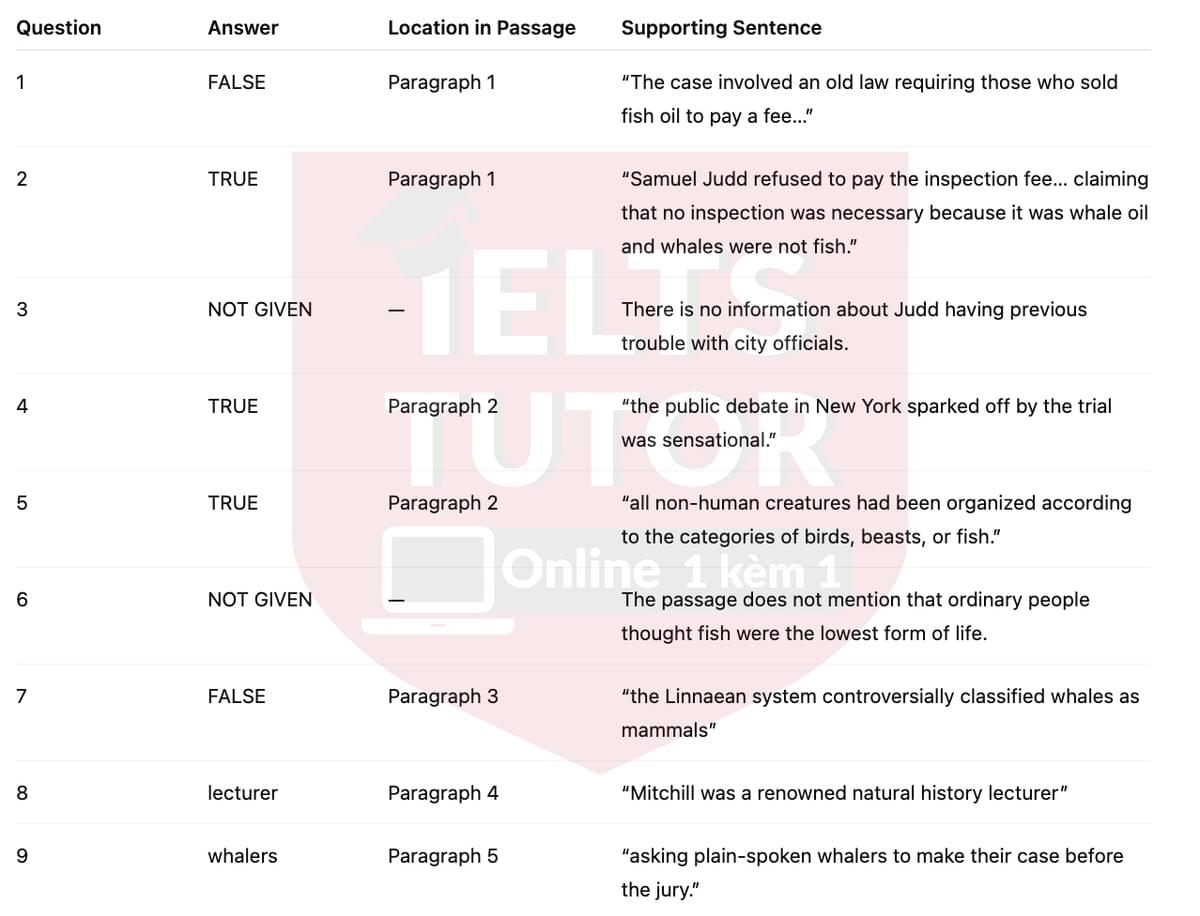
1. FALSE
2. TRUE
3. NOT GIVEN
4. TRUE
5. TRUE
6. NOT GIVEN
7. FALSE
8. lecturer
9. whalers
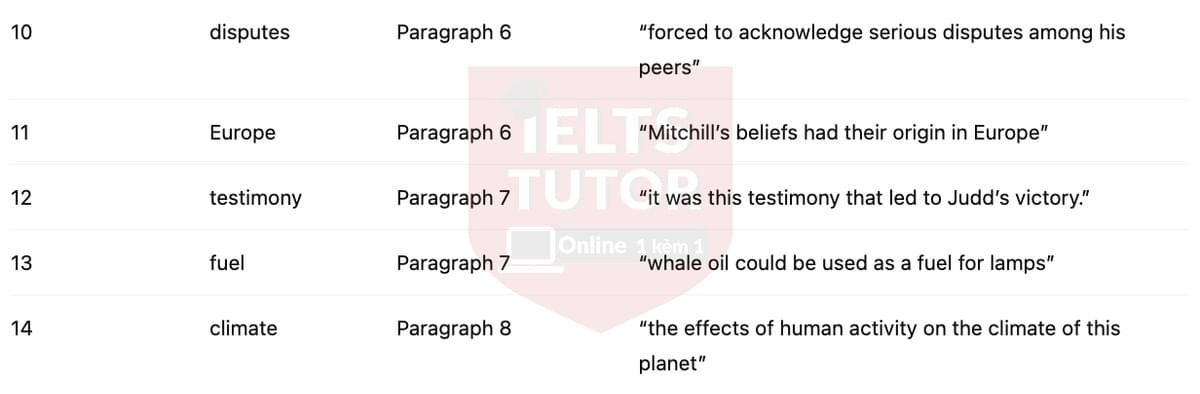
10. disputes
11. Europe
12. testimony
13. fuel
14. climate
📩 MN AI CHƯA CÓ ĐÁP ÁN FORECAST QUÝ MỚI PART 1-2-3 NHẮN ZL 0905834420 IELTS TUTOR GỬI FREE HẾT NHA

Các khóa học IELTS online 1 kèm 1 - 100% cam kết đạt target 6.0 - 7.0 - 8.0 - Đảm bảo đầu ra - Thi không đạt, học lại FREE
>> Thành tích học sinh IELTS TUTOR với hàng ngàn feedback được cập nhật hàng ngày
