
IELTS TUTOR cung cấp Walking With Dinosaurs Đề luyện tập IELTS READING (IELTS Reading Practice Test) - Làm bài online format computer-based, kèm đáp án, dịch & giải thích từ vựng - cấu trúc ngữ pháp khó & GIẢI ĐÁP ÁN VỚI LOCATION
I. Kiến thức liên quan
📩 MN AI CHƯA CÓ ĐÁP ÁN FORECAST QUÝ MỚI PART 1-2-3 NHẮN ZL 0905834420 IELTS TUTOR GỬI FREE HẾT NHA
II. Làm bài online (kéo xuống cuối bài blog để xem giải thích từ vựng & cấu trúc cụ thể hơn)
🦖 IELTS READING: Walking With Dinosaurs
Walking With Dinosaurs
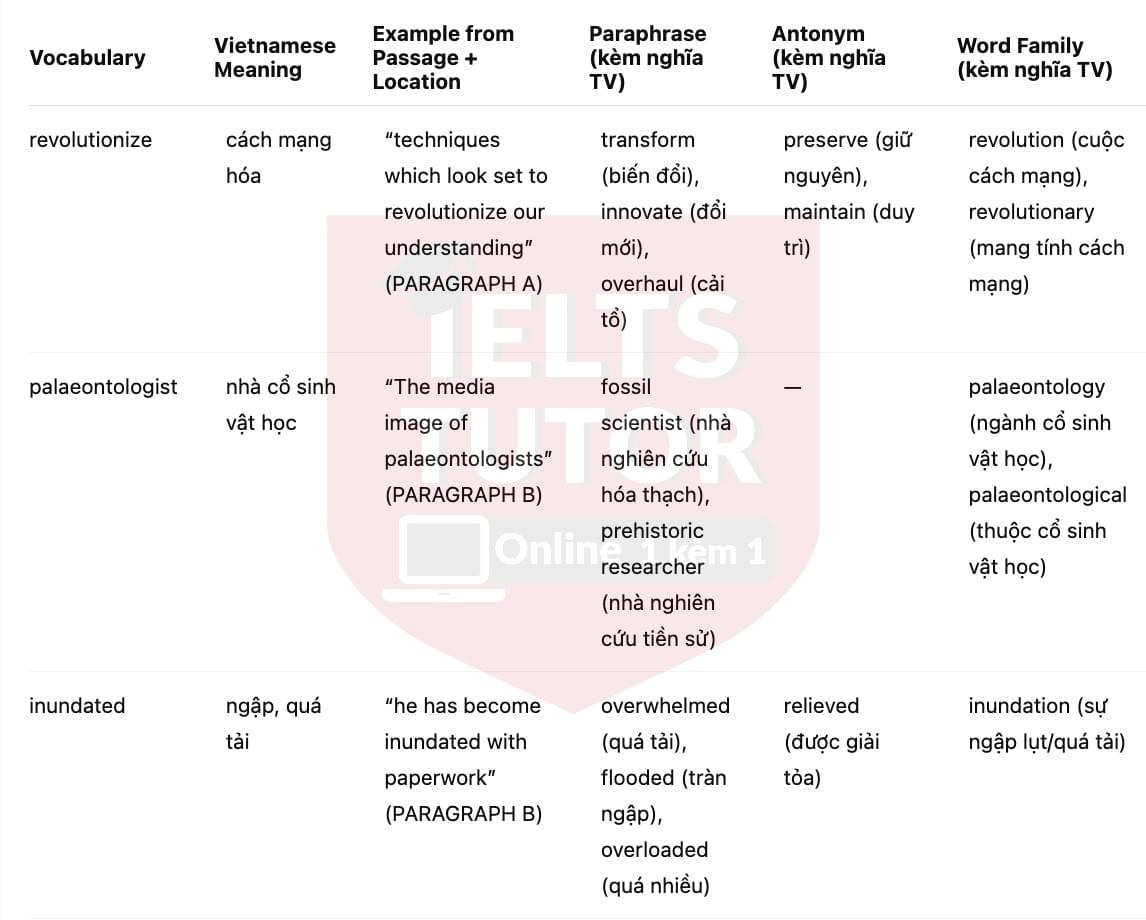
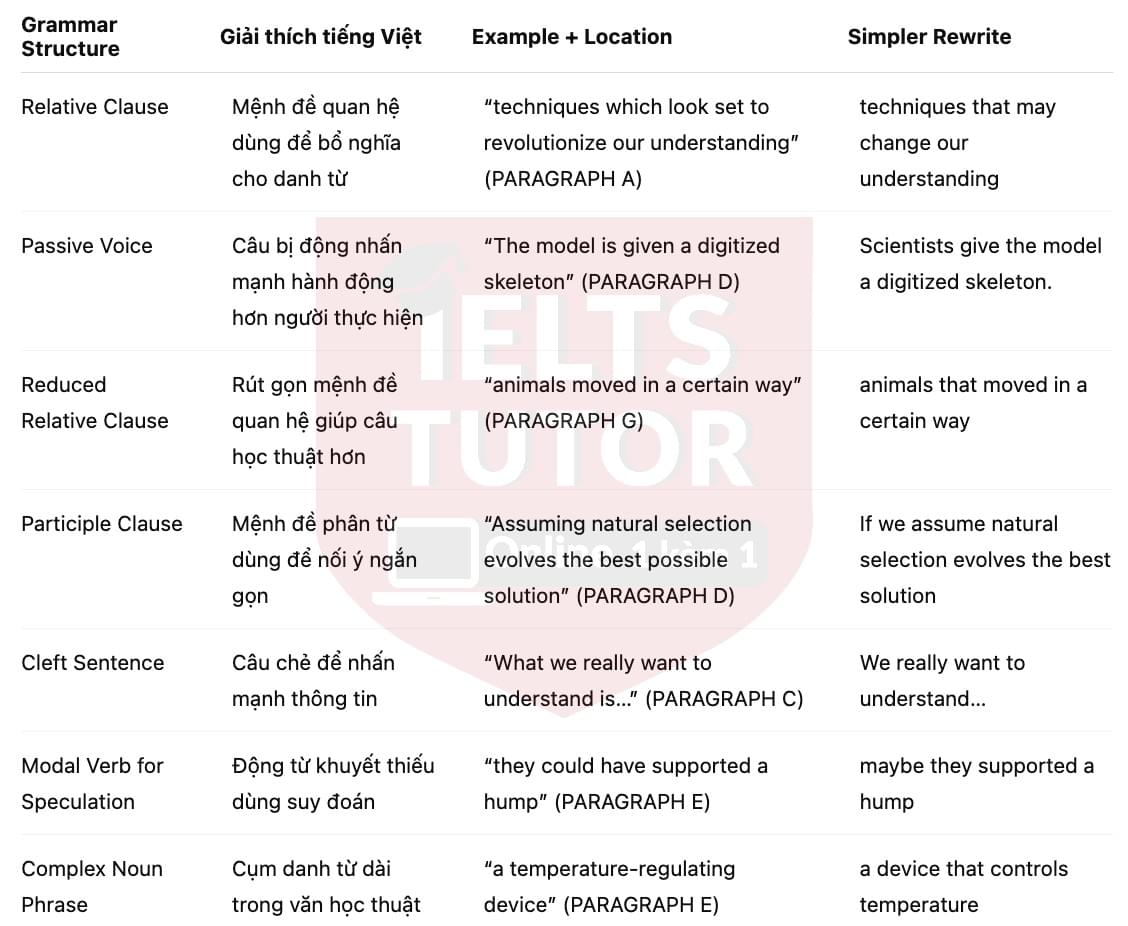
A Peter L. Falkingham and his colleagues at Manchester University are developing techniques which look set to revolutionize our understanding of how dinosaurs and other extinct animals behaved.
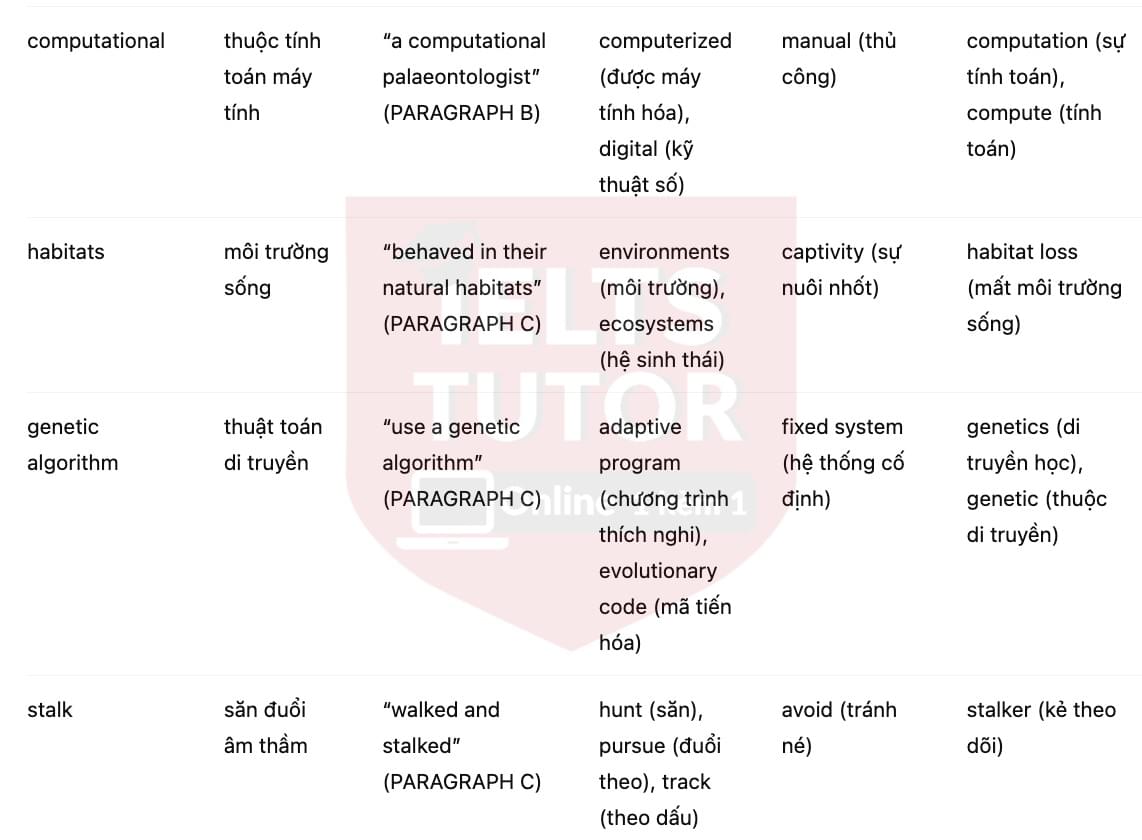
B The media image of palaeontologists who study prehistoric life is often of field workers camped in the desert in the hot sun, carefully picking away at the rock surrounding a large dinosaur bone. But Peter Falkingham has done little of that for a while now. Instead, he devotes himself to his computer. Not because he has become inundated with paperwork, but because he is a new kind of palaeontologist: a computational palaeontologist.
C What few people may consider is that uncovering a skeleton, or discovering a new species, is where the research begins, not where it ends. What we really want to understand is how the extinct animals and plants behaved in their natural habitats. Drs Bill Sellers and Phil Manning from the University of Manchester use a 'genetic algorithm—a kind of computer code that can change itself and 'evolve— to explore how extinct animals like dinosaurs, and our own early ancestors, walked and stalked.
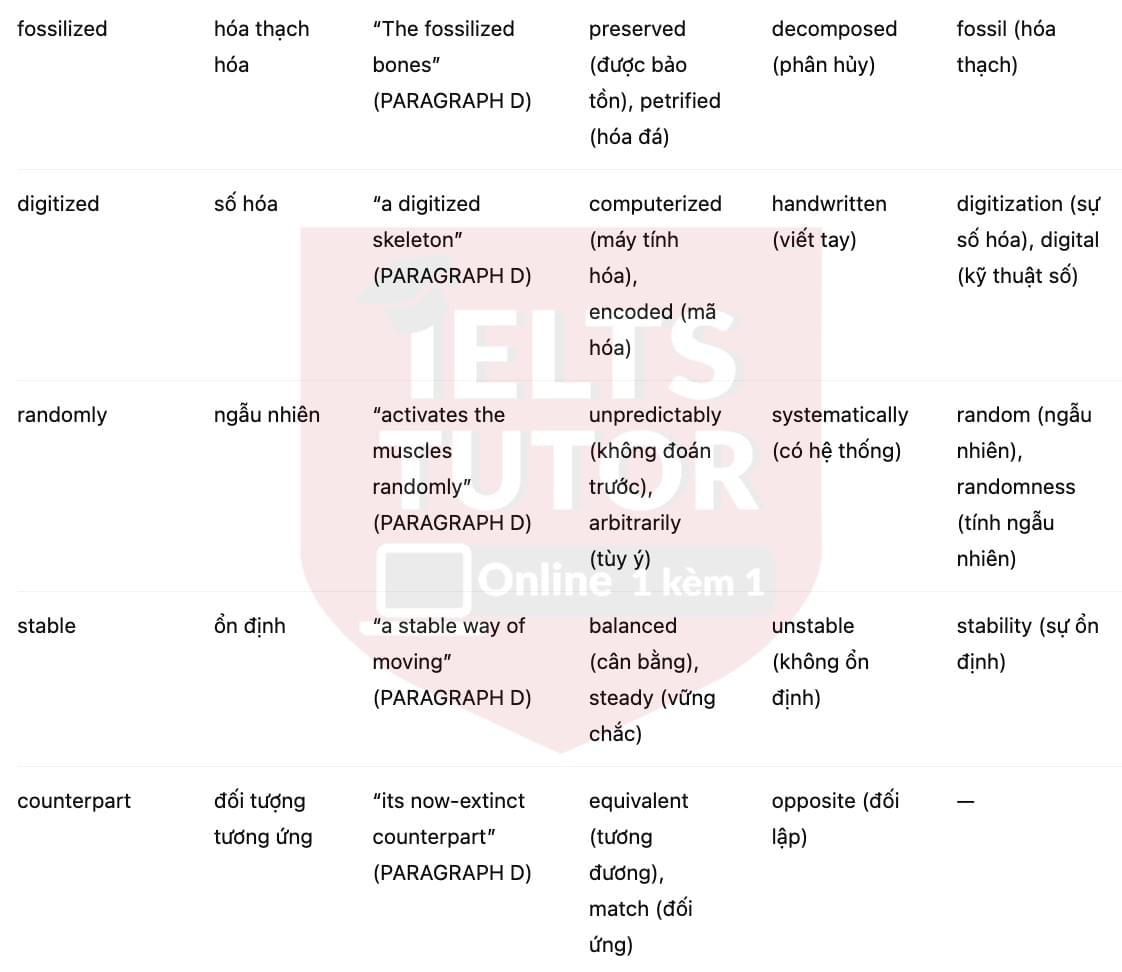
D The fossilized bones of a complete dinosaur skeleton can tell scientists a lot about the animal, but they do not make up the complete picture and the computer can try to fill the gap. The computer model is given a digitized skeleton, and the locations of known muscles. The model then randomly activates the muscles. This, perhaps unsurprisingly, results almost without fail in the animal falling on its face. So the computer alters the activation pattern and tries again... usually to similar effect. The modeled dinosaurs quickly 'evolve'. If there is any improvement, the computer discards the old pattern and adopts the new one as the base for alteration. Eventually, the muscle activation pattern evolves a stable way of moving, the best possible solution is reached, and the dinosaur can walk, run, chase or graze. Assuming natural selection evolves the best possible solution too, the modeled animal should be moving in a manner similar to its now-extinct counterpart. And indeed, using the same method for living animals (humans, emu and ostriches) similar top speeds were achieved on the computer as in reality. By comparing their cyberspace results with real measurements of living species, the Manchester team of palaeontologists can be confident in the results computed showing how extinct prehistoric animals such as dinosaurs moved.
E The Manchester University team have used the computer simulations to produce a model of a giant meat-eating dinosaur. It is called an acrocanthosaurus which literally means 'high spined lizard' because of the spines which run along its backbone. It is not really known why they are there but scientists have speculated they could have supported a hump that stored fat and water reserves. There are also those who believe that the spines acted as a support for a sail. Of these, one half think it was used as a display and could be flushed with blood and the other half think it was used as a temperature-regulating device. It may have been a mixture of the two. The skull seems out of proportion with its thick, heavy body because it is so narrow and the jaws are delicate and fine. The feet are also worthy of note as they look surprisingly small in contrast to the animal as a whole. It has a deep broad tail and powerful leg muscles to aid locomotion. It walked on its back legs and its front legs were much shorter with powerful claws.
F Falkingham himself is investigating fossilized tracks, or footprints, using computer simulations to help analyze how extinct animals moved. Modern-day trackers who study the habitats of wild animals can tell you what animal made a track, whether that animal was walking or running, sometimes even the sex of the animal. But a fossil track poses a more considerable challenge to interpret in the same way. A crucial consideration is knowing what the environment including the mud, or sediment, upon which the animal walked was like millions of years ago when the track was made. Experiments can answer these questions but the number of variables is staggering. To physically recreate each scenario with a box of mud is extremely time-consuming and difficult to repeat accurately. This is where computer simulation comes in.
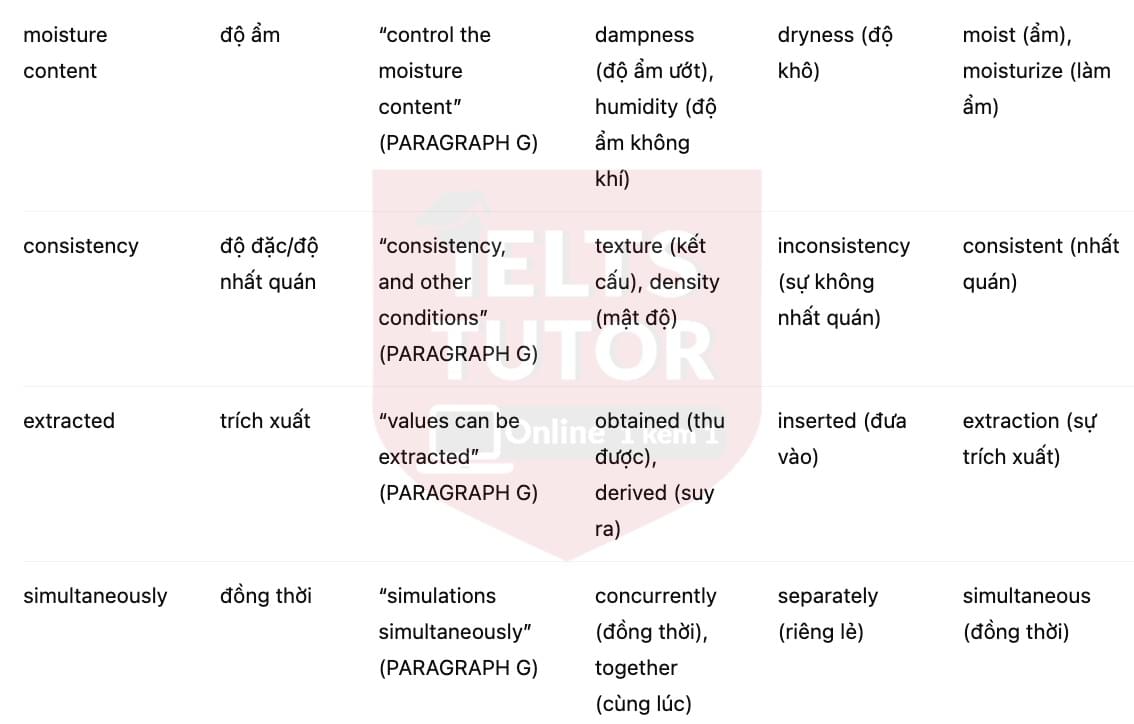
G Falkingham uses computational techniques to model a volume of mud and control the moisture content, consistency, and other conditions to simulate the mud of prehistoric times. A footprint is then made in the digital mud by a virtual foot. This footprint can be chopped up and viewed from any angle and stress values can be extracted and calculated from inside it. By running hundreds of these simulations simultaneously on supercomputers, Falkingham can start to understand what types of footprint would be expected if an animal moved in a certain way over a given kind of ground. Looking at the variation in the virtual tracks, researchers can make sense of fossil tracks with greater confidence.
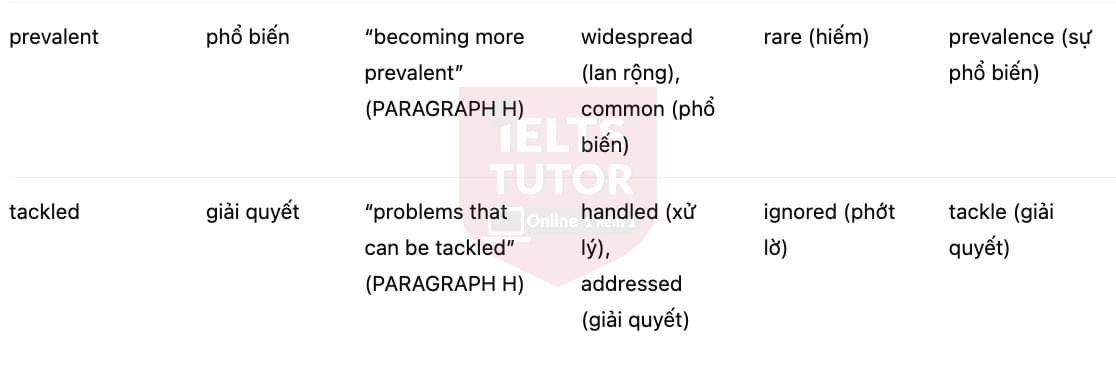
H The application of computational techniques in palaeontology is becoming more prevalent every year. As computer power continues to increase, the range of problems that can be tackled and questions that can be answered will only expand.
Questions 1-6 — YES / NO / NOT GIVEN
Questions 7-9 — Label diagram. ONE WORD from passage.
Questions 10-13 — Complete flow-chart. NO MORE THAN TWO WORDS.




III. Walking With Dinosaurs: Đề luyện tập IELTS READING (IELTS Reading Practice Test)
Walking With Dinosaurs
A Peter L. Falkingham and his colleagues at Manchester University are developing techniques which look set to revolutionize our understanding of how dinosaurs and other extinct animals behaved.
B The media image of palaeontologists who study prehistoric life is often of field workers camped in the desert in the hot sun, carefully picking away at the rock surrounding a large dinosaur bone. But Peter Falkingham has done little of that for a while now. Instead, he devotes himself to his computer. Not because he has become inundated with paperwork, but because he is a new kind of palaeontologist: a computational palaeontologist.
C What few people may consider is that uncovering a skeleton, or discovering a new species, is where the research begins, not where it ends. What we really want to understand is how the extinct animals and plants behaved in their natural habitats. Drs Bill Sellers and Phil Manning from the University of Manchester use a 'genetic algorithm—a kind of computer code that can change itself and 'evolve— to explore how extinct animals like dinosaurs, and our own early ancestors, walked and stalked.
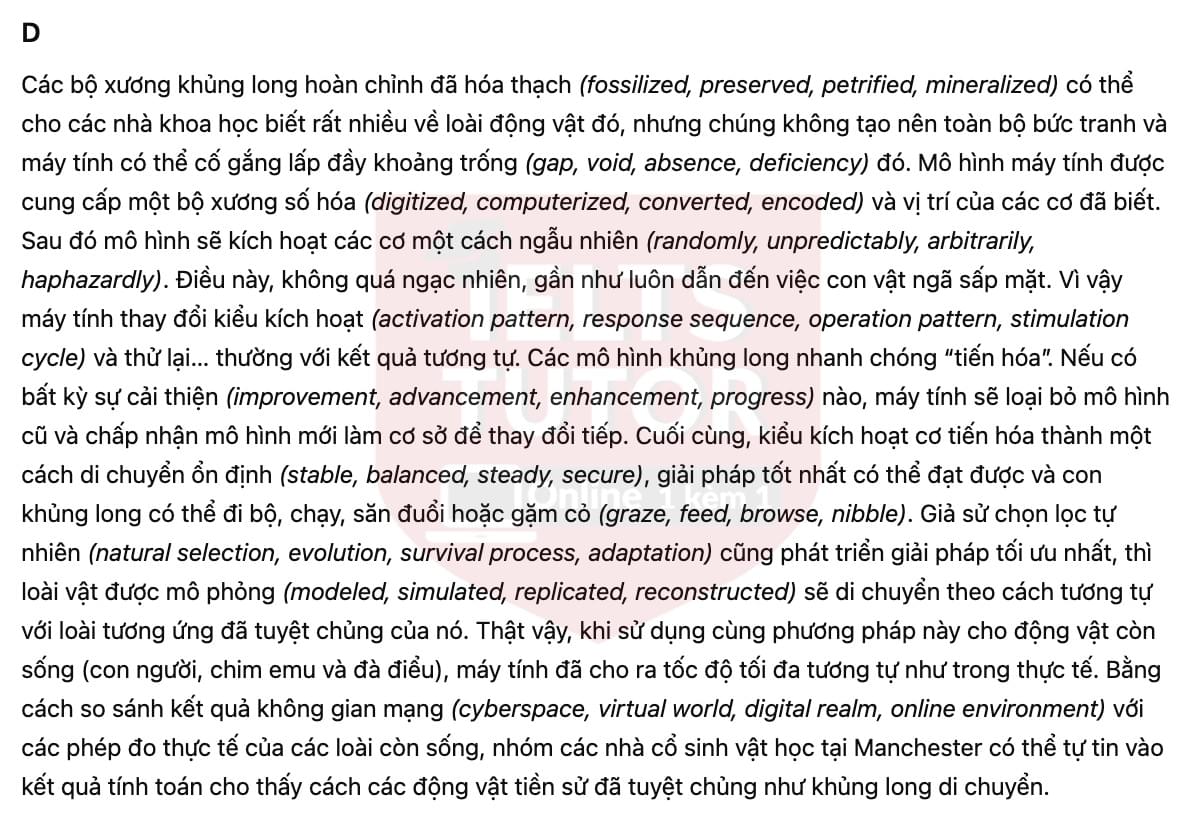
D The fossilized bones of a complete dinosaur skeleton can tell scientists a lot about the animal, but they do not make up the complete picture and the computer can try to fill the gap. The computer model is given a digitized skeleton, and the locations of known muscles. The model then randomly activates the muscles. This, perhaps unsurprisingly, results almost without fail in the animal falling on its face. So the computer alters the activation pattern and tries again... usually to similar effect. The modeled dinosaurs quickly 'evolve. If there is any improvement, the computer discards the old pattern and adopts the new one as the base for alteration. Eventually, the muscle activation pattern evolves a stable way of moving, the best possible solution is reached, and the dinosaur can walk, run, chase or graze. Assuming natural selection evolves the best possible solution too, the modeled animal should be moving in a manner similar to its now-extinct counterpart. And indeed, using the same method for living animals (humans, emu and ostriches) similar top speeds were achieved on the computer as in reality. By comparing their cyberspace results with real measurements of living species, the Manchester team of palaeontologists can be confident in the results computed showing how extinct prehistoric animals such as dinosaurs moved. >> 🔥 Form đăng kí giải đề thi thật IELTS 4 kĩ năng kèm bài giải bộ đề 100 đề PART 2 IELTS SPEAKING quý đang thi (update hàng tuần) từ IELTS TUTOR
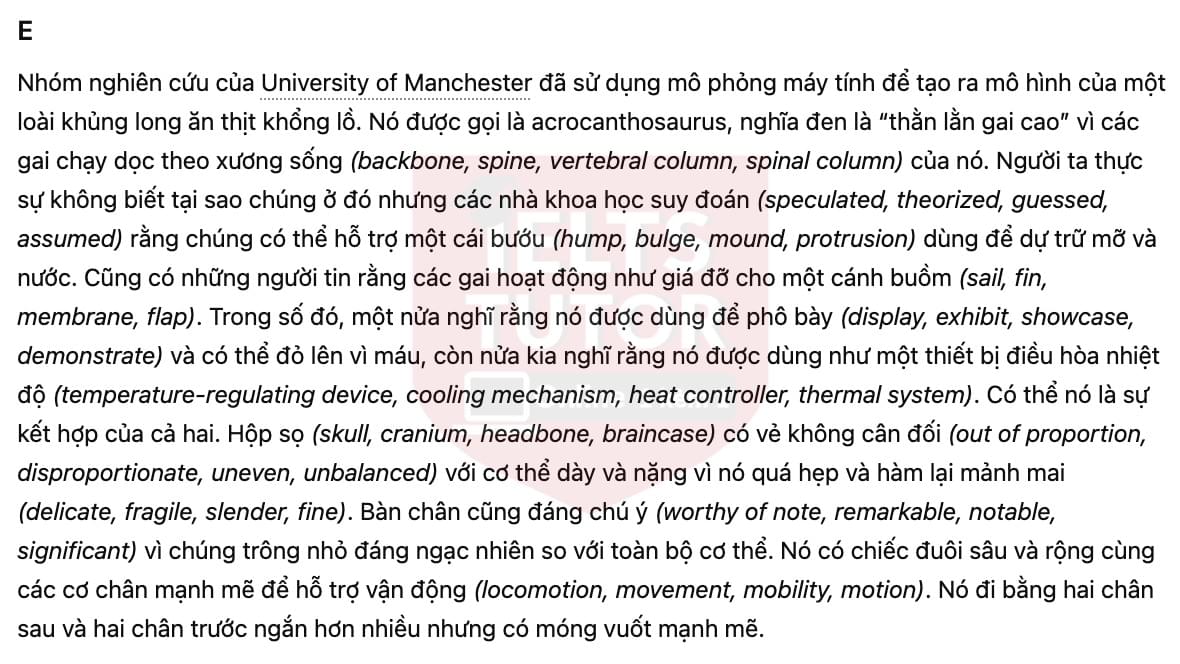
E The Manchester University team have used the computer simulations to produce a model of a giant meat-eating dinosaur. It is called an acrocanthosaurus which literally means 'high spined lizard because of the spines which run along its backbone. It is not really known why they are there but scientists have speculated they could have supported a hump that stored fat and water reserves. There are also those who believe that the spines acted as a support for a sail. Of these, one half think it was used as a display and could be flushed with blood and the other half think it was used as a temperature-regulating device. It may have been a mixture of the two. The skull seems out of proportion with its thick, heavy body because it is so narrow and the jaws are delicate and fine. The feet are also worthy of note as they look surprisingly small in contrast to the animal as a whole. It has a deep broad tail and powerful leg muscles to aid locomotion. It walked on its back legs and its front legs were much shorter with powerful claws.
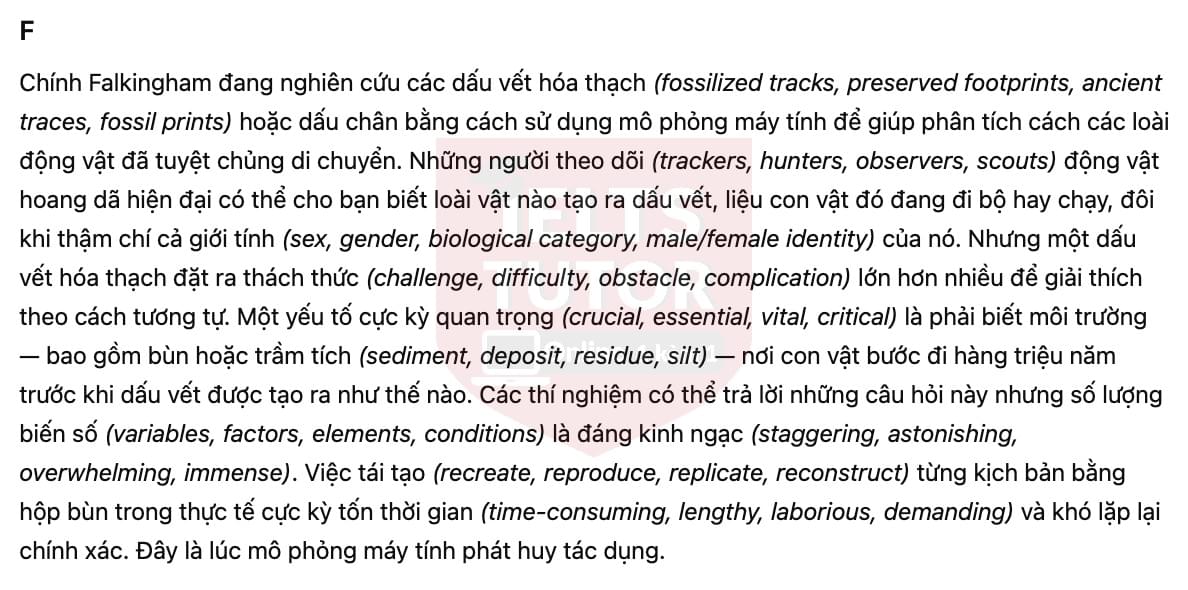
F Falkingham himself is investigating fossilized tracks, or footprints, using computer simulations to help analyze how extinct animals moved. Modern-day trackers who study the habitats of wild animals can tell you what animal made a track, whether that animal was walking or running, sometimes even the sex of the animal. But a fossil track poses a more considerable challenge to interpret in the same way. A crucial consideration is knowing what the environment including the mud, or sediment, upon which the animal walked was like millions of years ago when the track was made. Experiments can answer these questions but the number of variables is staggering. To physically recreate each scenario with a box of mud is extremely time-consuming and difficult to repeat accurately. This is where computer simulation comes in.
G Falkingham uses computational techniques to model a volume of mud and control the moisture content, consistency, and other conditions to simulate the mud of prehistoric times. A footprint is then made in the digital mud by a virtual foot. This footprint can be chopped up and viewed from any angle and stress values can be extracted and calculated from inside it. By running hundreds of these simulations simultaneously on supercomputers, Falkingham can start to understand what types of footprint would be expected if an animal moved in a certain way over a given kind of ground. Looking at the variation in the virtual tracks, researchers can make sense of fossil tracks with greater confidence. >> 🔥 Nhắn zalo 0905834420 join group zalo Hóng đề thi máy 4 skills để cập nhật đề thi thật 4 kĩ năng hằng ngày [Kèm giải & đề làm online]
H The application of computational techniques in palaeontology is becoming more prevalent every year. As computer power continues to increase, the range of problems that can be tackled and questions that can be answered will only expand.
Questions 1-6
Do the following statements agree with the information given in Reading Passage 12?
In boxes 1-6 below, write
YES if the statement agrees with the information
NO if the statement contradicts the information
NOT GIVEN if there is no information on this
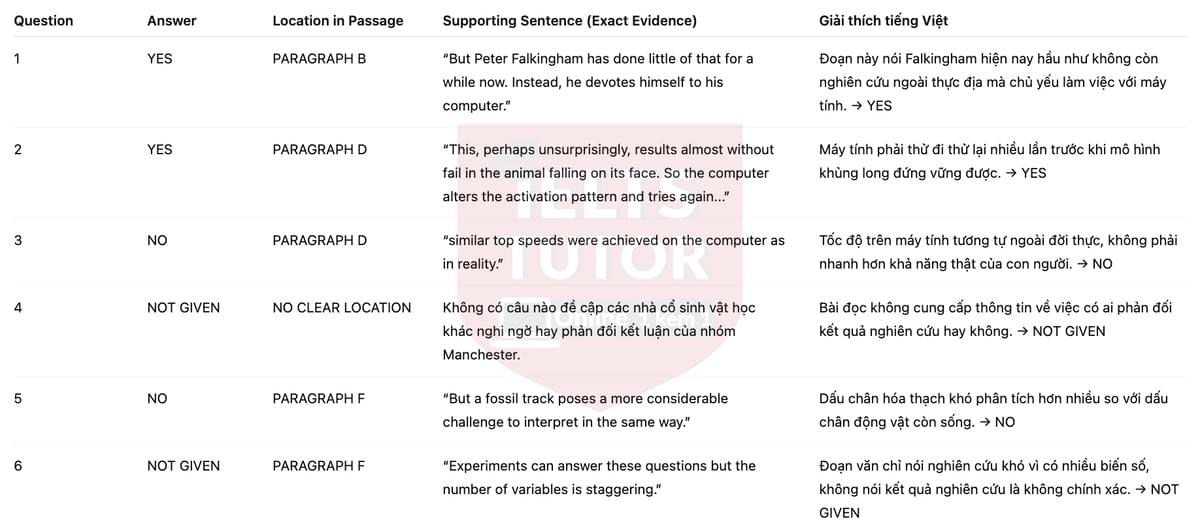
In his study of prehistoric life, Peter Falkingham rarely spends time on outdoor research these days.
O YES
O NO
O NOT GIVENSeveral attempts are usually needed before the computer model of a dinosaur used by Sellers and Manning manages to stay upright.
O YES
O NO
O NOT GIVENWhen the Sellers and Manning computer model was used for people, it showed them moving faster than they are physically able to.
O YES
O NO
O NOT GIVENSome palaeontologists have expressed reservations about the conclusions reached by the Manchester team concerning the movement of dinosaurs.
O YES
O NO
O NOT GIVENAn experienced tracker can analyze fossil footprints as easily as those made by live animals.
O YES
O NO
O NOT GIVENResearch carried out into the composition of prehistoric mud has been found to be inaccurate.
O YES
O NO
O NOT GIVEN >> 🔥 IELTS TUTOR gợi ý tham khảo CẦN VIẾT & THU ÂM BAO NHIÊU BÀI ĐỂ ĐẠT 8.0 SPEAKING & 7.0 WRITING?
Questions 7-9
Label the diagram below.
Choose NO MORE THAN ONE WORD from the passage for each answer.
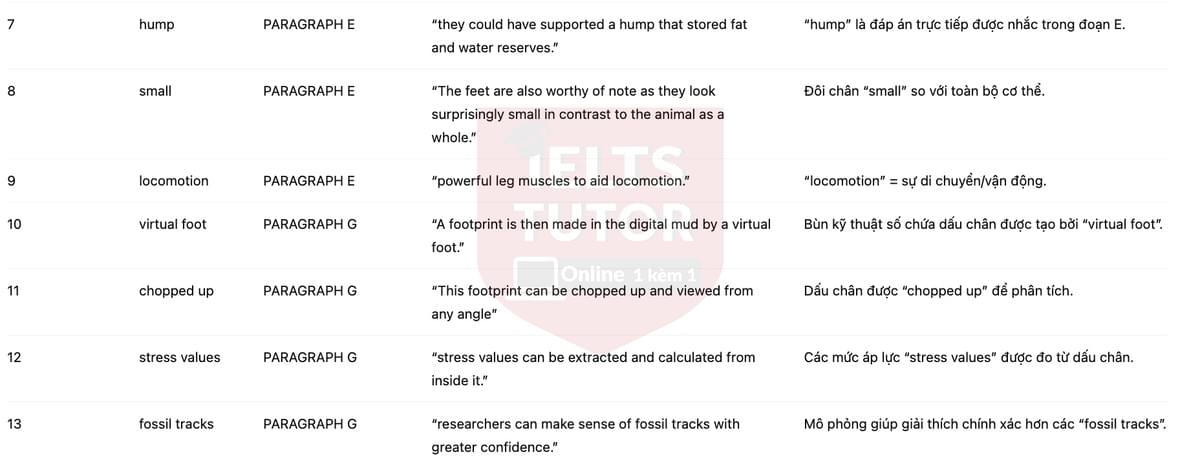
Dino's name comes from spines. One theory: they were necessary to hold up a ______
______ compared with rest of body
made cooler by wide tall and highly developed muscles in legs
Questions 10-13
Complete the flow-chart below.
Write NO MORE THAN TWO WORDS for each answer.
Peter Falkingham's computer model
STEP 01: Mud is simulated with attention to moisture content, consistency, and other conditions. It contains ______
STEP 02: A virtual foot produces a footprint in the mud.
STEP 03: The footprint is ______ and viewed from all angles.
STEP 04: Levels of ______ are measured within the footprint.
STEP 05: Multiple simulations create variations in the virtual tracks.
STEP 06: More accurate interpretation of ______ is possible.
IV. Dịch bài đọc Walking With Dinosaurs
V. Giải thích từ vựng Walking With Dinosaurs

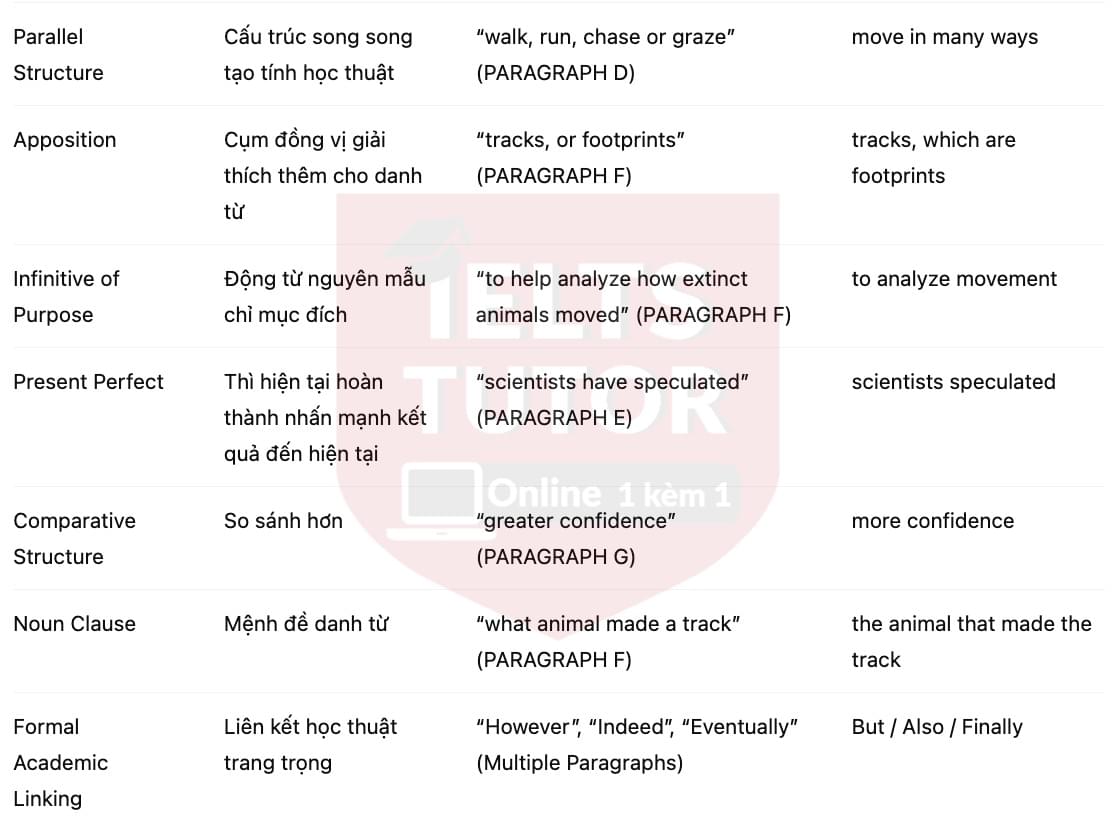
VI. Giải thích cấu trúc ngữ pháp khó Walking With Dinosaurs

VII. Đáp án Walking With Dinosaurs
1. YES
2. YES
3. NO
4. NOT GIVEN
5. NO
6. NOT GIVEN
7. hump
8. small
9. locomotion
10. virtual foot
11. chopped up
12. stress values
13. fossil tracks
📩 MN AI CHƯA CÓ ĐÁP ÁN FORECAST QUÝ MỚI PART 1-2-3 NHẮN ZL 0905834420 IELTS TUTOR GỬI FREE HẾT NHA

Các khóa học IELTS online 1 kèm 1 - 100% cam kết đạt target 6.0 - 7.0 - 8.0 - Đảm bảo đầu ra - Thi không đạt, học lại FREE
>> Thành tích học sinh IELTS TUTOR với hàng ngàn feedback được cập nhật hàng ngày
