
IELTS TUTOR cung cấp A much-travelled vegetable: Đề thi thật IELTS READING (IELTS Reading Recent Actual Test) - Làm bài online format computer-based, , kèm đáp án, dịch & giải thích từ vựng - cấu trúc ngữ pháp khó & GIẢI ĐÁP ÁN VỚI LOCATION
I. Kiến thức liên quan
II. Làm bài online (kéo xuống cuối bài blog để xem giải thích từ vựng & cấu trúc cụ thể hơn)
📖 IELTS READING · A MUCH-TRAVELLED VEGETABLE
The potato is a tuber – a short, thick, underground stem with stored starches and sugars – of the potato plant. It was given its botanical name, Solanum tuberosum, in 1596 by the Swiss botanist Gaspard Bauhin, and belongs to the Solanaceae family, the nightshades, which includes aubergines, peppers, and the tomato.
Growing wild as early as 13,000 years ago on the Chilean coast of South America, this tuber was cultivated by the inhabitants of the continent by 3,000 BCE. However, it was not until many years later that the Incan civilisation (mid-1400s to mid-1500s) realised the potato's true agricultural potential and grew it on a large scale. The climatic challenges of growing crops in the heights of South America's Andes Mountains are formidable. Radical swings in temperature – from highs of 17°C to lows below freezing, occur within a twenty-four-hour period and constantly disrupt the plants' physiological processes. Yet potatoes are ideally suited to these conditions; the plant grows in even the coldest areas and the hardiest species can survive at an altitude of 5,000 metres.
The Incas developed ingenious methods for cultivating and preserving potatoes on the steep mountain slopes. They carved terraces into the hillsides, creating flat platforms that prevented soil erosion and allowed for more efficient irrigation. To protect crops from frost, they developed a technique called ch'uño, which involved exposing potatoes to freezing night temperatures and then squeezing out the moisture by trampling them with bare feet. The resulting dehydrated product could be stored for years and provided a reliable food source during times of crop failure or harsh winters. This innovation was crucial to the expansion and maintenance of the vast Incan Empire, which at its height stretched for over 4,000 kilometres along the Andes.
When Spanish conquistadors led by Francisco Pizarro arrived in Peru in 1532, they encountered the potato for the first time. Initially, they were suspicious of this strange, knobbly tuber growing underground. The Spanish preferred foods that were mentioned in the Bible, and the potato had no such pedigree. Moreover, its membership in the nightshade family, some species of which were known to be poisonous, did little to inspire confidence. Nevertheless, the practical value of a crop that could feed armies and sailors on long voyages was undeniable. By the 1570s, the first potatoes had crossed the Atlantic, arriving in Spain and subsequently travelling to Italy, England, and other parts of Europe.
The potato's reception in Europe was mixed at best. In some regions, it was grown as a botanical curiosity in the gardens of the wealthy, admired for its pretty flowers rather than its edible tubers. In others, it was met with deep suspicion and outright hostility. Rumours spread that potatoes caused leprosy, syphilis, and other dreadful diseases. Religious authorities in some areas refused to baptise the vegetable, arguing that it was not mentioned in scripture. Peasants in Prussia and Russia initially resisted Frederick the Great's attempts to force potato cultivation upon them, viewing it as a degrading food fit only for animals. The potato's unfortunate appearance, with its knobbly shape and underground growth, led to associations with witchcraft and the devil in some folk traditions.
The transformation in the potato's fortunes came largely through necessity and the power of persuasion. In France, an eighteenth-century pharmacist and army chemist named Antoine-Augustin Parmentier dedicated years of his life to promoting the potato. Parmentier had been captured by the Prussians during the Seven Years' War and was fed nothing but potatoes in prison. He emerged in surprisingly good health, convinced of the tuber's nutritional virtues. Upon his return to France, he devised a brilliant public relations campaign. He convinced King Louis XVI and Queen Marie Antoinette to wear potato flowers in their lapels and hair, making the plant fashionable. He then planted potatoes on poor, sandy land outside Paris and placed armed guards around the fields during the day. At night, he deliberately withdrew the guards, allowing curious peasants to steal the "protected" crop. The strategy worked brilliantly, and potato cultivation spread rapidly across France.
By the nineteenth century, the potato had become a dietary staple across much of northern Europe. Its high yield per unit of land and exceptional nutritional content made it ideal for feeding rapidly growing populations. A single acre of potatoes could support a family for a year, whereas the same area planted with grain would provide far less sustenance. The potato provided abundant vitamin C, which helped eliminate scurvy in northern populations during winter months, and its cultivation required less skill and labour than grain farming. However, this dependence on a single crop proved disastrous when disaster struck. In Ireland, where the potato had become the primary food source for a third of the population, the arrival of a water mould called Phytophthora infestans in 1845 triggered the Great Famine. The blight destroyed potato crops across the country for several consecutive years, leading to the deaths of approximately one million people from starvation and disease, and forcing another million to emigrate.
The potato's journey was far from over. European colonists and traders carried it to new lands, establishing it as a crop in North America, Africa, Asia, and the Pacific. In each new environment, the adaptable tuber found a place, often becoming a cornerstone of local cuisines. India, China, and Russia are now among the world's largest potato producers, far exceeding the output of the vegetable's South American homeland. The potato had come full circle, from Andean staple to global commodity, feeding billions across the planet.
Perhaps the most extraordinary chapter in the potato's history began in the late twentieth century. As space agencies contemplated long-duration manned missions to Mars and beyond, the question of feeding astronauts became critical. Growing food in space offered obvious advantages over carrying all provisions from Earth. The potato, with its high nutritional density, compact growth habit, and adaptability to controlled environments, emerged as a leading candidate for space agriculture. In 1995, potato plants were grown aboard the Space Shuttle Columbia as part of experiments to understand plant growth in microgravity. Researchers at NASA and the University of Wisconsin developed specialised growth chambers to optimise tuber production in space. The results were promising: potatoes could indeed be grown in space, though challenges remained regarding pollination, water distribution, and radiation protection.
Today, the potato is the world's fourth-largest food crop, after maize, wheat, and rice. It feeds billions of people across every inhabited continent and is grown in more countries than any other crop except maize. The United Nations declared 2008 the International Year of the Potato, recognising its role in food security, poverty alleviation, and nutritional health. From its humble origins in the Andean highlands, through its transformation of European agriculture and its role in shaping world history, to its potential future in space colonies, the much-travelled vegetable continues its remarkable journey. The potato, once dismissed as fit only for animals and the desperate poor, has proven itself one of humanity's most valuable and versatile companions.
📩 MN AI CHƯA CÓ ĐÁP ÁN FORECAST QUÝ MỚI PART 1-2-3 NHẮN ZL 0905834420 IELTS TUTOR GỬI FREE HẾT NHA
III. A much-travelled vegetable: Đề thi thật IELTS READING (IELTS Reading Recent Actual Test)
A much-travelled vegetable
The history of the potato from ancient times to the space age
The potato is a tuber – a short, thick, underground stem with stored starches and sugars – of the potato plant. It was given its botanical name, Solanum tuberosum, in 1596 by the Swiss botanist Gaspard Bauhin, and belongs to the Solanaceae family, the nightshades, which includes aubergines, peppers, and the tomato.
Growing wild as early as 13,000 years ago on the Chilean coast of South America, this tuber was cultivated by the inhabitants of the continent by 3,000 BCE. However, it was not until many years later that the Incan civilisation (mid-1400s to mid-1500s) realised the potato's true agricultural potential and grew it on a large scale. The climatic challenges of growing crops in the heights of South America's Andes Mountains are formidable. Radical swings in temperature – from highs of 17°C to lows below freezing, occur within a twenty-four-hour period and constantly disrupt the plants' physiological processes. Yet potatoes are ideally suited to these conditions; the plant grows in even the coldest areas and the hardiest species can survive at an altitude of 5,000 metres.
The Incas developed ingenious methods for cultivating and preserving potatoes on the steep mountain slopes. They carved terraces into the hillsides, creating flat platforms that prevented soil erosion and allowed for more efficient irrigation. To protect crops from frost, they developed a technique called ch'uño, which involved exposing potatoes to freezing night temperatures and then squeezing out the moisture by trampling them with bare feet. The resulting dehydrated product could be stored for years and provided a reliable food source during times of crop failure or harsh winters. This innovation was crucial to the expansion and maintenance of the vast Incan Empire, which at its height stretched for over 4,000 kilometres along the Andes. >> 🔥 Form đăng kí giải đề thi thật IELTS 4 kĩ năng kèm bài giải bộ đề 100 đề PART 2 IELTS SPEAKING quý đang thi (update hàng tuần) từ IELTS TUTOR
When Spanish conquistadors led by Francisco Pizarro arrived in Peru in 1532, they encountered the potato for the first time. Initially, they were suspicious of this strange, knobbly tuber growing underground. The Spanish preferred foods that were mentioned in the Bible, and the potato had no such pedigree. Moreover, its membership in the nightshade family, some species of which were known to be poisonous, did little to inspire confidence. Nevertheless, the practical value of a crop that could feed armies and sailors on long voyages was undeniable. By the 1570s, the first potatoes had crossed the Atlantic, arriving in Spain and subsequently travelling to Italy, England, and other parts of Europe.
The potato's reception in Europe was mixed at best. In some regions, it was grown as a botanical curiosity in the gardens of the wealthy, admired for its pretty flowers rather than its edible tubers. In others, it was met with deep suspicion and outright hostility. Rumours spread that potatoes caused leprosy, syphilis, and other dreadful diseases. Religious authorities in some areas refused to baptise the vegetable, arguing that it was not mentioned in scripture. Peasants in Prussia and Russia initially resisted Frederick the Great's attempts to force potato cultivation upon them, viewing it as a degrading food fit only for animals. The potato's unfortunate appearance, with its knobbly shape and underground growth, led to associations with witchcraft and the devil in some folk traditions.
The transformation in the potato's fortunes came largely through necessity and the power of persuasion. In France, an eighteenth-century pharmacist and army chemist named Antoine-Augustin Parmentier dedicated years of his life to promoting the potato. Parmentier had been captured by the Prussians during the Seven Years' War and was fed nothing but potatoes in prison. He emerged in surprisingly good health, convinced of the tuber's nutritional virtues. Upon his return to France, he devised a brilliant public relations campaign. He convinced King Louis XVI and Queen Marie Antoinette to wear potato flowers in their lapels and hair, making the plant fashionable. He then planted potatoes on poor, sandy land outside Paris and placed armed guards around the fields during the day. At night, he deliberately withdrew the guards, allowing curious peasants to steal the "protected" crop. The strategy worked brilliantly, and potato cultivation spread rapidly across France.
By the nineteenth century, the potato had become a dietary staple across much of northern Europe. Its high yield per unit of land and exceptional nutritional content made it ideal for feeding rapidly growing populations. A single acre of potatoes could support a family for a year, whereas the same area planted with grain would provide far less sustenance. The potato provided abundant vitamin C, which helped eliminate scurvy in northern populations during winter months, and its cultivation required less skill and labour than grain farming. However, this dependence on a single crop proved disastrous when disaster struck. In Ireland, where the potato had become the primary food source for a third of the population, the arrival of a water mould called Phytophthora infestans in 1845 triggered the Great Famine. The blight destroyed potato crops across the country for several consecutive years, leading to the deaths of approximately one million people from starvation and disease, and forcing another million to emigrate.
The potato's journey was far from over. European colonists and traders carried it to new lands, establishing it as a crop in North America, Africa, Asia, and the Pacific. In each new environment, the adaptable tuber found a place, often becoming a cornerstone of local cuisines. India, China, and Russia are now among the world's largest potato producers, far exceeding the output of the vegetable's South American homeland. The potato had come full circle, from Andean staple to global commodity, feeding billions across the planet. >> 🔥 Nhắn zalo 0905834420 join group zalo Hóng đề thi máy 4 skills để cập nhật đề thi thật 4 kĩ năng hằng ngày [Kèm giải & đề làm online]
Perhaps the most extraordinary chapter in the potato's history began in the late twentieth century. As space agencies contemplated long-duration manned missions to Mars and beyond, the question of feeding astronauts became critical. Growing food in space offered obvious advantages over carrying all provisions from Earth. The potato, with its high nutritional density, compact growth habit, and adaptability to controlled environments, emerged as a leading candidate for space agriculture. In 1995, potato plants were grown aboard the Space Shuttle Columbia as part of experiments to understand plant growth in microgravity. Researchers at NASA and the University of Wisconsin developed specialised growth chambers to optimise tuber production in space. The results were promising: potatoes could indeed be grown in space, though challenges remained regarding pollination, water distribution, and radiation protection.
Today, the potato is the world's fourth-largest food crop, after maize, wheat, and rice. It feeds billions of people across every inhabited continent and is grown in more countries than any other crop except maize. The United Nations declared 2008 the International Year of the Potato, recognising its role in food security, poverty alleviation, and nutritional health. From its humble origins in the Andean highlands, through its transformation of European agriculture and its role in shaping world history, to its potential future in space colonies, the much-travelled vegetable continues its remarkable journey. The potato, once dismissed as fit only for animals and the desperate poor, has proven itself one of humanity's most valuable and versatile companions.
Questions 1–5
Do the following statements agree with the information given in Reading Passage 1?
In boxes 1–5 on your answer sheet, write
TRUE if the statement agrees with the information
FALSE if the statement contradicts the information
NOT GIVEN if there is no information on this
The potato's botanical name was given by a Swiss botanist in the sixteenth century.
The Incas were the first people to cultivate potatoes anywhere in the world.
The Incan technique of making ch'uño involved drying potatoes in the sun for several months.
Spanish conquistadors immediately recognised the potato's value as a food crop upon arriving in Peru.
Antoine-Augustin Parmentier deliberately used trickery to encourage French peasants to grow potatoes.
Questions 6–10
Complete the sentences below.
Choose ONE WORD ONLY from the passage for each answer.
Write your answers in boxes 6–10 on your answer sheet.
The Incas carved __________ into mountainsides to create flat areas for planting potatoes.
To make ch'uño, the Incas removed moisture by __________ on the potatoes with their feet.
Some Europeans believed that eating potatoes could cause __________, a serious disease affecting the skin and nerves.
In Prussia and Russia, peasants initially regarded potatoes as food suitable only for __________.
The potato's high content of vitamin C helped prevent __________ in northern European populations during winter. >> 🔥 IELTS TUTOR gợi ý tham khảo CẦN VIẾT & THU ÂM BAO NHIÊU BÀI ĐỂ ĐẠT 8.0 SPEAKING & 7.0 WRITING?
Questions 11–13
Answer the questions below.
Choose NO MORE THAN THREE WORDS AND/OR A NUMBER from the passage for each answer.
Write your answers in boxes 11–13 on your answer sheet.
What was the name of the water mould that caused the Irish potato blight in the 1840s?
In which year were potato plants grown aboard the Space Shuttle Columbia?
After maize, wheat, and rice, which crop is the world's fourth-largest food crop?
IV. Dịch bài đọc A much-travelled vegetable
V. Giải thích từ vựng A much-travelled vegetable
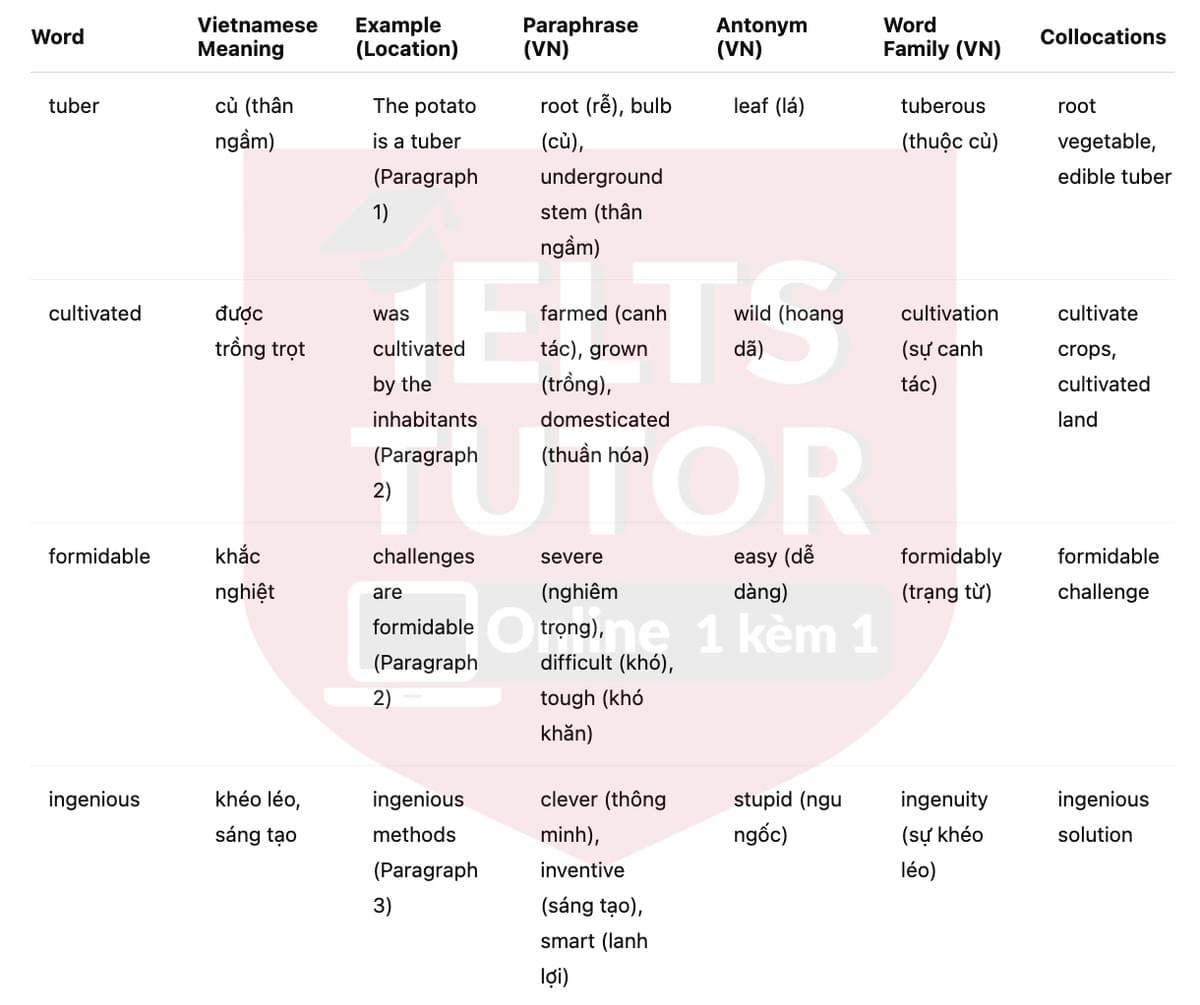
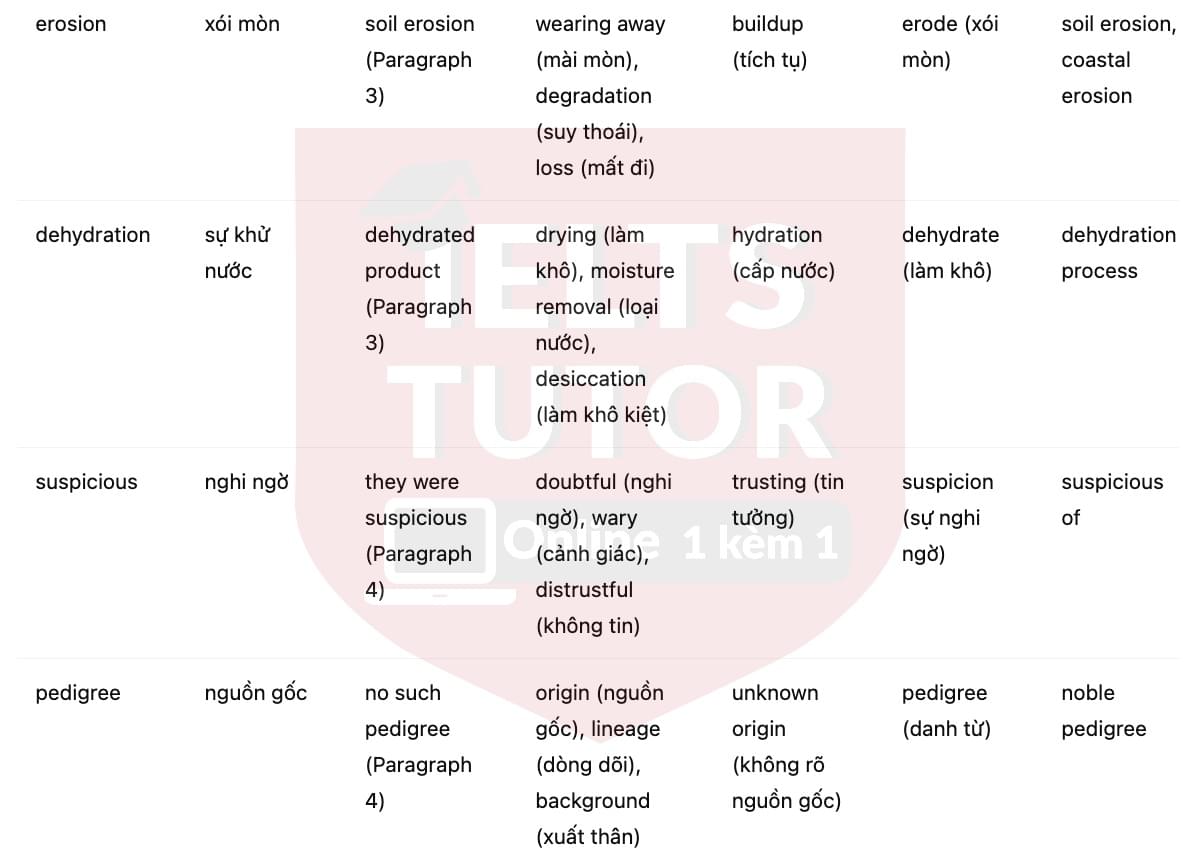
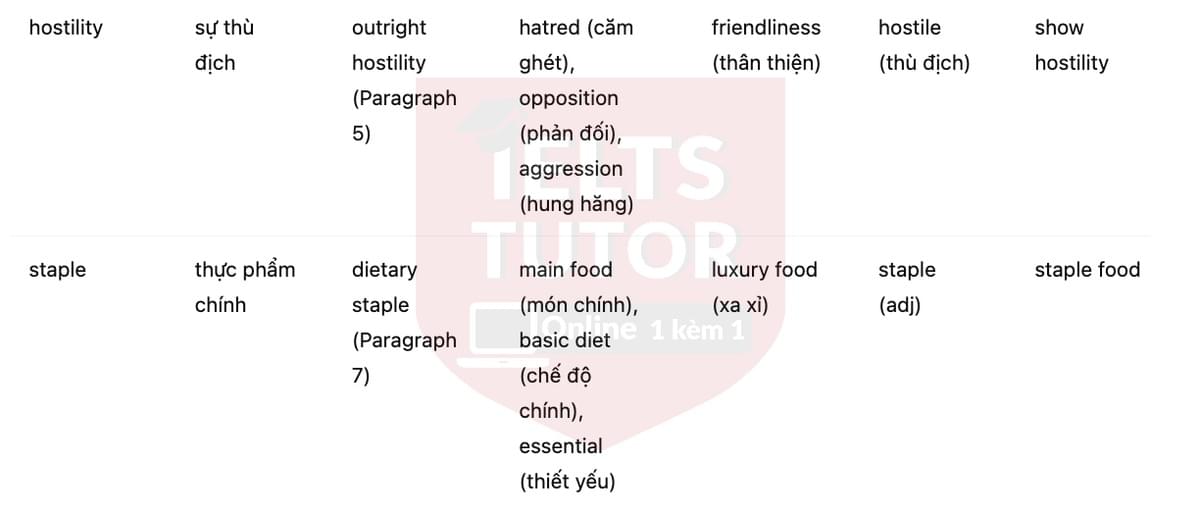
VI. Giải thích cấu trúc ngữ pháp khó A much-travelled vegetable
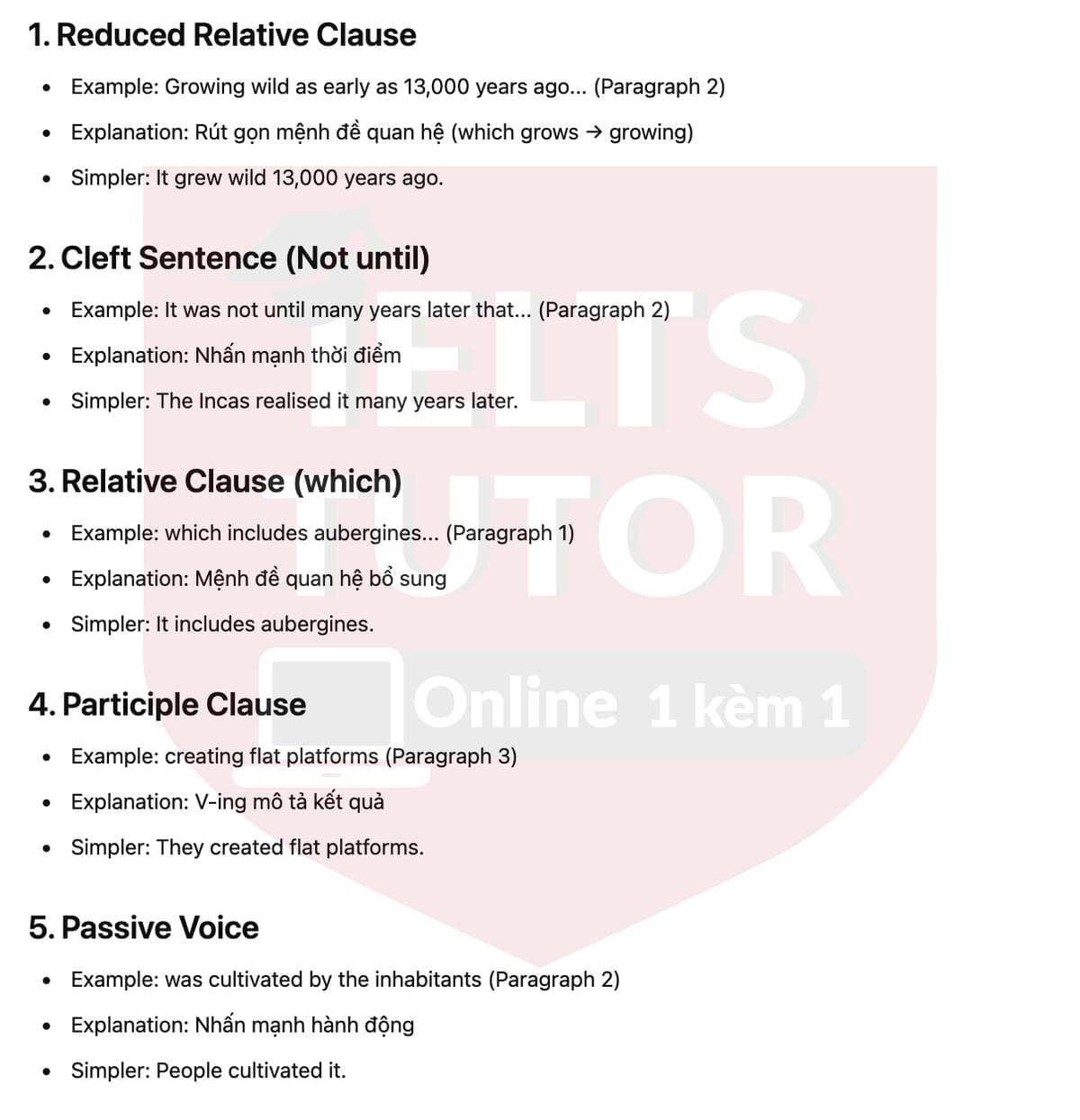

VII. Đáp án A much-travelled vegetable
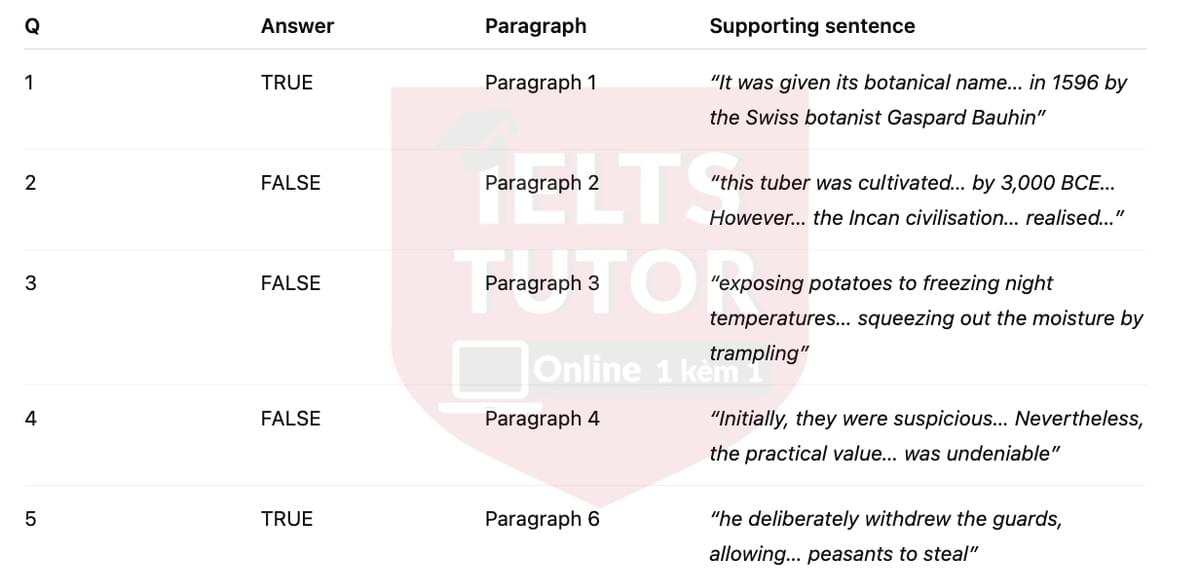
1. TRUE
2. FALSE
3. FALSE
4. FALSE
5. TRUE
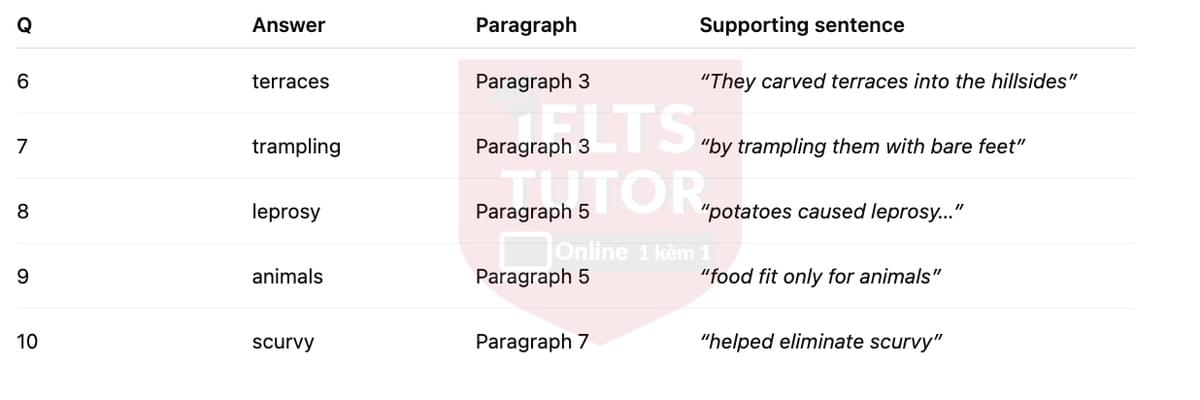
6. terraces
7. trampling
8. leprosy
9. animals
10. scurvy
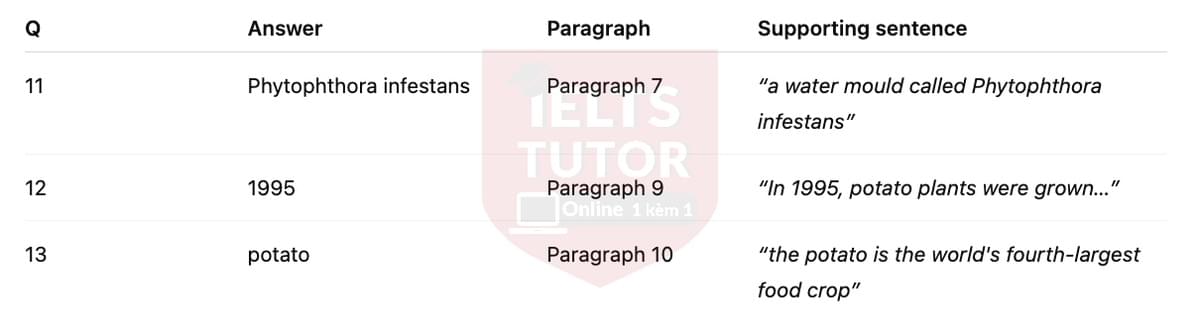
11. Phytophthora infestans
12. 1995
13. potato
📩 MN AI CHƯA CÓ ĐÁP ÁN FORECAST QUÝ MỚI PART 1-2-3 NHẮN ZL 0905834420 IELTS TUTOR GỬI FREE HẾT NHA

Các khóa học IELTS online 1 kèm 1 - 100% cam kết đạt target 6.0 - 7.0 - 8.0 - Đảm bảo đầu ra - Thi không đạt, học lại FREE
>> Thành tích học sinh IELTS TUTOR với hàng ngàn feedback được cập nhật hàng ngày
