
IELTS TUTOR cung cấp Australia's Airborne Dentists: Đề thi thật IELTS READING (IELTS Reading Recent Actual Test) - Làm bài online format computer-based, , kèm đáp án, dịch & giải thích từ vựng - cấu trúc ngữ pháp khó & GIẢI ĐÁP ÁN VỚI LOCATION
I. Kiến thức liên quan
II. Làm bài online (kéo xuống cuối bài blog để xem giải thích từ vựng & cấu trúc cụ thể hơn)
📩 MN AI CHƯA CÓ ĐÁP ÁN FORECAST QUÝ MỚI PART 1-2-3 NHẮN ZL 0905834420 IELTS TUTOR GỬI FREE HẾT NHA
You should spend about 20 minutes on Questions 1-13
Australia's Airborne Dentists
Australians living or traveling in rural and remote areas can face particular difficulties when they need medical care. Hundreds of kilometres from major cities and many hours by road from the closest hospital or clinic, some rural Australians do not have easy access to doctors, nurses and dentists.
Organisations such as the Royal Flying Doctor Service (RFDS) have been established to bring health services to outback Australian communities. The RFDS provides free medical care to people who live, work or travel in remote and regional parts of Australia. This non-profit organisation is the oldest and largest airborne health service of its kind in the world, and since 1928 it has used small aircraft to provide health services to some of Australia's most far-away communities.
In recent years, the RFDS has also started to fly dentists to regional Australia. As well as offering mobile dental clinics, the RFDS offers a range of preventative and educational services. Looking after the teeth of people in remote areas presents special challenges. These include providing care to disparate communities with no established dental facilities, and dealing with higher incidences of other diseases which are linked to, or caused by poor dental health.
People in remote areas have very infrequent visits by health staff. RFDS dentists might only visit a community once every few months, or sometimes once per year. Because of infrequent dentist visits, patients in these areas often need to put up with their dental problems before they can get treatment; consequently, people in remote areas are more likely to have tooth decay (the blackening and deterioration of teeth) and develop gum and other mouth diseases.
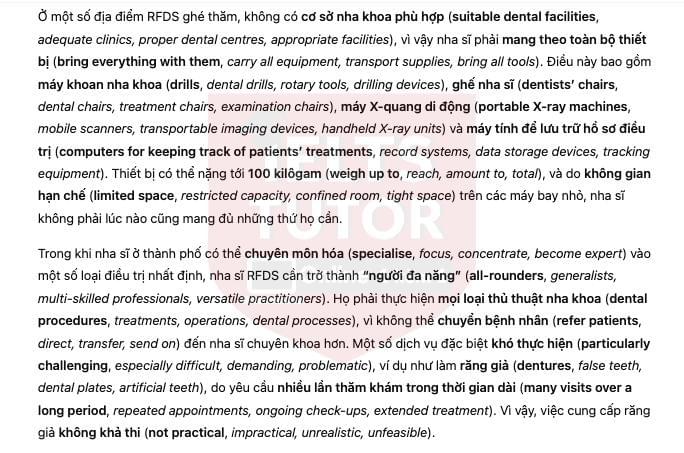
In some locations that the RFDS visits, there are no suitable dental facilities, so dentists have to bring everything with them. This includes drills, dentists' chairs, portable X-ray machines, and computers for keeping track of patients' treatments. Equipment can weigh up to 100 kilograms, and since the small planes that transport dentists have limited space, dentists cannot always bring everything that they need.
While dentists in town or city centres can specialise in certain types of treatment, RFDS dentists need to be 'all-rounders'. They need to be able to do all kinds of dental procedures, as they don't have the ability to refer patients to more specialised dentists. Even with their broad experience, there are some services that are particularly challenging for RFDS dentists. For example, dentures (for artificial teeth) can be very difficult to provide, as they need to be the right shape and size for the patient, and this requires many visits over a long period of time. As a result, it is not practical to make dentures available.
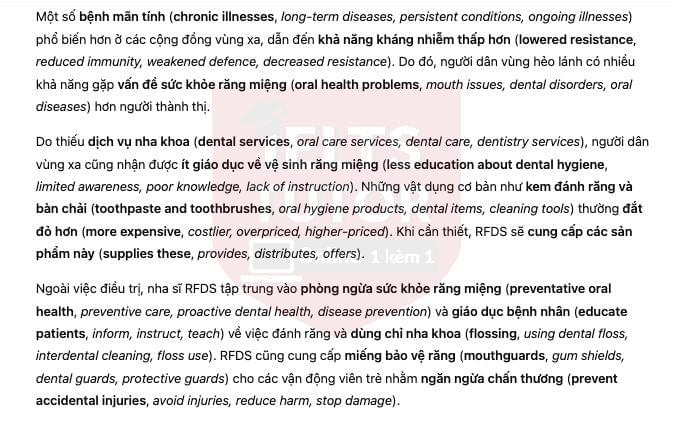
Some chronic illnesses are more common in remote communities than in the rest of Australia. These illnesses can in turn lead to a lowered resistance to infection, including gum and other oral infections. As a result, people in outback Australian communities are more likely to experience oral health problems than city folk, and this poses extra challenges for both the dentists and the doctors of the RFDS.
Because there aren't a lot of dental services in remote areas, people living in these areas also receive less education about good dental hygiene than their city counterparts do. Australians in very remote communities might not be aware of things that people in cities take for granted, such as the importance of daily tooth brushing. Also, basic dental hygiene items such as toothpaste and toothbrushes can be more expensive in outback areas. Many people are on low incomes, meaning they have extra difficulty affording these products. If this is the case, the RFDS supplies these.
As well as treating patients, RFDS dentists try to focus on preventative oral health and educate their patients on good oral hygiene, such as tooth brushing and flossing. The RFDS also provides mouthguards for young sports players. Playing contact sports, such as rugby league or Australian rules football, can damage young people's teeth, so mouthguards provide protection which prevents accidental injuries.
Adding fluoride to water supplies has been proven to reduce the incidence of tooth decay in many parts of the world. City dwellers in Australia use water supplies that have been fluoridated, and their rates of tooth decay are lower because of this. In remote areas, it is not practical to fluoridate drinking water supplies, and so people living in these areas are more subject to tooth decay. As a result, it is particularly important that people living in areas without fluoridated water pay special attention to regular brushing of their teeth with fluoridated toothpaste.
Despite many challenges, the RFDS continues to offer much-needed dental and medical support. Its presence in isolated communities greatly improves the quality of dental health, and supports important oral hygiene and health initiatives.
Questions 1-7
Do the following statements agree with the information given in Reading Passage 1?
In boxes 1-7 on your answer sheet, write:
TRUE - if the statement agrees with the information
FALSE - if the statement contradicts the information
NOT GIVEN - if there is no information on this
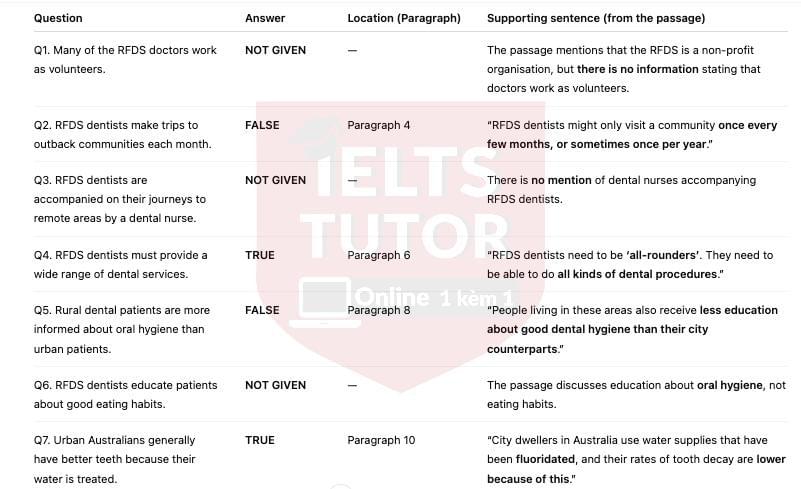
1. Many of the RFDS doctors work as volunteers.
2. RFDS dentists make trips to outback communities each month.
3. RFDS dentists are accompanied on their journeys to remote areas by a dental nurse.
4. RFDS dentists must provide a wide range of dental services.
5. Rural dental patients are more informed about oral hygiene than urban patients.
6. RFDS dentists educate patients about good eating habits.
7. Urban Australians generally have better teeth because their water is treated.
Questions 8-13
Complete the notes below.
Choose ONE WORD ONLY from the passage for each answer.
Write your answers in boxes 8-13 on your answer sheet.
Challenges faced by RFDS dentists
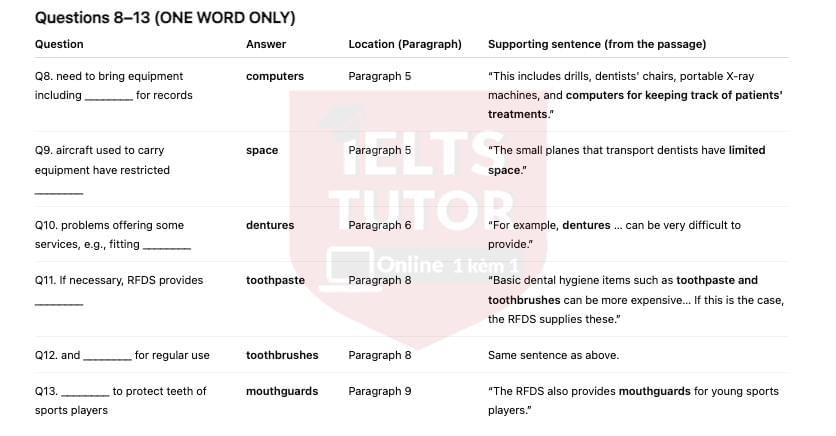
8. need to bring equipment including for records
9. aircraft used to carry equipment have restricted
10. problems offering some services, e.g., fitting
11. people in remote areas are more likely to have infection in their mouth
Products supplied by RFDS dentists
If necessary, RFDS provides:
12. and 13. for regular use
14. to protect teeth of sports players



III. Australia's Airborne Dentists: Đề thi thật IELTS READING (IELTS Reading Recent Actual Test)
READING PASSAGE 1
You should spend about 20 minutes on Questions 1-13, which are based on Reading Passage 1.
Australia's Airborne Dentists
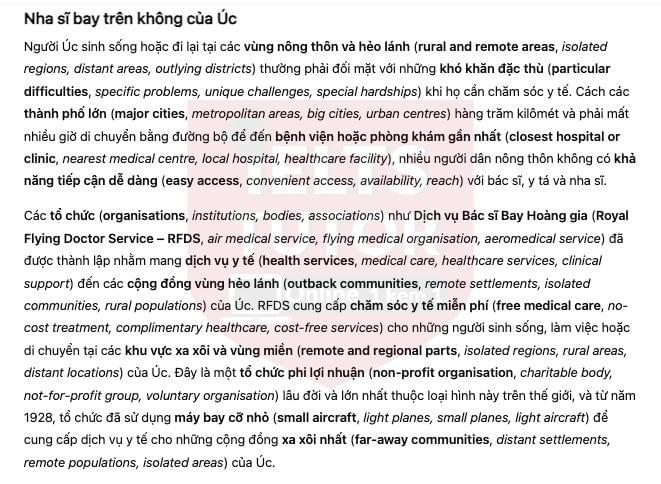
Australians living or traveling in rural and remote areas can face particular difficulties when they need medical care. Hundreds of kilometres from major cities and many hours by road from the closest hospital or clinic, some rural Australians do not have easy access to doctors, nurses and dentists.
Organisations such as the Royal Flying Doctor Service (RFDS) have been established to bring health services to outback Australian communities. The RFDS provides free medical care to people who live, work or travel in remote and regional parts of Australia. This non-profit organisation is the oldest and largest airborne health service of its kind in the world, and since 1928 it has used small aircraft to provide health services to some of Australia's most far-away communities.
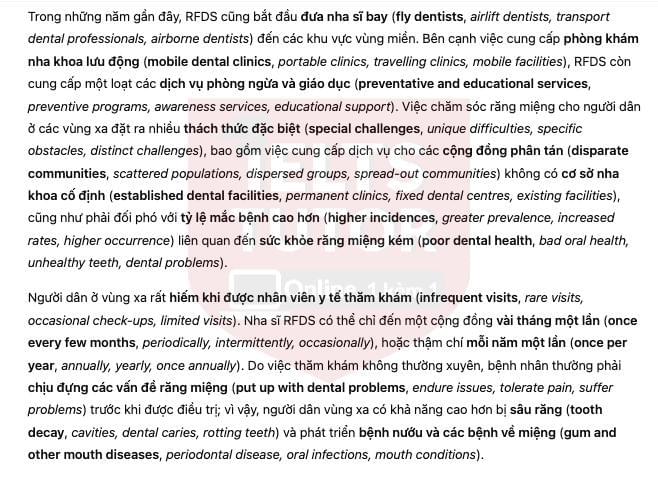
In recent years, the RFDS has also started to fly dentists to regional Australia. As well as offering mobile dental clinics, the RFDS offers a range of preventative and educational services. Looking after the teeth of people in remote areas presents special challenges. These include providing care to disparate communities with no established dental facilities, and dealing with higher incidences of other diseases which are linked to, or caused by poor dental health.
People in remote areas have very infrequent visits by health staff. RFDS dentists might only visit a community once every few months, or sometimes once per year. Because of infrequent dentist visits, patients in these areas often need to put up with their dental problems before they can get treatment; consequently, people in remote areas are more likely to have tooth decay (the blackening and deterioration of teeth) and develop gum and other mouth diseases.
In some locations that the RFDS visits, there are no suitable dental facilities, so dentists have to bring everything with them. This includes drills, dentists' chairs, portable X-ray machines, and computers for keeping track of patients' treatments. Equipment can weigh up to 100 kilograms, and since the small planes that transport dentists have limited space, dentists cannot always bring everything that they need.>> 🔥 Form đăng kí giải đề thi thật IELTS 4 kĩ năng kèm bài giải bộ đề 100 đề PART 2 IELTS SPEAKING quý đang thi (update hàng tuần) từ IELTS TUTOR
While dentists in town or city centres can specialise in certain types of treatment, RFDS dentists need to be 'all-rounders'. They need to be able to do all kinds of dental procedures, as they don't have the ability to refer patients to more specialised dentists. Even with their broad experience, there are some services that are particularly challenging for RFDS dentists. For example, dentures (for artificial teeth) can be very difficult to provide, as they need to be the right shape and size for the patient, and this requires many visits over a long period of time. As a result, it is not practical to make dentures available.
Some chronic illnesses are more common in remote communities than in the rest of Australia. These illnesses can in turn lead to a lowered resistance to infection, including gum and other oral infections. As a result, people in outback Australian communities are more likely to experience oral health problems than city folk, and this poses extra challenges for both the dentists and the doctors of the RFDS.
Because there aren't a lot of dental services in remote areas, people living in these areas also receive less education about good dental hygiene than their city counterparts do. Australians in very remote communities might not be aware of things that people in cities take for granted, such as the importance of daily tooth brushing. Also, basic dental hygiene items such as toothpaste and toothbrushes can be more expensive in outback areas. Many people are on low incomes, meaning they have extra difficulty affording these products. If this is the case, the RFDS supplies these.
As well as treating patients, RFDS dentists try to focus on preventative oral health and educate their patients on good oral hygiene, such as tooth brushing and flossing. The RFDS also provides mouthguards for young sports players. Playing contact sports, such as rugby league or Australian rules football, can damage young people's teeth, so mouthguards provide protection which prevents accidental injuries.
Adding fluoride to water supplies has been proven to reduce the incidence of tooth decay in many parts of the world. City dwellers in Australia use water supplies that have been fluoridated, and their rates of tooth decay are lower because of this. In remote areas, it is not practical to fluoridate drinking water supplies, and so people living in these areas are more subject to tooth decay. As a result, it is particularly important that people living in areas without fluoridated water pay special attention to regular brushing of their teeth with fluoridated toothpaste.>> 🔥 Nhắn zalo 0905834420 join group zalo Hóng đề thi máy 4 skills để cập nhật đề thi thật 4 kĩ năng hằng ngày [Kèm giải & đề làm online]
Despite many challenges, the RFDS continues to offer much-needed dental and medical support. Its presence in isolated communities greatly improves the quality of dental health, and supports important oral hygiene and health initiatives.
Questions 1-7
Do the following statements agree with the information given in Reading Passage 1?
In boxes 1-7 on your answer sheet, write:
TRUE - if the statement agrees with the information
FALSE - if the statement contradicts the information
NOT GIVEN - if there is no information on this
Many of the RFDS doctors work as volunteers.
RFDS dentists make trips to outback communities each month.
RFDS dentists are accompanied on their journeys to remote areas by a dental nurse.
RFDS dentists must provide a wide range of dental services.
Rural dental patients are more informed about oral hygiene than urban patients.
RFDS dentists educate patients about good eating habits.
Urban Australians generally have better teeth because their water is treated.
Questions 8-13
Complete the notes below.
Choose ONE WORD ONLY from the passage for each answer.
Write your answers in boxes 8-13 on your answer sheet.
Challenges faced by RFDS dentists
need to bring equipment including 8. ________ for records>> 🔥 IELTS TUTOR gợi ý tham khảo CẦN VIẾT & THU ÂM BAO NHIÊU BÀI ĐỂ ĐẠT 8.0 SPEAKING & 7.0 WRITING?
aircraft used to carry equipment have restricted 9. ________
problems offering some services, e.g., fitting 10. ________
people in remote areas are more likely to have infection in their mouth
Products supplied by RFDS dentists
If necessary, RFDS provides:
11. ________ and 12. ________ for regular use
13. ________ to protect teeth of sports players
IV. Dịch bài đọc Australia's Airborne Dentists
V. Giải thích từ vựng Australia's Airborne Dentists


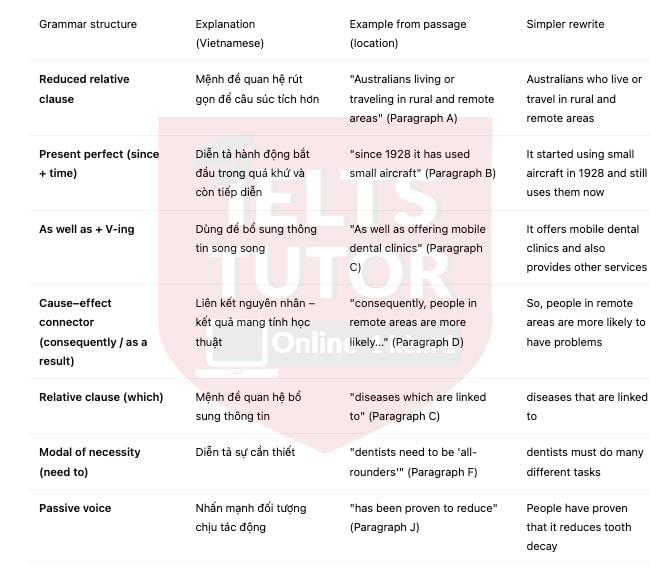
VI. Giải thích cấu trúc ngữ pháp khó Australia's Airborne Dentists
VII. Đáp án Australia's Airborne Dentists
NOT GIVEN
FALSE
NOT GIVEN
TRUE
FALSE
NOT GIVEN
TRUE
computers
space
dentures
toothpaste
toothbrushes
mouthguards
📩 MN AI CHƯA CÓ ĐÁP ÁN FORECAST QUÝ MỚI PART 1-2-3 NHẮN ZL 0905834420 IELTS TUTOR GỬI FREE HẾT NHA
Các khóa học IELTS online 1 kèm 1 - 100% cam kết đạt target 6.0 - 7.0 - 8.0 - Đảm bảo đầu ra - Thi không đạt, học lại FREE
>> Thành tích học sinh IELTS TUTOR với hàng ngàn feedback được cập nhật hàng ngày
