
IELTS TUTOR cung cấp Roller coaster: the great fairground attraction: Đề thi thật IELTS READING (IELTS Reading Recent Actual Test) - Làm bài online format computer-based, , kèm đáp án, dịch & giải thích từ vựng - cấu trúc ngữ pháp khó & GIẢI ĐÁP ÁN VỚI LOCATION
I. Kiến thức liên quan
II. Làm bài online (kéo xuống cuối bài blog để xem giải thích từ vựng & cấu trúc cụ thể hơn)
📩 MN AI CHƯA CÓ ĐÁP ÁN FORECAST QUÝ MỚI PART 1-2-3 NHẮN ZL 0905834420 IELTS TUTOR GỬI FREE HẾT NHA
Choose ONE WORD ONLY from the passage for each answer. Write your answers in boxes 14–16 on your answer sheet.
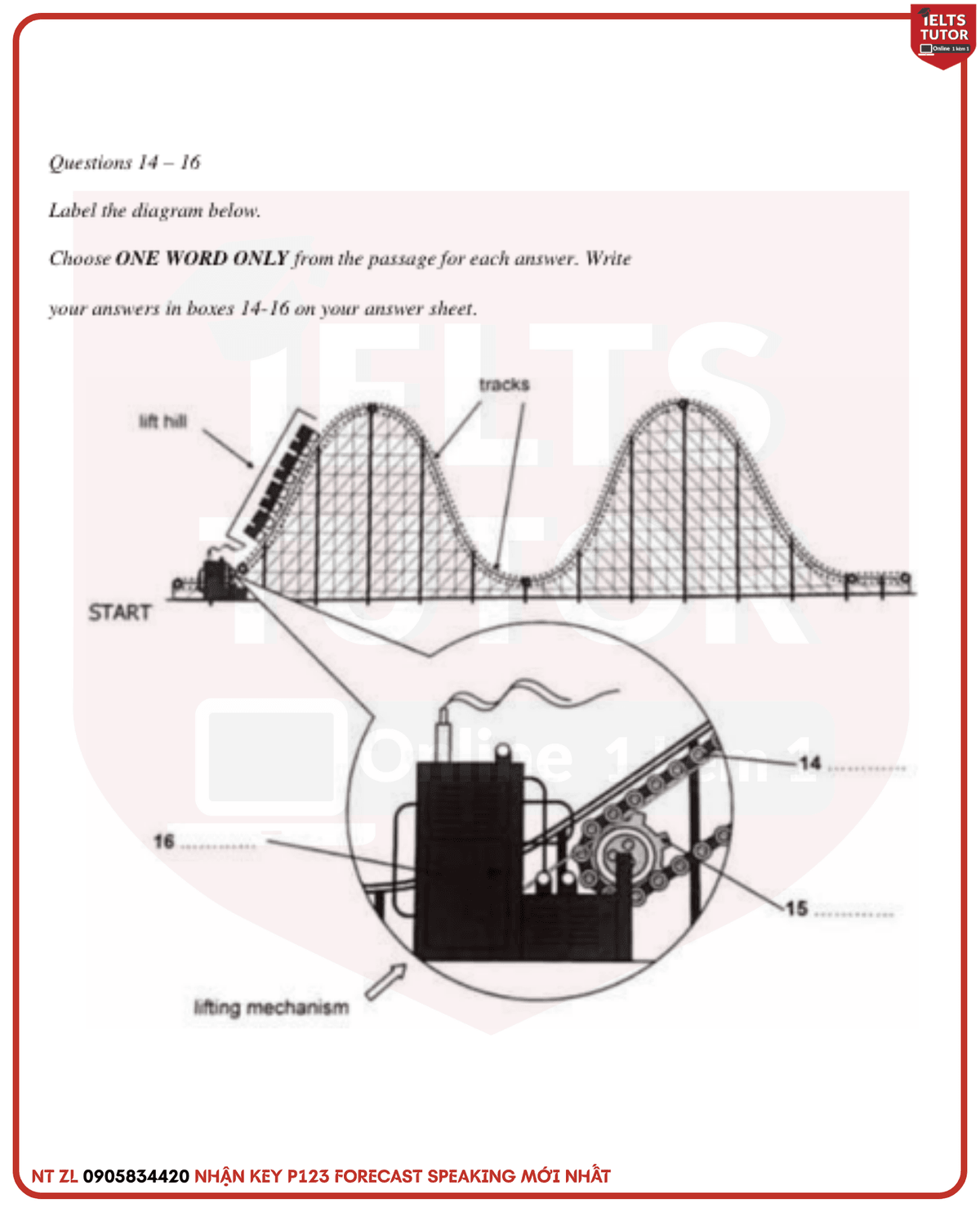
14.
15.
16.
Choose NO MORE THAN TWO WORDS from the passage for each answer. Write your answers in boxes 17–21 on your answer sheet.
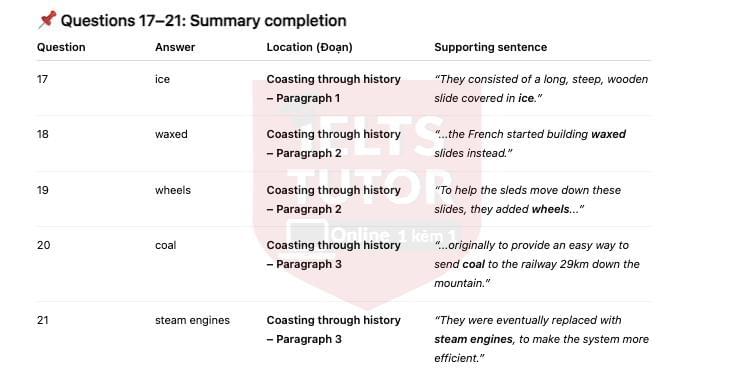
Modern roller coasters are descended from 16th-century Russian slides with a face of 17 .
People climbed to the top, and travelled down in sleds. In France, because of the higher temperatures, the wooden surface on the slides was 18 and 19 were added.
The first US coaster was used for transporting 20 . Initially, these were pulled by mules but in time power was produced by 21 .
In boxes 22–26 on your answer sheet, write TRUE if the statement agrees with the information, FALSE if the statement contradicts the information, and NOT GIVEN if there is no information on this.
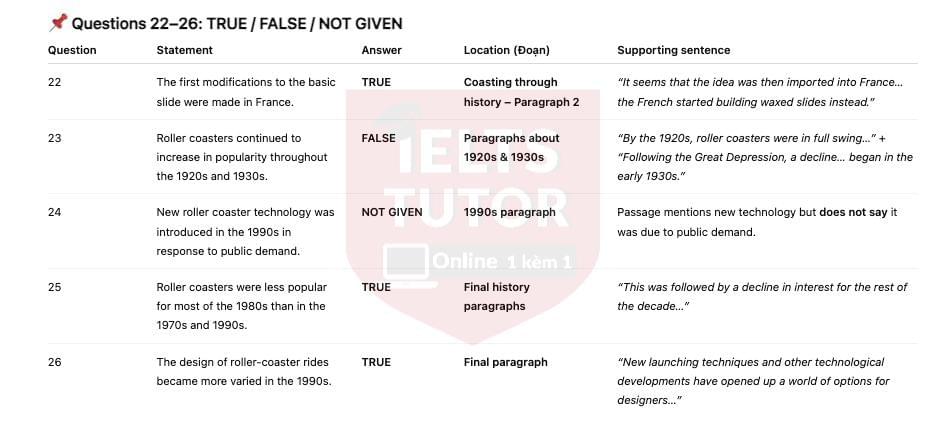
22. The first modifications to the basic slide were made in France.
23. Roller coasters continued to increase in popularity throughout the 1920s and 1930s.
24. New roller coaster technology was introduced in the 1990s in response to public demand.
25. Roller coasters were less popular for most of the 1980s than in the 1970s and 1990s.
26. The design of roller-coaster rides became more varied in the 1990s.
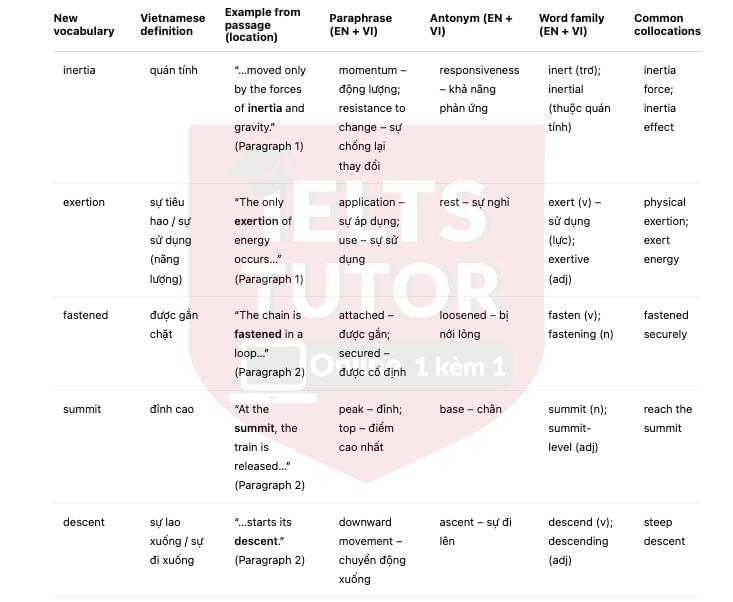
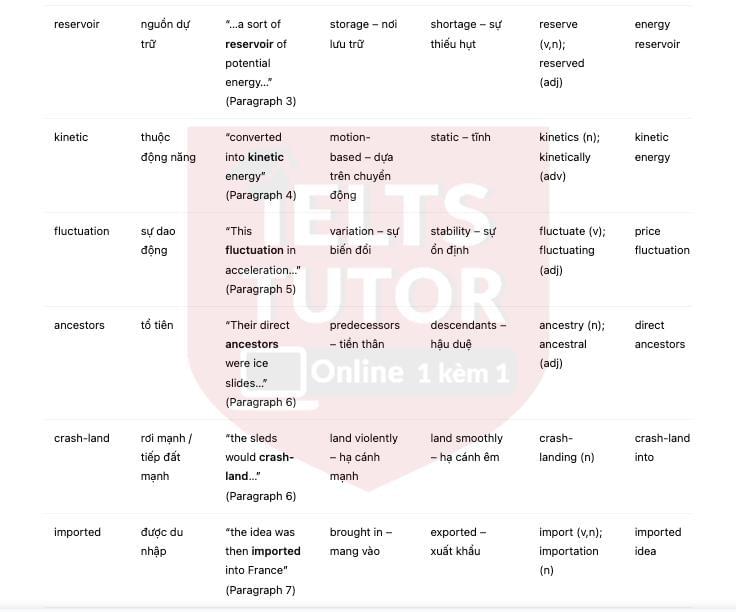
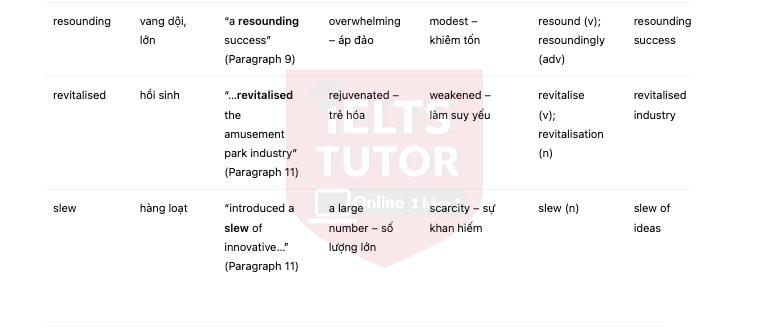
Example entry: inertia — the tendency of an object to resist changes in its motion. Example: "Because of inertia, the coaster keeps moving forward after it leaves the hill."

Example structure explanation: "the course of the track is constantly converting..." — this is a present participle phrase describing continuous action. Example sentence: "The machine keeps converting heat into motion."
III. Roller coaster: the great fairground attraction: Đề thi thật IELTS READING (IELTS Reading Recent Actual Test)
READING PASSAGE 2
You should spend about 20 minutes on Questions 14–26, which are based on Reading Passage 2.
Roller coaster: the great fairground attraction
How they move
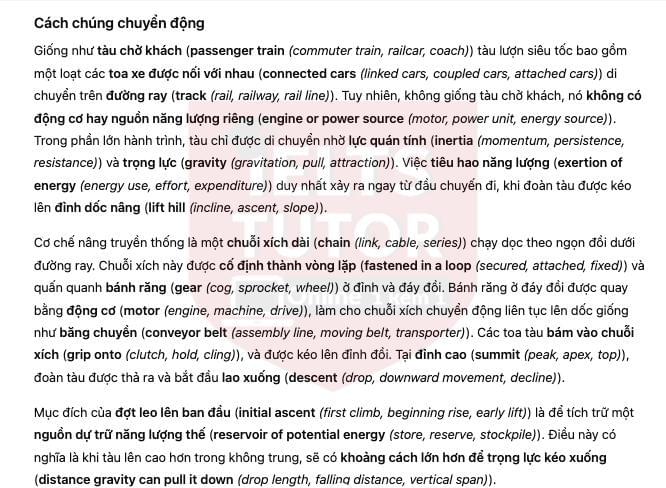
Like a passenger train, a roller coaster consists of a series of connected cars that move on a track. But unlike a passenger train, it has no engine or power source of its own. For most of the ride, it is moved only by the forces of inertia and gravity. The only exertion of energy occurs at the very beginning of the ride when the coaster train is pulled up the lift hill.
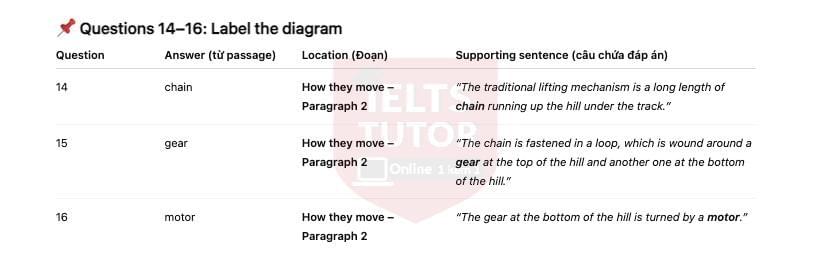
The traditional lifting mechanism is a long length of chain running up the hill under the track. The chain is fastened in a loop, which is wound around a gear at the top of the hill and another one at the bottom of the hill. The gear at the bottom of the hill is turned by a motor. This turns the chain so that it continually moves up the hill like a long conveyor belt. The coaster cars grip onto the chain, which simply pulls them to the top of the hill. At the summit, the train is released and starts its descent.
The purpose of this initial ascent is to build up a sort of reservoir of potential energy, which simply means that as the coaster gets higher in the air, there is a greater distance gravity can pull it down.>> 🔥 Form đăng kí giải đề thi thật IELTS 4 kĩ năng kèm bài giải bộ đề 100 đề PART 2 IELTS SPEAKING quý đang thi (update hàng tuần) từ IELTS TUTOR
As the train starts coasting down the hill, this potential energy is converted into kinetic energy (energy of motion), and the train speeds up. At the bottom of the hill, this has reached its maximum, and this propels the train up the second hill, again building up the potential energy level.
In this way, the course of the track is constantly converting energy from kinetic to potential and back again. This fluctuation in acceleration is what makes roller coasters so much fun. At its most basic level, this is all a roller coaster is—a machine that uses gravity and inertia to send a train along a winding track.
Coasting through history
Roller coasters have a long, fascinating history. Their direct ancestors were ice slides, popular in Russia in the 16th and 17th centuries. They consisted of a long, steep, wooden slide covered in ice. Riders walked up a ladder or set of stairs to the top of the slide, as high as 21 metres up. At the top, they climbed into sleds made out of wood or blocks of ice and shot down the slope. At the base of the slide, the sleds would crash-land in a sand pile.
It seems that the idea was then imported into France. For most of the year, the warmer climate would melt the ice, so the French started building waxed slides instead. To help the sleds move down these slides, they added wheels, and in 1817, for the first time, a train was attached to the track. The French continued to expand on this idea, coming up with more complex track layouts, with multiple cars and all sorts of twists and turns.>> 🔥 IELTS TUTOR gợi ý tham khảo CẦN VIẾT & THU ÂM BAO NHIÊU BÀI ĐỂ ĐẠT 8.0 SPEAKING & 7.0 WRITING?
The first American roller coaster was built in the mountains of Pennsylvania in the mid-1800s, originally to provide an easy way to send coal to the railway 29km down the mountain. When the track was first built, a crew at the bottom of the mountain would attach the cart to a team of mules after emptying the load, and the mules would drag it back up to the top. They were eventually replaced with steam engines, to make the system more efficient.
Soon after these improvements were made, the railway company built a new tunnel that brought the freight trains much closer to the coal mine. Now no longer required for its original purpose, the roller coaster was configured as a ‘scenic tour’. For one dollar, tourists got a leisurely ride up to the top of the mountain, followed by a wild, bumpy ride straight down. This was soon a resounding success, attracting thousands of tourists every year.
Scenic rides like this continued to thrive and were joined by wooden roller coasters similar to the ones we know today. These coasters were the main attraction at popular amusement parks throughout the United States, such as the many parks of Coney Island in New York. By the 1920s, roller coasters were in full swing, with some 2,000 rides in operation around the country.
Following the Great Depression, a decline in roller coaster production began in the early 1930s, but a second roller-coaster boom in the 1970s and the beginning of the 1980s revitalised the amusement park industry, and introduced a slew of innovative tubular steel coasters.
This was followed by a decline in interest for the rest of the decade, but since the early 1990s, the amusement-park industry has experienced another coaster boom of sorts. New launching techniques and other technological developments have opened up a world of options for designers, so in some rides you feel as if you are flying. In the next few years we can expect to see many faster, taller and more twisted rides popping up in amusement parks around the world.
Questions 14–16
Label the diagram below.
Choose ONE WORD ONLY from the passage for each answer.
Write your answers in boxes 14–16 on your answer sheet.
Questions 17–21
Complete the summary below.
Choose NO MORE THAN TWO WORDS from the passage for each answer.
Write your answers in boxes 17–21 on your answer sheet.
Modern roller coasters are descended from 16th-century Russian slides with a face of 17 _____. People climbed to the top, and travelled down in sleds. In France, because of the higher temperatures, the wooden surface on the slides was 18 _____ and 19 _____ were added. The first US coaster was used for transporting 20 _____. Initially, these were pulled by mules but in time power was produced by 21 _____
Questions 22–26
Do the following statements agree with the information given in Reading Passage 2?>> 🔥 Nhắn zalo 0905834420 join group zalo Hóng đề thi máy 4 skills để cập nhật đề thi thật 4 kĩ năng hằng ngày [Kèm giải & đề làm online]
In boxes 22–26 on your answer sheet, write
TRUE if the statement agrees with the information
FALSE if the statement contradicts the information
NOT GIVEN if there is no information on this
The first modifications to the basic slide were made in France.
Roller coasters continued to increase in popularity throughout the 1920s and 1930s.
New roller coaster technology was introduced in the 1990s in response to public demand.
Roller coasters were less popular for most of the 1980s than in the 1970s and 1990s.
The design of roller-coaster rides became more varied in the 1990s.
IV. Dịch bài đọc Roller coaster: the great fairground attraction
V. Giải thích từ vựng Roller coaster: the great fairground attraction
VI. Giải thích cấu trúc ngữ pháp khó Roller coaster: the great fairground attraction
VII. Đáp án Roller coaster: the great fairground attraction
14–16
14. chain
15. gear
16. motor
17–21
17. ice
18. waxed
19. wheels
20. coal
21. steam engines
22–26
22. TRUE
23. FALSE
24. NOT GIVEN
25. TRUE
26. TRUE
📩 MN AI CHƯA CÓ ĐÁP ÁN FORECAST QUÝ MỚI PART 1-2-3 NHẮN ZL 0905834420 IELTS TUTOR GỬI FREE HẾT NHA

Các khóa học IELTS online 1 kèm 1 - 100% cam kết đạt target 6.0 - 7.0 - 8.0 - Đảm bảo đầu ra - Thi không đạt, học lại FREE
>> Thành tích học sinh IELTS TUTOR với hàng ngàn feedback được cập nhật hàng ngày
