
IELTS TUTOR cung cấp Homo ergaster Đề luyện tập IELTS READING (IELTS Reading Practice Test) - Làm bài online format computer-based, kèm đáp án, dịch & giải thích từ vựng - cấu trúc ngữ pháp khó & GIẢI ĐÁP ÁN VỚI LOCATION
I. Kiến thức liên quan
📩 MN AI CHƯA CÓ ĐÁP ÁN FORECAST QUÝ MỚI PART 1-2-3 NHẮN ZL 0905834420 IELTS TUTOR GỬI FREE HẾT NHA
II. Làm bài online (kéo xuống cuối bài blog để xem giải thích từ vựng & cấu trúc cụ thể hơn)
IELTS Reading Test - Homo Ergaster
A Huge debate rages about human origins, but the broad consensus among scientists is that all the different species of human (hominids) that have ever existed were descended from ape-like creatures that walked upright in Africa more than six million years ago. These creatures had many descendants, most of which became extinct, but the first creature we would recognise as human first appeared in Africa almost two million years ago. Homo ergaster, meaning 'working human', evolved during an accelerated period of global cooling and drying that cleared more and more tropical rainforest from Africa, and created desert in the northern half of the continent.
B One of the best sources of information about Homo ergaster is a skeleton found in 1984 by Alan Walker and Kamoya Kimeu at Nariokotome in West Turkana, Kenya. The remains turned out to be those of a young boy, who was between the ages of 11 and 13 when he died around 1.5 million years ago. The boy's body sank into the marsh where he died, and became fossilised. His teeth show signs of a sizeable abscess where his milk teeth fell out, indicating that he may have died from blood poisoning.
C The Nariokotome skeleton, often referred to as 'Turkana Boy', is remarkably complete. Over 80 percent of the skeleton was recovered, making it one of the most intact early hominid fossils ever found. Analysis of the bones revealed that Homo ergaster had a body remarkably similar to modern humans. The rib cage was barrel-shaped rather than conical, the pelvis was narrow, and the legs were long. These features suggest that Homo ergaster was a highly efficient walker and runner, well adapted to long-distance travel across the open savannah.
D The physical adaptations of Homo ergaster also included a larger brain capacity than earlier hominids, ranging from 700 to 900 cubic centimetres. This is still only about two-thirds the size of the modern human brain, but it represents a significant increase over Australopithecus and Homo habilis. Alongside this brain growth came changes in the skull, including a less prominent brow ridge and smaller teeth. The reduction in tooth size suggests a shift in diet, possibly including more meat and cooked foods, though direct evidence of fire use from this period remains controversial.
E Homo ergaster is also notable for being the first hominid to have body proportions that fall within the range of modern humans. The limbs were longer and more slender than earlier species, and the shoulders were less adapted for climbing. This suggests that Homo ergaster had abandoned a significant amount of tree-dwelling behaviour and was fully committed to life on the ground. The ability to walk and run efficiently would have allowed these early humans to hunt and scavenge over large territories, and to compete successfully with other predators on the African savannah.
F Perhaps most significantly, Homo ergaster is widely believed to be the first hominid to leave Africa. Fossil evidence from the Republic of Georgia, dated to around 1.8 million years ago, has been attributed to Homo ergaster or a very similar species. These specimens, found at Dmanisi, represent the earliest known human ancestors outside Africa. The ability to colonise new environments, with different climates and food sources, demonstrates the adaptability and behavioural flexibility of this species. It is likely that Homo ergaster had developed more complex social structures and possibly even simple language to coordinate hunting and migration.
G The eventual fate of Homo ergaster is uncertain. Some palaeoanthropologists believe that the species evolved directly into Homo erectus in Asia, while others argue that Homo ergaster was a distinct African species that eventually went extinct. What is clear, however, is that the physical and behavioural adaptations seen in Homo ergaster laid the foundation for the success of later humans, including our own species, Homo sapiens. The Turkana Boy and other fossils like him provide a remarkable window into a crucial phase of human evolution.
Reading Passage 2 has seven paragraphs, A-G.
Choose the correct heading for each paragraph from the list of headings below.
Write the correct number, i-x, in boxes 14-20.
Complete the sentences below.
Choose NO MORE THAN TWO WORDS from the passage for each answer.
Do the following statements agree with the information given in Reading Passage 2?
Write TRUE, FALSE, or NOT GIVEN


III. Homo ergaster: Đề luyện tập IELTS READING (IELTS Reading Practice Test)
READING PASSAGE 2
You should spend about 20 minutes on Questions 14–26, which are based on Reading Passage 2 below.
Homo ergaster
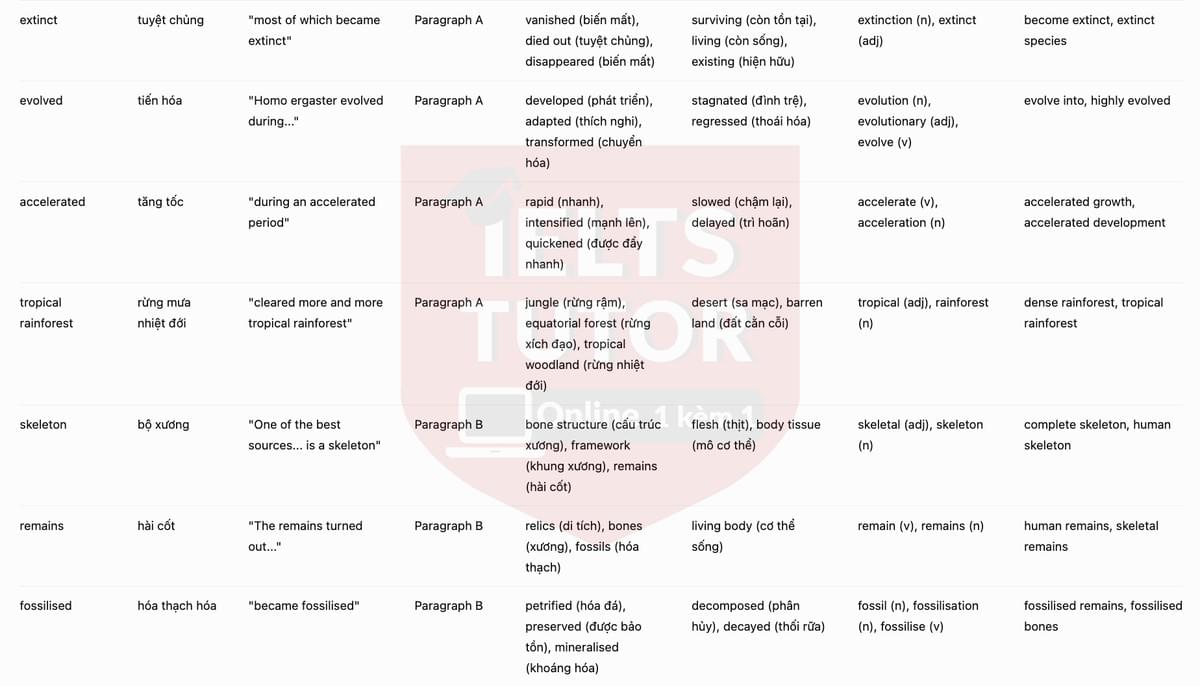
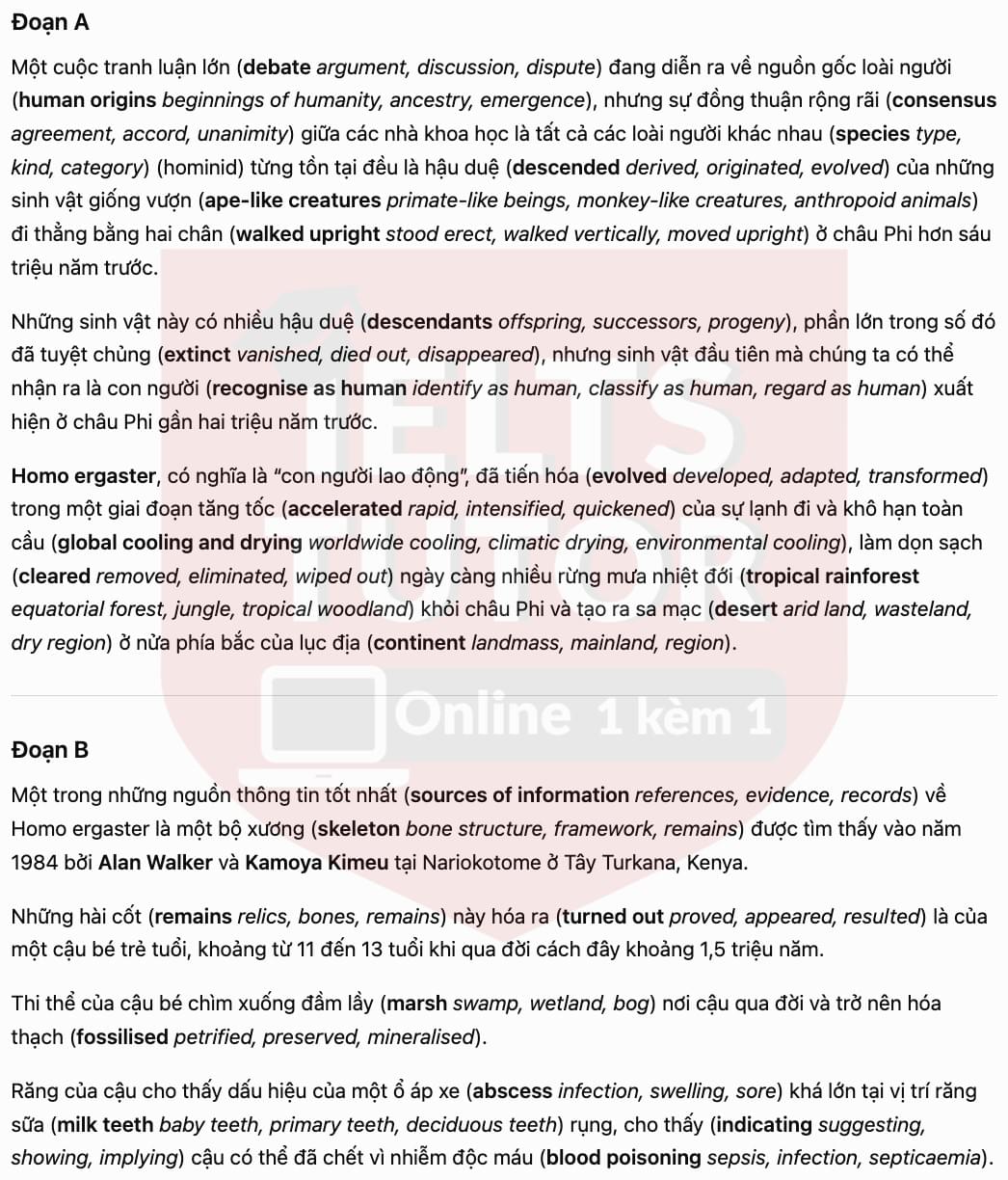
A Huge debate rages about human origins, but the broad consensus among scientists is that all the different species of human (hominids) that have ever existed were descended from ape-like creatures that walked upright in Africa more than six million years ago. These creatures had many descendants, most of which became extinct, but the first creature we would recognise as human first appeared in Africa almost two million years ago. Homo ergaster, meaning 'working human', evolved during an accelerated period of global cooling and drying that cleared more and more tropical rainforest from Africa, and created desert in the northern half of the continent.
B One of the best sources of information about Homo ergaster is a skeleton found in 1984 by Alan Walker and Kamoya Kimeu at Nariokotome in West Turkana, Kenya. The remains turned out to be those of a young boy, who was between the ages of 11 and 13 when he died around 1.5 million years ago. The boy's body sank into the marsh where he died, and became fossilised. His teeth show signs of a sizeable abscess where his milk teeth fell out, indicating that he may have died from blood poisoning.
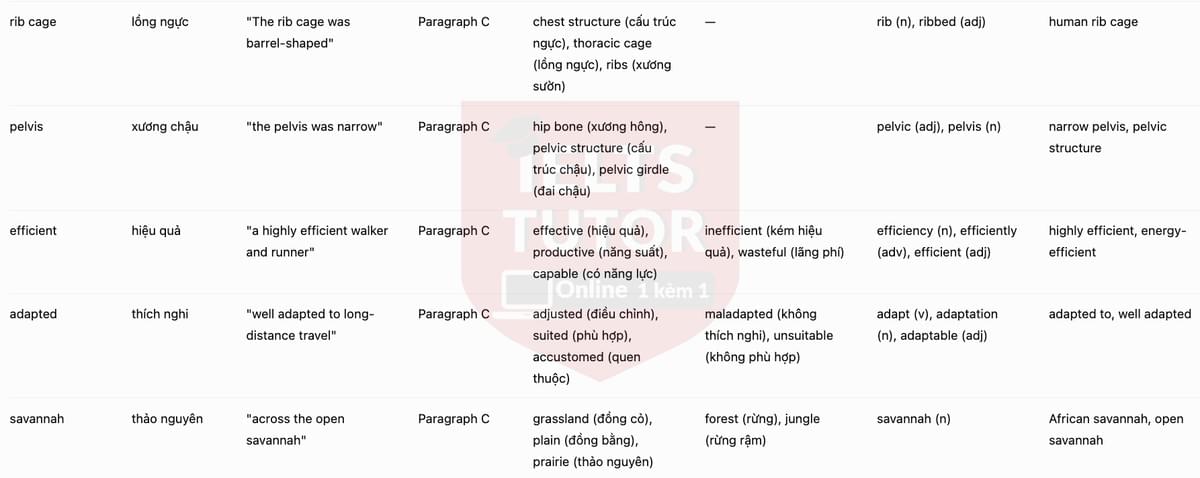
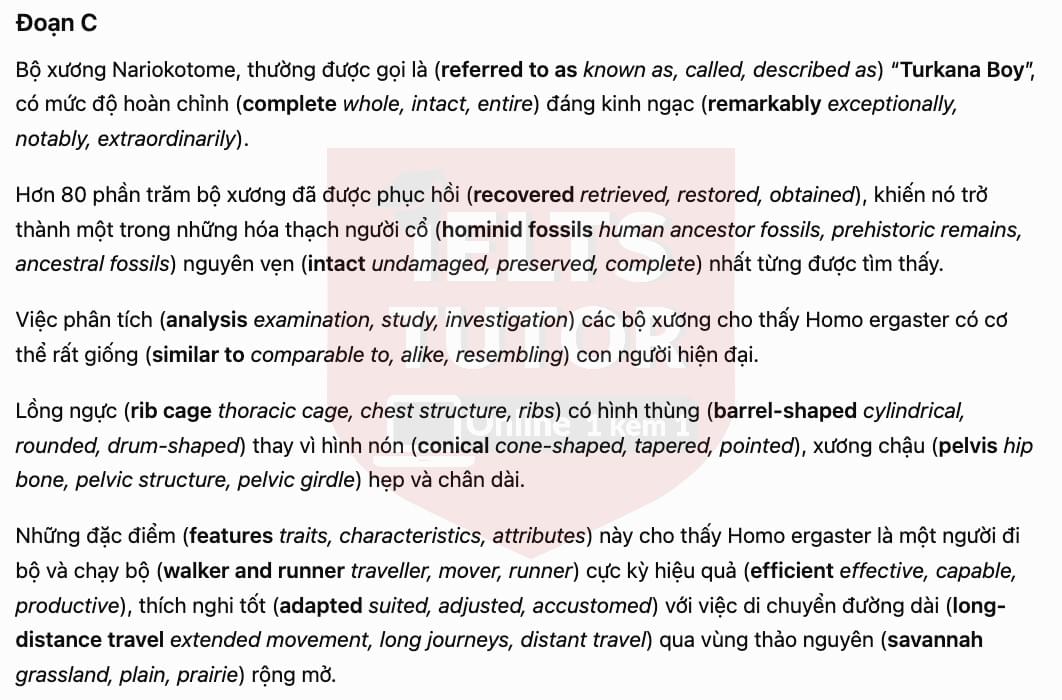
C The Nariokotome skeleton, often referred to as 'Turkana Boy', is remarkably complete. Over 80 percent of the skeleton was recovered, making it one of the most intact early hominid fossils ever found. Analysis of the bones revealed that Homo ergaster had a body remarkably similar to modern humans. The rib cage was barrel-shaped rather than conical, the pelvis was narrow, and the legs were long. These features suggest that Homo ergaster was a highly efficient walker and runner, well adapted to long-distance travel across the open savannah. >> 🔥 Form đăng kí giải đề thi thật IELTS 4 kĩ năng kèm bài giải bộ đề 100 đề PART 2 IELTS SPEAKING quý đang thi (update hàng tuần) từ IELTS TUTOR
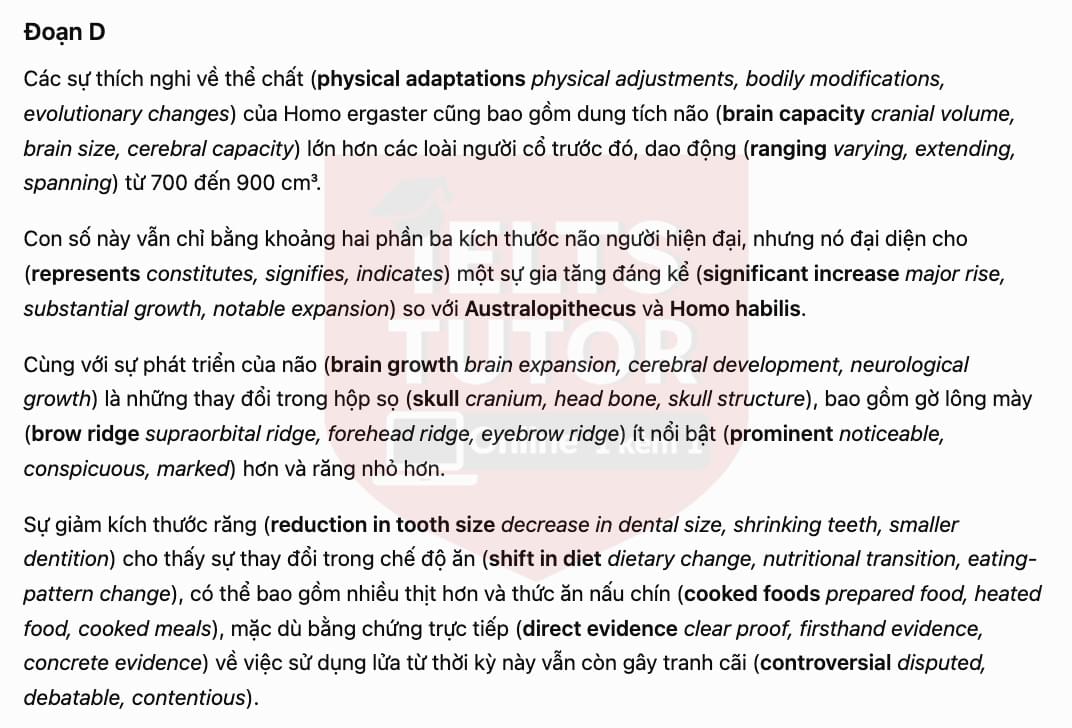
D The physical adaptations of Homo ergaster also included a larger brain capacity than earlier hominids, ranging from 700 to 900 cubic centimetres. This is still only about two-thirds the size of the modern human brain, but it represents a significant increase over Australopithecus and Homo habilis. Alongside this brain growth came changes in the skull, including a less prominent brow ridge and smaller teeth. The reduction in tooth size suggests a shift in diet, possibly including more meat and cooked foods, though direct evidence of fire use from this period remains controversial.
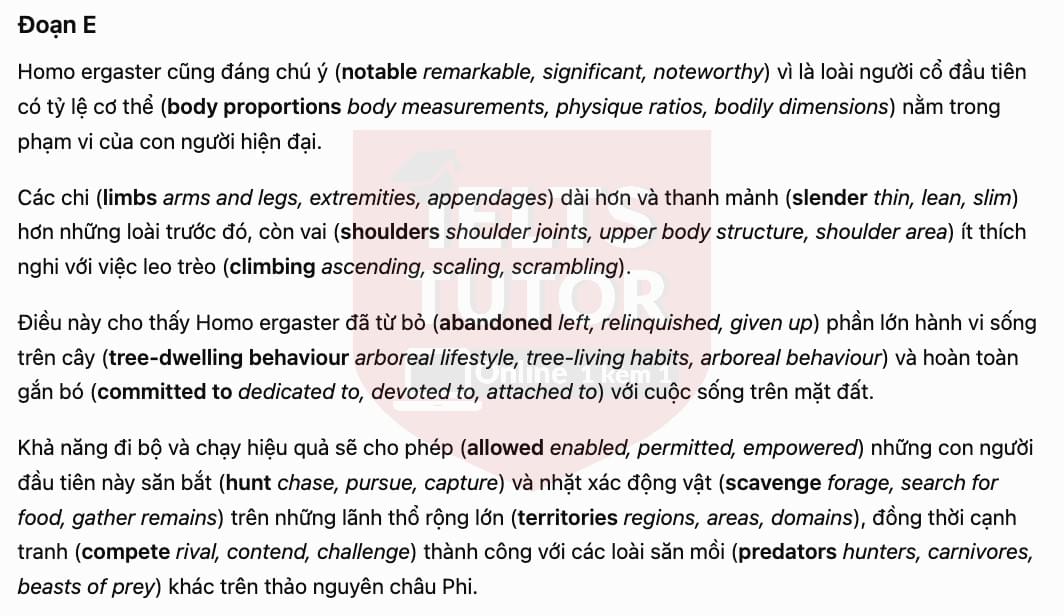
E Homo ergaster is also notable for being the first hominid to have body proportions that fall within the range of modern humans. The limbs were longer and more slender than earlier species, and the shoulders were less adapted for climbing. This suggests that Homo ergaster had abandoned a significant amount of tree-dwelling behaviour and was fully committed to life on the ground. The ability to walk and run efficiently would have allowed these early humans to hunt and scavenge over large territories, and to compete successfully with other predators on the African savannah.
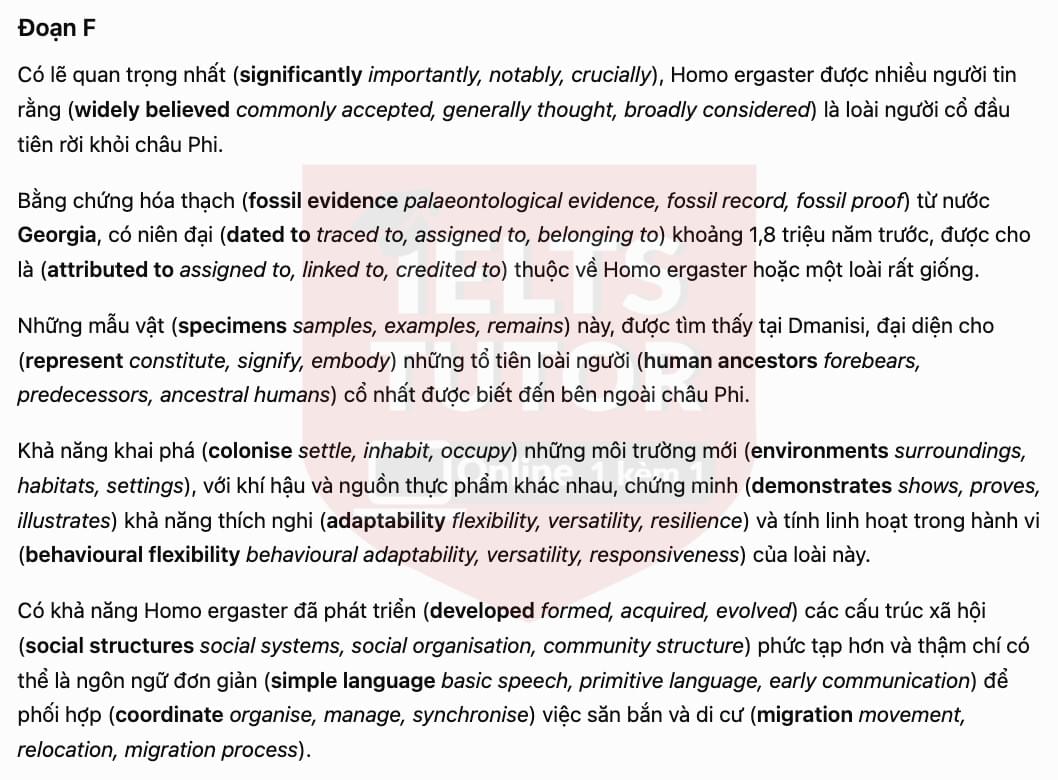
F Perhaps most significantly, Homo ergaster is widely believed to be the first hominid to leave Africa. Fossil evidence from the Republic of Georgia, dated to around 1.8 million years ago, has been attributed to Homo ergaster or a very similar species. These specimens, found at Dmanisi, represent the earliest known human ancestors outside Africa. The ability to colonise new environments, with different climates and food sources, demonstrates the adaptability and behavioural flexibility of this species. It is likely that Homo ergaster had developed more complex social structures and possibly even simple language to coordinate hunting and migration.
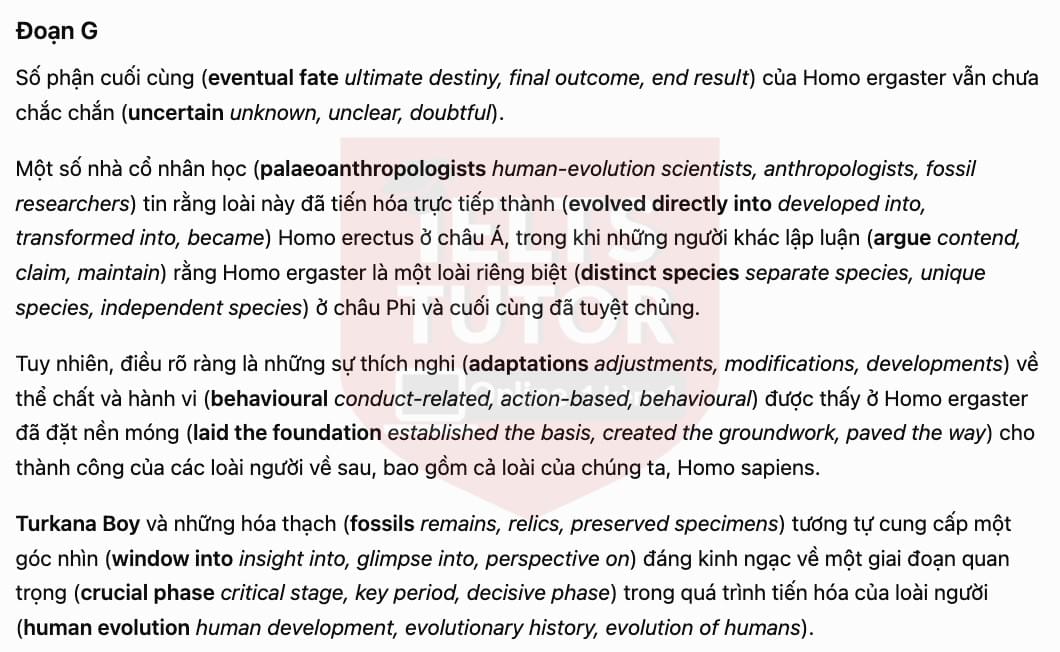
G The eventual fate of Homo ergaster is uncertain. Some palaeoanthropologists believe that the species evolved directly into Homo erectus in Asia, while others argue that Homo ergaster was a distinct African species that eventually went extinct. What is clear, however, is that the physical and behavioural adaptations seen in Homo ergaster laid the foundation for the success of later humans, including our own species, Homo sapiens. The Turkana Boy and other fossils like him provide a remarkable window into a crucial phase of human evolution. >> 🔥 Nhắn zalo 0905834420 join group zalo Hóng đề thi máy 4 skills để cập nhật đề thi thật 4 kĩ năng hằng ngày [Kèm giải & đề làm online]
Questions 14–20
Reading Passage 2 has seven paragraphs, A–G.
Choose the correct heading for each paragraph from the list of headings below.
Write the correct number, i–x, in boxes 14–20 on your answer sheet.
List of Headings
| i | Assumptions about language and nutrition |
| ii | A series of developments involving bone structure |
| iii | Conflicting theories about Homo ergaster's ancestry |
| iv | The earliest occurrence of a human-like species |
| v | The beginnings of human migration |
| vi | Evidence of conflict between populations |
| vii | Physical features adapted for climate |
| viii | The social behaviour linked to human reproductive features |
| ix | Technical advances in the analysis of human remains |
| x | The valuable discovery of a specimen |
14 Paragraph A
15 Paragraph B
16 Paragraph C
17 Paragraph D
18 Paragraph E
19 Paragraph F
20 Paragraph G >> 🔥 IELTS TUTOR gợi ý tham khảo CẦN VIẾT & THU ÂM BAO NHIÊU BÀI ĐỂ ĐẠT 8.0 SPEAKING & 7.0 WRITING?
Questions 21–23
Complete the sentences below.
Choose NO MORE THAN TWO WORDS from the passage for each answer.
Write your answers in boxes 21–23 on your answer sheet.
21 The name Homo ergaster means '_______________ human'.
22 The skeleton found at Nariokotome is often called '_______________'.
23 The Dmanisi specimens represent the earliest known human ancestors outside _______________.
Questions 24–26
Do the following statements agree with the information given in Reading Passage 2?
In boxes 24–26 on your answer sheet, write
| TRUE | if the statement agrees with the information |
| FALSE | if the statement contradicts the information |
| NOT GIVEN | if there is no information on this |
24 The Nariokotome skeleton was discovered by a team of French archaeologists.
25 Homo ergaster had a larger brain capacity than Homo habilis.
26 All palaeoanthropologists agree that Homo ergaster evolved directly into Homo erectus.
IV. Dịch bài đọc Homo ergaster
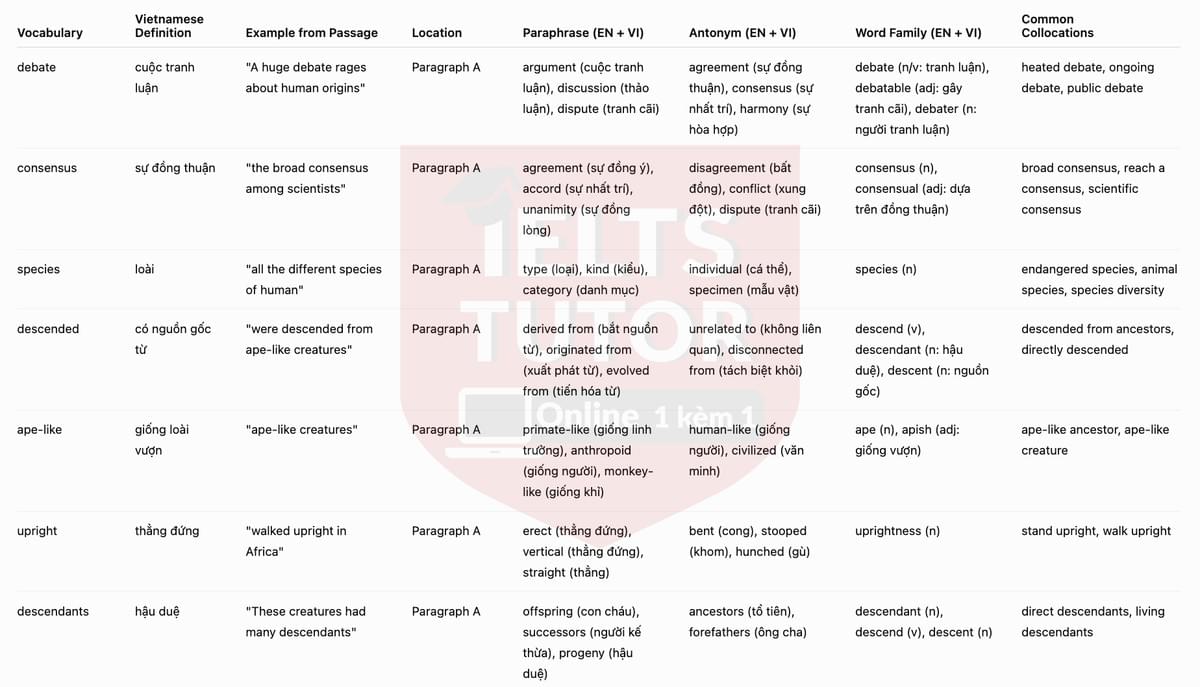
V. Giải thích từ vựng Homo ergaster
VI. Giải thích cấu trúc ngữ pháp khó Homo ergaster
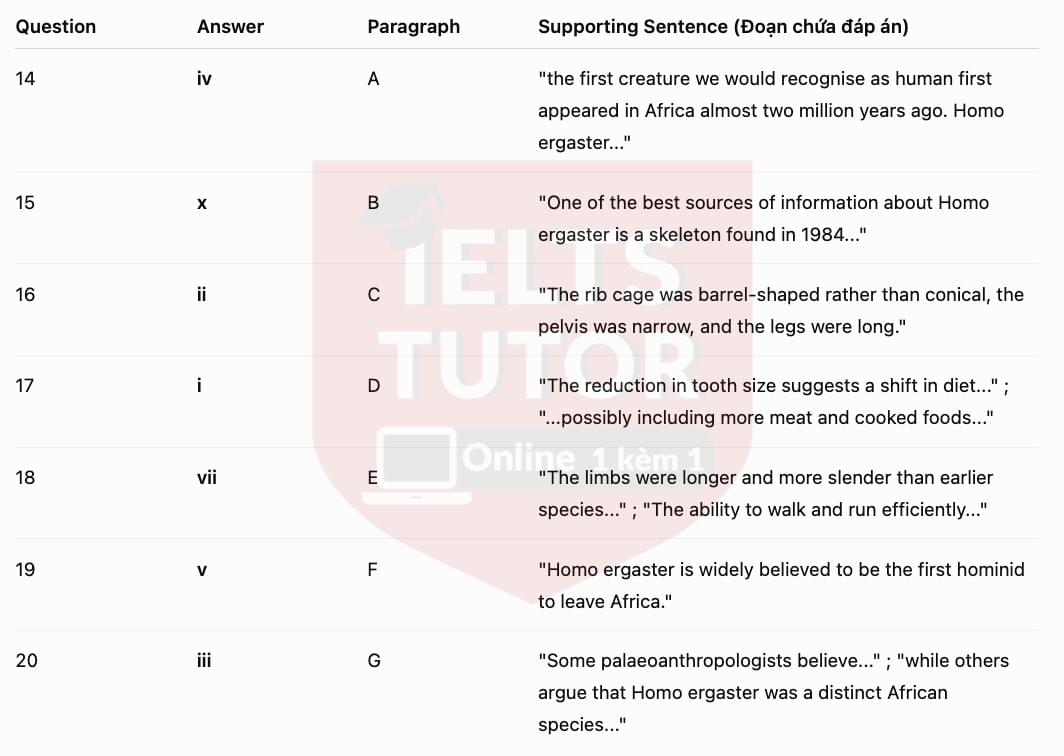
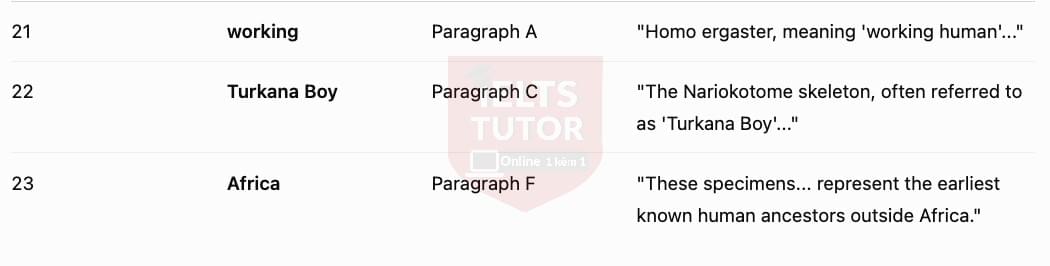
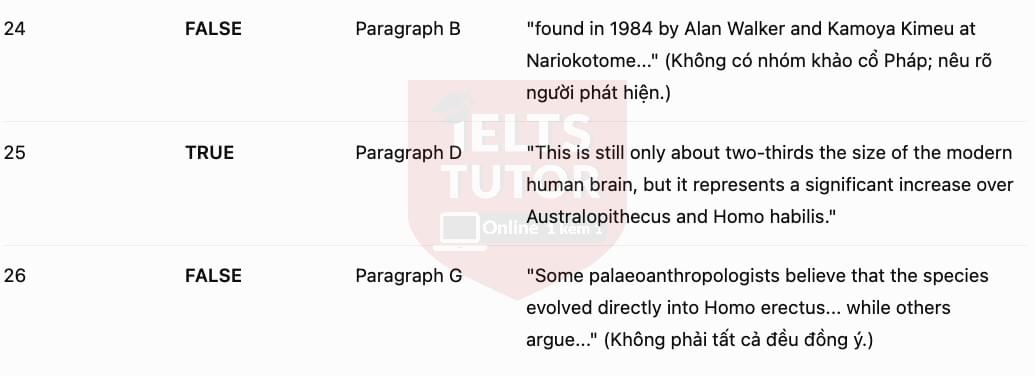
VII. Đáp án Homo ergaster
14. iv
15. x
16. ii
17. i
18. vii
19. v
20. iii
21. working
22. Turkana Boy
23. Africa
24. FALSE
25. TRUE
26. FALSE
📩 MN AI CHƯA CÓ ĐÁP ÁN FORECAST QUÝ MỚI PART 1-2-3 NHẮN ZL 0905834420 IELTS TUTOR GỬI FREE HẾT NHA

Các khóa học IELTS online 1 kèm 1 - 100% cam kết đạt target 6.0 - 7.0 - 8.0 - Đảm bảo đầu ra - Thi không đạt, học lại FREE
>> Thành tích học sinh IELTS TUTOR với hàng ngàn feedback được cập nhật hàng ngày
