
IELTS TUTOR cung cấp Science in the kitchen Đề luyện tập IELTS READING (IELTS Reading Practice Test) - Làm bài online format computer-based, kèm đáp án, dịch & giải thích từ vựng - cấu trúc ngữ pháp khó & GIẢI ĐÁP ÁN VỚI LOCATION
I. Kiến thức liên quan
📩 MN AI CHƯA CÓ ĐÁP ÁN FORECAST QUÝ MỚI PART 1-2-3 NHẮN ZL 0905834420 IELTS TUTOR GỬI FREE HẾT NHA
II. Làm bài online (kéo xuống cuối bài blog để xem giải thích từ vựng & cấu trúc cụ thể hơn)
Science in the kitchen
Chefs are bringing a new standard of experimentation and precision to their cooking
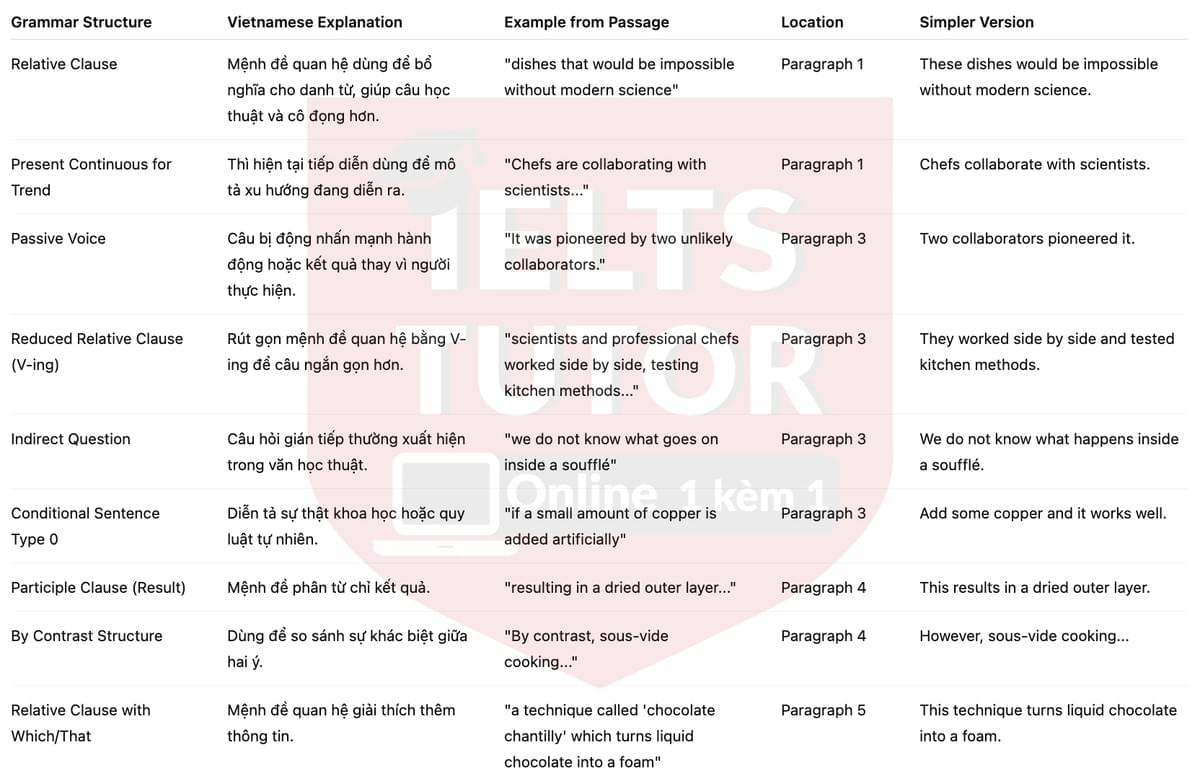
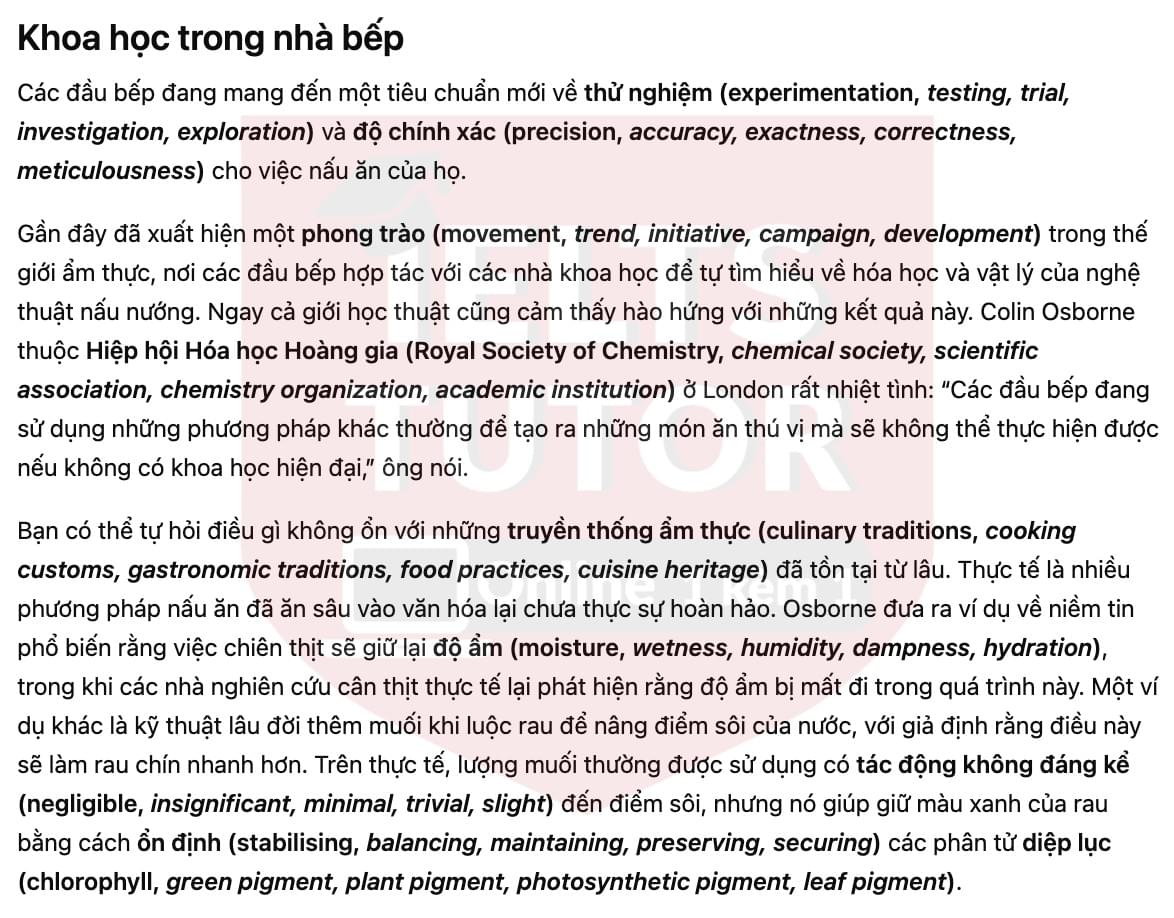
There is a recent movement in the world of food, in which chefs are collaborating with scientists to teach themselves the chemistry and physics of cuisine. Even academics are getting excited about the results. Colin Osborne of the Royal Society of Chemistry in London is enthused: 'Chefs are using unusual methods to produce exciting dishes that would be impossible without modern science,' he says.
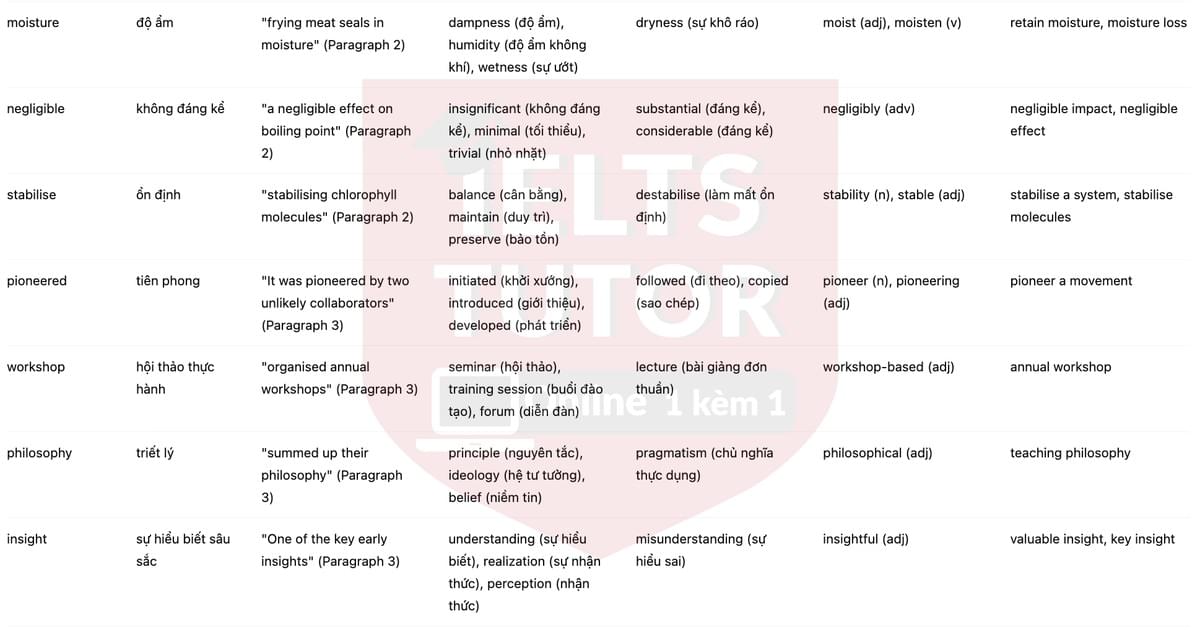
You may wonder what's wrong with long-established culinary traditions. The fact is, many culturally ingrained cooking methods are less than perfect. Osborne gives the example of the common belief that frying meat seals in moisture, while researchers who weighed the meat actually found that moisture is lost in the process. Another example is the age-old technique of adding salt when boiling vegetables to raise the boiling point of water, assuming that this will cook the vegetables faster. In reality, the amount of salt typically used has a negligible effect on boiling point, but it does help preserve the vegetables' green colour by stabilising chlorophyll molecules.
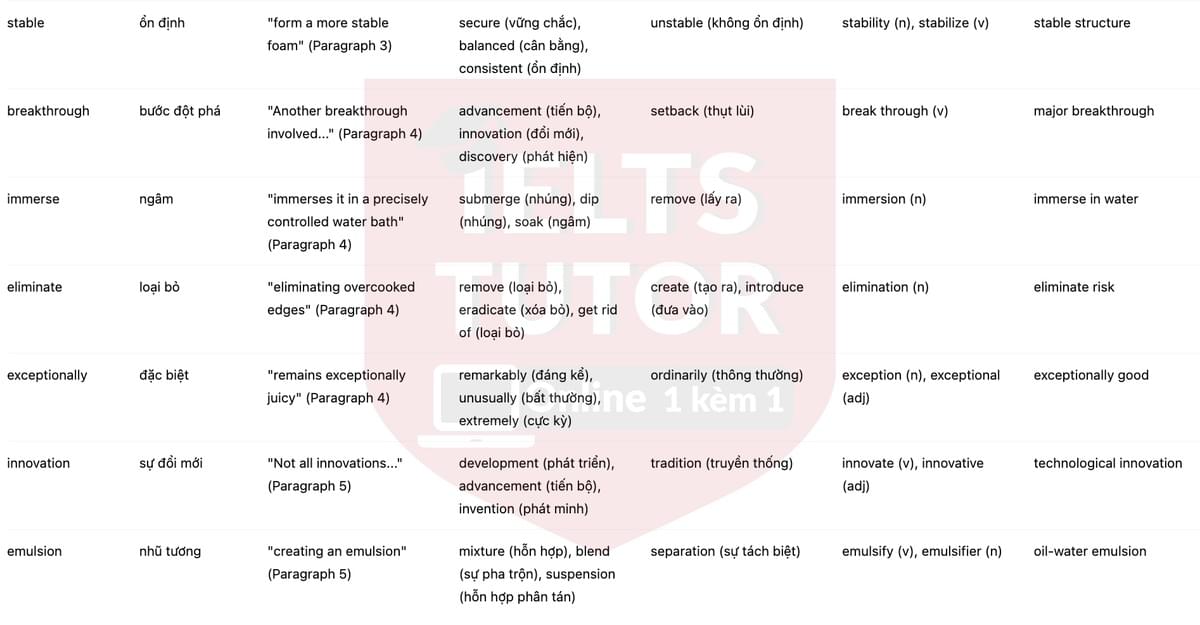
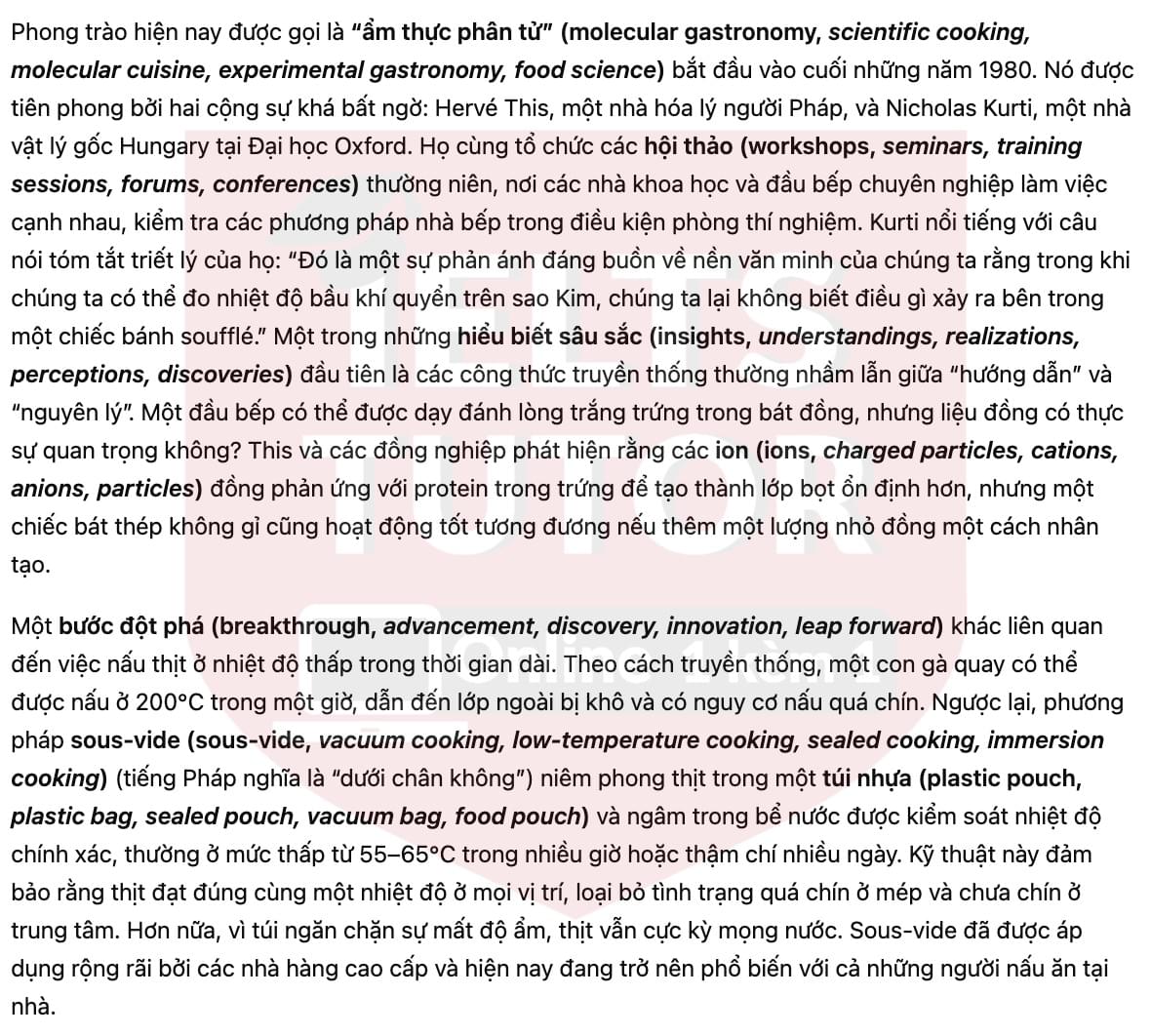
The movement now known as 'molecular gastronomy' began in the late 1980s. It was pioneered by two unlikely collaborators: Hervé This, a French physical chemist, and Nicholas Kurti, a Hungarian-born physicist at Oxford University. Together, they organised annual workshops where scientists and professional chefs worked side by side, testing kitchen methods under laboratory conditions. Kurti famously summed up their philosophy: 'It is a sad reflection on our civilisation that while we can measure the temperature of the atmosphere on Venus, we do not know what goes on inside a soufflé.' One of the key early insights was that traditional recipes often confuse 'instructions' with 'principles'. A chef might be taught to beat egg whites in a copper bowl, but does copper actually matter? This and his colleagues discovered that copper ions react with egg proteins to form a more stable foam, but a stainless steel bowl works equally well if a small amount of copper is added artificially.
Another breakthrough involved the cooking of meat at low temperatures for extended periods. Traditionally, a roast chicken might be cooked at 200°C for an hour, resulting in a dried outer layer and a risk of overcooking. By contrast, sous-vide (French for 'under vacuum') cooking seals meat in a plastic pouch and immerses it in a precisely controlled water bath, often at temperatures as low as 55–65°C for several hours or even days. This technique ensures that the meat reaches exactly the same temperature throughout, eliminating overcooked edges and undercooked centres. Moreover, because the pouch prevents moisture loss, the meat remains exceptionally juicy. Sous-vide has been widely adopted by high-end restaurants and is now becoming available to home cooks.
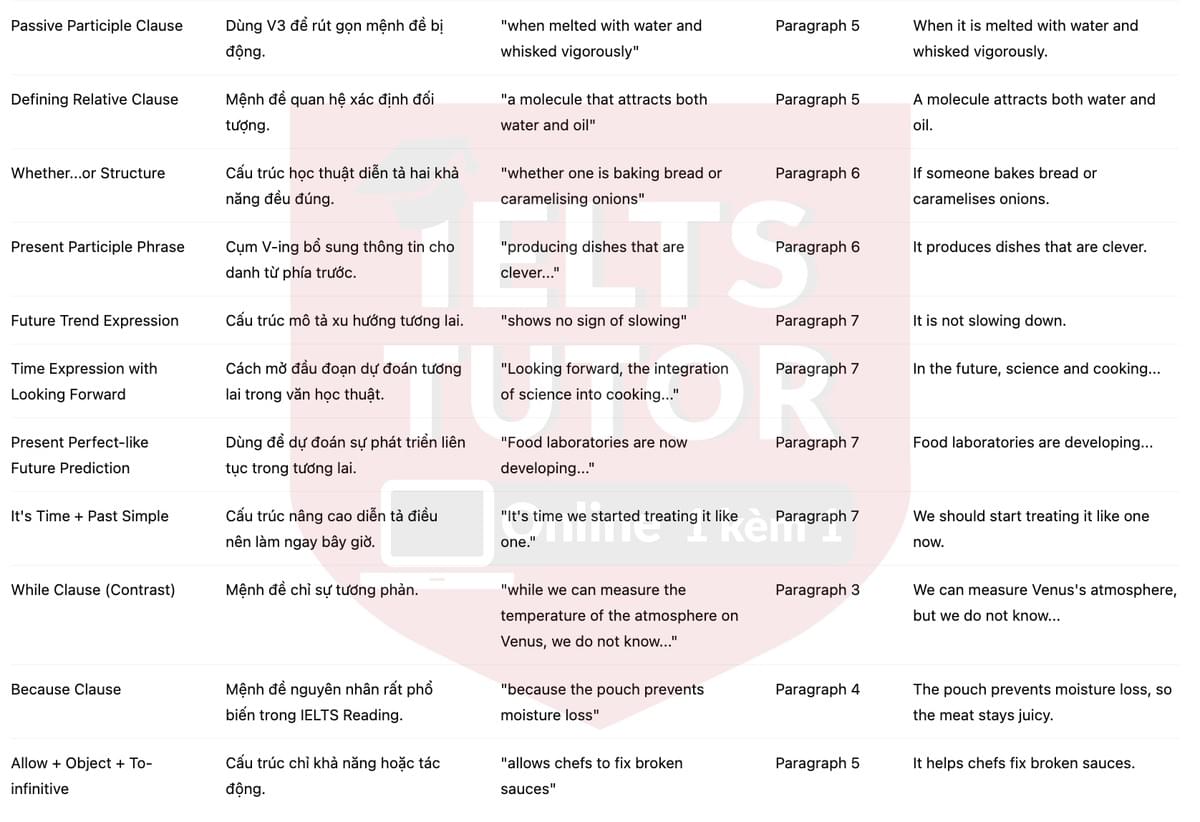
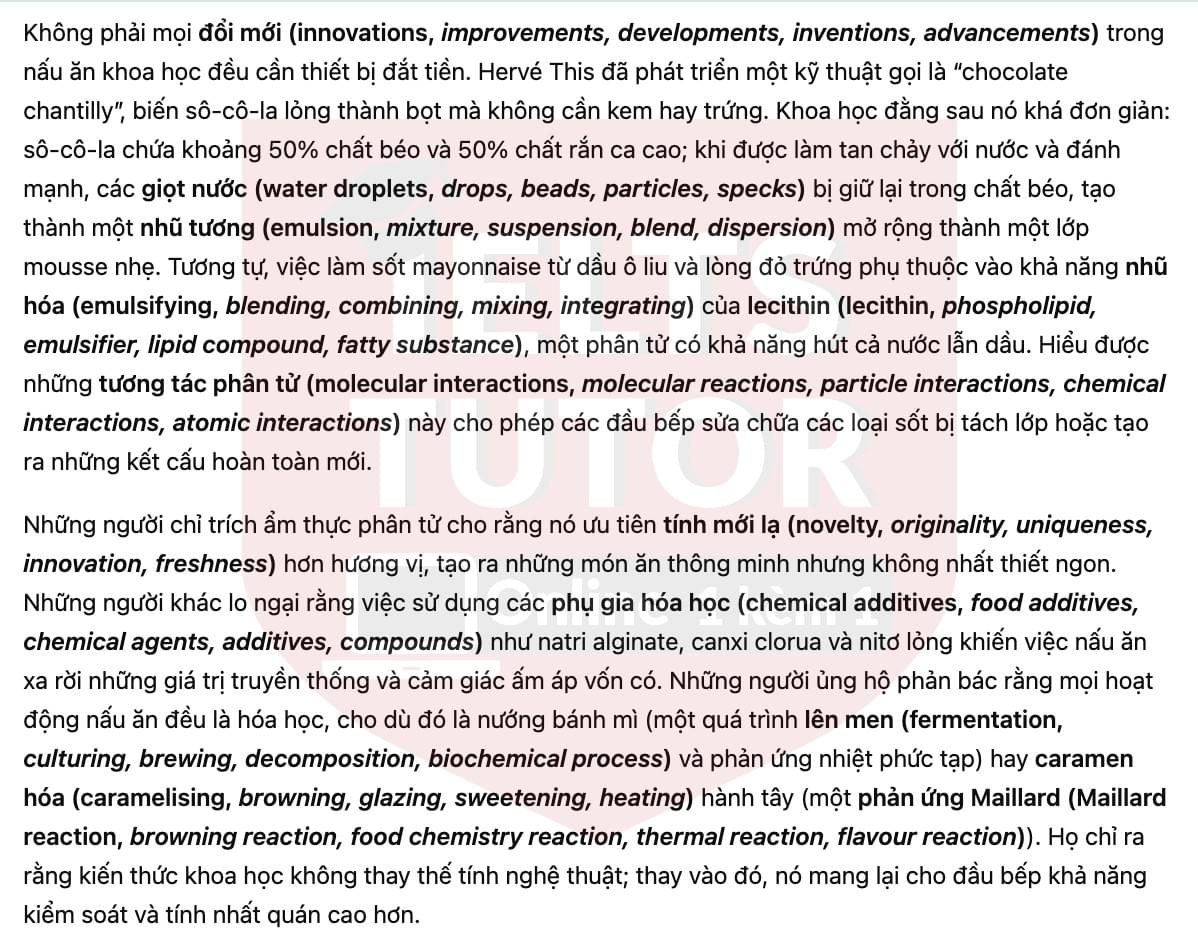
Not all innovations in scientific cooking require expensive equipment. Hervé This developed a technique called 'chocolate chantilly' which turns liquid chocolate into a foam without cream or eggs. The science is simple: chocolate contains about 50% fat and 50% cocoa solids; when melted with water and whisked vigorously, the water droplets become trapped in the fat, creating an emulsion that expands into a light mousse. Similarly, making a mayonnaise from olive oil and egg yolk depends on the emulsifying power of lecithin, a molecule that attracts both water and oil. Understanding these molecular interactions allows chefs to fix broken sauces or create entirely new textures.
Critics of molecular gastronomy argue that it prioritises novelty over flavour, producing dishes that are clever but not necessarily delicious. Others worry that the use of chemical additives such as sodium alginate, calcium chloride, and liquid nitrogen distances cooking from its traditional, comforting roots. Proponents counter that all cooking is chemistry, whether one is baking bread (a complex fermentation and thermal reaction) or caramelising onions (a Maillard reaction). They point out that scientific knowledge does not replace artistry; rather, it gives the chef greater control and consistency.
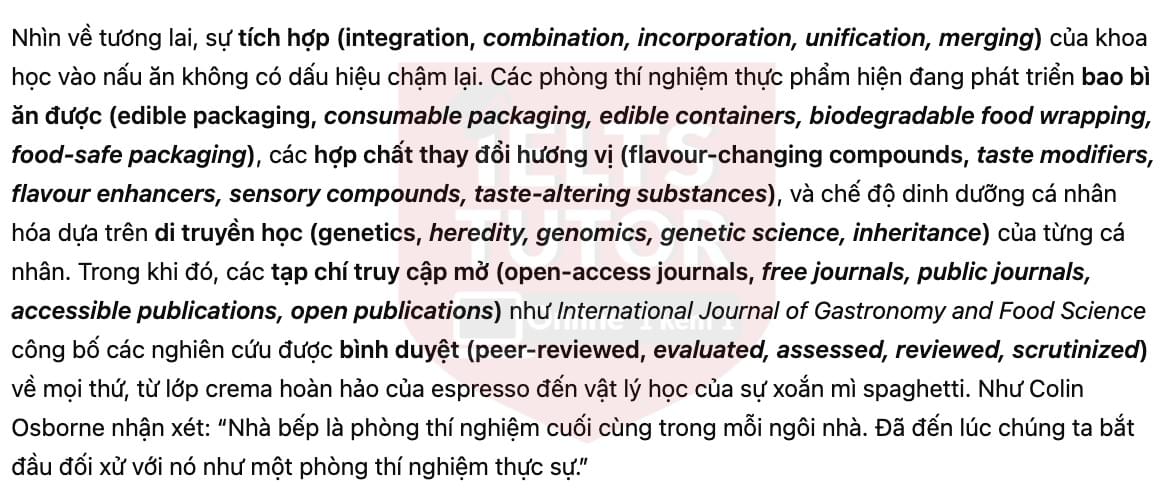
Looking forward, the integration of science into cooking shows no sign of slowing. Food laboratories are now developing edible packaging, flavour-changing compounds, and personalised nutrition based on individual genetics. Meanwhile, open-access journals such as the International Journal of Gastronomy and Food Science publish peer-reviewed research on everything from the perfect espresso crema to the physics of spaghetti twisting. As Colin Osborne notes, 'The kitchen is the last laboratory in the home. It's time we started treating it like one.'
Do the following statements agree with the information? Write TRUE / FALSE / NOT GIVEN
Complete the summary. Choose NO MORE THAN TWO WORDS from the passage.
Choose the correct letter A, B, C, or D.
III. Science in the kitchen: Đề luyện tập IELTS READING (IELTS Reading Practice Test)
READING PASSAGE 3
You should spend about 20 minutes on Questions 27–40, which are based on Reading Passage 3 below.
Science in the kitchen
Chefs are bringing a new standard of experimentation and precision to their cooking
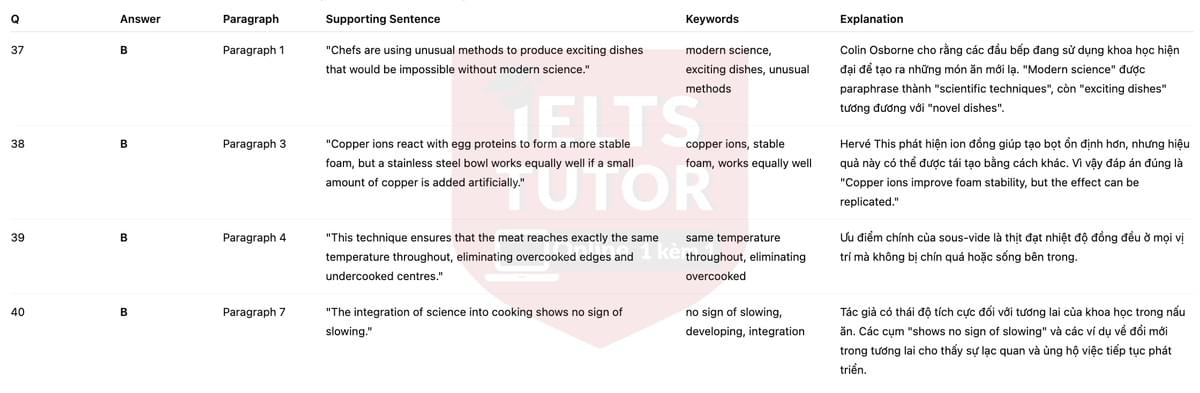
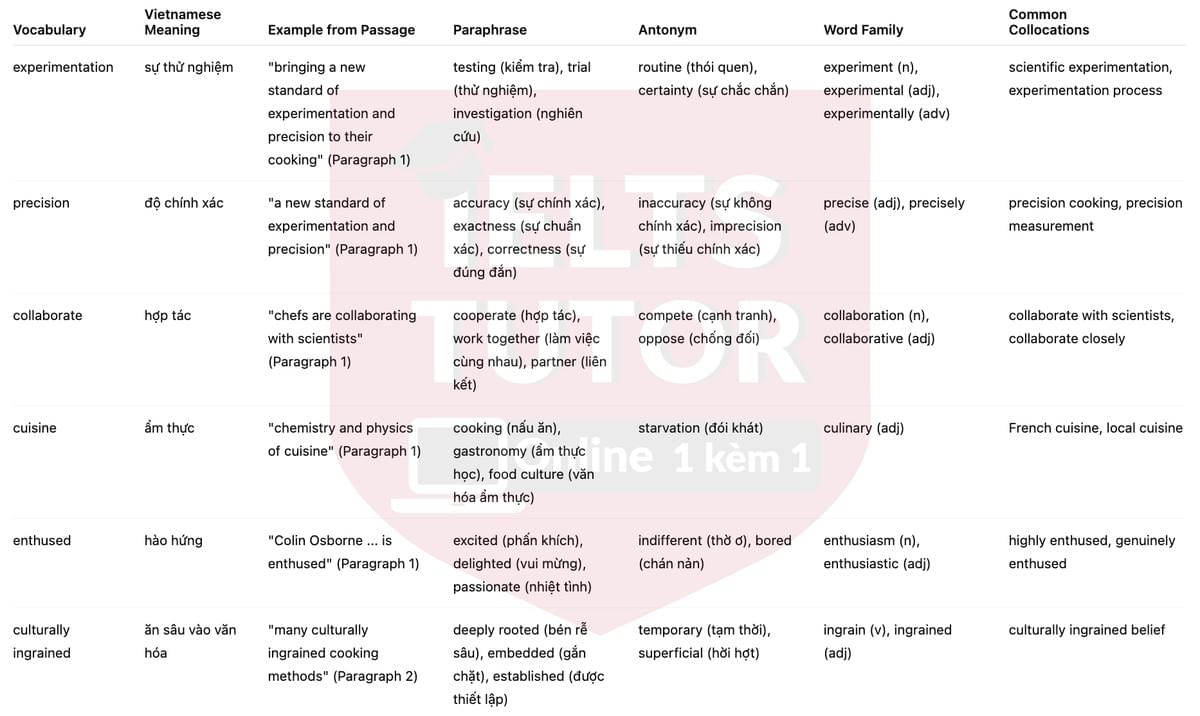
There is a recent movement in the world of food, in which chefs are collaborating with scientists to teach themselves the chemistry and physics of cuisine. Even academics are getting excited about the results. Colin Osborne of the Royal Society of Chemistry in London is enthused: 'Chefs are using unusual methods to produce exciting dishes that would be impossible without modern science,' he says.
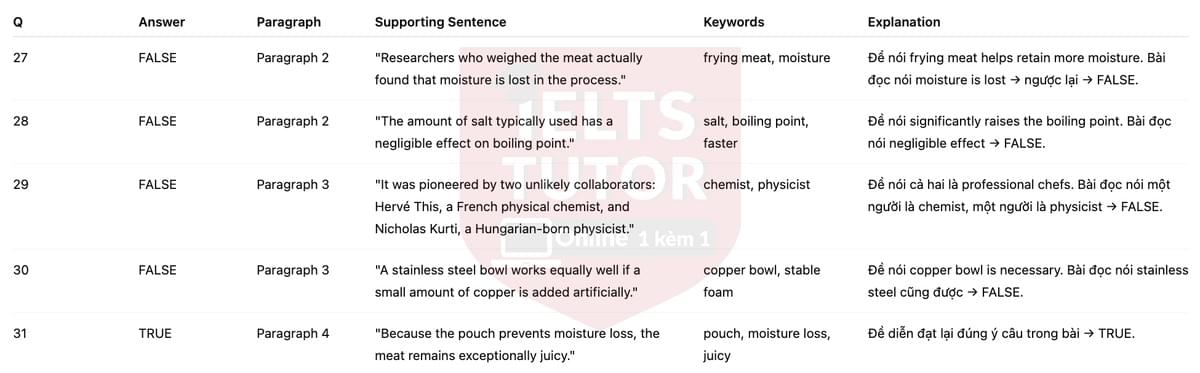
You may wonder what's wrong with long-established culinary traditions. The fact is, many culturally ingrained cooking methods are less than perfect. Osborne gives the example of the common belief that frying meat seals in moisture, while researchers who weighed the meat actually found that moisture is lost in the process. Another example is the age-old technique of adding salt when boiling vegetables to raise the boiling point of water, assuming that this will cook the vegetables faster. In reality, the amount of salt typically used has a negligible effect on boiling point, but it does help preserve the vegetables' green colour by stabilising chlorophyll molecules.
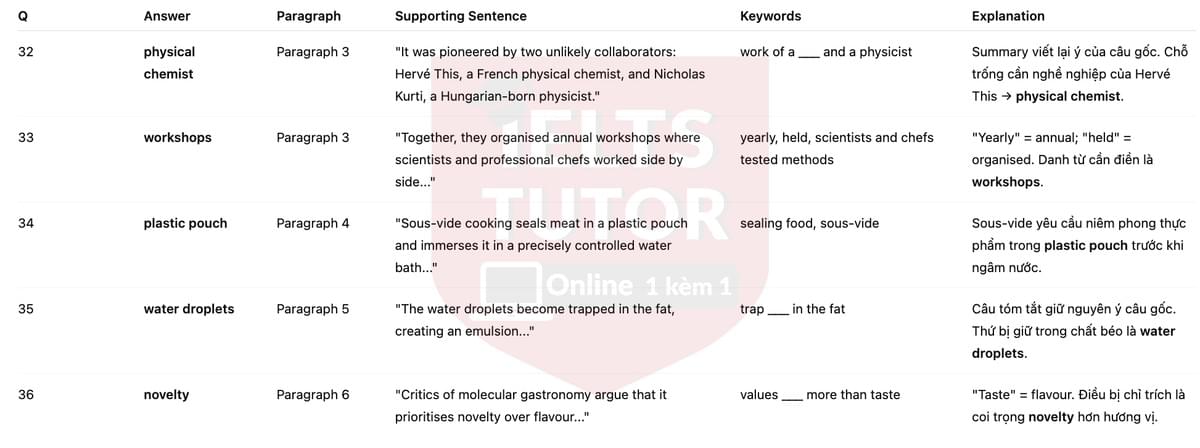
The movement now known as 'molecular gastronomy' began in the late 1980s. It was pioneered by two unlikely collaborators: Hervé This, a French physical chemist, and Nicholas Kurti, a Hungarian-born physicist at Oxford University. Together, they organised annual workshops where scientists and professional chefs worked side by side, testing kitchen methods under laboratory conditions. Kurti famously summed up their philosophy: 'It is a sad reflection on our civilisation that while we can measure the temperature of the atmosphere on Venus, we do not know what goes on inside a soufflé.' One of the key early insights was that traditional recipes often confuse 'instructions' with 'principles'. A chef might be taught to beat egg whites in a copper bowl, but does copper actually matter? This and his colleagues discovered that copper ions react with egg proteins to form a more stable foam, but a stainless steel bowl works equally well if a small amount of copper is added artificially. >> 🔥 Form đăng kí giải đề thi thật IELTS 4 kĩ năng kèm bài giải bộ đề 100 đề PART 2 IELTS SPEAKING quý đang thi (update hàng tuần) từ IELTS TUTOR
Another breakthrough involved the cooking of meat at low temperatures for extended periods. Traditionally, a roast chicken might be cooked at 200°C for an hour, resulting in a dried outer layer and a risk of overcooking. By contrast, sous-vide (French for 'under vacuum') cooking seals meat in a plastic pouch and immerses it in a precisely controlled water bath, often at temperatures as low as 55–65°C for several hours or even days. This technique ensures that the meat reaches exactly the same temperature throughout, eliminating overcooked edges and undercooked centres. Moreover, because the pouch prevents moisture loss, the meat remains exceptionally juicy. Sous-vide has been widely adopted by high-end restaurants and is now becoming available to home cooks.
Not all innovations in scientific cooking require expensive equipment. Hervé This developed a technique called 'chocolate chantilly' which turns liquid chocolate into a foam without cream or eggs. The science is simple: chocolate contains about 50% fat and 50% cocoa solids; when melted with water and whisked vigorously, the water droplets become trapped in the fat, creating an emulsion that expands into a light mousse. Similarly, making a mayonnaise from olive oil and egg yolk depends on the emulsifying power of lecithin, a molecule that attracts both water and oil. Understanding these molecular interactions allows chefs to fix broken sauces or create entirely new textures.
Critics of molecular gastronomy argue that it prioritises novelty over flavour, producing dishes that are clever but not necessarily delicious. Others worry that the use of chemical additives such as sodium alginate, calcium chloride, and liquid nitrogen distances cooking from its traditional, comforting roots. Proponents counter that all cooking is chemistry, whether one is baking bread (a complex fermentation and thermal reaction) or caramelising onions (a Maillard reaction). They point out that scientific knowledge does not replace artistry; rather, it gives the chef greater control and consistency.
Looking forward, the integration of science into cooking shows no sign of slowing. Food laboratories are now developing edible packaging, flavour-changing compounds, and personalised nutrition based on individual genetics. Meanwhile, open-access journals such as the International Journal of Gastronomy and Food Science publish peer-reviewed research on everything from the perfect espresso crema to the physics of spaghetti twisting. As Colin Osborne notes, 'The kitchen is the last laboratory in the home. It's time we started treating it like one.'
>> 🔥 Nhắn zalo 0905834420 join group zalo Hóng đề thi máy 4 skills để cập nhật đề thi thật 4 kĩ năng hằng ngày [Kèm giải & đề làm online]
Questions 27–31
Do the following statements agree with the information given in Reading Passage 3?
Write TRUE, FALSE, or NOT GIVEN.
According to research, frying meat helps it retain more moisture than other cooking methods.
Adding salt to boiling water significantly raises the boiling point and cooks vegetables faster.
Nicholas Kurti and Hervé This were both trained as professional chefs.
A copper bowl is necessary for making stable egg white foam.
Sous-vide cooking can keep meat juicy because the pouch prevents moisture loss.
Questions 32–36
Complete the summary below.
Choose NO MORE THAN TWO WORDS from the passage for each answer.
Molecular gastronomy emerged in the late 1980s through the work of a (32) ………………… and a physicist. They held yearly (33) ………………… where scientists and chefs tested cooking methods using laboratory equipment. One technique they refined was sous-vide, which involves sealing food in a (34) ………………… and cooking it in a temperature-controlled water bath. A simpler innovation by Hervé This turns chocolate into a foam by whisking melted chocolate with water to trap (35) ………………… in the fat, creating an emulsion. Critics, however, argue that molecular gastronomy sometimes values (36) ………………… more than actual taste. >> 🔥 IELTS TUTOR gợi ý tham khảo CẦN VIẾT & THU ÂM BAO NHIÊU BÀI ĐỂ ĐẠT 8.0 SPEAKING & 7.0 WRITING?
Questions 37–40
Choose the correct letter, A, B, C, or D.
37. What does Colin Osborne say about modern chefs?
A) They are ignoring traditional cooking methods completely.
B) They are using scientific techniques to create novel dishes.
C) They have rejected all collaboration with academics.
D) They only work with expensive equipment.
38. What did Hervé This discover about copper bowls?
A) They are the only material suitable for beating eggs.
B) Copper ions improve foam stability, but the effect can be replicated.
C) Stainless steel bowls produce better results than copper.
D) Copper bowls are dangerous for cooking.
39. In sous-vide cooking, what is the main advantage of low temperature over extended time?
A) The meat cooks faster than traditional methods.
B) The meat reaches a uniform temperature throughout without overcooking.
C) The outside becomes crisp while the inside stays raw.
D) No water or liquid is required.
40. What is the author's attitude towards the future of science in cooking?
A) Skeptical and concerned about the loss of tradition
B) Enthusiastic about continued innovation and integration
C) Indifferent, believing it will remain a niche movement
D) Critical, arguing that it produces inferior food
IV. Dịch bài đọc Science in the kitchen
V. Giải thích từ vựng Science in the kitchen
VI. Giải thích cấu trúc ngữ pháp khó Science in the kitchen
VII. Đáp án Science in the kitchen
27. FALSE
28. FALSE
29. FALSE
30. FALSE
31. TRUE
32. physical chemist
33. workshops
34. plastic pouch
35. water droplets
36. novelty
37. B
38. B
39. B
40. B
📩 MN AI CHƯA CÓ ĐÁP ÁN FORECAST QUÝ MỚI PART 1-2-3 NHẮN ZL 0905834420 IELTS TUTOR GỬI FREE HẾT NHA

Các khóa học IELTS online 1 kèm 1 - 100% cam kết đạt target 6.0 - 7.0 - 8.0 - Đảm bảo đầu ra - Thi không đạt, học lại FREE
>> Thành tích học sinh IELTS TUTOR với hàng ngàn feedback được cập nhật hàng ngày
