
IELTS TUTOR cung cấp Should We Stop Eating Meat? Đề luyện tập IELTS READING (IELTS Reading Practice Test) - Làm bài online format computer-based, kèm đáp án, dịch & giải thích từ vựng - cấu trúc ngữ pháp khó & GIẢI ĐÁP ÁN VỚI LOCATION
I. Kiến thức liên quan
📩 MN AI CHƯA CÓ ĐÁP ÁN FORECAST QUÝ MỚI PART 1-2-3 NHẮN ZL 0905834420 IELTS TUTOR GỬI FREE HẾT NHA
II. Làm bài online (kéo xuống cuối bài blog để xem giải thích từ vựng & cấu trúc cụ thể hơn)
Should We Stop Eating Meat?
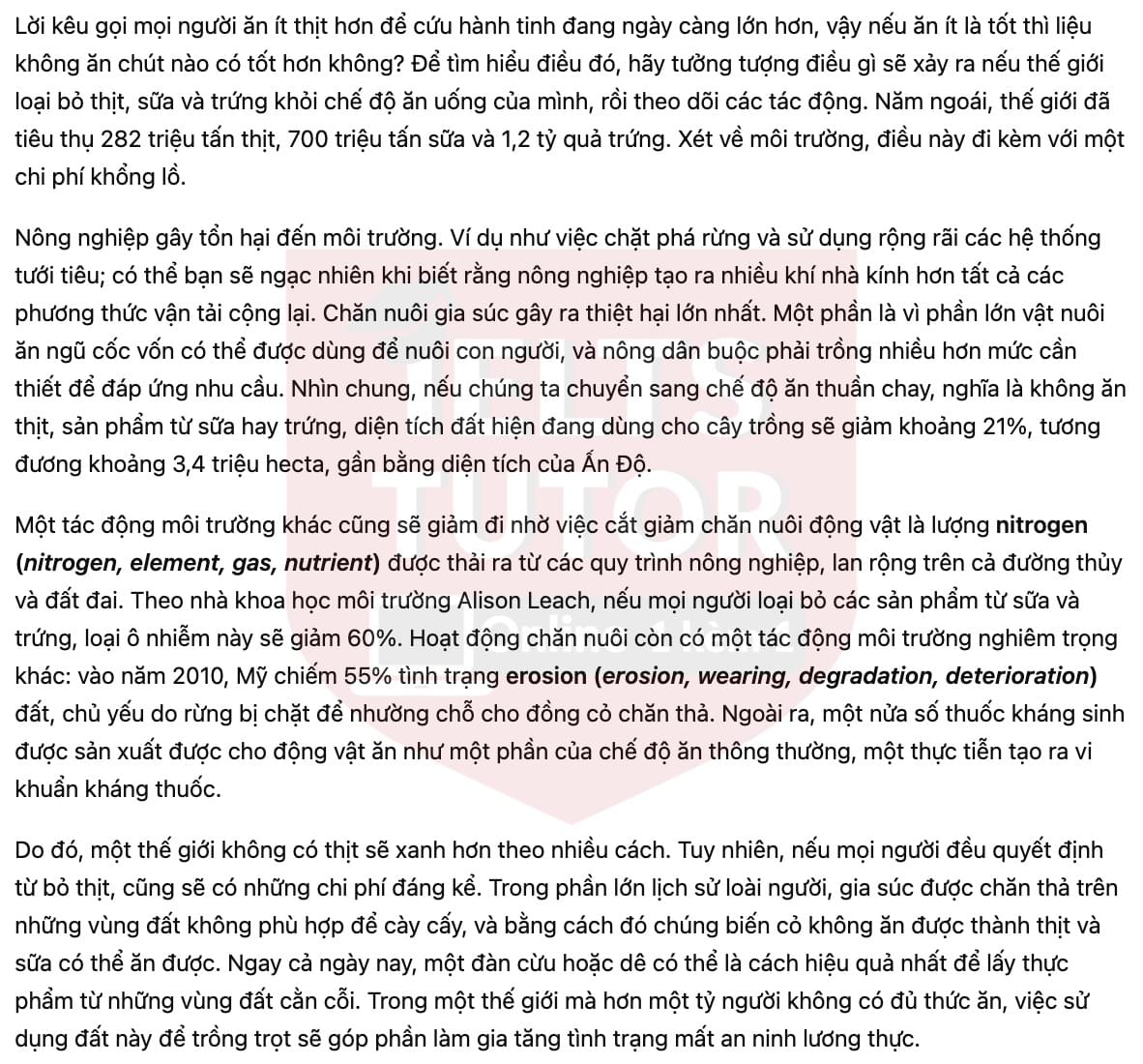
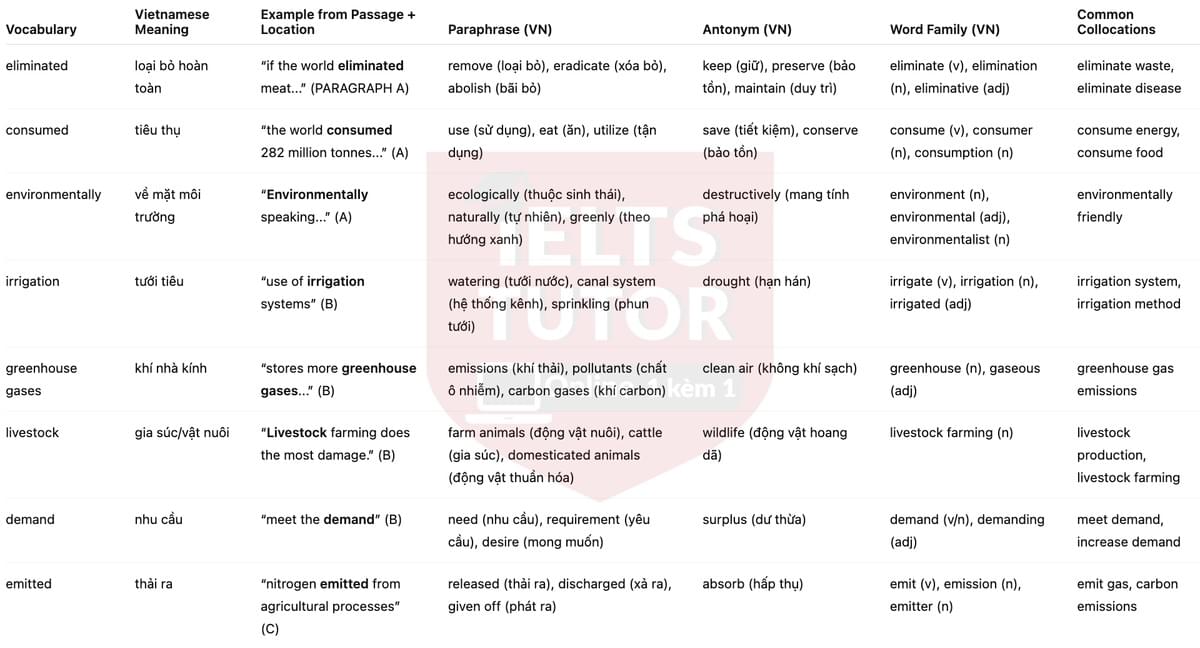
A call for people to eat less meat to save the planet is growing louder, so if less is good, wouldn't none be better? To find out, let's imagine what would happen if the world eliminated meat, milk and eggs from its diet, then trace the effects. Last year, the world consumed 282 million tonnes of meat, 700 million tonnes of milk and 1.2 billion eggs. Environmentally speaking, this came at an enormous cost.
Agriculture damages the environment. Take, for example, the telling of forests and the widespread use of irrigation systems; it may surprise you to know that agriculture stores more greenhouse gases than all methods of transport put together. Livestock farming does the most damage. In part that is because most livestock eat grain that could be used to feed human populations, and farmers are forced to grow more than we would otherwise need to meet the demand. Altogether, if we switched to a vegan diet, meaning no meat, dairy or eggs, the land currently required for crops would drop by an estimated 21 per cent, about 3.4 million hectares, roughly the size of India.
One environmental impact that would also lessen through a reduction in animal farming would be nitrogen emitted from agricultural processes, which spread over both waterways and land. According to environmental scientist Alison Leach, if everyone eliminated dairy products and eggs, this kind of pollution would fall by 60 per cent. Livestock production has another serious environmental impact: by 2010, the US accounted for 55 per cent of erosion, mainly from forests being cut down to make way for grazing land. On top of this, half of all antibiotics manufactured are fed to animals as part of their normal diet, a practice creating resistant bacteria.
A meat-free world, then, would be greener in many ways. However, if everyone opted to give up meat, there would be significant costs too. For most of human history, stock grazed on land that wasn't suitable for ploughing, and in doing so they converted inedible grass into edible meat and milk. Even today, a flock of sheep or goats can be the most efficient way to get food from marginal land. In a world in which over a billion people do not have enough to eat, using this land for crop production would contribute to food insecurity.
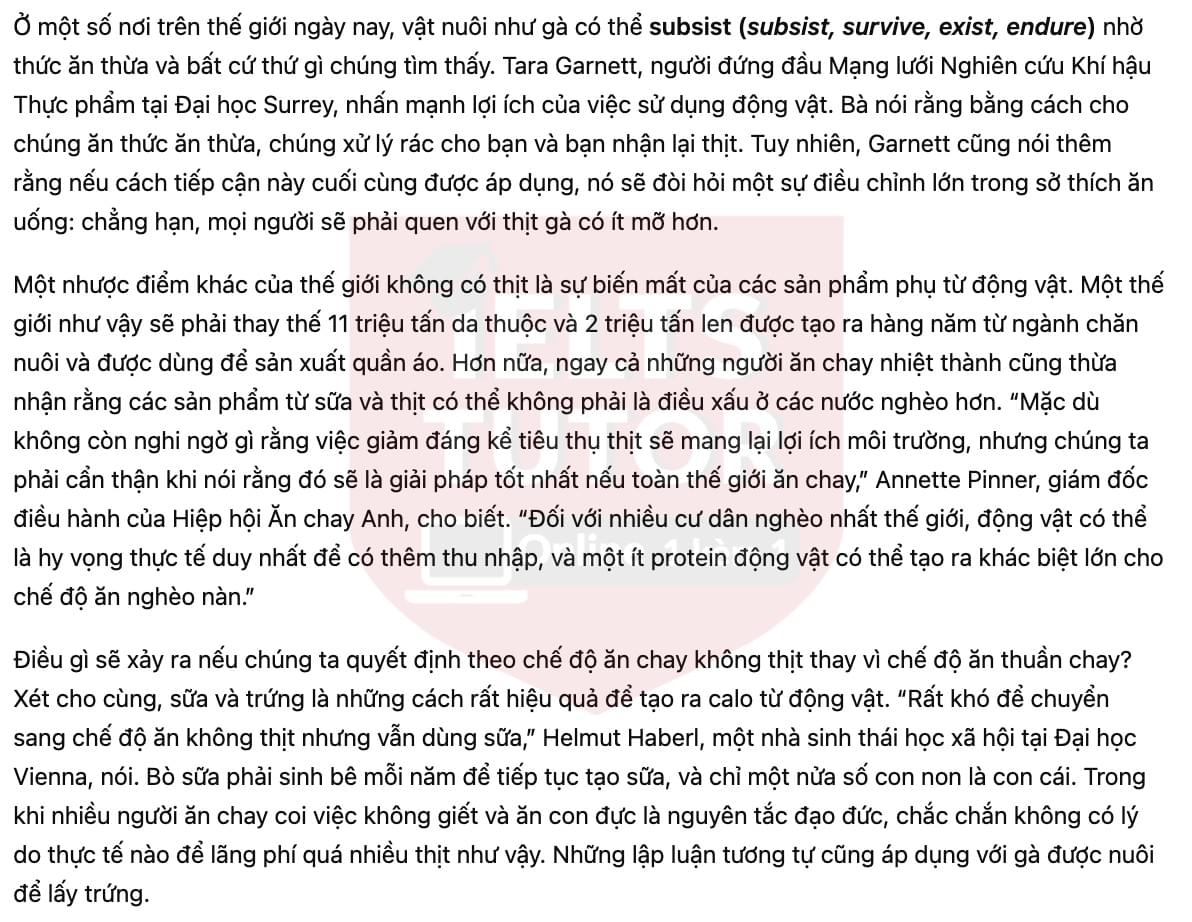
In some parts of the world today, livestock such as chickens can subsist on leftovers and whatever they find. Tara Garnett, who heads the Food Climate Research Network at the University of Surrey, points out the use of the animals. By giving them your leftovers, she says, they deal with your rubbish, and you get meat. Garnett adds, though, that if this kind of approach were eventually adopted, it would require a major adjustment in food preference: people would have to get used to chicken, for example, with less fat.
Another downside to a meat-free world would be the disappearance of animal by-products. Such a world would have to replace the 11 million tonnes of leather and 2 million tonnes of wool that come annually from livestock farming and which are turned into clothing. Furthermore, even ardent vegetarians acknowledge that dairy products and meat may not be a good thing in poorer countries. "Whilst there's no doubt that considerable reduction of meat consumption would have an environmental benefit, we do have to be careful about saying it would be the best solution if the whole world were vegetarian," says Annette Pinner, chief executive of the UK Vegetarian Society. "For many of the world's poorest residents, animals may present their only realistic hope of an extra income, and a little animal protein can make a big difference to a marginal diet."
What if we decided on a no-meat but vegetarian diet, rather than a vegan diet? After all, milk and eggs are very efficient ways of producing animal calories. "It's difficult to switch to a no-meat-but-milk diet," says Helmut Haberl, a social ecologist at the University of Vienna. Dairy cows must calve every year to keep producing milk, and only half their offspring will be female. While many vegetarians make it a moral rule not to kill and eat the males, there is surely no practical reason to waste so much meat. Similar arguments apply to chickens kept for eggs.
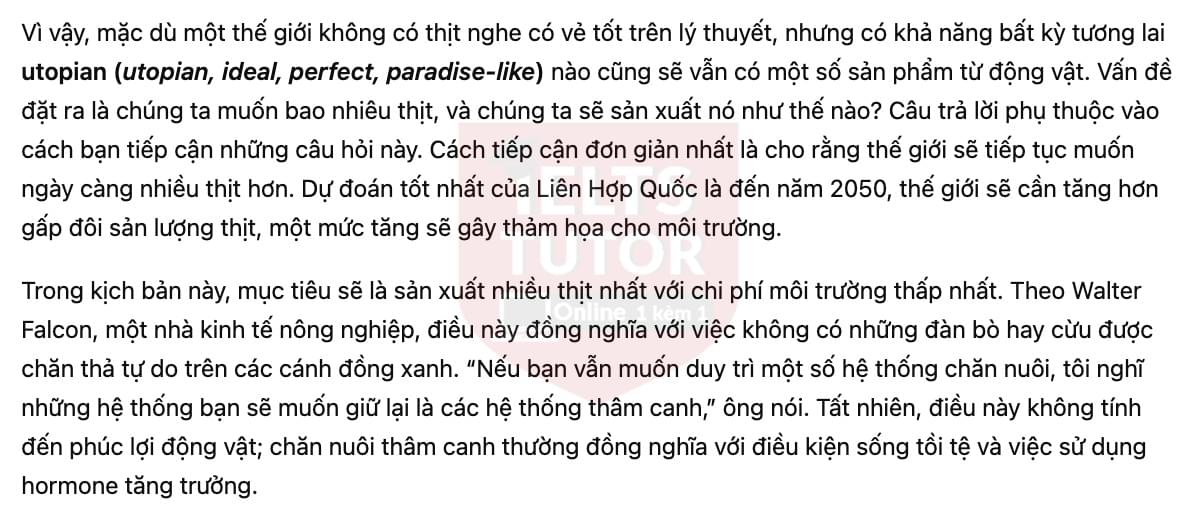
So even though a meat-free world sounds good on paper, it is likely that any utopian future will have some animal products in it. The questions, then, are how much meat do we want, and how will we produce it? The answers depend on how you approach these questions. The most straightforward approach is to argue that the world will continue to want ever more meat. The United Nations' best guess is that by 2050 the world will need to more than double its production of meat, an increase that would be environmentally disastrous.
Under this scenario, the goal will have to be producing the most meat at the lowest environmental cost. According to Walter Falcon, an agricultural economist, this means no free-range cows and sheep in green fields. "If you're going to keep some livestock systems, I think the ones you'll want to keep are the intensive ones," he says. Of course, this does not take into account animal welfare; intensive farming usually means poor living conditions and the use of growth hormones.
A. Alison Leach | B. Tara Garnett | C. Annette Pinner | D. Helmut Haberl | E. Walter Falcon
III. Should We Stop Eating Meat?: Đề luyện tập IELTS READING (IELTS Reading Practice Test)
Should We Stop Eating Meat?
A call for people to eat less meat to save the planet is growing louder, so if less is good, wouldn't none be better? To find out, let's imagine what would happen if the world eliminated meat, milk and eggs from its diet, then trace the effects. Last year, the world consumed 282 million tonnes of meat, 700 million tonnes of milk and 1.2 billion eggs. Environmentally speaking, this came at an enormous cost.
Agriculture damages the environment. Take, for example, the telling of forests and the widespread use of irrigation systems; it may surprise you to know that agriculture stores more greenhouse gases than all methods of transport put together. Livestock farming does the most damage. In part that is because most livestock eat grain that could be used to feed human populations, and farmers are forced to grow more than we would otherwise need to meet the demand. Altogether, if we switched to a vegan diet, meaning no meat, dairy or eggs, the land currently required for crops would drop by an estimated 21 per cent, about 3.4 million hectares, roughly the size of India.
One environmental impact that would also lessen through a reduction in animal farming would be nitrogen emitted from agricultural processes, which spread over both waterways and land. According to environmental scientist Alison Leach, if everyone eliminated dairy products and eggs, this kind of pollution would fall by 60 per cent. Livestock production has another serious environmental impact: by 2010, the US accounted for 55 per cent of erosion, mainly from forests being cut down to make way for grazing land. On top of this, half of all antibiotics manufactured are fed to animals as part of their normal diet, a practice creating resistant bacteria.
A meat-free world, then, would be greener in many ways. However, if everyone opted to give up meat, there would be significant costs too. For most of human history, stock grazed on land that wasn't suitable for ploughing, and in doing so they converted inedible grass into edible meat and milk. Even today, a flock of sheep or goats can be the most efficient way to get food from marginal land. In a world in which over a billion people do not have enough to eat, using this land for crop production would contribute to food insecurity. >> 🔥 Form đăng kí giải đề thi thật IELTS 4 kĩ năng kèm bài giải bộ đề 100 đề PART 2 IELTS SPEAKING quý đang thi (update hàng tuần) từ IELTS TUTOR
In some parts of the world today, livestock such as chickens can subsist on leftovers and whatever they find. Tara Garnett, who heads the Food Climate Research Network at the University of Surrey, points out the use of the animals. By giving them your leftovers, she says, they deal with your rubbish, and you get meat. Garnett adds, though, that if this kind of approach were eventually adopted, it would require a major adjustment in food preference: people would have to get used to chicken, for example, with less fat.
Another downside to a meat-free world would be the disappearance of animal by-products. Such a world would have to replace the 11 million tonnes of leather and 2 million tonnes of wool that come annually from livestock farming and which are turned into clothing. Furthermore, even ardent vegetarians acknowledge that dairy products and meat may not be a good thing in poorer countries. "Whilst there's no doubt that considerable reduction of meat consumption would have an environmental benefit, we do have to be careful about saying it would be the best solution if the whole world were vegetarian," says Annette Pinner, chief executive of the UK Vegetarian Society. "For many of the world's poorest residents, animals may present their only realistic hope of an extra income, and a little animal protein can make a big difference to a marginal diet."
What if we decided on a no-meat but vegetarian diet, rather than a vegan diet? After all, milk and eggs are very efficient ways of producing animal calories. "It's difficult to switch to a no-meat-but-milk diet," says Helmut Haberl, a social ecologist at the University of Vienna. Dairy cows must calve every year to keep producing milk, and only half their offspring will be female. While many vegetarians make it a moral rule not to kill and eat the males, there is surely no practical reason to waste so much meat. Similar arguments apply to chickens kept for eggs.
So even though a meat-free world sounds good on paper, it is likely that any utopian future will have some animal products in it. The questions, then, are how much meat do we want, and how will we produce it? The answers depend on how you approach these questions. The most straightforward approach is to argue that the world will continue to want ever more meat. The United Nations' best guess is that by 2050 the world will need to more than double its production of meat, an increase that would be environmentally disastrous.
>> 🔥 Nhắn zalo 0905834420 join group zalo Hóng đề thi máy 4 skills để cập nhật đề thi thật 4 kĩ năng hằng ngày [Kèm giải & đề làm online]
Under this scenario, the goal will have to be producing the most meat at the lowest environmental cost. According to Walter Falcon, an agricultural economist, this means no free-range cows and sheep in green fields. "If you're going to keep some livestock systems, I think the ones you'll want to keep are the intensive ones," he says. Of course, this does not take into account animal welfare; intensive farming usually means poor living conditions and the use of growth hormones.
Questions 14-17
Reading Passage 2 has nine paragraphs, A-I. Which paragraph contains the following information?
Write the correct letter, A-I, in boxes 14-17 on your answer sheet.
the suggestion that people may need to adapt to a different quality of meat
a description of the way animals were fed in the past
a prediction in regard to human and farming
the potential consequences of a meat-free world for textile industries
Questions 18-22
Complete the summary below.
Choose ONE WORD ONLY from the passage for each answer.
The Environmental Impact of Farming
Agriculture causes significant harm to the environment in a number of ways, including the frequent use of 18 ______ in modern farming and the cutting down of trees. It is also responsible for the production of many greenhouse gases, more so than all methods of 19 ______ put together. However, it is 20 ______ farming in particular that is most harmful. A meat-free diet would also mean less chemical pollution, specifically in the form of 21 ______. If consumers cut out dairy and egg products as well as meat, the land currently required for crops would drop by an estimated 21 per cent. In the US, there is clear evidence that considerable 22 ______ occurs, although there is no information on this from other countries. >> 🔥 IELTS TUTOR gợi ý tham khảo CẦN VIẾT & THU ÂM BAO NHIÊU BÀI ĐỂ ĐẠT 8.0 SPEAKING & 7.0 WRITING?
Questions 23-25
Look at the following statements (Questions 23-25) and the list of people below.
Match each statement with the correct person, A-E.
You may use any letter more than once.
It is not possible to say that a vegetarian diet is right for everyone.
It may be economically preferable to farm animals in a confined space.
It does not make sense to give up meat without giving up dairy products too.
Some animals can be fed in a way that allows waste to be recycled.
List of People
A. Alison Leach
B. Tara Garnett
C. Annette Pinner
D. Helmut Haberl
E. Walter Falcon
IV. Dịch bài đọc Should We Stop Eating Meat?
V. Giải thích từ vựng Should We Stop Eating Meat?
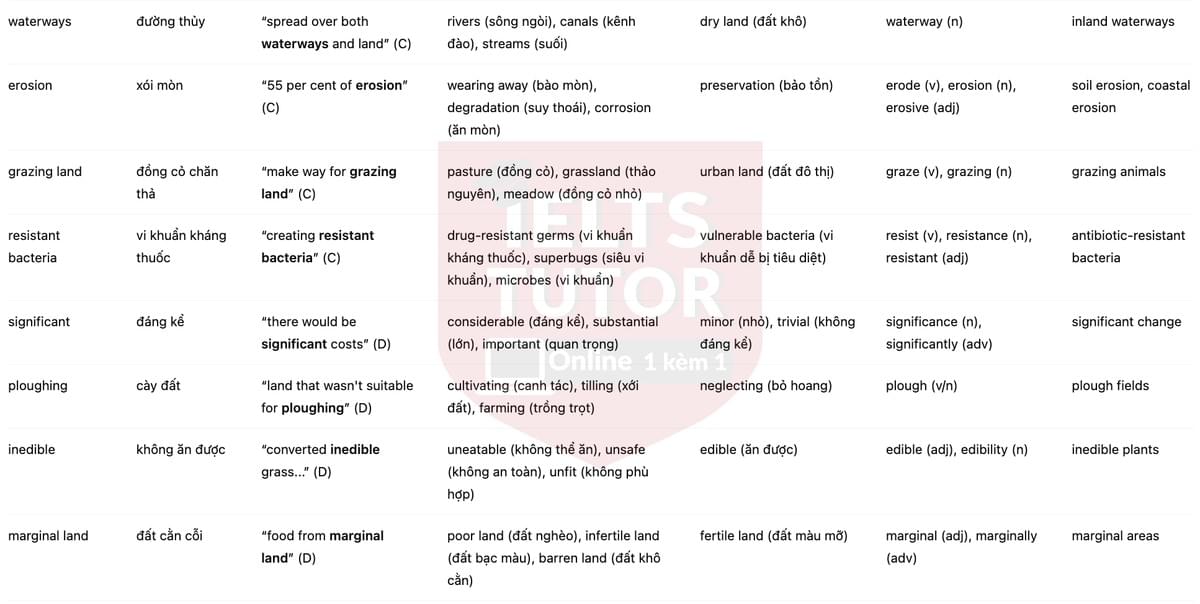
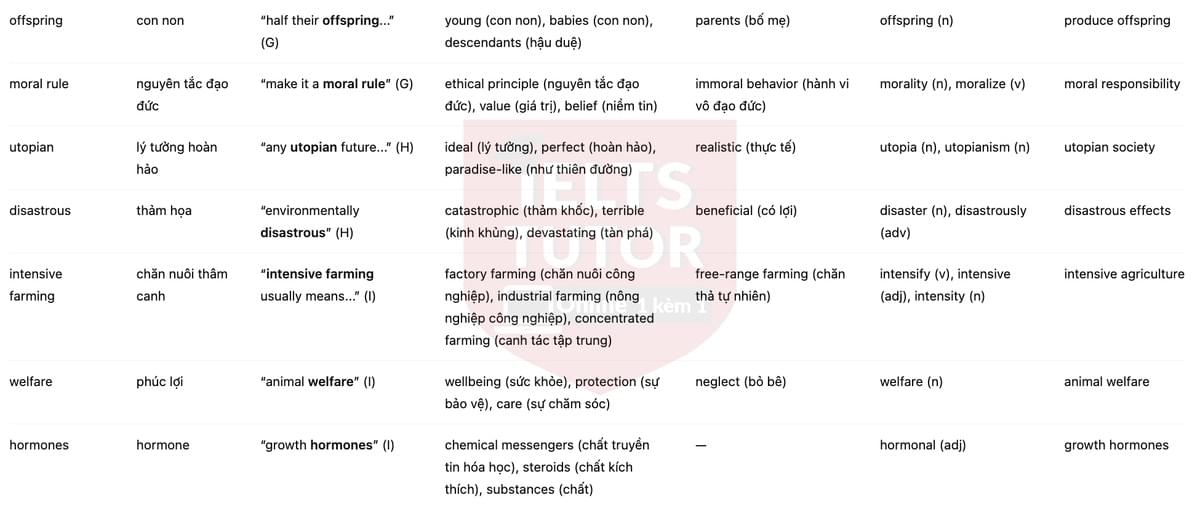
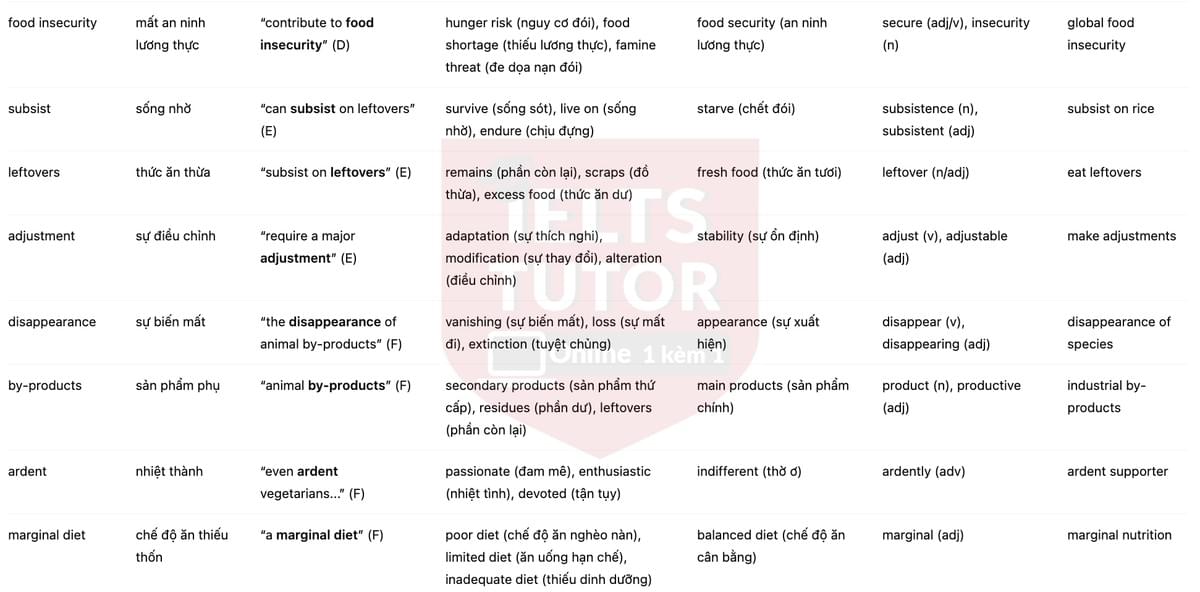
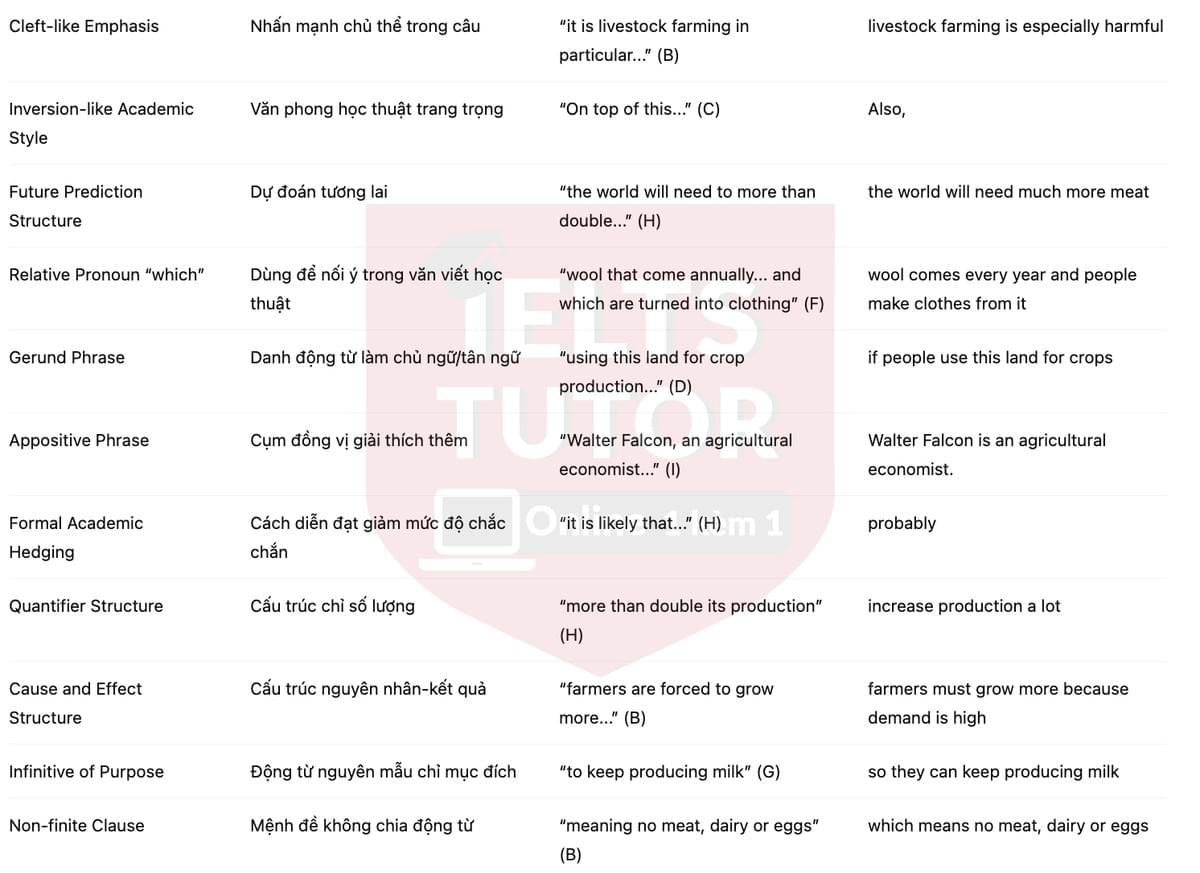
VI. Giải thích cấu trúc ngữ pháp khó Should We Stop Eating Meat?
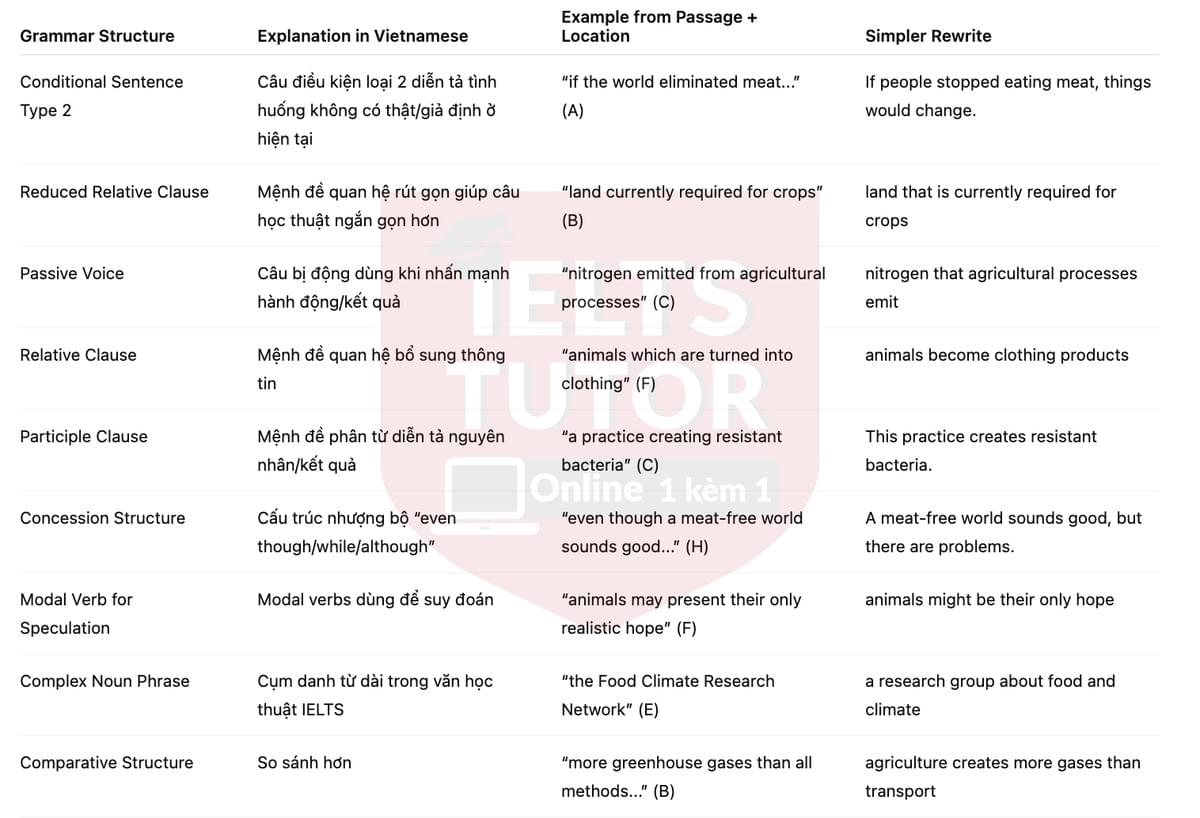
VII. Đáp án Should We Stop Eating Meat?
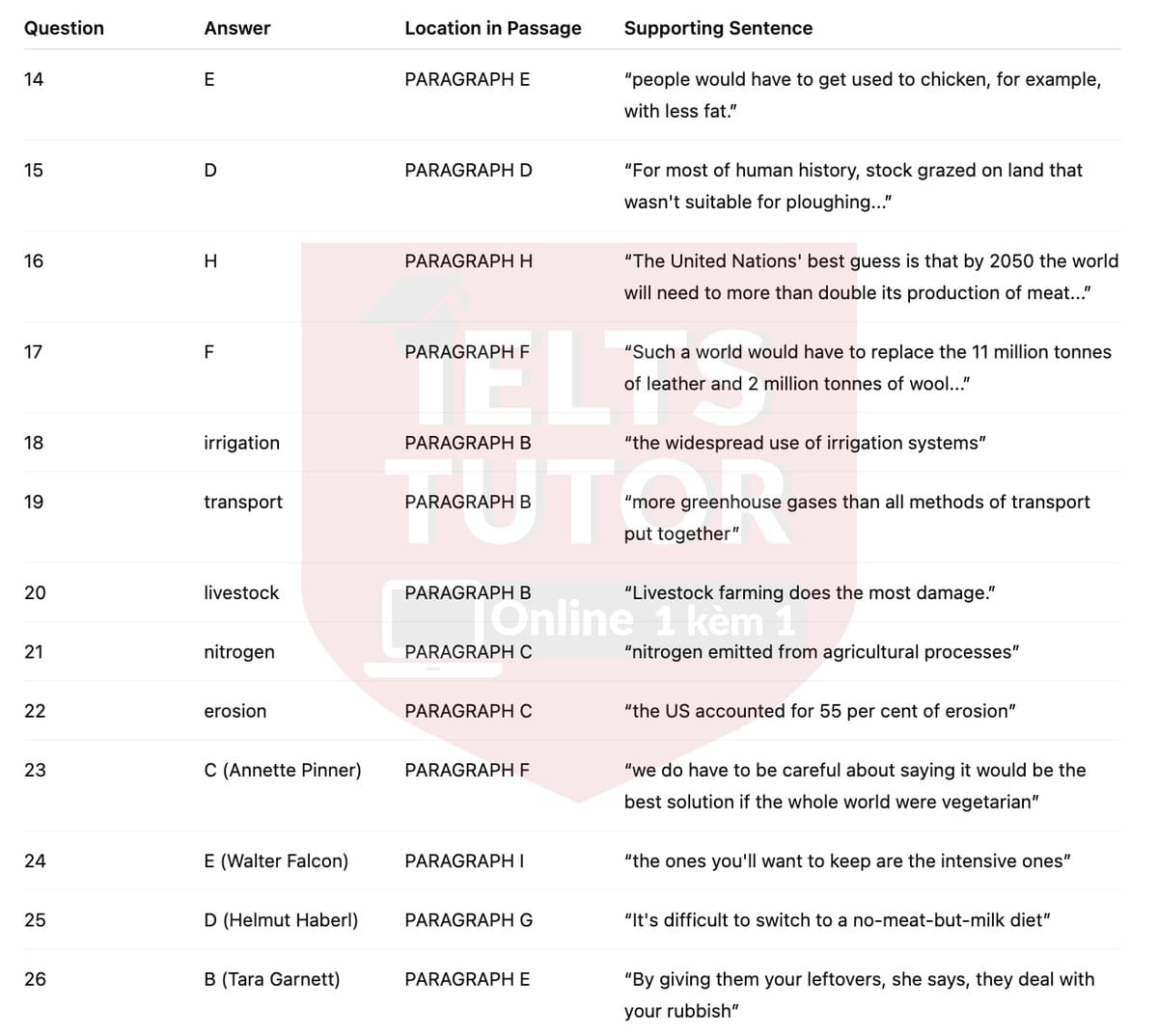
14. E
15. D
16. H
17. F
18. irrigation
19. transport
20. livestock
21. nitrogen
22. erosion
23. C
24. E
25. D
26. B
📩 MN AI CHƯA CÓ ĐÁP ÁN FORECAST QUÝ MỚI PART 1-2-3 NHẮN ZL 0905834420 IELTS TUTOR GỬI FREE HẾT NHA

Các khóa học IELTS online 1 kèm 1 - 100% cam kết đạt target 6.0 - 7.0 - 8.0 - Đảm bảo đầu ra - Thi không đạt, học lại FREE
>> Thành tích học sinh IELTS TUTOR với hàng ngàn feedback được cập nhật hàng ngày
