
IELTS TUTOR cung cấp Memory Champions...or just good at tricks? Đề luyện tập IELTS READING (IELTS Reading Practice Test) - Làm bài online format computer-based, kèm đáp án, dịch & giải thích từ vựng - cấu trúc ngữ pháp khó & GIẢI ĐÁP ÁN VỚI LOCATION
I. Kiến thức liên quan
📩 MN AI CHƯA CÓ ĐÁP ÁN FORECAST QUÝ MỚI PART 1-2-3 NHẮN ZL 0905834420 IELTS TUTOR GỬI FREE HẾT NHA
II. Làm bài online (kéo xuống cuối bài blog để xem giải thích từ vựng & cấu trúc cụ thể hơn)
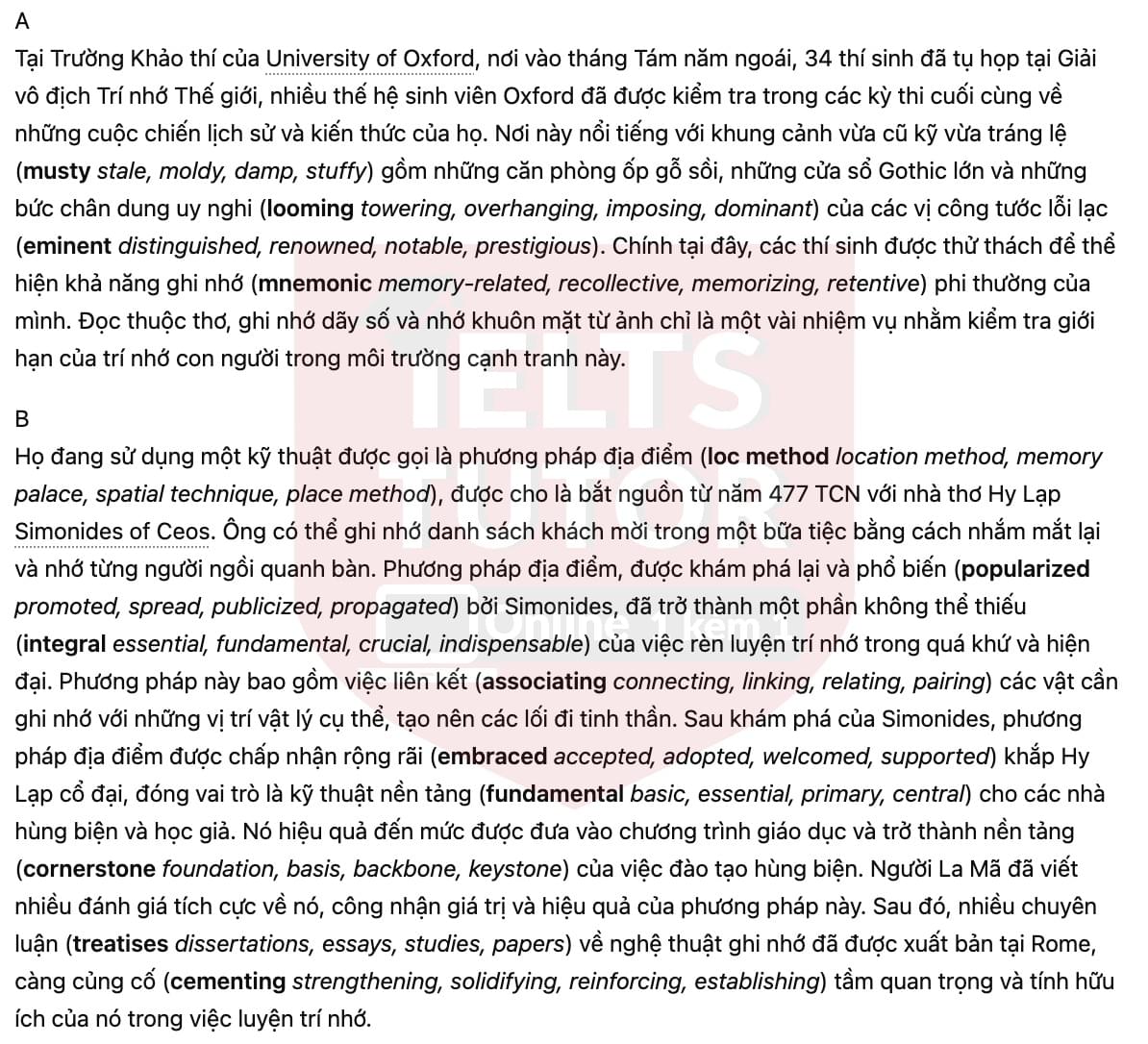
A The Examinations School at Oxford University where, last August, 34 competitors and cars. It is here that generations of Oxford students have been tested in their final gathered at the World Memory Championships historical wars, known for its musty yet grandiose setting of oak-paneled rooms, large Gothic windows, and looming portraits of eminent dukes on their memory and knowledge, and it is here that these contestants were challenged to demonstrate their exceptional mnemonic abilities. Reciting poems, memorizing digit sequences, and recalling faces from photographs are just a few of the tasks that test the limits of human memory in this competitive setting.
B They are using a technique known as the loc method, reportedly originating in 477 BC with the Greek poet Simonides of Ceos. He was able to memorize the guest list at a dinner by closing his eyes and recalling each individual around the table. The loc method, which was rediscovered and popularized by Simonides, has become an integral part of historical and modern memory training. This method involves associating items to be remembered with specific physical locations, creating mental pathways. After Simonides’ discovery, the loc method became widely embraced across ancient Greece, serving as a fundamental technique for orators and scholars. It was so effective that it was incorporated into educational curricula and became a cornerstone of rhetorical training. Romans wrote favorably about recognizing its value and effectiveness. Later, a number of treatises on the art of memory were published in Rome, further cementing its importance and utility in memory training.
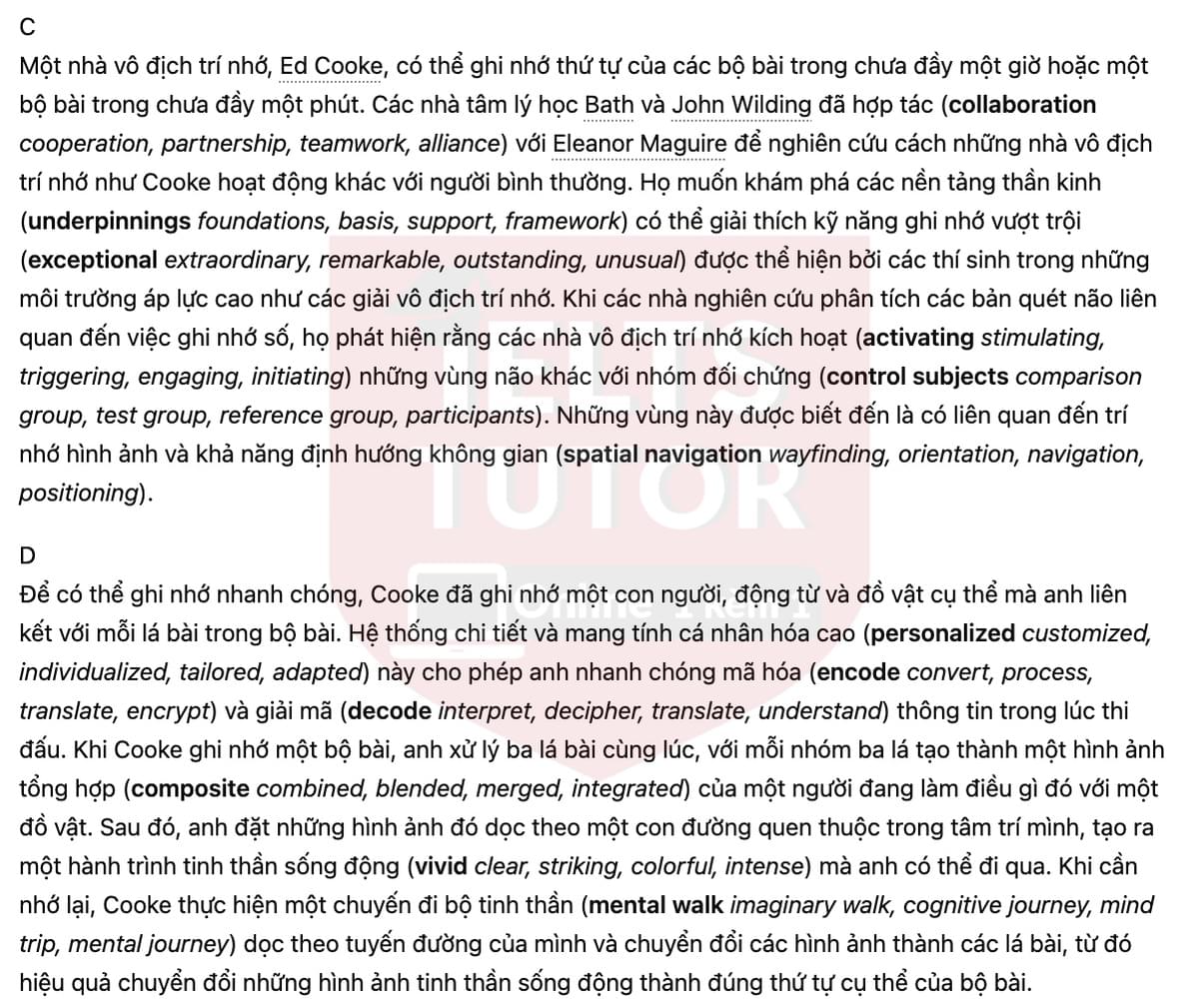
C One memory champion, Ed Cooke, can memorize the order of the operate differently from average individuals. Their collaboration decks of playing cards in less than one hour or one deck of cards in less than one minute. Psychologists Bath and John Wilding have teamed up with Eleanor Maguire to study how memory champions like Cooke to explore the neural underpinnings that might explain the exceptional memory skills exhibited by competitors in high-pressure environments such as memory championships. When the researchers analyzed the brain scans from the number memorization, they found that the memory champions were activating some brain regions that was different from the control subjects were using. These regions are known to be involved in visual memory and spatial navigation.
D To enable himself to memorize quickly, Cooke has memorized a specific human being, verb, and object that he associates with every card in the deck. This detailed and highly personalized system allows him to rapidly encode and decode information during competition. When Cooke commits a deck to memory, he does three cards in one go, with every three-card group forming a composite picture of a person doing something to an object. He then places those images along a specific familiar path in his mind, creating a vivid mental journey that he can traverse. When it comes to recall, Cooke takes a mental walk along his route and translates the images into cards, effectively and efficiently converting his vivid mental images back into the specific order of the deck.
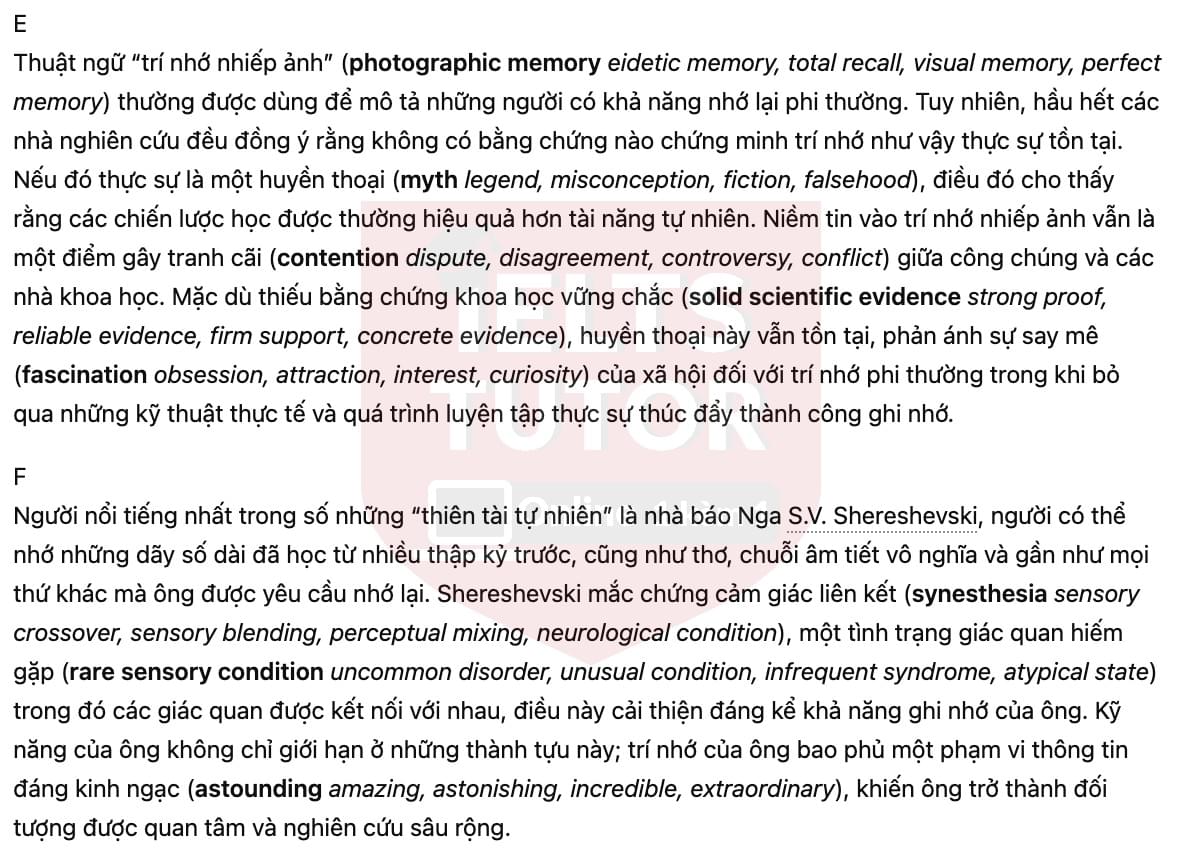
E The term ‘photographic memory’ is frequently used to describe people with exceptional recall. Yet, most researchers agree there is no proof that such a memory truly exists. If it is indeed a myth, it highlights how learned strategies are often more effective than natural talent. The belief in photographic memory remains a point of contention among the public and scientists alike. Despite the absence of solid scientific evidence, this myth persists, reflecting how society’s fascination with remarkable memory continues to ignore the practical techniques and training that genuinely drive mnemonic success.
F The most renowned of the naturals was the Russian journalist S.V. Shereshevski, who could remember long sequences of numbers learned decades before, as well as poems, strings of meaningless syllables, and nearly anything else he was asked to recall. Shereshevski experienced synesthesia, a rare sensory condition where senses are interconnected, which significantly improved his memorization ability. His skills were not limited to these accomplishments; his memory covered an astounding range of information, making him a figure of great interest and study.
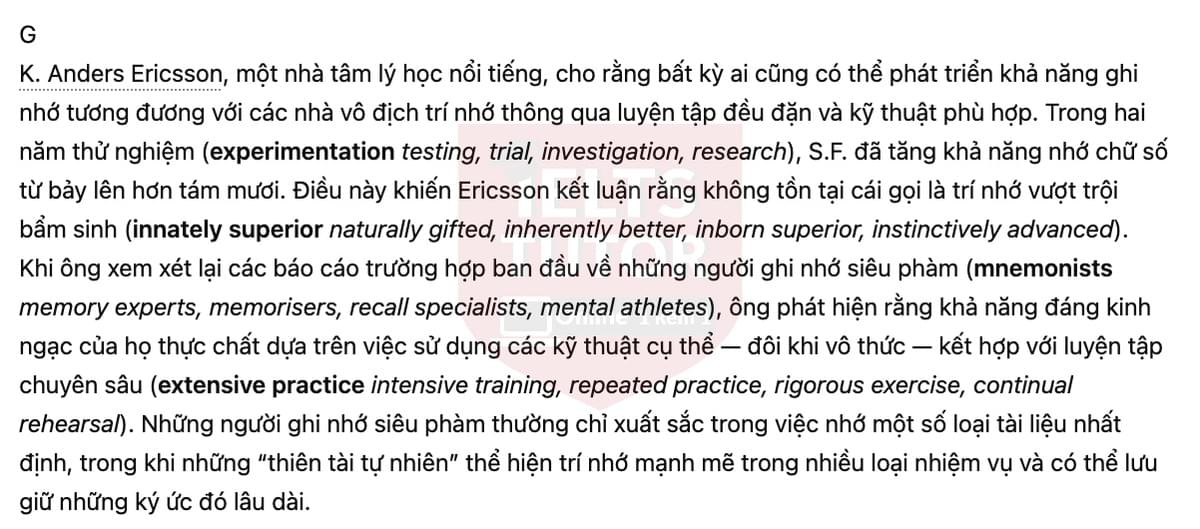
G K. Anders Ericsson, a well-known psychologist, claims that anyone can develop memory abilities comparable to those of memory champions through consistent practice and proper techniques. During two years of experimentation, S.F. increased his ability to recall digits from seven to over eighty. This led Ericsson to conclude that there is no such thing as an innately superior memory. When he revisited original case reports of mnemonists, he discovered that their remarkable abilities were actually based on the use of specific techniques – sometimes unconsciously – combined with extensive practice. Mnemonists are usually outstanding at remembering only certain kinds of material, whereas naturals exhibit strong memory across many types of tasks and can retain those memories may...
A. activated brains associated with visual and spatial memory
B. became widespread in ancient Greece for making speeches and debates.
C. the result of techniques and extensive practice
D. retaining a wide variety of tasks
E. benefited from additional cognitive abilities
F. every card in the deck
III. Memory Champions...or just good at tricks?: Đề luyện tập IELTS READING (IELTS Reading Practice Test)
Memory Champions...or just good at tricks?
A The Examinations School at Oxford University where, last August, 34 competitors and cars. It is here that generations of Oxford students have been tested in their final gathered at the World Memory Championships historical wars, known for its musty yet grandiose setting of oak-paneled rooms, large Gothic windows, and looming portraits of eminent dukes on their memory and knowledge, and it is here that these contestants were challenged to demonstrate their exceptional mnemonic abilities. Reciting poems, memorizing digit sequences, and recalling faces from photographs are just a few of the tasks that test the limits of human memory in this competitive setting.
B They are using a technique known as the loc method, reportedly originating in 477 BC with the Greek poet Simonides of Ceos. He was able to memorize the guest list at a dinner by closing his eyes and recalling each individual around the table. The loc method, which was rediscovered and popularized by Simonides, has become an integral part of historical and modern memory training. This method involves associating items to be remembered with specific physical locations, creating mental pathways. After Simonides’ discovery, the loc method became widely embraced across ancient Greece, serving as a fundamental technique for orators and scholars. It was so effective that it was incorporated into educational curricula and became a cornerstone of rhetorical training. Romans wrote favorably about recognizing its value and effectiveness. Later, a number of treatises on the art of memory were published in Rome, further cementing its importance and utility in memory training.
C One memory champion, Ed Cooke, can memorize the order of the operate differently from average individuals. Their collaboration decks of playing cards in less than one hour or one deck of cards in less than one minute. Psychologists Bath and John Wilding have teamed up with Eleanor Maguire to study how memory champions like Cooke to explore the neural underpinnings that might explain the exceptional memory skills exhibited by competitors in high-pressure environments such as memory championships. When the researchers analyzed the brain scans from the number memorization, they found that the memory champions were activating some brain regions that was different from the control subjects were using. These regions are known to be involved in visual memory and spatial navigation. >> 🔥 Form đăng kí giải đề thi thật IELTS 4 kĩ năng kèm bài giải bộ đề 100 đề PART 2 IELTS SPEAKING quý đang thi (update hàng tuần) từ IELTS TUTOR
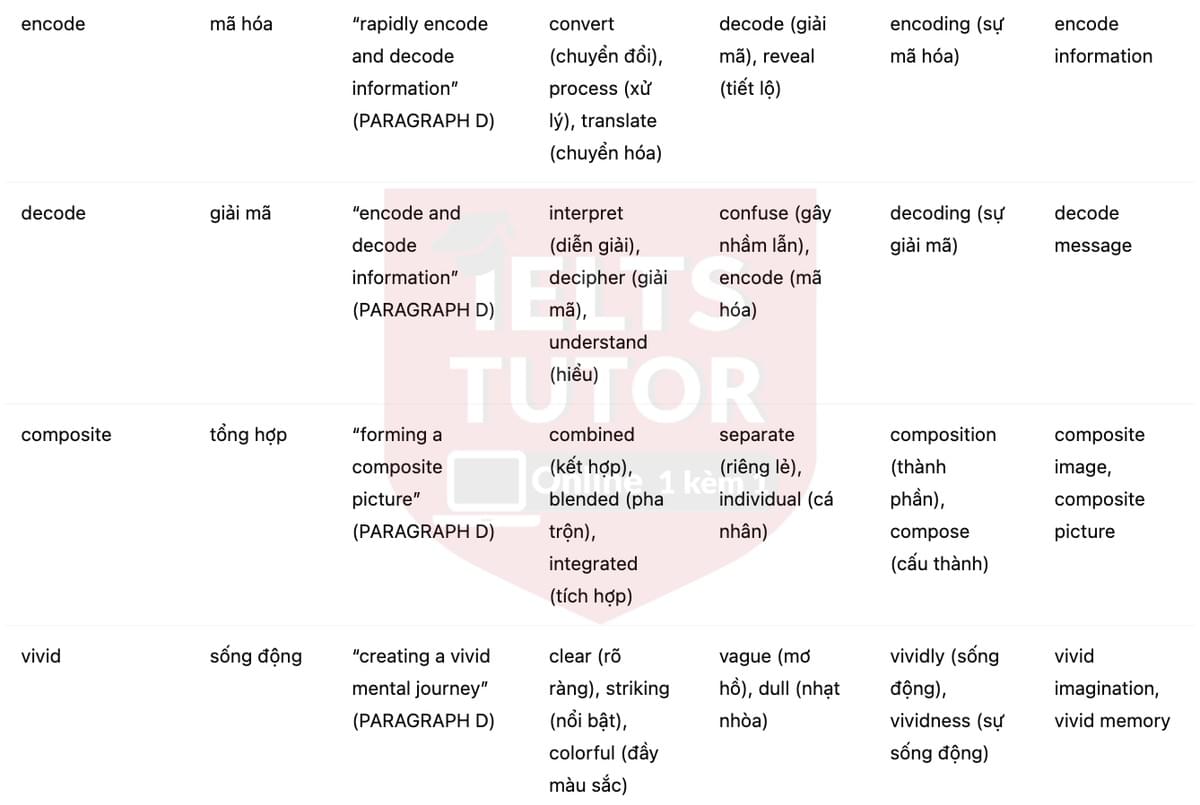
D To enable himself to memorize quickly, Cooke has memorized a specific human being, verb, and object that he associates with every card in the deck. This detailed and highly personalized system allows him to rapidly encode and decode information during competition. When Cooke commits a deck to memory, he does three cards in one go, with every three-card group forming a composite picture of a person doing something to an object. He then places those images along a specific familiar path in his mind, creating a vivid mental journey that he can traverse. When it comes to recall, Cooke takes a mental walk along his route and translates the images into cards, effectively and efficiently converting his vivid mental images back into the specific order of the deck.
E The term ‘photographic memory’ is frequently used to describe people with exceptional recall. Yet, most researchers agree there is no proof that such a memory truly exists. If it is indeed a myth, it highlights how learned strategies are often more effective than natural talent. The belief in photographic memory remains a point of contention among the public and scientists alike. Despite the absence of solid scientific evidence, this myth persists, reflecting how society’s fascination with remarkable memory continues to ignore the practical techniques and training that genuinely drive mnemonic success.
F The most renowned of the naturals was the Russian journalist S.V. Shereshevski, who could remember long sequences of numbers learned decades before, as well as poems, strings of meaningless syllables, and nearly anything else he was asked to recall. Shereshevski experienced synesthesia, a rare sensory condition where senses are interconnected, which significantly improved his memorization ability. His skills were not limited to these accomplishments; his memory covered an astounding range of information, making him a figure of great interest and study.
G K. Anders Ericsson, a well-known psychologist, claims that anyone can develop memory abilities comparable to those of memory champions through consistent practice and proper techniques. During two years of experimentation, S.F. increased his ability to recall digits from seven to over eighty. This led Ericsson to conclude that there is no such thing as an innately superior memory. When he revisited original case reports of mnemonists, he discovered that their remarkable abilities were actually based on the use of specific techniques – sometimes unconsciously – combined with extensive practice. Mnemonists are usually outstanding at remembering only certain kinds of material, whereas naturals exhibit strong memory across many types of tasks and can retain those memories may... >> 🔥 Nhắn zalo 0905834420 join group zalo Hóng đề thi máy 4 skills để cập nhật đề thi thật 4 kĩ năng hằng ngày [Kèm giải & đề làm online]
Questions 27-32
Reading Passage 3 has seven paragraphs, A-G.
Which paragraph contains the following information?
Write the correct letter, A-G in boxes 27-32 on your answer sheet. You may use any letter more than once.
27 a description of how a contestant remembers complex sequences __
28 an example of how one person's memory was improved over time __
29 a description of a memory competition __
30 a commonly held belief about memory that many experts say is unproven __
31 a reference to the first recorded use of memorizing through location __
32 a reference to an unusual condition which results in improved memory __
Questions 33-36
Complete the notes below.
Choose NO MORE THAN THREE WORDS from the passage for each answer.
Ed Cooke’s Method for Memorising a Pack of Cards
A specific person, an action, and a thing are assigned to 33 ____
Combining these images allows Cooke to memorise 34 ____
The mind pictures are then placed on a 35 ____
The pack of cards is recalled by going for a 36 __ __ while the pictures are converted back into cards. >> 🔥 IELTS TUTOR gợi ý tham khảo CẦN VIẾT & THU ÂM BAO NHIÊU BÀI ĐỂ ĐẠT 8.0 SPEAKING & 7.0 WRITING?
Questions 37-40
Complete each sentence with the correct ending, A-F, below.
Write the correct letter, A-F, in boxes 37-40 on your answer sheet.
37 Valentine, Wilding and Maguire’s experiment shows that the memory contestants __
38 After Simonides discovered the loc method in 477 BC, it was __
39 Ericsson finds out that mnemonists’ strategic memories are __
40 According to Ericsson, S.F.’s skills __
A activated brains associated with visual and spatial memory
B became widespread in ancient Greece for making speeches and debates.
C the result of techniques and extensive practice
D retaining a wide variety of tasks
E benefited from additional cognitive abilities
F every card in the deck
IV. Dịch bài đọc Memory Champions...or just good at tricks?
V. Giải thích từ vựng Memory Champions...or just good at tricks?
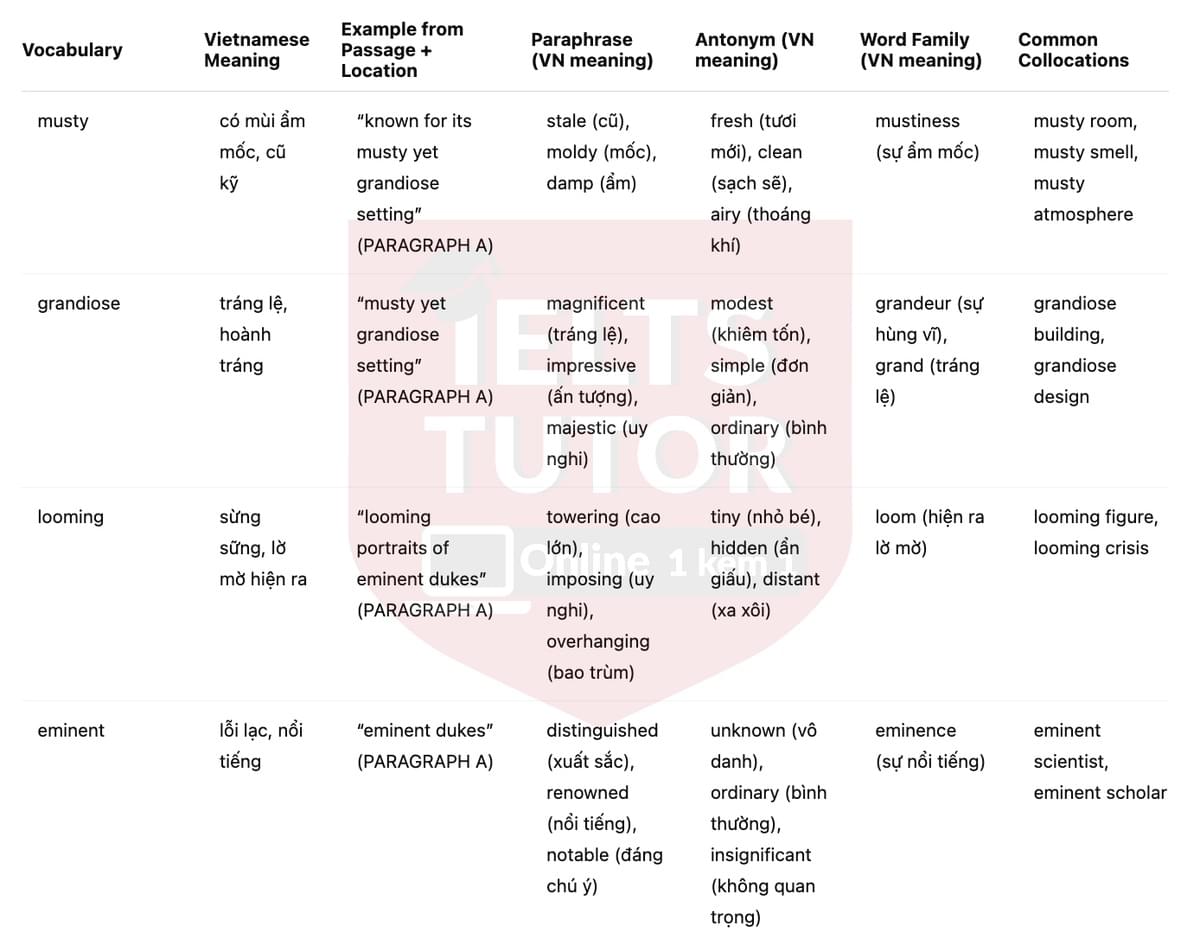
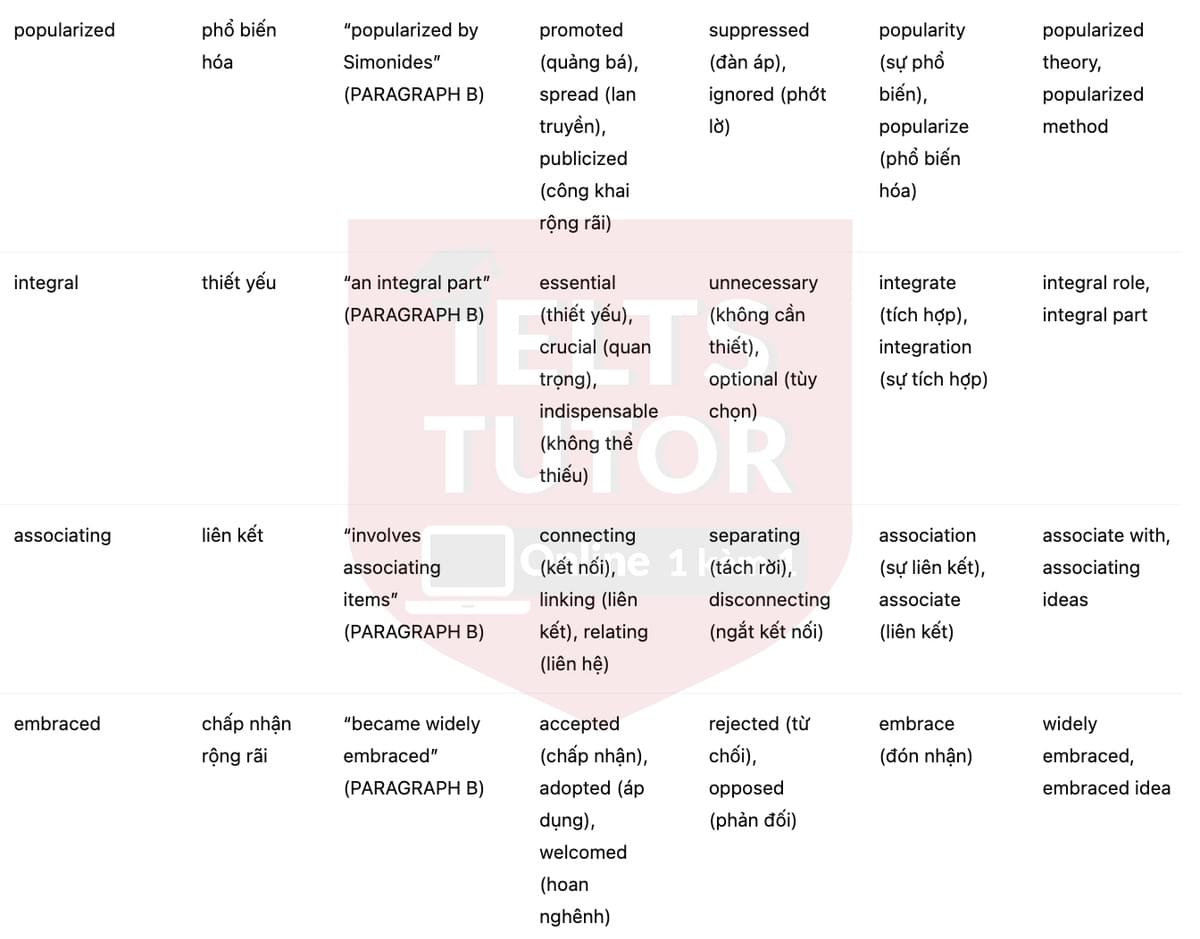
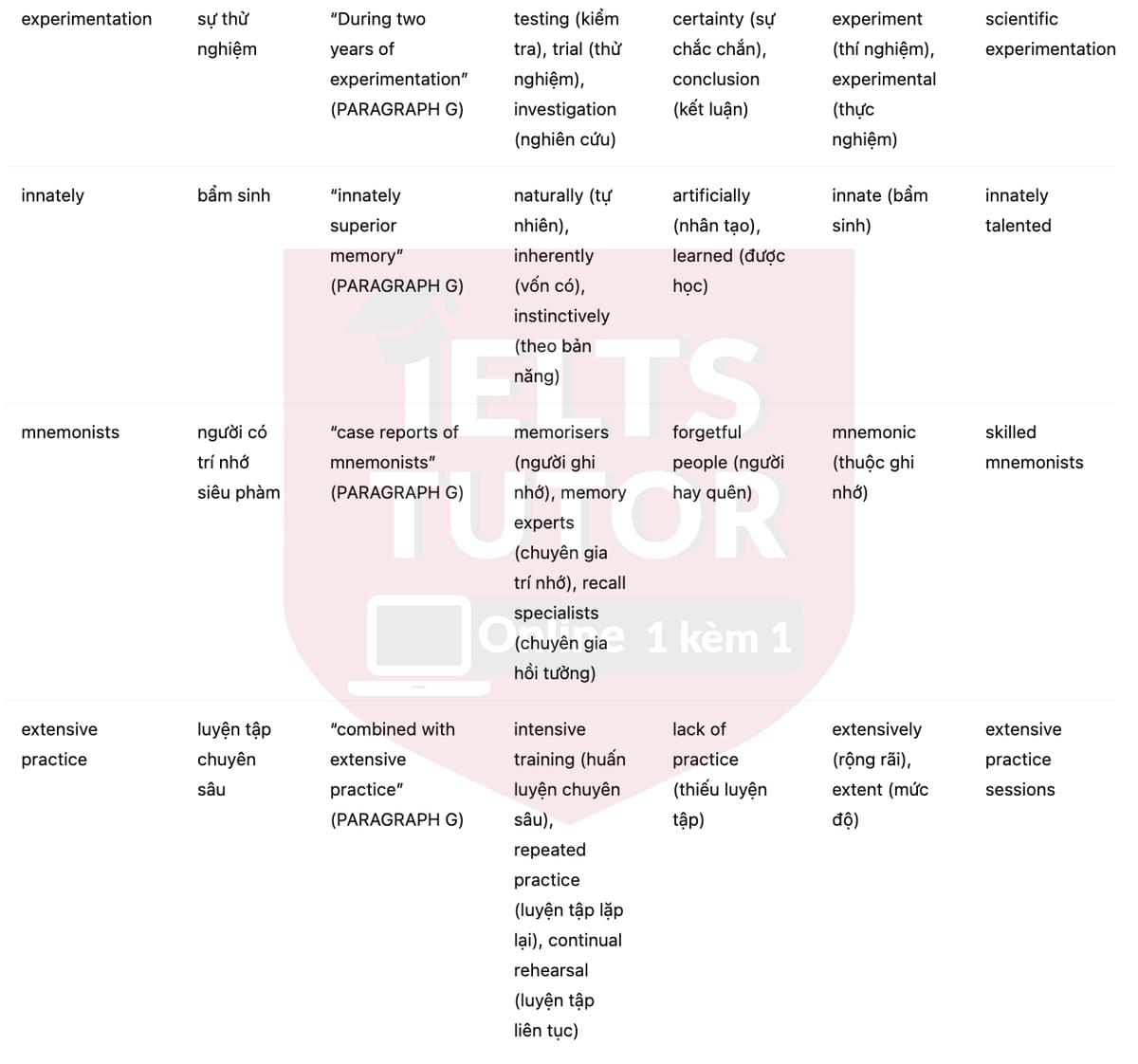
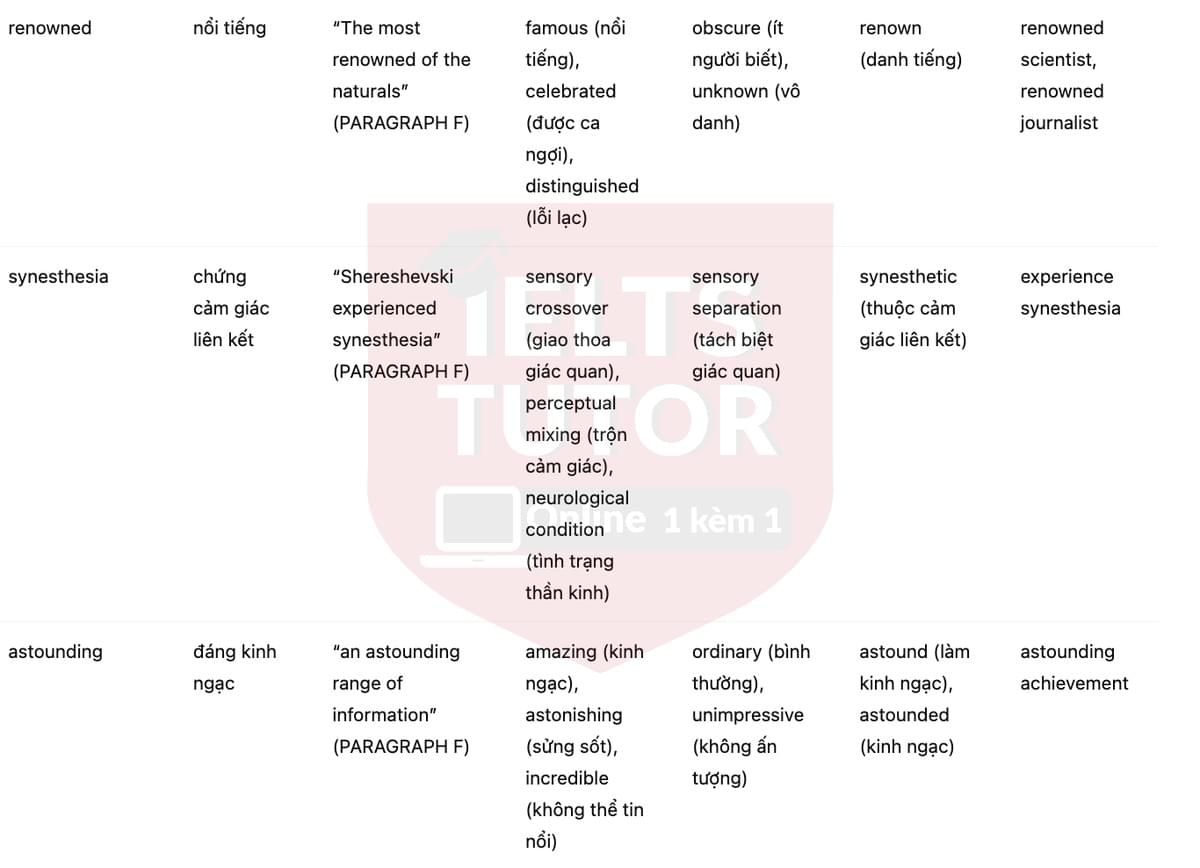
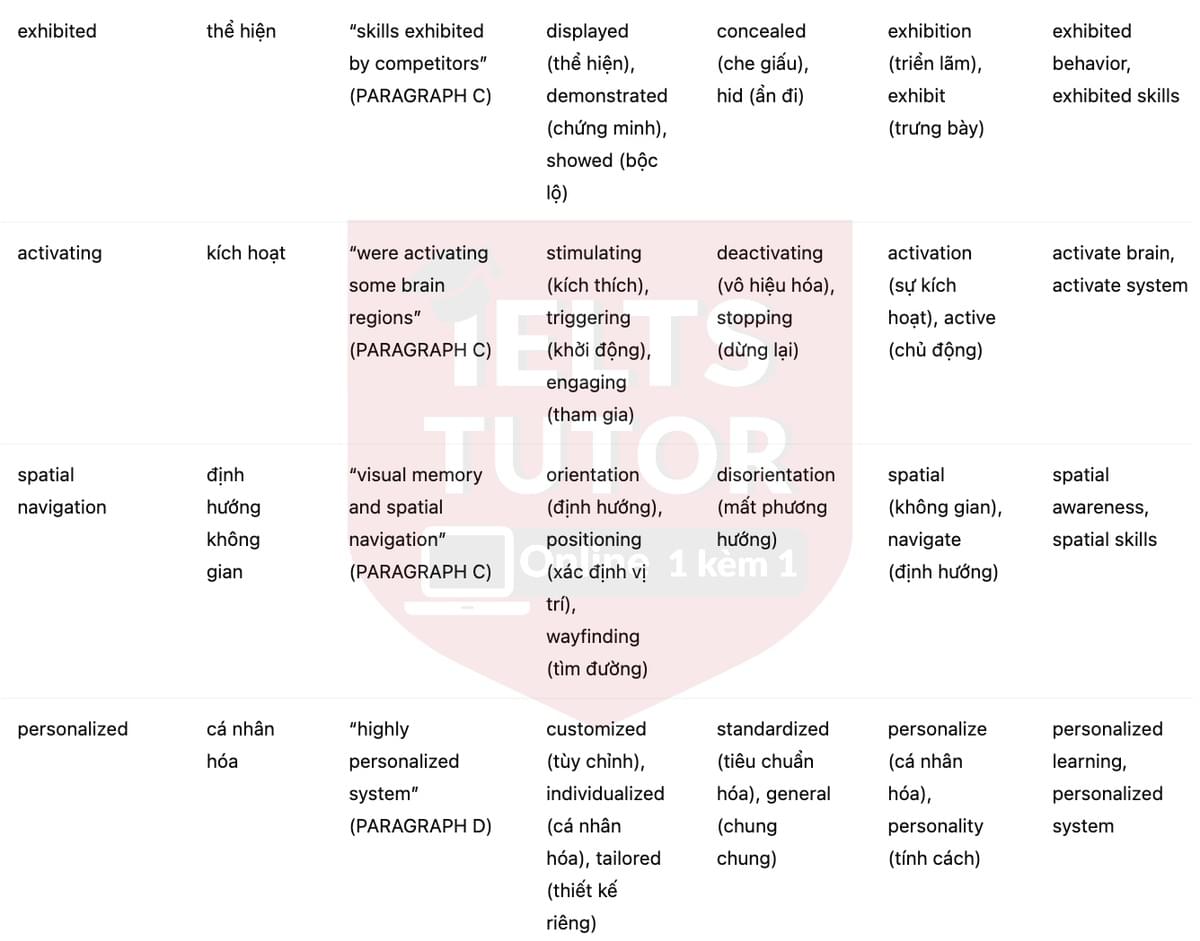
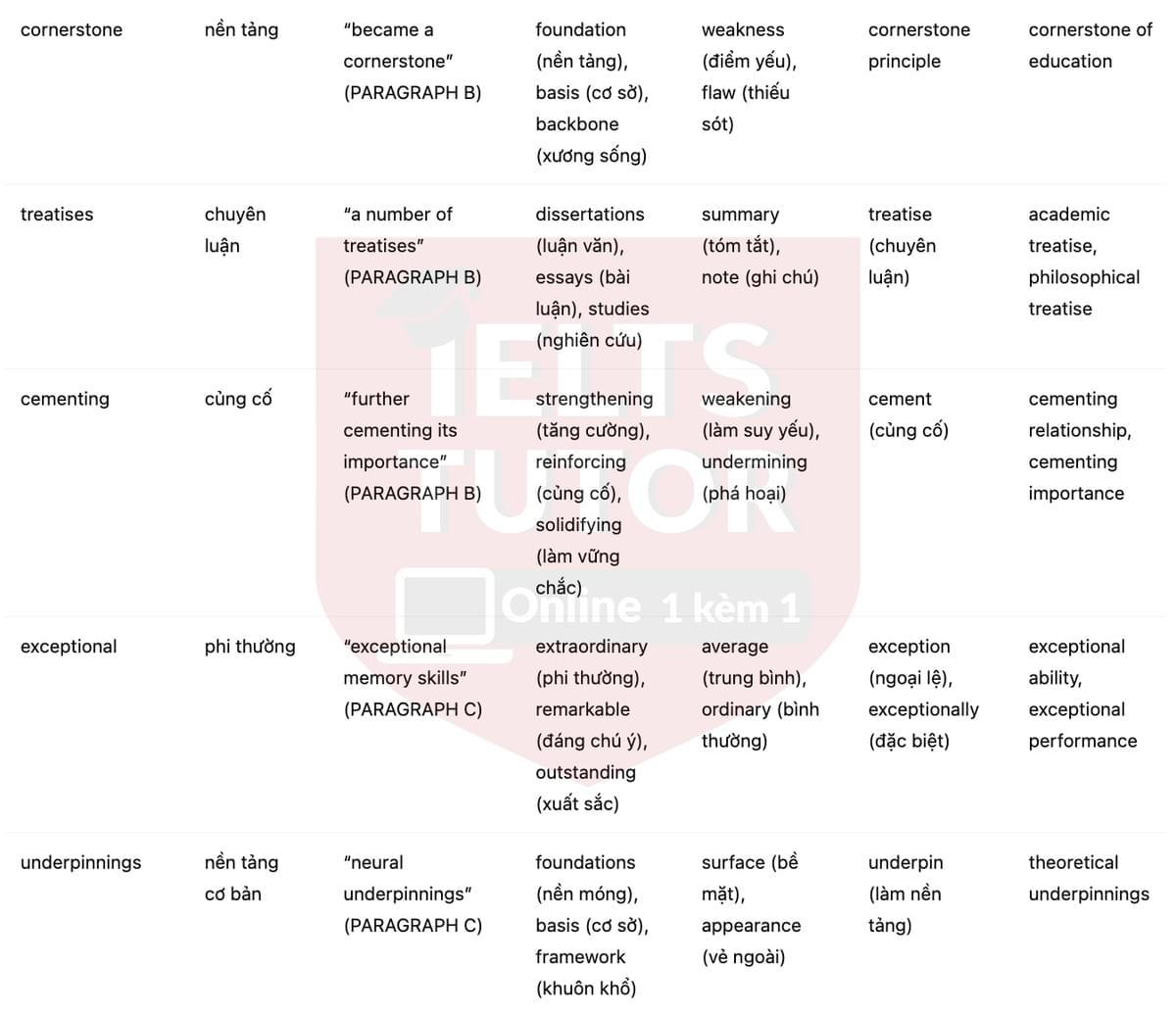
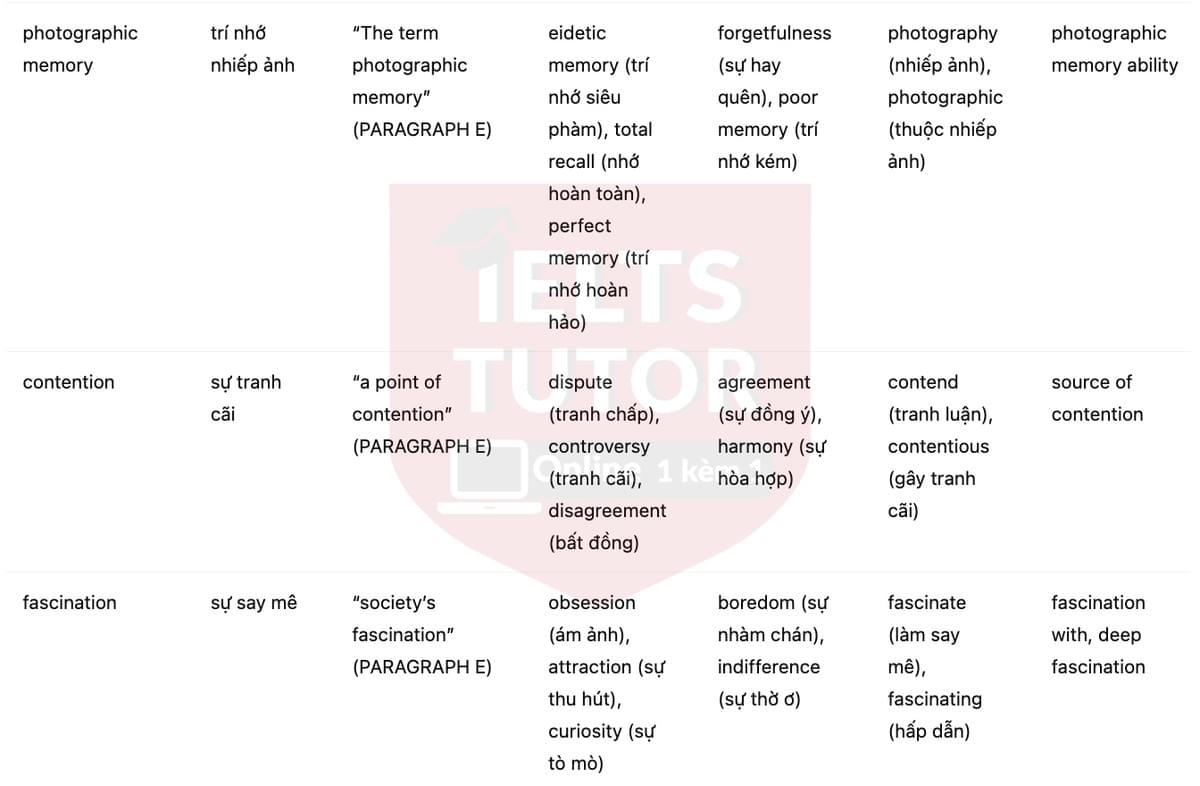
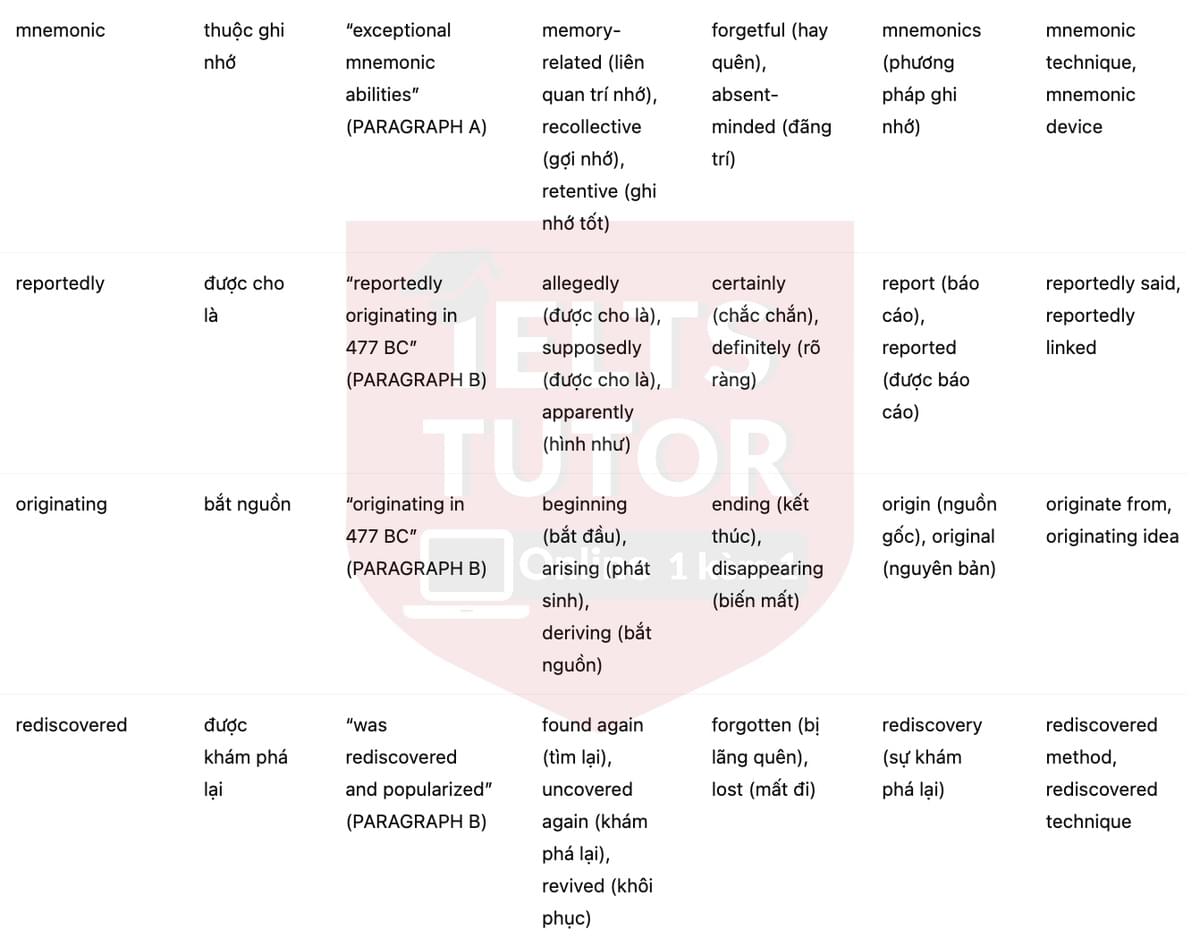
VI. Giải thích cấu trúc ngữ pháp khó Memory Champions...or just good at tricks?

VII. Đáp án Memory Champions...or just good at tricks?
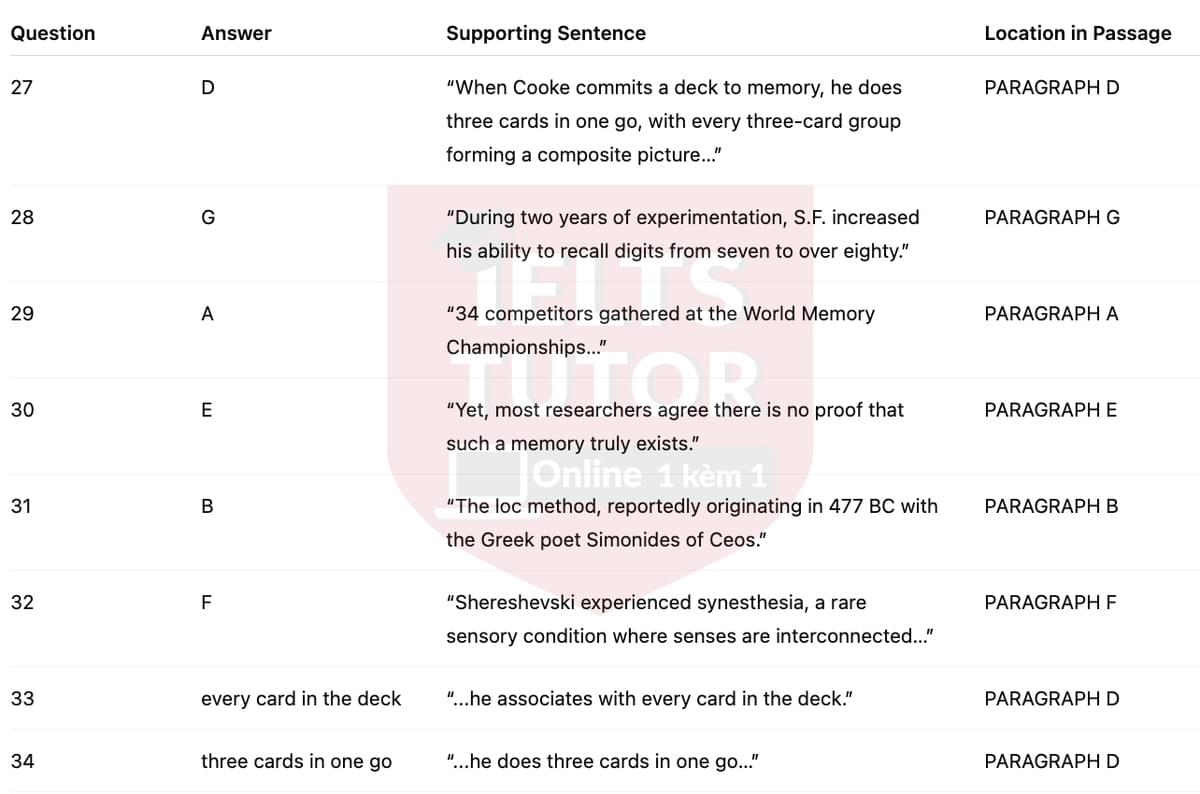
27. D
28. G
29. A
30. E
31. B
32. F
33. every card in the deck
34. three cards in one go
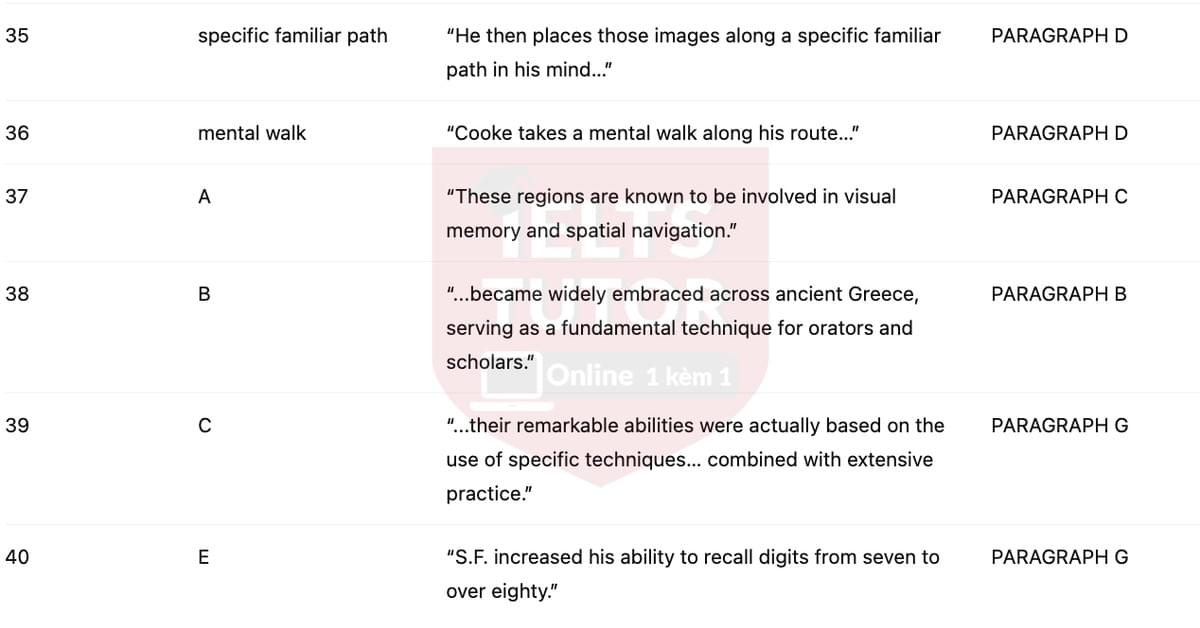
35. specific familiar path
36. mental walk
37. A
38. B
39. C
40. E
📩 MN AI CHƯA CÓ ĐÁP ÁN FORECAST QUÝ MỚI PART 1-2-3 NHẮN ZL 0905834420 IELTS TUTOR GỬI FREE HẾT NHA

Các khóa học IELTS online 1 kèm 1 - 100% cam kết đạt target 6.0 - 7.0 - 8.0 - Đảm bảo đầu ra - Thi không đạt, học lại FREE
>> Thành tích học sinh IELTS TUTOR với hàng ngàn feedback được cập nhật hàng ngày
