
IELTS TUTOR cung cấp The contradictions of tourism Đề luyện tập IELTS READING (IELTS Reading Practice Test) - Làm bài online format computer-based, kèm đáp án, dịch & giải thích từ vựng - cấu trúc ngữ pháp khó & GIẢI ĐÁP ÁN VỚI LOCATION
I. Kiến thức liên quan
II. Làm bài online (kéo xuống cuối bài blog để xem giải thích từ vựng & cấu trúc cụ thể hơn)
Tourism may bring benefits to a society but its effects are not always straightforward
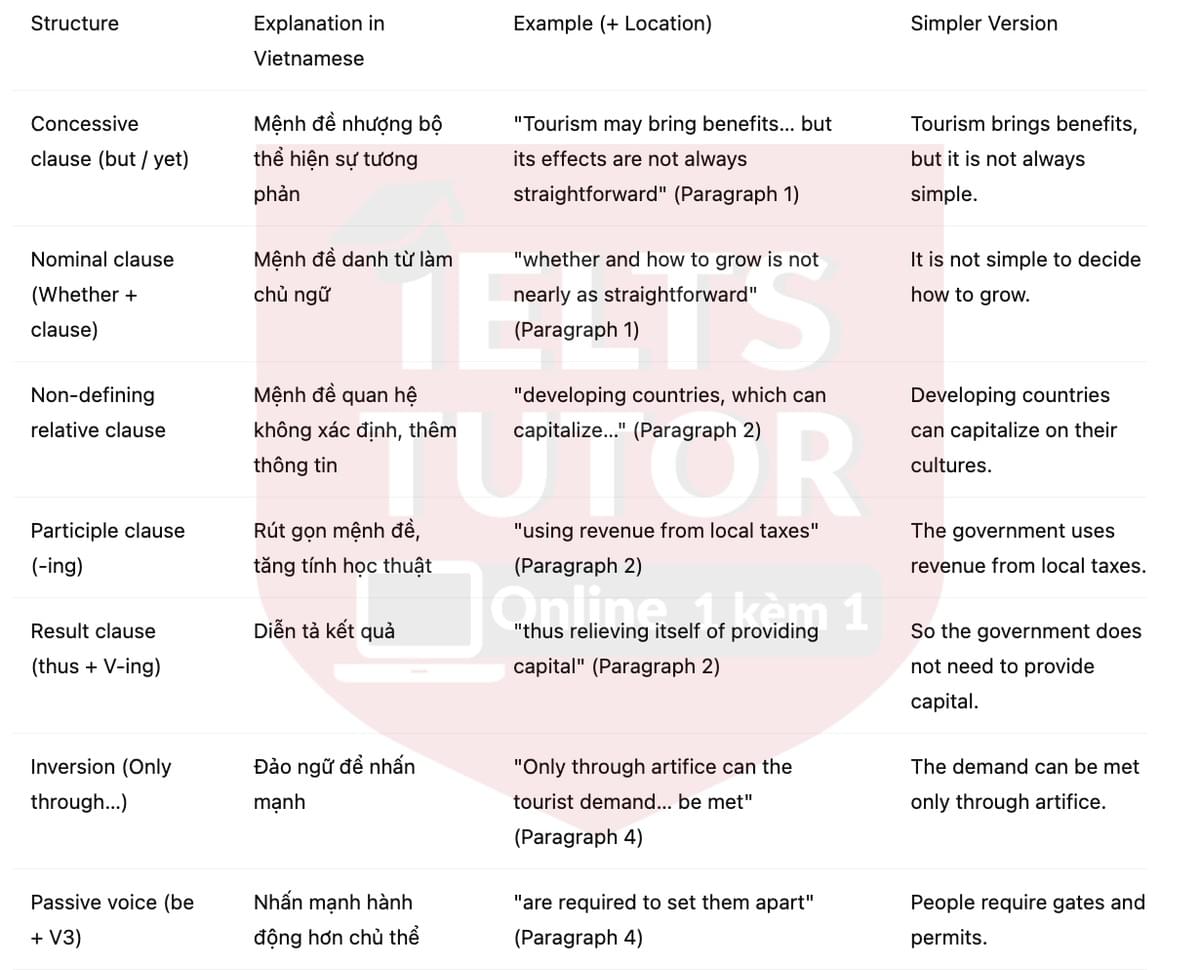
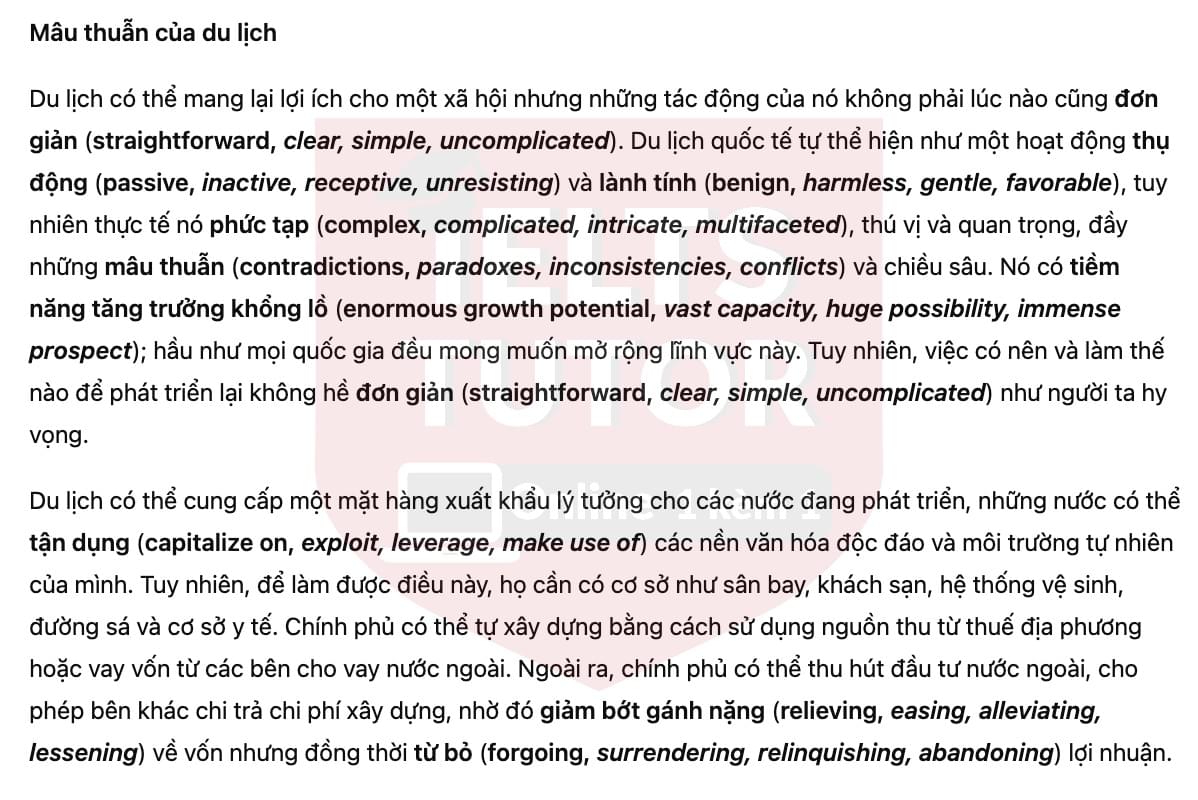
International tourism presents itself as straightforward, passive and benign, yet it is complex, interesting and important, full of contradictions and depths. It has enormous growth potential; almost every country desires an expansion in this sector. Yet whether and how to grow is not nearly as straightforward as one might hope.
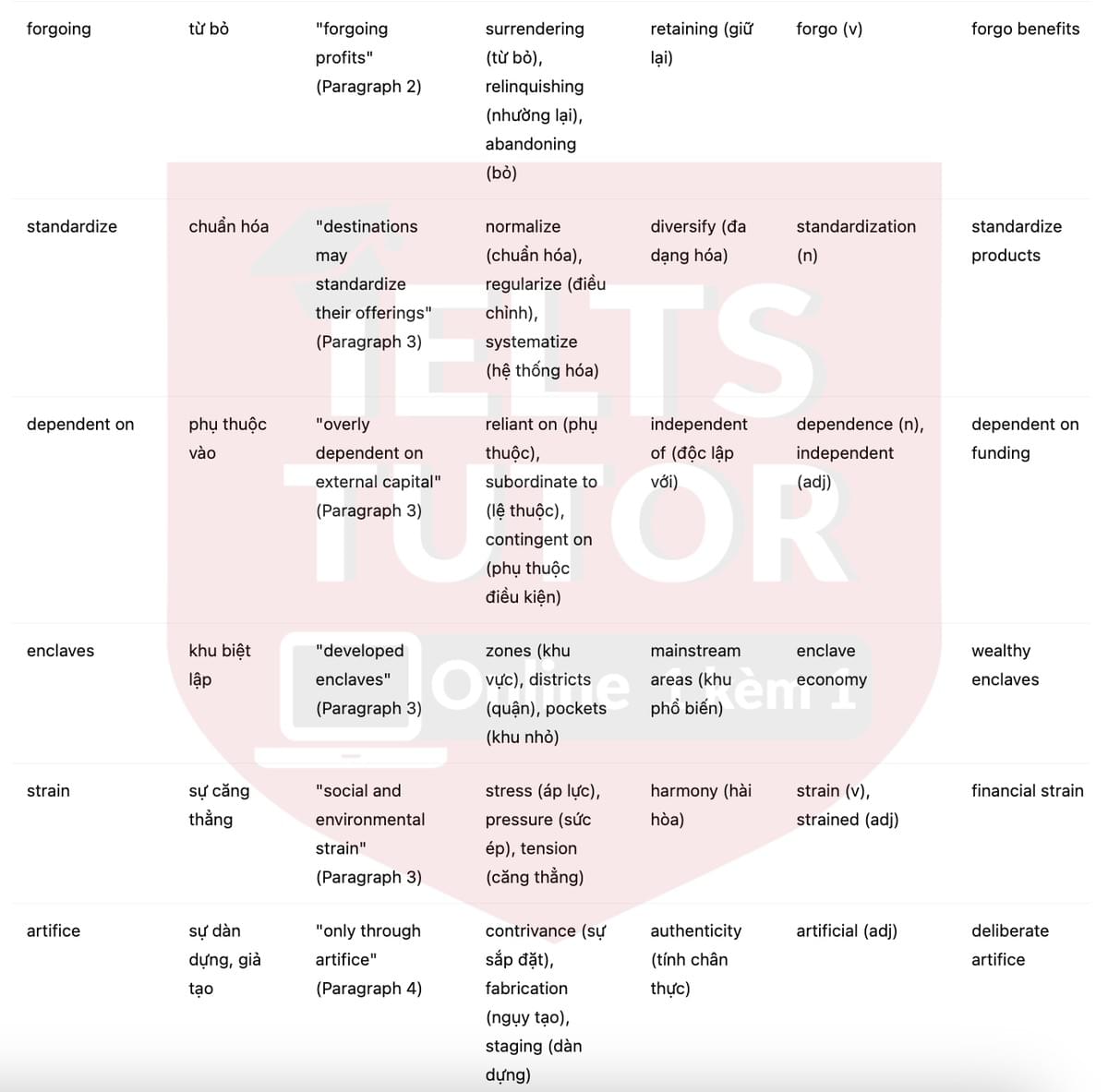
Tourism can provide the ideal export for developing countries, which can capitalize on their unique cultures and natural environments. However, to do this they need to have features such as airports, hotels, sanitation facilities, roads and medical facilities. A government can build these itself, using revenue from local taxes or getting finance from foreign lenders. Alternatively, the government may attract foreign investment, allowing others to pay for the building, thus relieving itself of providing capital but forgoing profits.
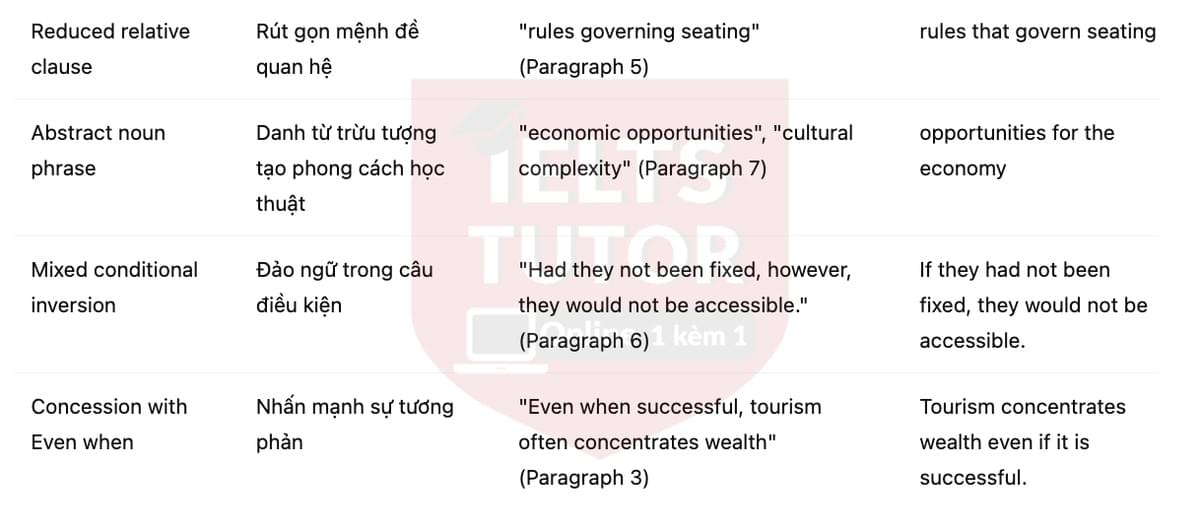
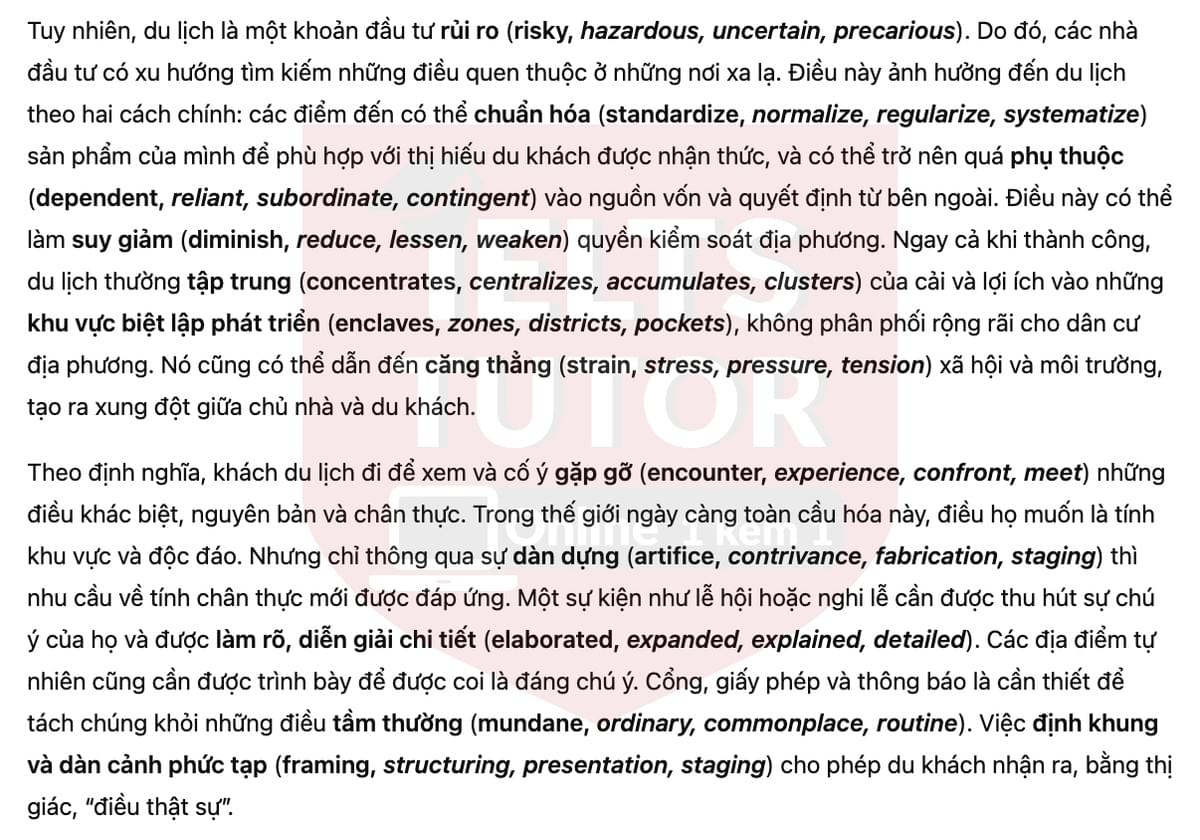
Tourism is, however, a risky investment. As a consequence, investors tend to look for the familiar in foreign places. This affects tourism in two key ways: destinations may standardize their offerings to suit perceived tourist tastes, and they may become overly dependent on external capital and decision-making. This can diminish local control. Even when successful, tourism often concentrates wealth and benefits in specific, developed enclaves, failing to distribute them widely across the local population. It can also lead to social and environmental strain, creating tensions between hosts and guests.
By definition, tourists travel to see and knowingly to encounter the different, the original, the authentic. In this increasingly global world, what they want is regional and unique. But only through artifice can the tourist demand for authenticity be met. An event such as a festival or ceremony needs to be brought to their attention and its importance and unique nature elaborated to them. Natural sites, too, need to be presented if they are to be regarded as noteworthy. Gates, permits, and notices are required to set them apart from the mundane. Complicated framing and staging allows tourists to recognize, by sight, 'the actual thing'.
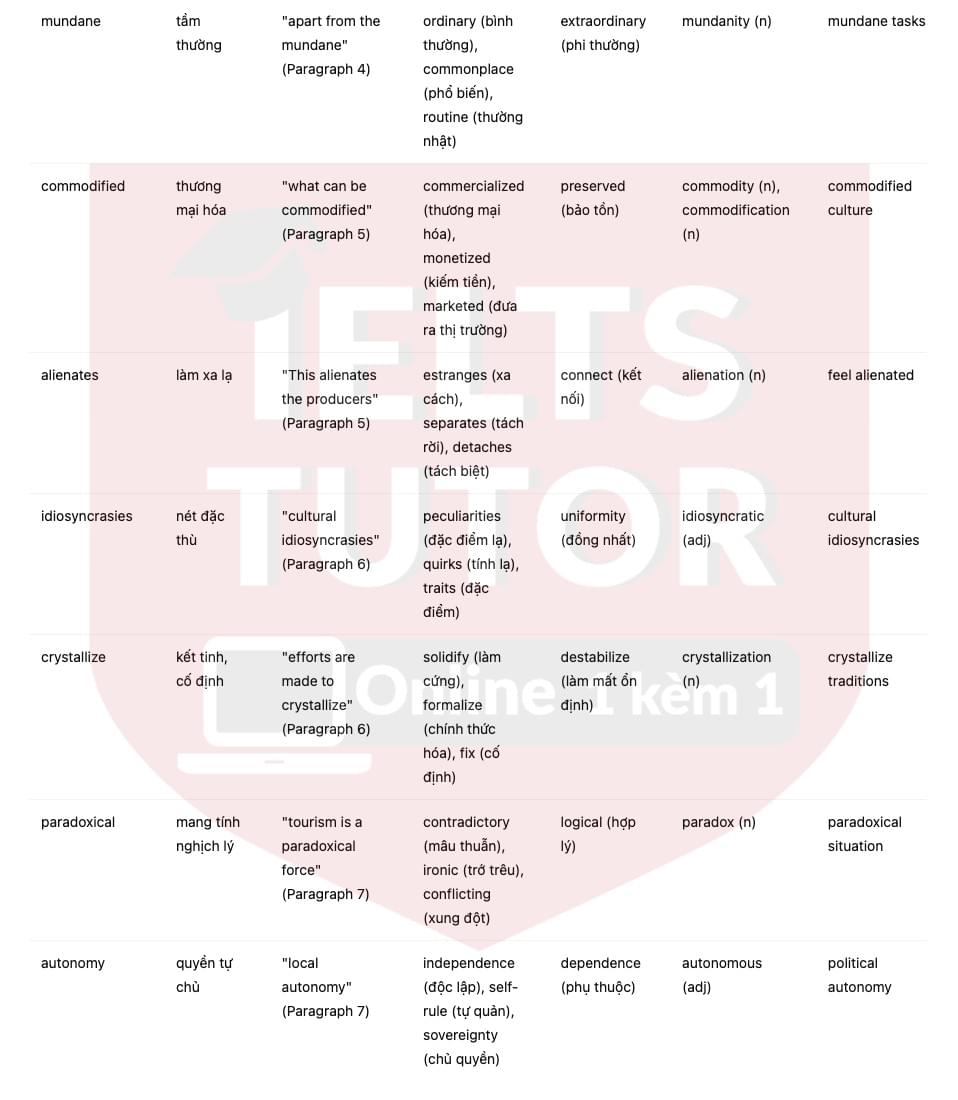
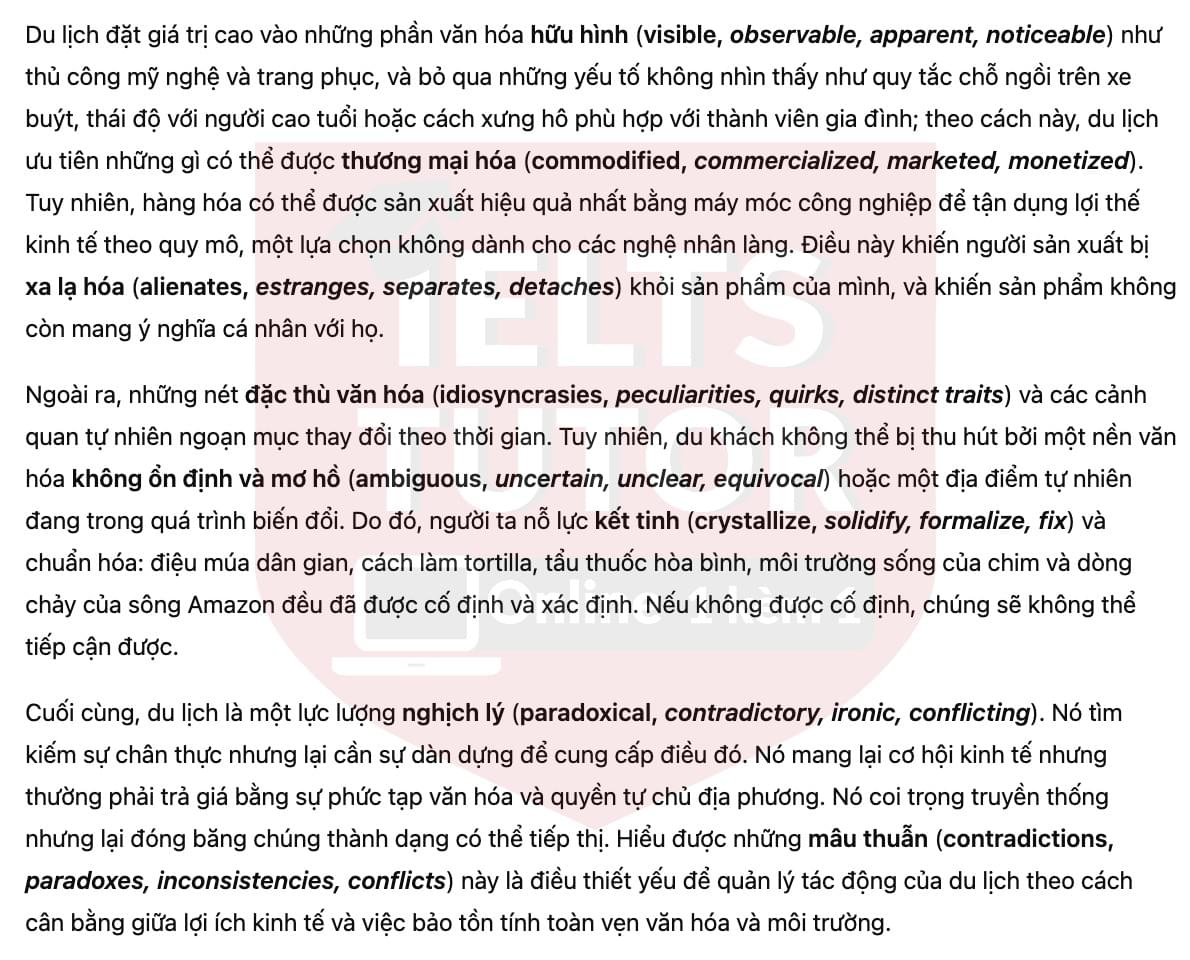
Tourism places a premium on the parts of a culture that are visible, such as handicrafts and costume, and disregards those that are not, like the rules governing seating on a bus, attitudes to the elderly, or appropriate ways of addressing family members; in this way, tourism favors what can be commodified. Yet commodities can be produced most efficiently using industrial machinery to take advantage of economies of scale, an option closed to village artisans. This alienates the producers from what is being produced, and means the product no longer has any personal meaning to them.
In addition, cultural idiosyncrasies and natural spectacles change over time. Tourists can't be attracted, however, to an unstable and ambiguous culture, or to a natural site that is in the process of transformation itself. As a consequence, efforts are made to crystallize and standardize: folk dances, tortilla-making, peace pipes, bird habitats and the course of the Amazon have all been bound and defined. Had they not been fixed, however, they would not be accessible.
Ultimately, tourism is a paradoxical force. It seeks authenticity but requires staging to deliver it. It offers economic opportunities but often at the cost of cultural complexity and local autonomy. It values tradition but freezes it into a marketable form. Understanding these contradictions is essential for managing tourism's impacts in a way that balances economic gain with the preservation of cultural and environmental integrity.
Complete the notes below. Choose NO MORE THAN TWO WORDS from the passage for each answer.
The Contradictions and Impacts of Tourism
Do the following statements agree with the claims of the writer? Write:
YES if the statement agrees with the claims of the writer
NO if the statement contradicts the claims of the writer
NOT GIVEN if it is impossible to say what the writer thinks about this
Choose the correct letter, A, B, C, or D.
📩 MN AI CHƯA CÓ ĐÁP ÁN FORECAST QUÝ MỚI PART 1-2-3 NHẮN ZL 0905834420 IELTS TUTOR GỬI FREE HẾT NHA
III. The contradictions of tourism: Đề luyện tập IELTS READING (IELTS Reading Practice Test)
READING PASSAGE 3
You should spend about 20 minutes on Questions 27-40, which are based on Reading Passage 3 below.
The contradictions of tourism
Tourism may bring benefits to a society but its effects are not always straightforward
International tourism presents itself as straightforward, passive and benign, yet it is complex, interesting and important, full of contradictions and depths. It has enormous growth potential; almost every country desires an expansion in this sector. Yet whether and how to grow is not nearly as straightforward as one might hope.
Tourism can provide the ideal export for developing countries, which can capitalize on their unique cultures and natural environments. However, to do this they need to have features such as airports, hotels, sanitation facilities, roads and medical facilities. A government can build these itself, using revenue from local taxes or getting finance from foreign lenders. Alternatively, the government may attract foreign investment, allowing others to pay for the building, thus relieving itself of providing capital but forgoing profits.
Tourism is, however, a risky investment. As a consequence, investors tend to look for the familiar in foreign places. This affects tourism in two key ways: destinations may standardize their offerings to suit perceived tourist tastes, and they may become overly dependent on external capital and decision-making. This can diminish local control. Even when successful, tourism often concentrates wealth and benefits in specific, developed enclaves, failing to distribute them widely across the local population. It can also lead to social and environmental strain, creating tensions between hosts and guests. >> 🔥 Form đăng kí giải đề thi thật IELTS 4 kĩ năng kèm bài giải bộ đề 100 đề PART 2 IELTS SPEAKING quý đang thi (update hàng tuần) từ IELTS TUTOR
By definition, tourists travel to see and knowingly to encounter the different, the original, the authentic. In this increasingly global world, what they want is regional and unique. But only through artifice can the tourist demand for authenticity be met. An event such as a festival or ceremony needs to be brought to their attention and its importance and unique nature elaborated to them. Natural sites, too, need to be presented if they are to be regarded as noteworthy. Gates, permits, and notices are required to set them apart from the mundane. Complicated framing and staging allows tourists to recognize, by sight, ‘the actual thing’.
Tourism places a premium on the parts of a culture that are visible, such as handicrafts and costume, and disregards those that are not, like the rules governing seating on a bus, attitudes to the elderly, or appropriate ways of addressing family members; in this way, tourism favors what can be commodified. Yet commodities can be produced most efficiently using industrial machinery to take advantage of economies of scale, an option closed to village artisans. This alienates the producers from what is being produced, and means the product no longer has any personal meaning to them.
In addition, cultural idiosyncrasies and natural spectacles change over time. Tourists can’t be attracted, however, to an unstable and ambiguous culture, or to a natural site that is in the process of transformation itself. As a consequence, efforts are made to crystallize and standardize: folk dances, tortilla-making, peace pipes, bird habitats and the course of the Amazon have all been bound and defined. Had they not been fixed, however, they would not be accessible.
Ultimately, tourism is a paradoxical force. It seeks authenticity but requires staging to deliver it. It offers economic opportunities but often at the cost of cultural complexity and local autonomy. It values tradition but freezes it into a marketable form. Understanding these contradictions is essential for managing tourism’s impacts in a way that balances economic gain with the preservation of cultural and environmental integrity. >> 🔥 Nhắn zalo 0905834420 join group zalo Hóng đề thi máy 4 skills để cập nhật đề thi thật 4 kĩ năng hằng ngày [Kèm giải & đề làm online]
Questions 27-31
Complete the notes below. Choose NO MORE THAN TWO WORDS from the passage for each answer.
The Contradictions and Impacts of Tourism
Initial Investment: Developing countries need infrastructure like airports and roads. This can be financed through local taxes, foreign loans, or 27 ________ investment.
Risks of Tourism: Investors seek familiarity, leading to the 28 ________ of tourist offerings. Benefits often fail to spread widely and remain in developed 29 ________.
The 'Authenticity' Paradox: Tourists seek the authentic, but it must be presented through 30 ________ (e.g., gates, signs, staging) to be recognized.
Commodification: Tourism values visible, marketable aspects of culture (e.g., handicrafts), often sidelining deeper social 31 ________.
Questions 32-35
Do the following statements agree with the claims of the writer in Reading Passage 3? Write:
YES if the statement agrees with the claims of the writer
NO if the statement contradicts the claims of the writer
NOT GIVEN if it is impossible to say what the writer thinks about this
Every country is certain about the best way to expand its tourism sector.
Letting foreign investors build infrastructure allows a government to keep all the profits from tourism.
Mass production of cultural crafts can make the artisans feel disconnected from their work.
The passage states that tourism always improves the living standards of the entire local population. >> 🔥 IELTS TUTOR gợi ý tham khảo CẦN VIẾT & THU ÂM BAO NHIÊU BÀI ĐỂ ĐẠT 8.0 SPEAKING & 7.0 WRITING?
Questions 36-40
Choose the correct letter, A, B, C, or D.
What is the writer's main purpose in the first paragraph?
A. To define international tourism
B. To praise the economic potential of tourism
C. To introduce the complex and contradictory nature of tourism
D. To criticize the growth of the tourism sectorAccording to the passage, why do tourist destinations often standardize their cultural presentations?
A. To preserve cultural traditions accurately
B. To meet the expectations of investors and tourists
C. To make them easier for locals to perform
D. To protect them from outside influenceThe writer uses the example of "folk dances" and "the course of the Amazon" to illustrate:
A. How tourism helps preserve natural environments.
B. The need for tourism to make cultural and natural phenomena static and defined.
C. The diversity of attractions available to tourists.
D. The negative environmental impact of tourism.What does the writer imply about the relationship between tourism and culture?
A. Tourism helps cultures evolve in a healthy way.
B. Tourism tends to simplify and commercialize culture.
C. Tourism has no significant impact on deep cultural values.
D. Tourism is the best way to fund cultural preservation.What is the overall message of the passage?
A. Tourism's benefits far outweigh its costs.
B. Tourism is a simple and positive force for development.
C. The effects of tourism are straightforward and easy to manage.
D. Tourism involves fundamental tensions that must be carefully managed.
IV. Dịch bài đọc The contradictions of tourism
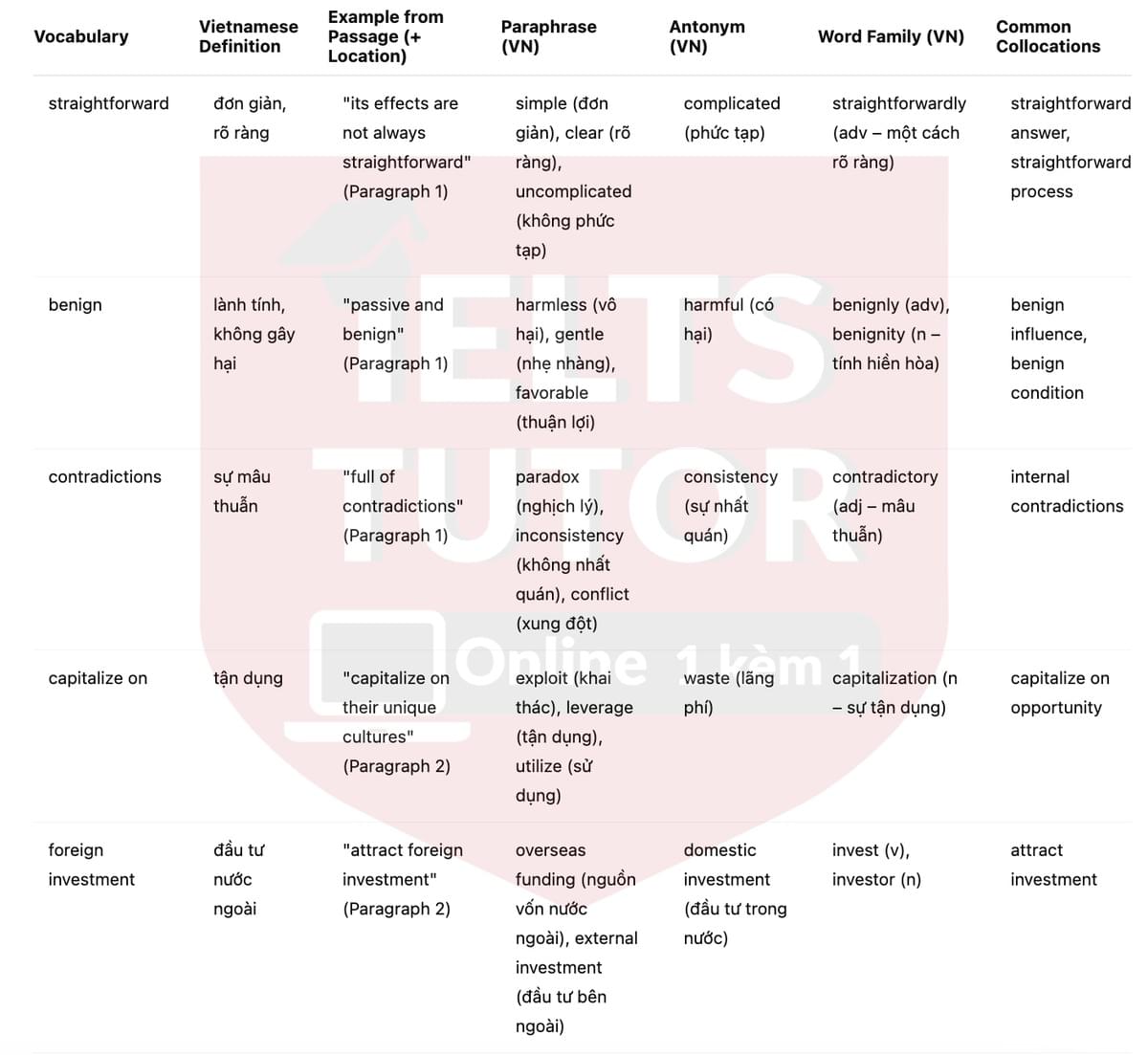
V. Giải thích từ vựng The contradictions of tourism
VI. Giải thích cấu trúc ngữ pháp khó The contradictions of tourism
VII. Đáp án The contradictions of tourism
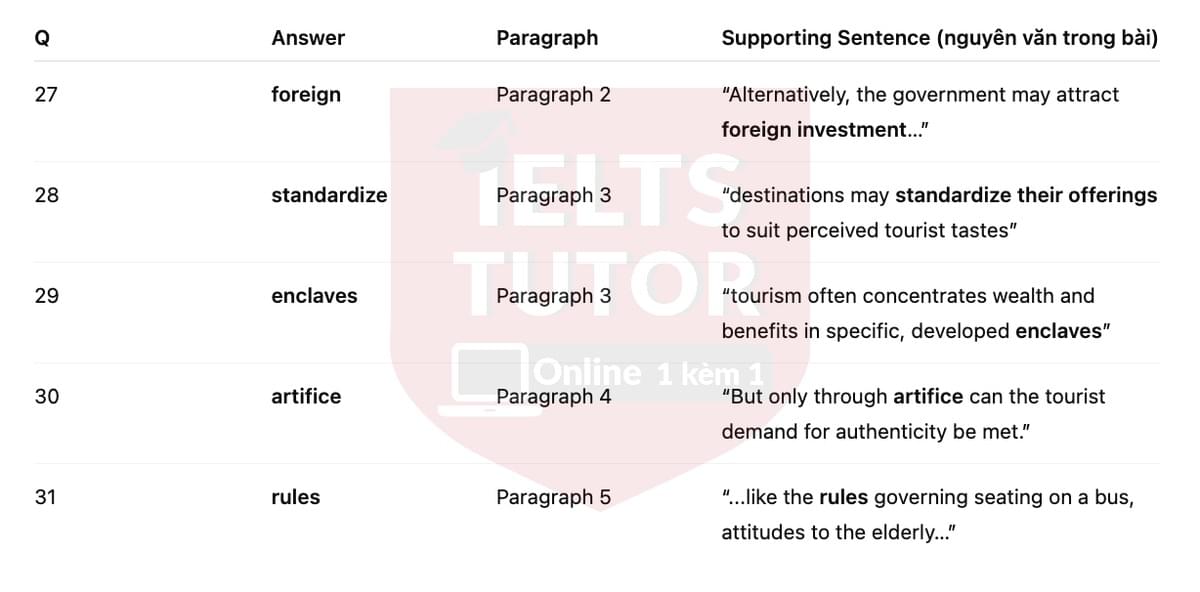
27. foreign
28. standardize
29. enclaves
30. artifice
31. rules
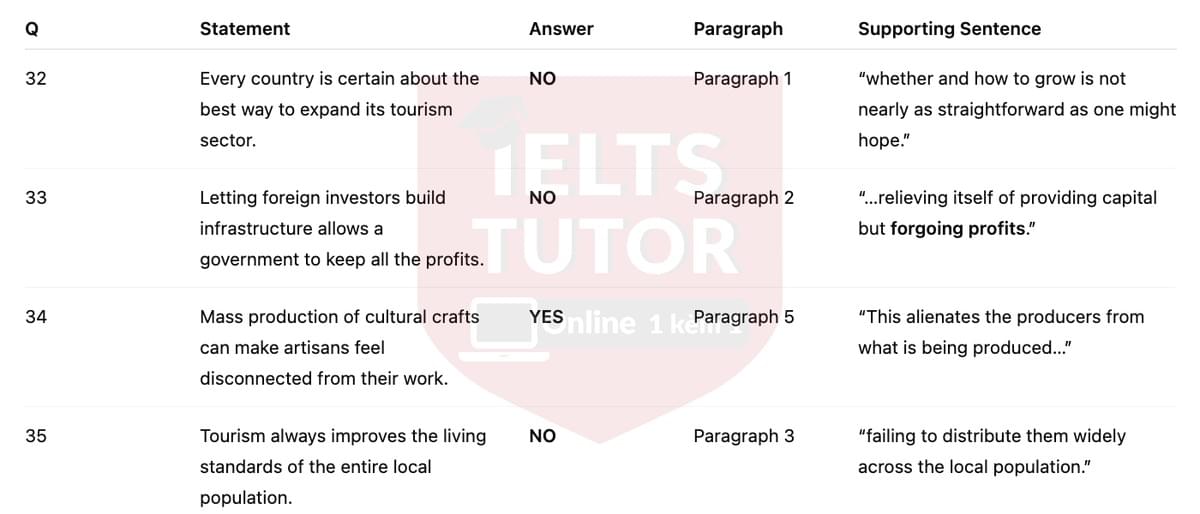
32. NO
33. NO
34. YES
35. NO
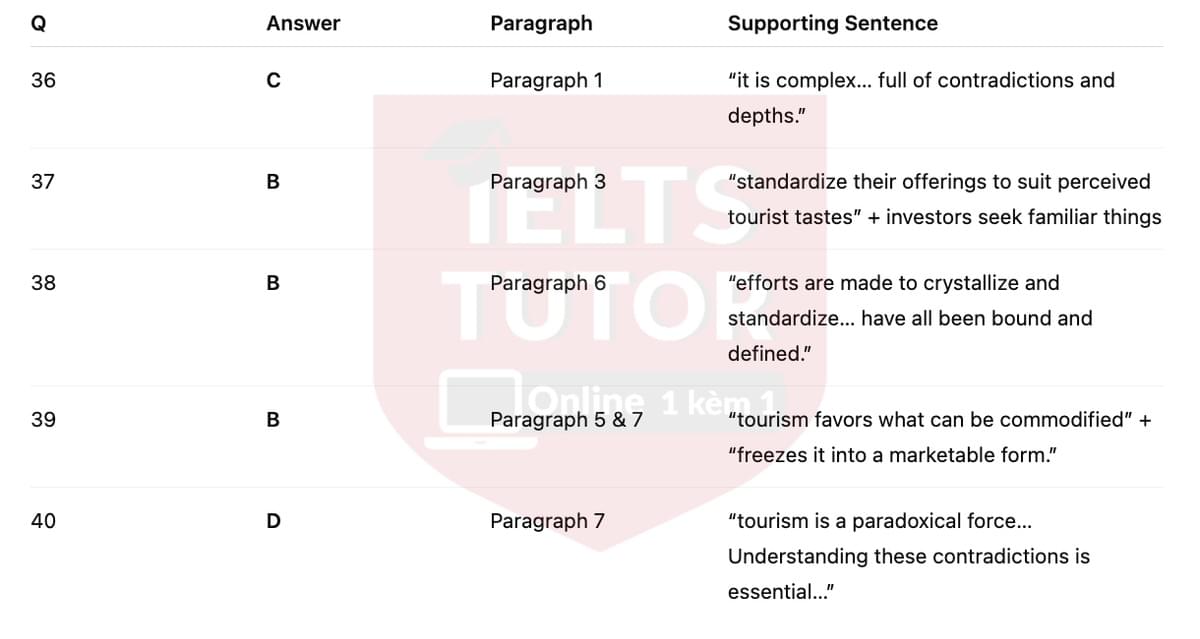
36. C
37. B
38. B
39. B
40. D
📩 MN AI CHƯA CÓ ĐÁP ÁN FORECAST QUÝ MỚI PART 1-2-3 NHẮN ZL 0905834420 IELTS TUTOR GỬI FREE HẾT NHA

Các khóa học IELTS online 1 kèm 1 - 100% cam kết đạt target 6.0 - 7.0 - 8.0 - Đảm bảo đầu ra - Thi không đạt, học lại FREE
>> Thành tích học sinh IELTS TUTOR với hàng ngàn feedback được cập nhật hàng ngày
