
IELTS TUTOR cung cấp The development of the bicycle Đề luyện tập IELTS READING (IELTS Reading Practice Test) - Làm bài online format computer-based, kèm đáp án, dịch & giải thích từ vựng - cấu trúc ngữ pháp khó & GIẢI ĐÁP ÁN VỚI LOCATION
I. Kiến thức liên quan
II. Làm bài online (kéo xuống cuối bài blog để xem giải thích từ vựng & cấu trúc cụ thể hơn)
📩 MN AI CHƯA CÓ ĐÁP ÁN FORECAST QUÝ MỚI PART 1-2-3 NHẮN ZL 0905834420 IELTS TUTOR GỬI FREE HẾT NHA
🚲 IELTS READING: The Development of the Bicycle
The development of the bicycle
In a 2005 survey of British radio listeners, the bicycle was voted the most significant technological invention since 1800. As with many other technological innovations, however, it is difficult to determine exactly by whom or when the bicycle was invented. In fact, what we recognise as a bicycle today was never created fully formed, but rather represents a process of evolution, the product of incremental changes initiated by many individuals over time.
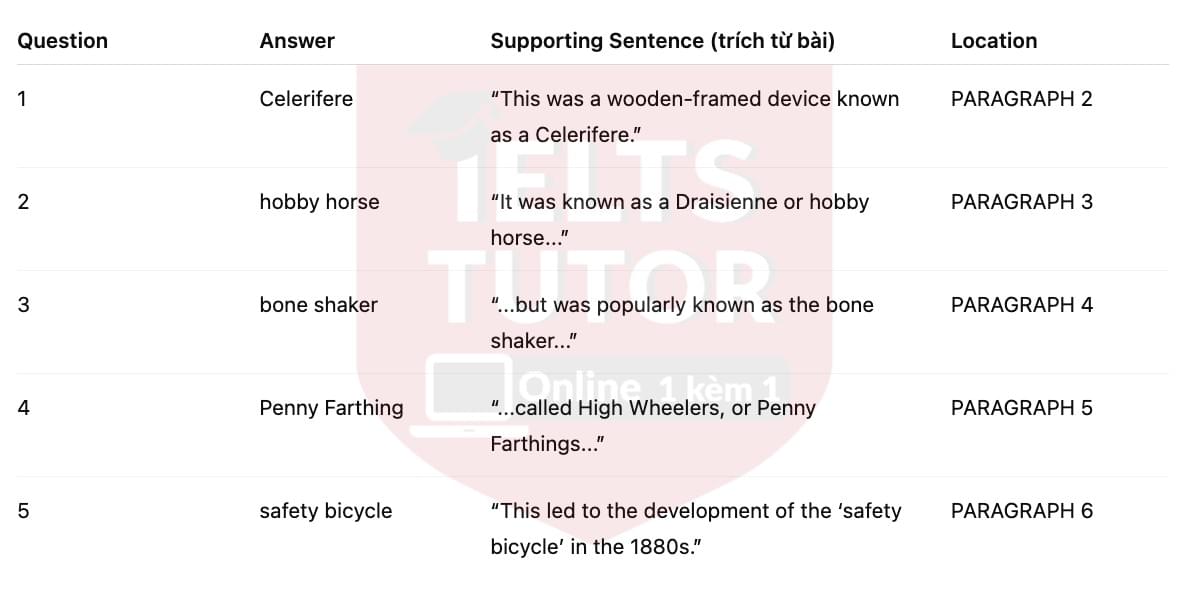
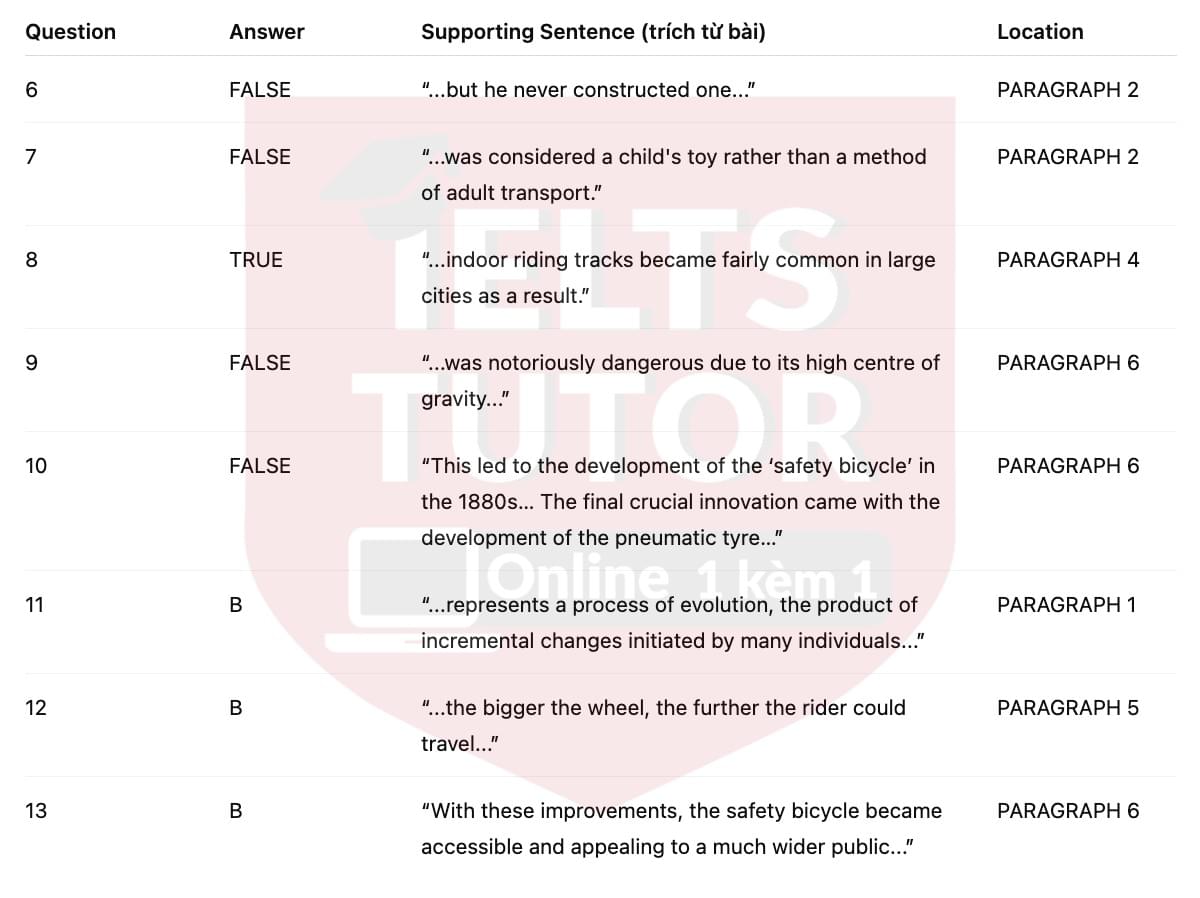
The Italian artist and inventor Leonardo da Vinci (1452-1519) is often cited as the first person to visualise the concept of a bicycle, but he never constructed one, and there are doubts surrounding the authenticity of a sketch of a two-wheeled device discovered among his papers. In about 1790, the French Comte de Sivrac was the first person to build what could be said to resemble a bicycle. This was a wooden-framed device known as a Celerifere. With no pedals or steering mechanism, the Celerifere was considered a child's toy rather than a method of adult transport.
In 1817 Baron von Drais, a German inventor, created a device with two wheels of the same size mounted in line on a wooden frame. The riders sat on a seat on the frame with a leg on either side and simply pushed themselves along with their feet. It was known as a Draisienne or hobby horse, and although it could be steered it proved impractical for transportation anywhere but on a smooth road or path.
The next appearance of a two-wheeled device was in 1865, when pedals were attached directly to the front wheel. This device was officially called a velocipede, but was popularly known as the bone shaker as its wooden (later metal) wheels made for an extremely uncomfortable ride. However, riding velocipedes for pleasure became popular, and indoor riding tracks became fairly common in large cities as a result.
The desire for speed was the driving factor behind the next significant step in the development of two-wheeled transport, which took place in the 1870s. The most obvious way to increase the speed that could be obtained was to increase the size of the wheel to which the pedals were attached. The front wheels became larger and larger as manufacturers realised that the bigger the wheel, the further the rider could travel with one rotation of the pedals. At about the same time, the first all-metal two-wheeled devices appeared due to advances in the production of strong, relatively lightweight materials. Then solid rubber tyres were added, providing a somewhat smoother ride. These newly adapted devices, called High Wheelers, or Penny Farthings, were the first to actually be considered proper bicycles and gained considerable popularity among young, athletic men.
The Penny Farthing, however, was notoriously dangerous due to its high centre of gravity and the rider's position directly over the large front wheel. A fall from such a height could cause serious injury. This led to the development of the "safety bicycle" in the 1880s. This design featured two wheels of equal size and a chain drive connecting pedals to the rear wheel, which lowered the rider's seat and made the bicycle much more stable and easier to mount. The final crucial innovation came with the development of the pneumatic (air-filled) tyre by John Boyd Dunlop in 1888, which provided a comfortable ride over various surfaces. With these improvements, the safety bicycle became accessible and appealing to a much wider public, including women, and its basic design has remained largely unchanged to this day. The bicycle’s evolution from a novelty toy to a global means of personal transportation illustrates how practical needs, technological progress, and social acceptance combine to shape an invention.
Label the timeline below. Choose NO MORE THAN TWO WORDS from the passage for each answer.
| Year | Development | Name of Device |
|---|---|---|
| ~1790 | First built device resembling a bicycle; no pedals or steering. | |
| 1817 | Two-wheeled, steerable device powered by pushing feet. | Draisienne or |
| 1865 | Pedals attached to front wheel; very uncomfortable ride. | Velocipede or |
| 1870s | Large front wheel for speed; first all-metal frames. | High Wheeler or |
| 1880s | Equal-sized wheels, chain drive; much safer design. |









III. The development of the bicycle: Đề luyện tập IELTS READING (IELTS Reading Practice Test)
READING PASSAGE 1
The development of the bicycle
In a 2005 survey of British radio listeners, the bicycle was voted the most significant technological invention since 1800. As with many other technological innovations, however, it is difficult to determine exactly by whom or when the bicycle was invented. In fact, what we recognise as a bicycle today was never created fully formed, but rather represents a process of evolution, the product of incremental changes initiated by many individuals over time.
The Italian artist and inventor Leonardo da Vinci (1452-1519) is often cited as the first person to visualise the concept of a bicycle, but he never constructed one, and there are doubts surrounding the authenticity of a sketch of a two-wheeled device discovered among his papers. In about 1790, the French Comte de Sivrac was the first person to build what could be said to resemble a bicycle. This was a wooden-framed device known as a Celerifere. With no pedals or steering mechanism, the Celerifere was considered a child's toy rather than a method of adult transport.
In 1817 Baron von Drais, a German inventor, created a device with two wheels of the same size mounted in line on a wooden frame. The riders sat on a seat on the frame with a leg on either side and simply pushed themselves along with their feet. It was known as a Draisienne or hobby horse, and although it could be steered it proved impractical for transportation anywhere but on a smooth road or path.
The next appearance of a two-wheeled device was in 1865, when pedals were attached directly to the front wheel. This device was officially called a velocipede, but was popularly known as the bone shaker as its wooden (later metal) wheels made for an extremely uncomfortable ride. However, riding velocipedes for pleasure became popular, and indoor riding tracks became fairly common in large cities as a result. >> 🔥 Form đăng kí giải đề thi thật IELTS 4 kĩ năng kèm bài giải bộ đề 100 đề PART 2 IELTS SPEAKING quý đang thi (update hàng tuần) từ IELTS TUTOR
The desire for speed was the driving factor behind the next significant step in the development of two-wheeled transport, which took place in the 1870s. The most obvious way to increase the speed that could be obtained was to increase the size of the wheel to which the pedals were attached. The front wheels became larger and larger as manufacturers realised that the bigger the wheel, the further the rider could travel with one rotation of the pedals. At about the same time, the first all-metal two-wheeled devices appeared due to advances in the production of strong, relatively lightweight materials. Then solid rubber tyres were added, providing a somewhat smoother ride. These newly adapted devices, called High Wheelers, or Penny Farthings, were the first to actually be considered proper bicycles and gained considerable popularity among young, athletic men.
The Penny Farthing, however, was notoriously dangerous due to its high centre of gravity and the rider's position directly over the large front wheel. A fall from such a height could cause serious injury. This led to the development of the "safety bicycle" in the 1880s. This design featured two wheels of equal size and a chain drive connecting pedals to the rear wheel, which lowered the rider's seat and made the bicycle much more stable and easier to mount. The final crucial innovation came with the development of the pneumatic (air-filled) tyre by John Boyd Dunlop in 1888, which provided a comfortable ride over various surfaces. With these improvements, the safety bicycle became accessible and appealing to a much wider public, including women, and its basic design has remained largely unchanged to this day. The bicycle’s evolution from a novelty toy to a global means of personal transportation illustrates how practical needs, technological progress, and social acceptance combine to shape an invention. >> 🔥 Nhắn zalo 0905834420 join group zalo Hóng đề thi máy 4 skills để cập nhật đề thi thật 4 kĩ năng hằng ngày [Kèm giải & đề làm online]

Questions 6-10
Do the following statements agree with the information given in the passage? Write:
TRUE if the statement agrees with the information
FALSE if the statement contradicts the information
NOT GIVEN if there is no information on this
Leonardo da Vinci built a working model of a bicycle.
The Celerifere was intended for use by adults.
Riding velocipedes led to the construction of special indoor tracks.
The main advantage of the Penny Farthing was its safety.
The pneumatic tyre was invented before the safety bicycle >> 🔥 IELTS TUTOR gợi ý tham khảo CẦN VIẾT & THU ÂM BAO NHIÊU BÀI ĐỂ ĐẠT 8.0 SPEAKING & 7.0 WRITING?
Questions 11-13
Choose the correct letter, A, B, C, or D.
What is the main idea of the first paragraph?
A. The bicycle was invented in 1800.
B. The bicycle's development was a slow process involving many people.
C. British listeners know more about technology than others.
D. It is easy to identify the true inventor of the bicycle.Why did the front wheel of bicycles become so large in the 1870s?
A. To make the bicycle look more impressive
B. To allow the rider to travel faster
C. To improve the steering mechanism
D. To make the frame lighterWhat development finally made bicycles suitable for the general public?
A. The invention of the chain
B. The combination of the safety bicycle design and pneumatic tyres
C. The use of solid rubber tyres
D. The production of all-metal frames
IV. Dịch bài đọc The development of the bicycle
V. Giải thích từ vựng The development of the bicycle
VI. Giải thích cấu trúc ngữ pháp khó The development of the bicycle
VII. Đáp án The development of the bicycle
1. Celerifere
2. hobby horse
3. bone shaker
4. Penny Farthing
5. safety bicycle
6. FALSE
7. FALSE
8. TRUE
9. FALSE
10. FALSE
11. B
12. B
13. B
📩 MN AI CHƯA CÓ ĐÁP ÁN FORECAST QUÝ MỚI PART 1-2-3 NHẮN ZL 0905834420 IELTS TUTOR GỬI FREE HẾT NHA

Các khóa học IELTS online 1 kèm 1 - 100% cam kết đạt target 6.0 - 7.0 - 8.0 - Đảm bảo đầu ra - Thi không đạt, học lại FREE
>> Thành tích học sinh IELTS TUTOR với hàng ngàn feedback được cập nhật hàng ngày
