
IELTS TUTOR cung cấp The Origin and Development of Applause - Đề luyện tập IELTS READING (IELTS Reading Practice Test) - Làm bài online format computer-based, kèm đáp án, dịch & giải thích từ vựng - cấu trúc ngữ pháp khó & GIẢI ĐÁP ÁN VỚI LOCATION
I. Kiến thức liên quan
📩 MN AI CHƯA CÓ ĐÁP ÁN FORECAST QUÝ MỚI PART 1-2-3 NHẮN ZL 0905834420 IELTS TUTOR GỬI FREE HẾT NHA
II. Làm bài online (kéo xuống cuối bài blog để xem giải thích từ vựng & cấu trúc cụ thể hơn)
📖 IELTS READING · The Origin and Development of Applause
The Origin and Development of Applause
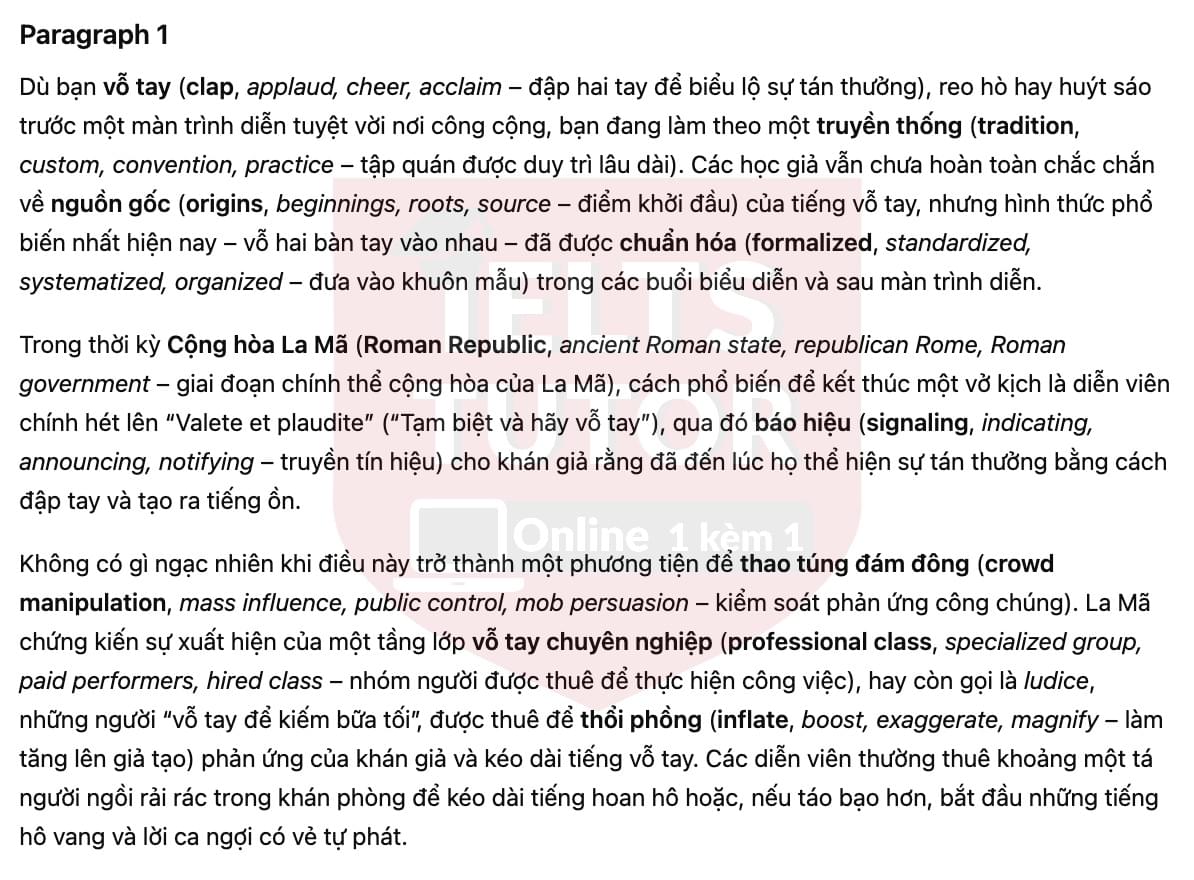
Paragraph 1 Whether you clap, cheer or whistle at a great public performance, you are following an old tradition. Scholars aren't quite sure about the origins of applause, but the form that is still most common, clapping the hands together, was formalized in theaters after performances. During the time of the Roman Republic (509 BC–27 BC) the common way to end a play was for the chief actor to yell "Valete et plaudite!" (Goodbye and applause), thus signaling to the audience that it was time for them to give praise by striking hands. Not surprisingly, then, this became a means of crowd manipulation. Rome saw the rise of a professional class of laudiceni, or people who clapped for their dinner, hired to infiltrate crowds and manipulate their reaction to performances. Actors would hire a dozen or so people to spread out among their audiences and prolong the applause, or, if they were feeling especially bold, to start spontaneous chants and shouts of praise.
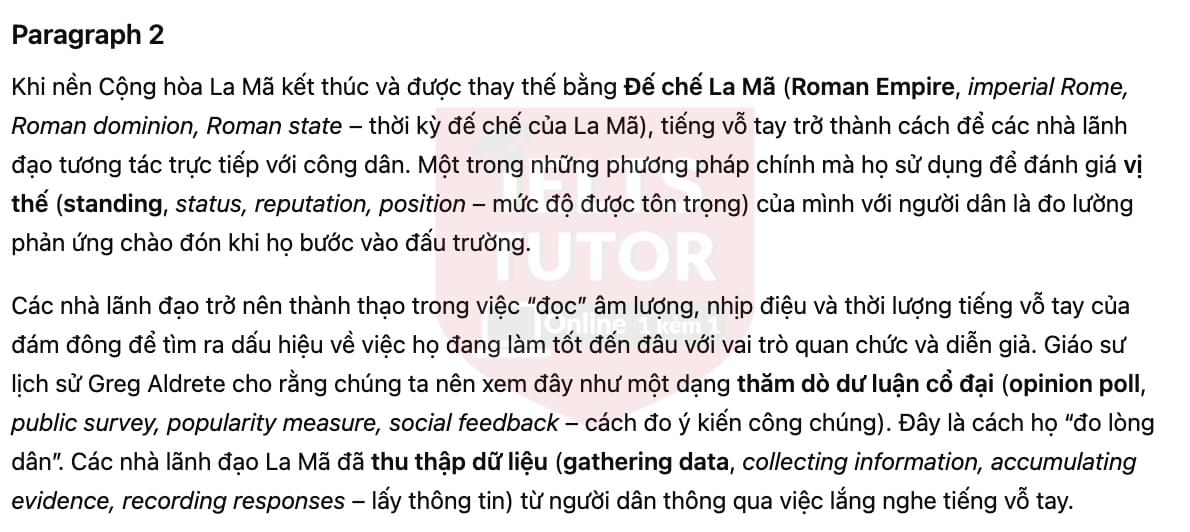
Paragraph 2 The Roman Republic came to an end and was replaced by the Roman Empire (27 BC–476 AD) where applause became a way for leaders to interact directly with their citizens. One of the chief methods they used to assess their standing with the people was gauging the greetings they got when they entered the arena. Leaders became adept at reading the volume, the rhythm, and the length of the crowd's claps for clues about how well they were doing as officials and rulers. "We should think of it as an ancient type of opinion poll," says Greg Aldrete, a professor of history. "This is how you gauge the people. Roman leaders are gathering data about people by listening to applause."
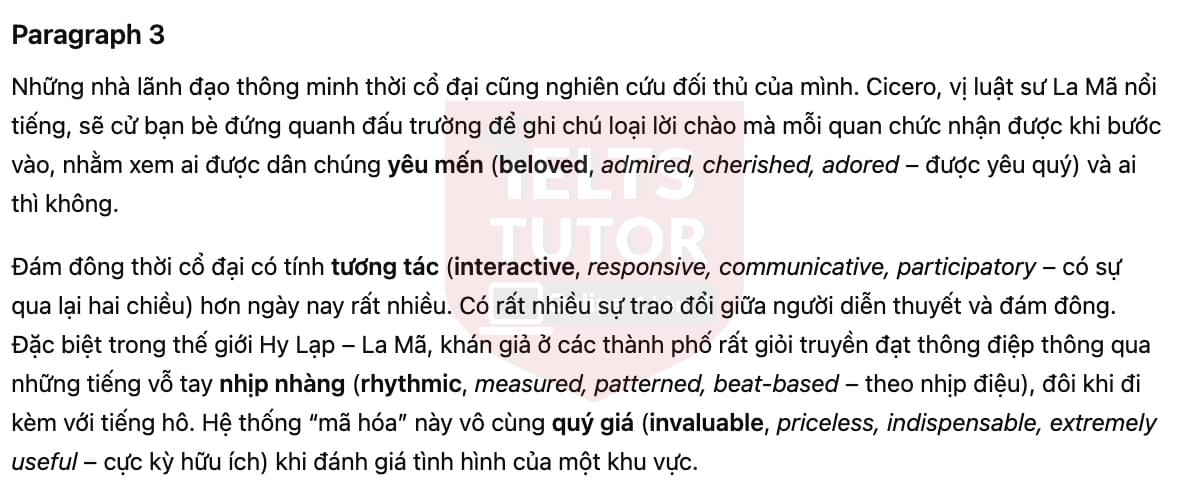
Paragraph 3 Clever leaders of the ancient world researched their rivals, too. Cicero, the Roman lawyer, would send friends to stand around outside the arena, taking notes to see what kind of greeting each official got when he entered, the better to see who was beloved by the people, and who was not. They had a lot of information to assess. Ancient crowds were more interactive than they are today, Aldrete points out. There was a lot of back and forth between speakers and crowds. And particularly in the Greco-Roman world, crowds, especially in cities, were really good at communicating messages through rhythmic clapping sometimes coupled with shouts. The coding was, he says, invaluable when assessing an area's fortunes.
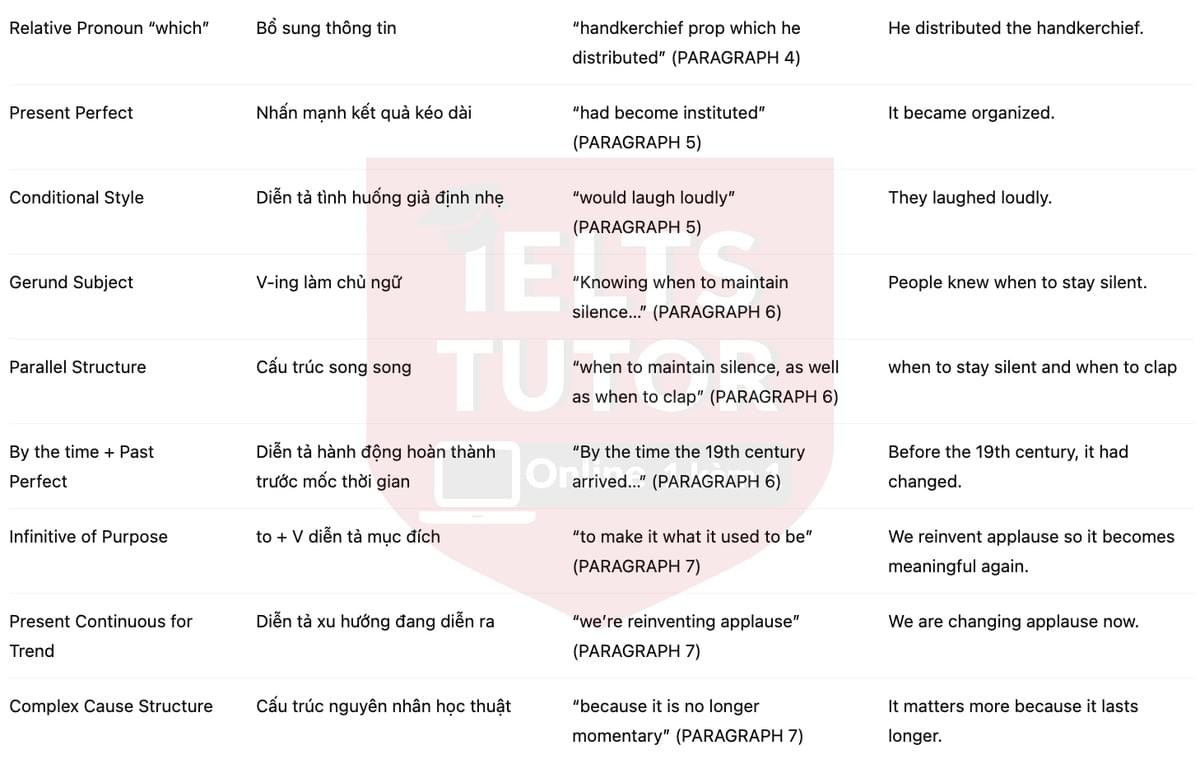
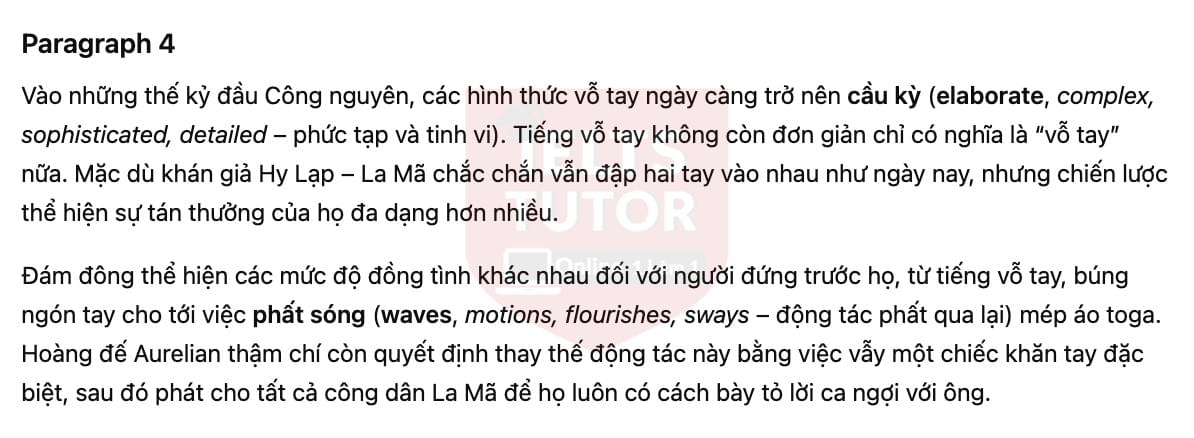
Paragraph 4 Around the first centuries AD, the terms of applause became more and more elaborate. Applause no longer meant, simply, 'claps'. While Greco-Roman audiences certainly smacked their palms together the same way we do today, their overall strategies of applause were much more varied than clapping alone. Crowds expressed degrees of approval of the person or persons before them, ranging from claps, to snaps (of the finger and thumb), to waves (of the edge of the toga). The emperor Aurelian decided to replace this gesture by waving a special handkerchief prop which he then distributed to all Romans, so they would never be without a way to praise him.
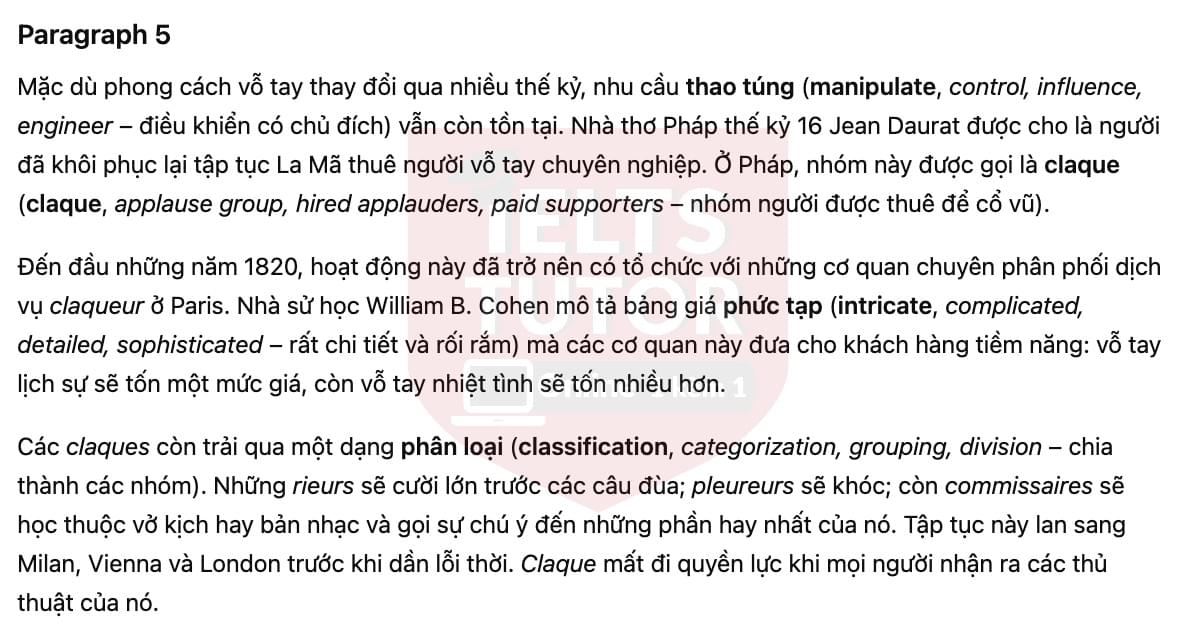
Paragraph 5 Although style of applause may have changed over the centuries, the need to manipulate remained. 16th-century French poet Jean Daurat is credited with bringing back the Roman practice of hiring professional applauders. In France, this group became known as claqueurs. Daurat handed out tickets to his own performances to people who promised to applaud at the end. By the early 1820s, claques had become instituted with an agency in Paris specializing in the distribution of the claqueur services. The historian William B. Cohen describes the intricate price list agencies of this kind would hand out to potential patrons: polite clapping would cost this many francs, enthusiastic applause would cost this many. The claqueurs underwent a kind of classification: the rieurs (laughters) would laugh loudly at the jokes; the pleureurs (criers) would feign reaction to performances; the commisaires (officers) would learn a play or a piece of music by heart and then call attention to its best parts. The practice spread to Milan, to Vienna, and to London before falling out of fashion. The claque lost its power once people became aware of its tricks.
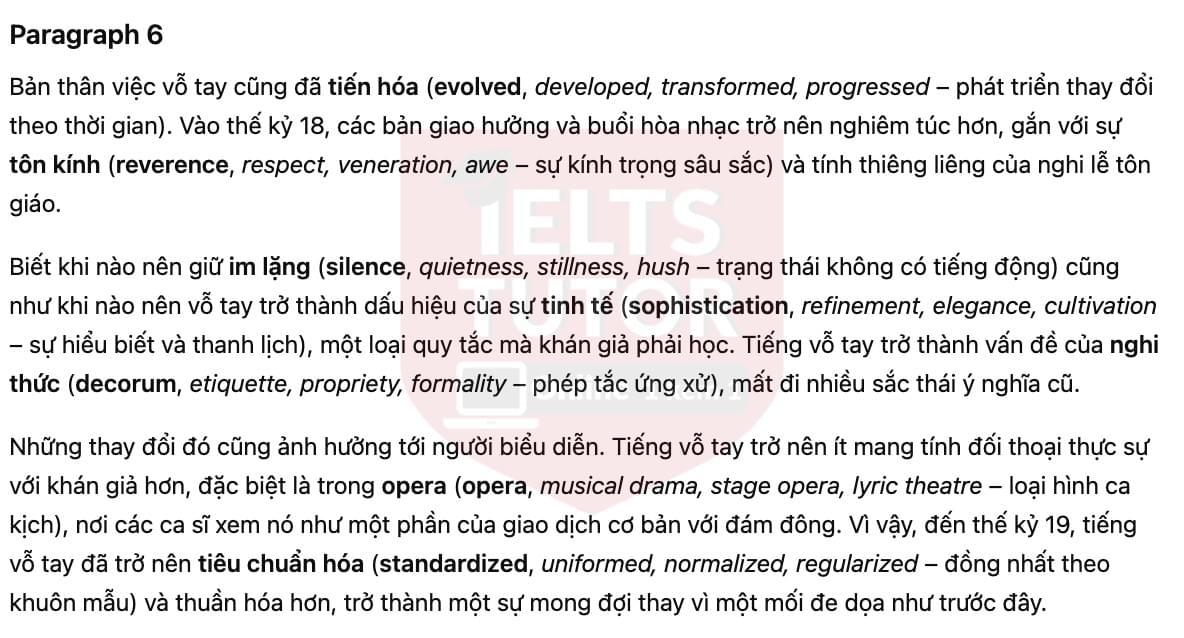
Paragraph 6 And clapping itself evolved. In the 18th century, symphonies and concerts became more serious, aligning themselves with the reverence and spirituality associated with religious ceremonies. Knowing when to maintain silence, as well as when to clap, became a mark of sophistication, a kind of code for audiences to learn. Applause became a matter of decorum, losing many old shades of meaning. Those changes changed performers, too. Applause became much less of a true dialogue with an audience, especially so with opera, where the singers saw it as part of a basic transaction with the crowd. So by the time the 19th century arrived, applause had become standardized and codified, and had become an expectation rather than the threat it used to be.
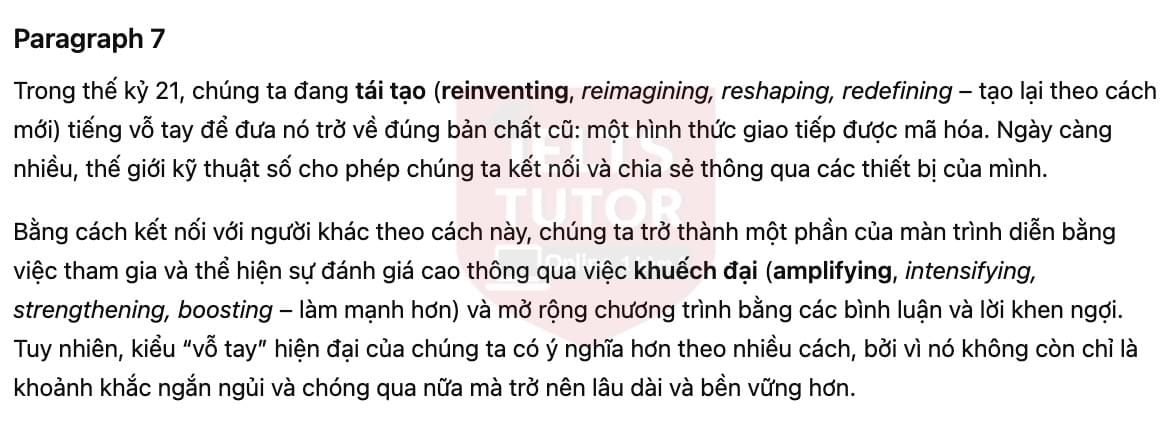
Paragraph 7 In the 21st century we're reinventing applause, to make it what it used to be: a coded form of communication. More and more the digital world allows us to link and share through our devices. By connecting with others in this way, we become part of the performance by participating in demonstrating our appreciation by amplifying and expanding the show through commenting and praising, but our kind of applause matters more now, in many ways, because it is no longer momentary and short-lived, but is far more permanent indeed.
A. The use of applause by political figures to evaluate their own popularity
B. A form of applause that is more far-reaching than before
C. The initial emergence of applause as a behaviour in the theatre
D. The different methods of applause employed in ancient times, besides clapping
E. The impact of musical performance on the etiquette of applause
F. The re-emergence and disappearance of fake appreciation
G. The use of applause in working out how popular an opponent was
Answer for 21:
Answer for 22:

III. The Origin and Development of Applause: Đề luyện tập IELTS READING (IELTS Reading Practice Test)
The Origin and Development of Applause
Paragraph 1 Whether you clap, cheer or white a great public performance, you are following along tradition. Scholars aren't quite sure about the origins of aplause, but the form that is still most common, clapping the hands together, was formalized in Watering and after performances. During the time of the Roman Republic (509C-27BC) the common way to end a play was for the chief actor to yell "Valet par (Goodbye and applause) thus signaling to the sunce that it was time for them to give praise by striking hands and making exp no surprise, then that this became a means of crowd manipulationRome saw the rise of profesional clas of ludice, or people who clapped for their dinner, hired to infitate crowds and manipulate their reaction to performances Actors would hire a dozen or so people to spread out among
their audiences and prolong the applause, or, if they were feeling expecially bold, to start spontaneous chants and shouts of prais
Paragraph 2 The Roman Republic came to an end and was replaced by the Roman Empire (27 DC-476 AD) where aple became a way for leaders to interact directly with their citizens. One of the chief methods they used to eat their standing with the people was gauging the greetings they got when they entered the area Leaders became a reading the volume, the rhythm, and the length of the crowd's claps for clues about how wel they were doing as officals and wakers. We should think of it as an ancient type of opinion pol," says Greg Aldrete, a professor of history.
"This is how you gauge the people. Roman leaders are gathering data about people by listening to aplause
Paragraph 3 Clever leaders of the ancient world researched their rivals, too. Cicero, the Roman lawyer, would send friends to stand around outside the arena, taking notes to see what kind of greating each official got when he entered, the beer to see who was beloved by the people, and who was
not. They had a lot of information to asess. Ancient crowds were more interactive than they are today Aldre points out. There was alot of back and forth between speakers and crowds. And particularly in the Greco-Roman world, crowds, especially in cities, were really good at communicating
mesages through mythmic claping sometimes coupled with shouts. The coding was, he says, invaluable when asesing area's fortunes >> 🔥 Form đăng kí giải đề thi thật IELTS 4 kĩ năng kèm bài giải bộ đề 100 đề PART 2 IELTS SPEAKING quý đang thi (update hàng tuần) từ IELTS TUTOR
Paragraph 4 Around the first centuries AD, the terms of apple became more and more elaborate. Applause no longer meant, simply, 'caps'. While Greco-Roman audiences certainly macked their pair together the same way we do today, their overall strategies of apple much
more varied than clapping alone. Crowds expressed degrees of approval of the person or persons before them, ranging from caps, to snaps of the finger and thumb), to waves (of the edge of the toga. The emperor Aurelian decided to replace this gesture by waving a special handkerchief
prop which he then distributed to all Romances, so they would never be without a way to praise him.
Paragraph 5 Athough style of applause may have changed over the centuries, the need to manipulate remained 16th-century French post Jean Duracredited with bringing back the Roman practice of hiring professional aplauders. In France, this group became known as aqueou
handed out Sckets to his own performances to people who promised to applaud at the end. By the early 1820s, claques had become instituted with an agency in Paris specializing in the distribution of the claqueuserviss. The historian William B. Chen describes the intricate price list
agencies of this kind would hand out to potential patrons polite clapping would cost this many francs, enthusiastic applause would cost this many. The claques underwent kind of classifcator: the reurs (aughers) would laugh loudly at the jokes; the pleurus (cries) would fin
reaction to performances; the commisies (oficers) would learn a play or a piece of music by heart and then call atention to its best parts. The practice spread to Milan, to Vienna, and to London before falling out of fashion. The claque lost its power once people became aware of its tricks
Paragraph 6 And claping self evolved. In the 18th century, symphonies and concerts became more serious, aligning theives with the reverence and spirituality associated with religious ceremonies. Knowing when to maintainence, as well as when to clap, became a mark of sophistication a
kind of code for audiences to learn. Applause became a matter of door'dant, losing many old shades of meaning. Those changes changed performers, too. Aplause became much less of a true dialogue with an audience, especially so with opera, where the singers saw it as part of a basic >> 🔥 Nhắn zalo 0905834420 join group zalo Hóng đề thi máy 4 skills để cập nhật đề thi thật 4 kĩ năng hằng ngày [Kèm giải & đề làm online]
transaction with the crowd. So by the time the 19th century arived, applause had become standardized and adoled, and had become an expectation rather than thread it used to be
Paragraph 7 in the 21st century we're reinventing applause, to make it what it used to be a coded form of communication. More and more the digital world allows us to link and share through our devices. By connecting with others in this way, we became part of the performance by participating int
demonstrating our apreciation by amplifying and axanding the show through commenting and praising, but our kind of applausemates more now, in many ways, because it is no longer momentary and short-lived, but is far more permanent ind
Questions 14-20
The text has seven paragraphs. Choose the correct heading for each paragraph from the list below.
List of Headings
A The use of applause by political figures to evaluate their own popularity
B A form of app that is more far-reaching than before
C The initial emergence of aplause as a behaviour in the theatre
D The diferent methods of aple employed in ancient times, besides claping
E The impact of musical performance on the equate of aplause
F The re-emergence and disappearance of fake appreciation
G The use of aplause in working out how popular an opponent was
14 Paragraph 1 ___
15 Paragraph 2 ___
16 Paragraph 3 ___
17 Paragraph 4 ___
18 Paragraph 5 ___
19 Paragraph 6 ___
20 Paragraph 7 ___ >> 🔥 IELTS TUTOR gợi ý tham khảo CẦN VIẾT & THU ÂM BAO NHIÊU BÀI ĐỂ ĐẠT 8.0 SPEAKING & 7.0 WRITING?
Questions 21-22
Which TWO of the following statements are true of the claque in France?
Write the two correct letters, A-E, in boxes 21-22.
A As a practice in France, it first appeared in the 18th century
B It did not become a widespread practice within France.
C The cost of hire depended on the fame of the client.
D Claqueurs were divided into diferent categories
E The practice did not extend beyond France to other countries
Questions 23-26
Complete the sentences.
Write ONE WORD ONLY from the passage for each answer.
23 In the 18th century, people could show their superiority by understanding when either __________ or applause was appropriate.
24 Performers in the 18th century, in particular those singing in the __________, no longer had a meaningful dangus with their audiences.
25 In the 19th century, applause was no longer ofered a __________ to performers.
26 Nowadays our expressions of approval are seen as __________ in comparison to the aplause of the past.
IV. Dịch bài đọc The Origin and Development of Applause
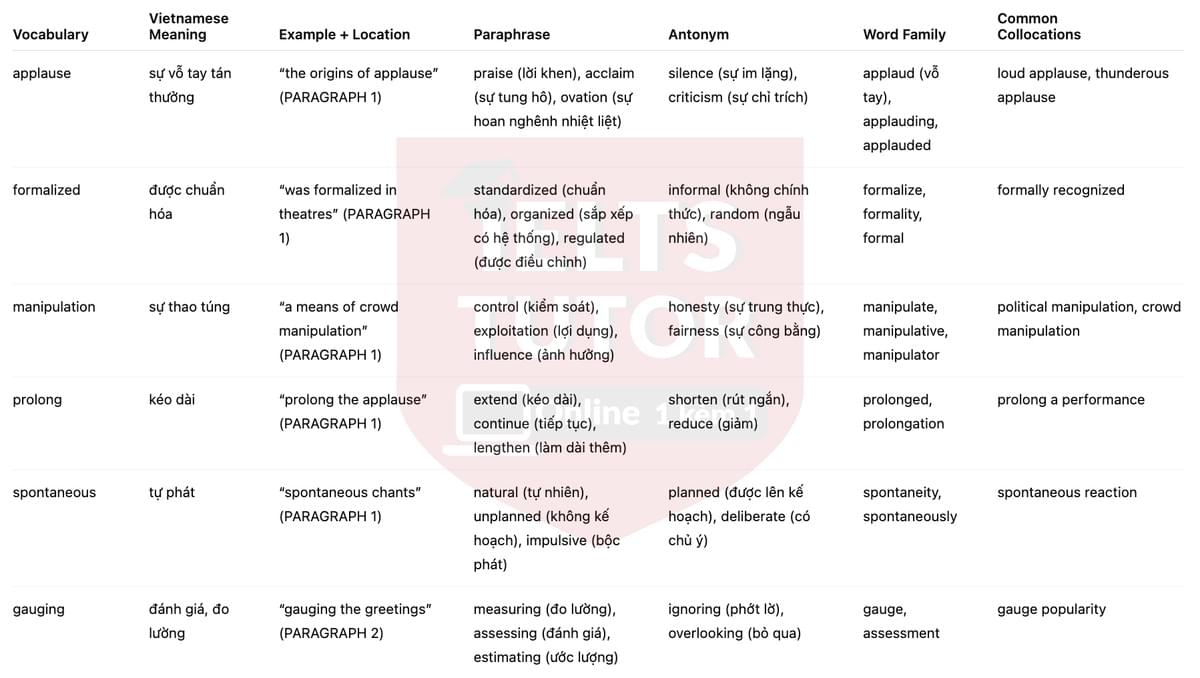
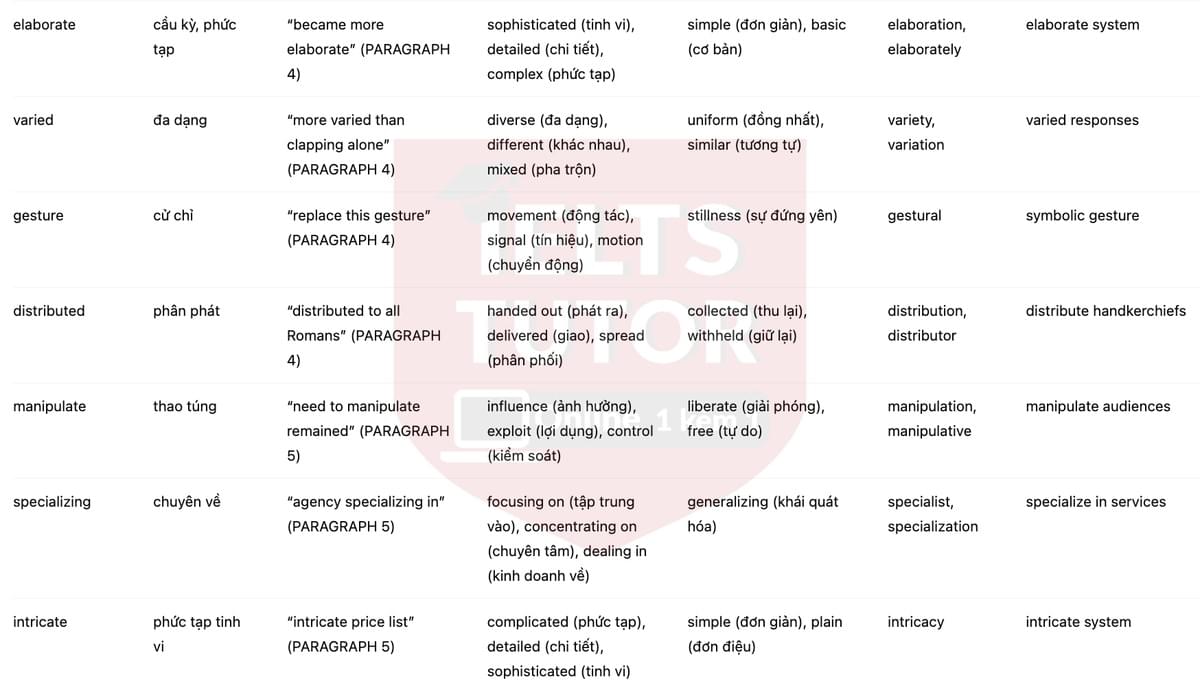
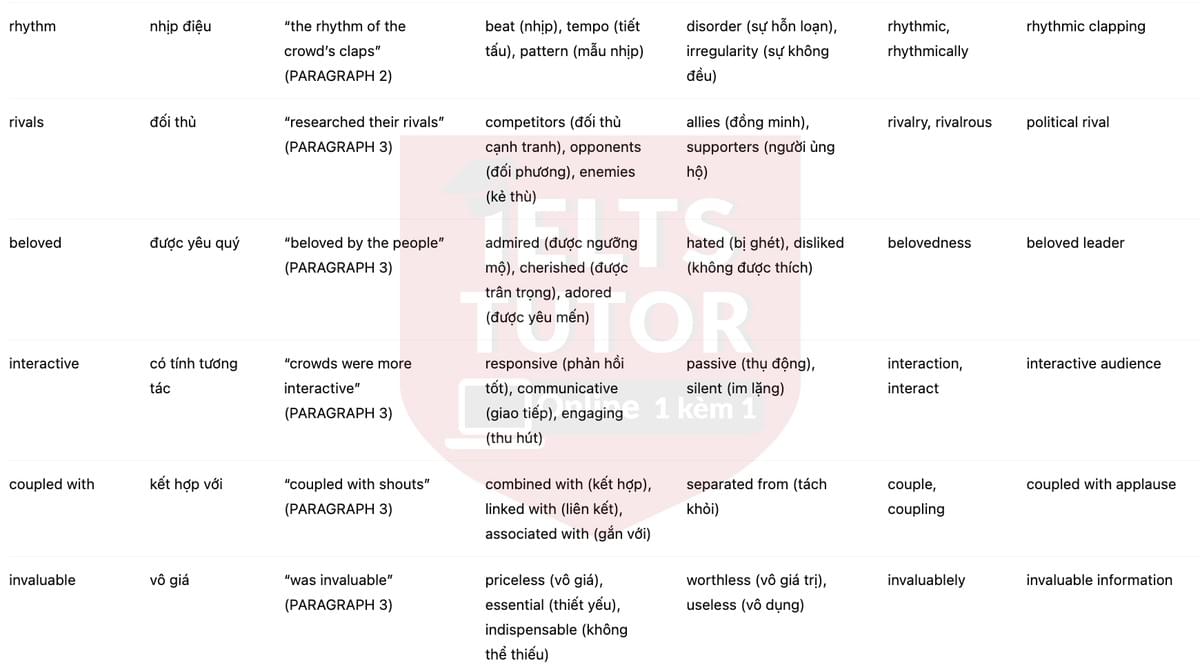
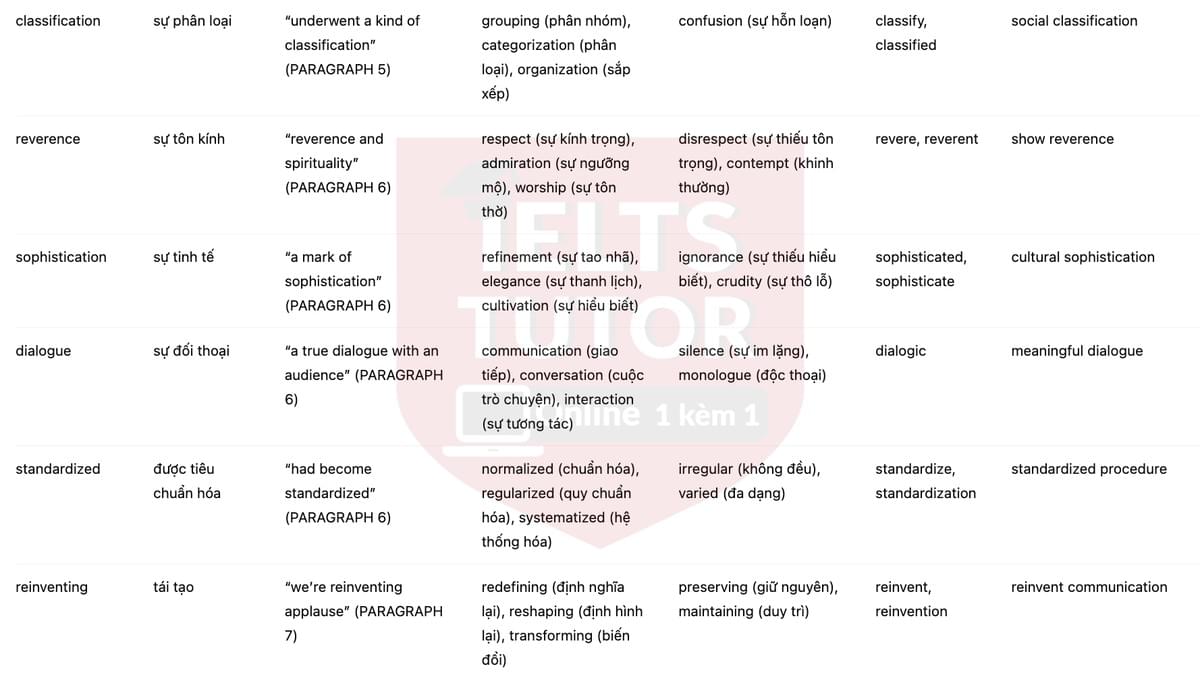
V. Giải thích từ vựng The Origin and Development of Applause
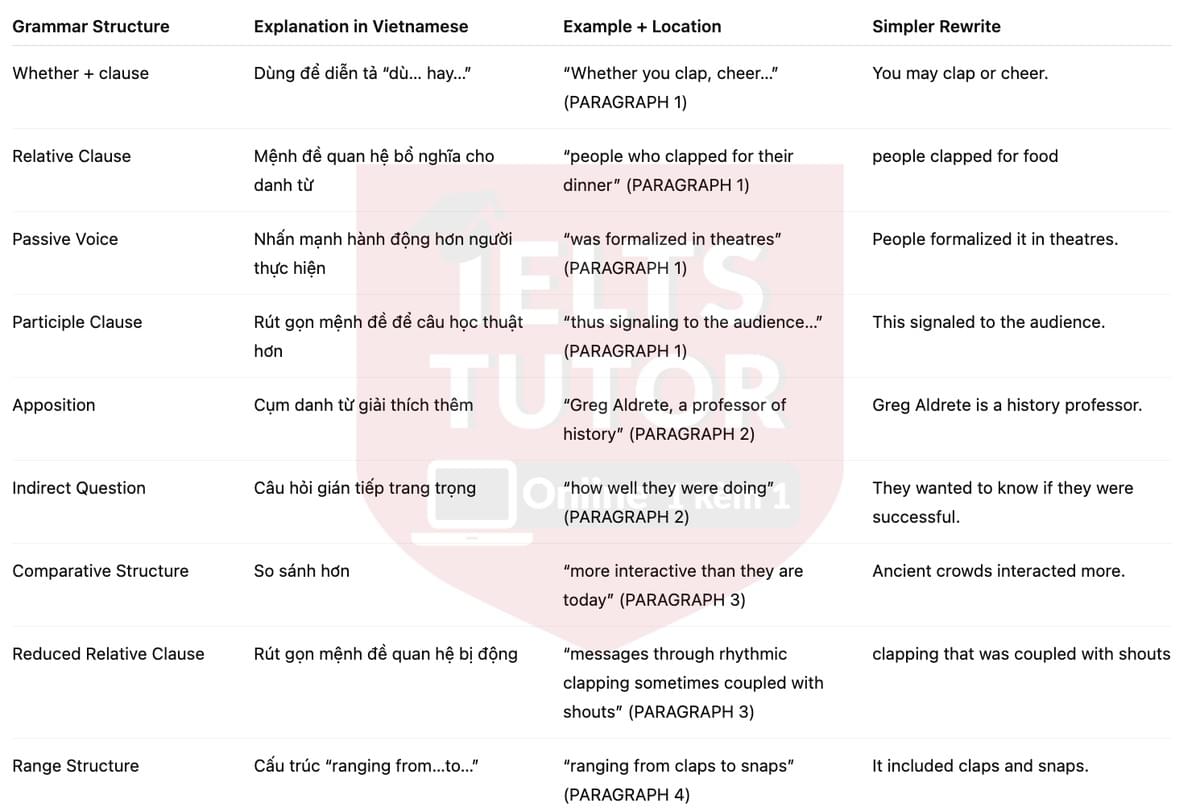
VI. Giải thích cấu trúc ngữ pháp khó The Origin and Development of Applause
VII. Đáp án The Origin and Development of Applause
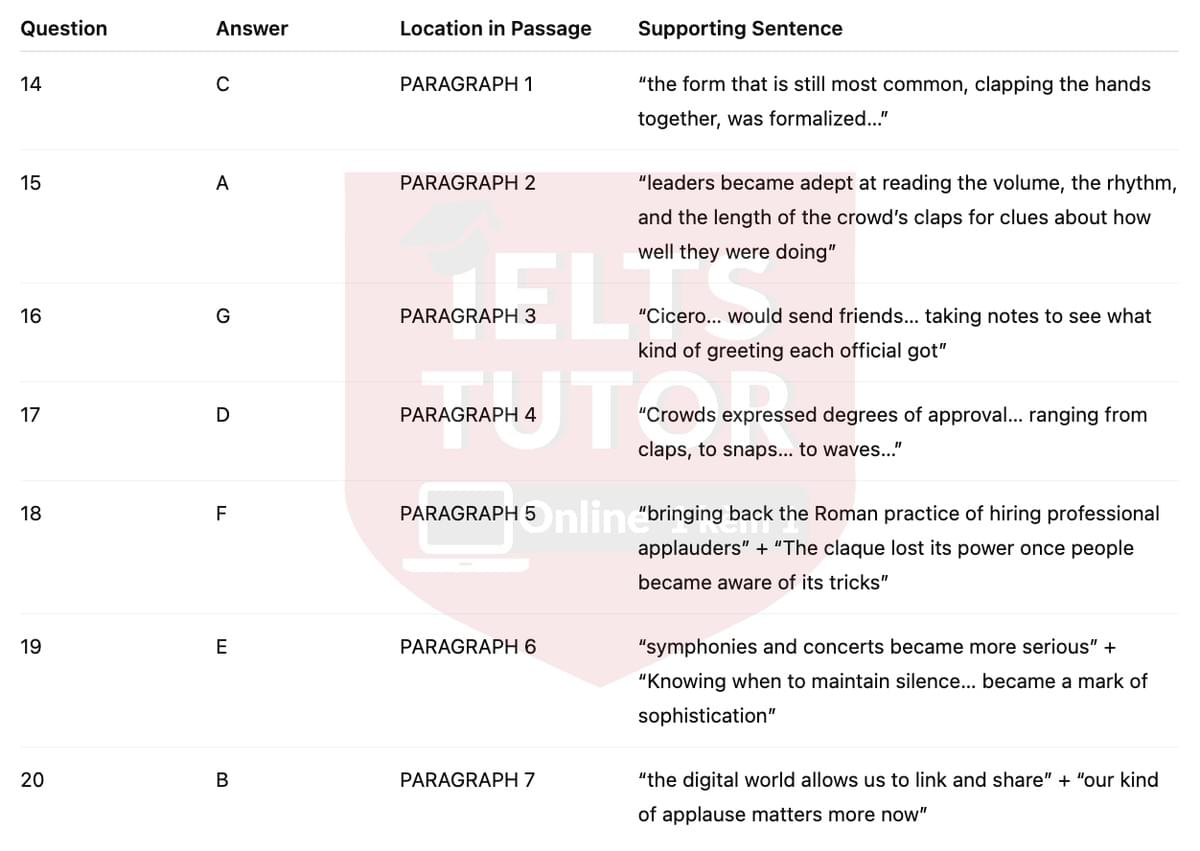
14. C
15. A
16. G
17. D
18. F
19. E
20. B
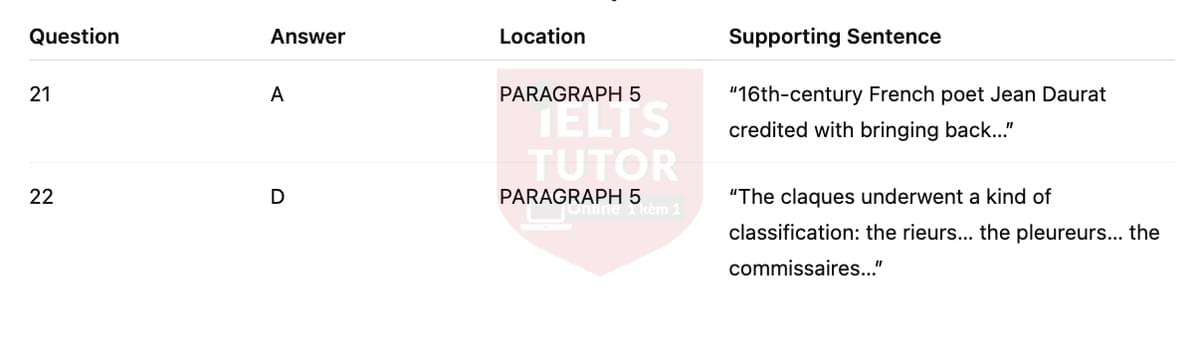
21. A
22. D
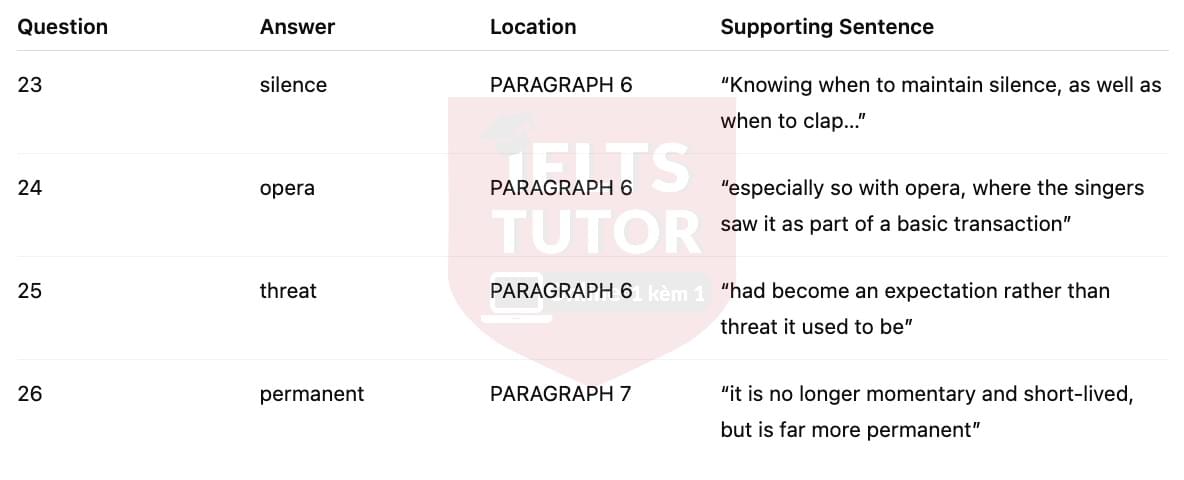
23. silence
24. opera
25. threat
26. permanent
📩 MN AI CHƯA CÓ ĐÁP ÁN FORECAST QUÝ MỚI PART 1-2-3 NHẮN ZL 0905834420 IELTS TUTOR GỬI FREE HẾT NHA

Các khóa học IELTS online 1 kèm 1 - 100% cam kết đạt target 6.0 - 7.0 - 8.0 - Đảm bảo đầu ra - Thi không đạt, học lại FREE
>> Thành tích học sinh IELTS TUTOR với hàng ngàn feedback được cập nhật hàng ngày
