
IELTS TUTOR cung cấp The origins of tennis Đề luyện tập IELTS READING (IELTS Reading Practice Test) - Làm bài online format computer-based, kèm đáp án, dịch & giải thích từ vựng - cấu trúc ngữ pháp khó & GIẢI ĐÁP ÁN VỚI LOCATION
I. Kiến thức liên quan
📩 MN AI CHƯA CÓ ĐÁP ÁN FORECAST QUÝ MỚI PART 1-2-3 NHẮN ZL 0905834420 IELTS TUTOR GỬI FREE HẾT NHA
II. Làm bài online (kéo xuống cuối bài blog để xem giải thích từ vựng & cấu trúc cụ thể hơn)
IELTS Reading Test
You have 20 minutes to complete this test
The game of tennis has a very long history. It is officially still known as 'lawn tennis,' partly because it was originally only played on grass, and also to distinguish it from the older game known as 'real tennis,' from which the modern game developed.
Some people believe that the ancient Egyptians, Greeks, and Romans played various versions of tennis. No drawings or descriptions of any tennis-like games have been discovered, but a couple of Arabic words dating from ancient Egyptian times are cited as evidence. The theory goes that the name 'tennis' is derived from the Egyptian town of Tinnis alongside the Nile, and the word 'racquet' evolved from the Arabic word for the palm of the hand, rahat.
Aside from these two Arabic words, there is no other evidence for any form of tennis prior to the year 1000. Most historians believe the origins of the game date back to 11th- and 12th-century France. It's thought that French monks were the first to play a basic game of handball against their monastery buildings, or over a rope strung across a courtyard. Those who dispute more ancient origins argue that the name 'tennis' is derived from the French tenez, which meant something to the effect of 'take this,' said as one player would serve to the other.
This game took on the name jeu de paume, which means "game of the hand or palm." But as they found playing with bare hands quite uncomfortable, players began using a simple glove, and later either a glove with webbing between the fingers or a solid paddle, similar to the ones used in table tennis today. Wooden racquets were not invented until much later.
The French nobility learned the game from the monks, and some accounts report as many as 1,800 tennis courts in France by the 13th century. The game, which remained exclusive to the upper classes, gained more popularity over the 14th and 15th centuries. As it became more widespread, the game spread to England, where both Henry VII and Henry VIII were keen players. Henry VIII built a tennis court at Hampton Court Palace in 1530, which still exists today.
The game continued to evolve over the centuries. In 1873, Major Walter Wingfield invented a version of tennis that could be played on a lawn. He patented his game, which he called Sphairistiké (Greek for "playing ball"), and began selling equipment. His rules were later refined by the All England Croquet Club, which held the first Wimbledon tournament in 1877. The club changed its name to the All England Lawn Tennis and Croquet Club, and Wimbledon quickly became the most prestigious tennis tournament in the world.
Modern tennis has changed little since the late 19th century, though equipment and playing styles have continued to develop. Today, tennis is played by millions of people worldwide, both recreationally and professionally, and remains one of the most popular sports on the planet.
Do the following statements agree with the information given in Reading Passage 1?
TRUE if the statement agrees with the information
FALSE if the statement contradicts the information
NOT GIVEN if there is no information on this
Complete the summary below.
Write your answers in boxes 7–10 on your answer sheet.
Early development of tennis
The modern game of tennis developed from an older game called . Some historians believe that the origin of tennis dates back to in the 11th and 12th centuries. The name jeu de paume means "game of the hand," because players originally used their to hit the ball. Later, players began using a simple glove, and then a glove with webbing or a solid .
Answer the questions below.
Write your answers in boxes 11–13 on your answer sheet.
III. The origins of tennis: Đề luyện tập IELTS READING (IELTS Reading Practice Test)
READING PASSAGE 1
You should spend about 20 minutes on Questions 1–13, which are based on Reading Passage 1 below.
The origins of tennis
The game of tennis has a very long history. It is officially still known as 'lawn tennis,' partly because it was originally only played on grass, and also to distinguish it from the older game known as 'real tennis,' from which the modern game developed.
Some people believe that the ancient Egyptians, Greeks, and Romans played various versions of tennis. No drawings or descriptions of any tennis-like games have been discovered, but a couple of Arabic words dating from ancient Egyptian times are cited as evidence. The theory goes that the name 'tennis' is derived from the Egyptian town of Tinnis alongside the Nile, and the word 'racquet' evolved from the Arabic word for the palm of the hand, rahat.
Aside from these two Arabic words, there is no other evidence for any form of tennis prior to the year 1000. Most historians believe the origins of the game date back to 11th- and 12th-century France. It's thought that French monks were the first to play a basic game of handball against their monastery buildings, or over a rope strung across a courtyard. Those who dispute more ancient origins argue that the name 'tennis' is derived from the French tenez, which meant something to the effect of 'take this,' said as one player would serve to the other.
This game took on the name jeu de paume, which means "game of the hand or palm." But as they found playing with bare hands quite uncomfortable, players began using a simple glove, and later either a glove with webbing between the fingers or a solid paddle, similar to the ones used in table tennis today. Wooden racquets were not invented until much later. >> 🔥 Form đăng kí giải đề thi thật IELTS 4 kĩ năng kèm bài giải bộ đề 100 đề PART 2 IELTS SPEAKING quý đang thi (update hàng tuần) từ IELTS TUTOR
The French nobility learned the game from the monks, and some accounts report as many as 1,800 tennis courts in France by the 13th century. The game, which remained exclusive to the upper classes, gained more popularity over the 14th and 15th centuries. As it became more widespread, the game spread to England, where both Henry VII and Henry VIII were keen players. Henry VIII built a tennis court at Hampton Court Palace in 1530, which still exists today.
The game continued to evolve over the centuries. In 1873, Major Walter Wingfield invented a version of tennis that could be played on a lawn. He patented his game, which he called Sphairistiké (Greek for "playing ball"), and began selling equipment. His rules were later refined by the All England Croquet Club, which held the first Wimbledon tournament in 1877. The club changed its name to the All England Lawn Tennis and Croquet Club, and Wimbledon quickly became the most prestigious tennis tournament in the world.
Modern tennis has changed little since the late 19th century, though equipment and playing styles have continued to develop. Today, tennis is played by millions of people worldwide, both recreationally and professionally, and remains one of the most popular sports on the planet. >> 🔥 Nhắn zalo 0905834420 join group zalo Hóng đề thi máy 4 skills để cập nhật đề thi thật 4 kĩ năng hằng ngày [Kèm giải & đề làm online]
Questions 1–6
Do the following statements agree with the information given in Reading Passage 1?
In boxes 1–6 on your answer sheet, write
| TRUE | if the statement agrees with the information |
| FALSE | if the statement contradicts the information |
| NOT GIVEN | if there is no information on this |
1 There are a few surviving documents which show that a game similar to tennis was played in the ancient world.
2 An early form of tennis involved players hitting a ball with just their hand.
3 The game of table tennis developed around the same time as tennis.
4 King Henry VIII of England built a tennis court at Hampton Court Palace.
5 Major Walter Wingfield invented the game of real tennis.
6 The first Wimbledon tournament took place before 1877.
Questions 7–10
Complete the summary below.
Choose NO MORE THAN TWO WORDS from the passage for each answer.
Write your answers in boxes 7–10 on your answer sheet.
Early development of tennis
The modern game of tennis developed from an older game called 7 _______________. Some historians believe that the origin of tennis dates back to 8 _______________ in the 11th and 12th centuries. The name jeu de paume means "game of the hand," because players originally used their 9 _______________ to hit the ball. Later, players began using a simple glove, and then a glove with webbing or a solid 10 _______________.
Questions 11–13
Answer the questions below.
Choose NO MORE THAN THREE WORDS from the passage for each answer.
Write your answers in boxes 11–13 on your answer sheet.
11 What did Major Walter Wingfield call his version of tennis?
12 Which organisation held the first Wimbledon tournament?
13 What type of surface was tennis originally played on?
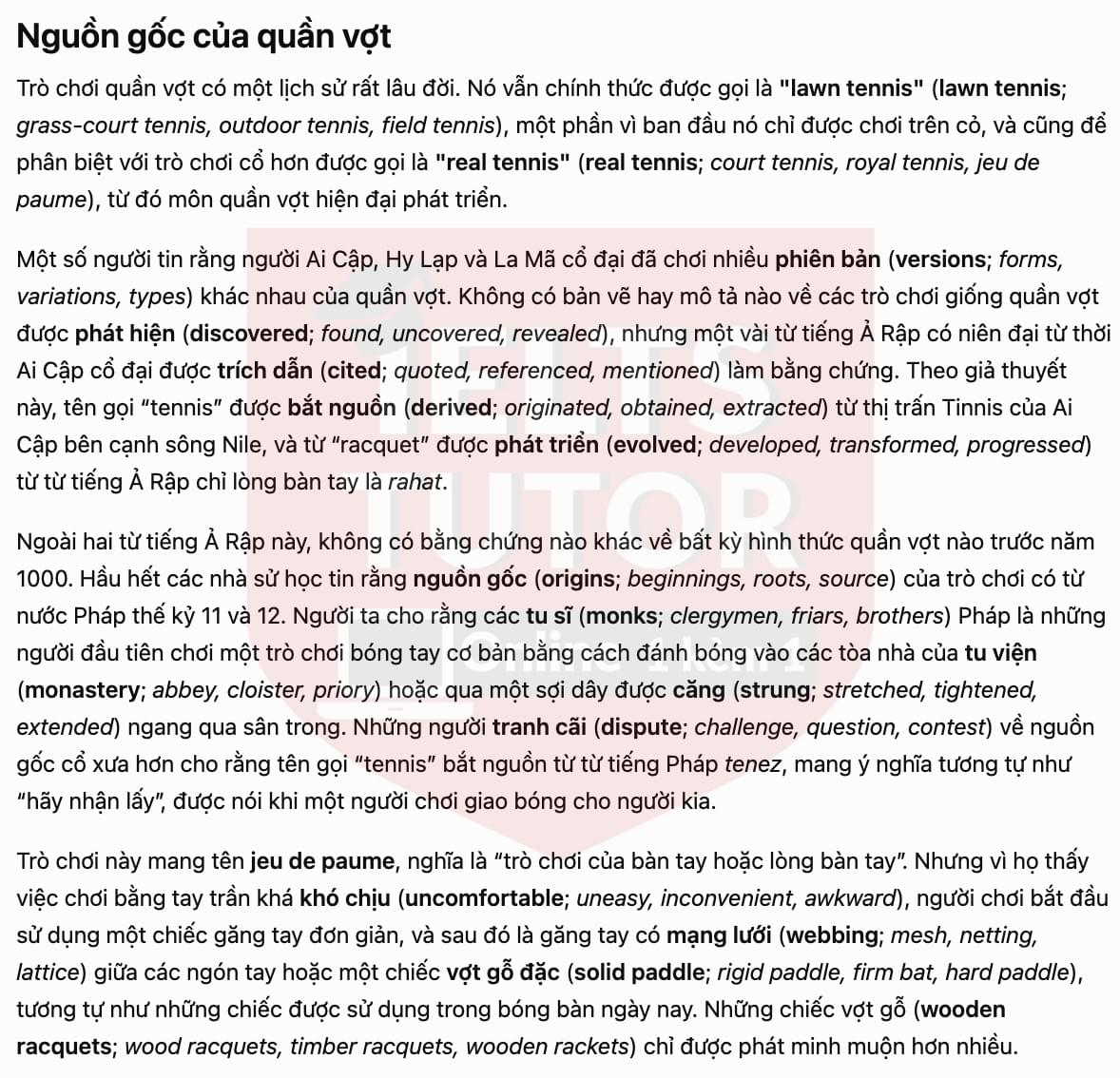
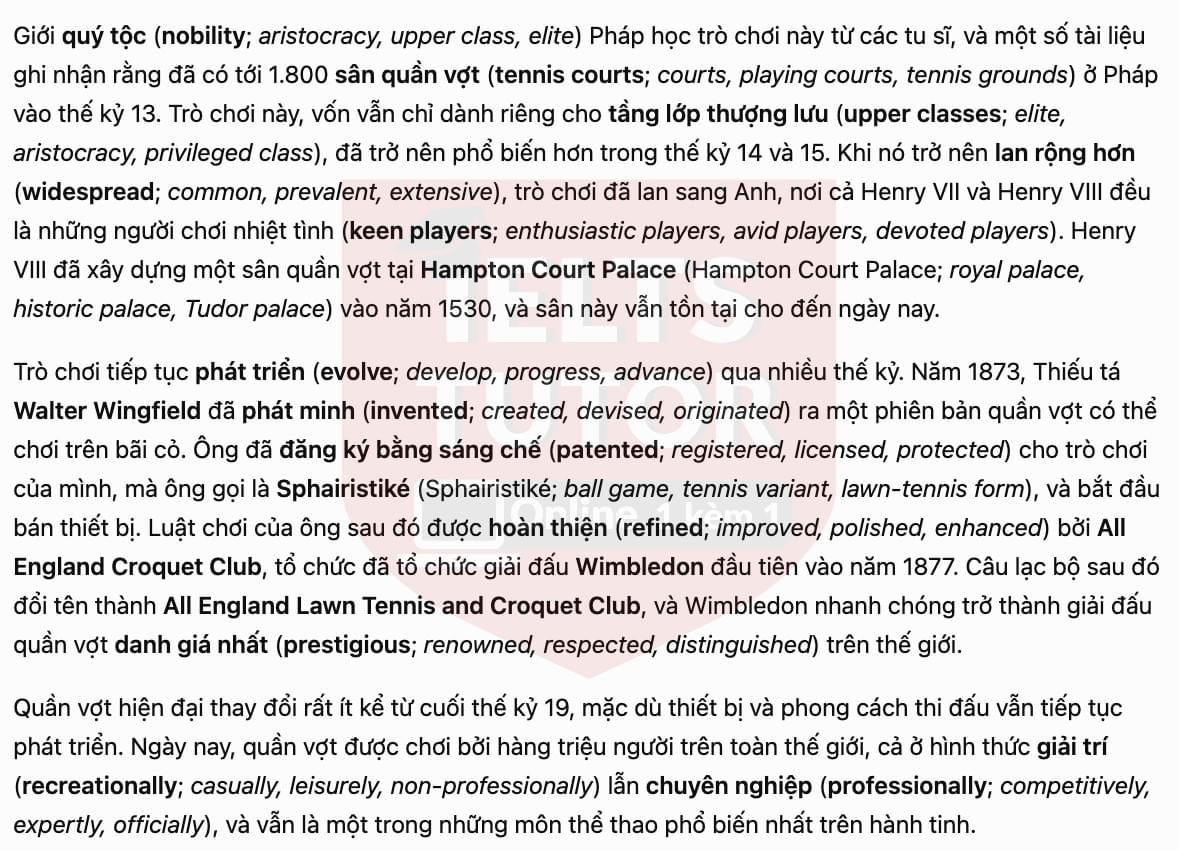
IV. Dịch bài đọc The origins of tennis
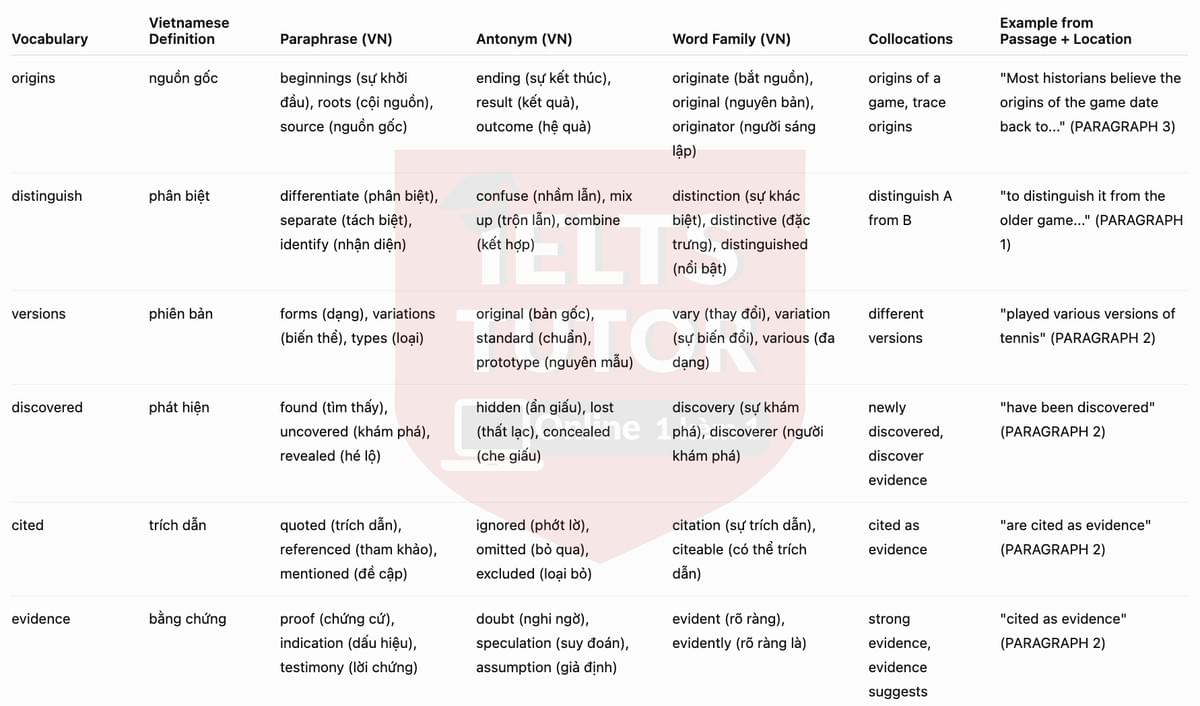
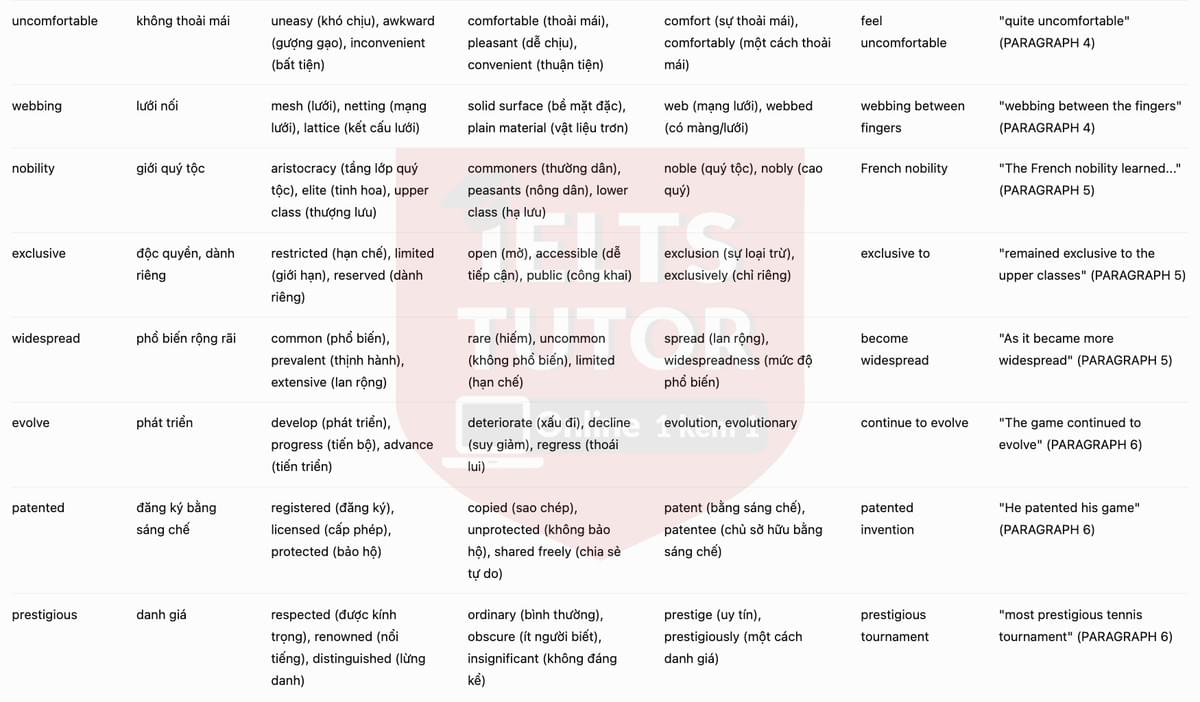
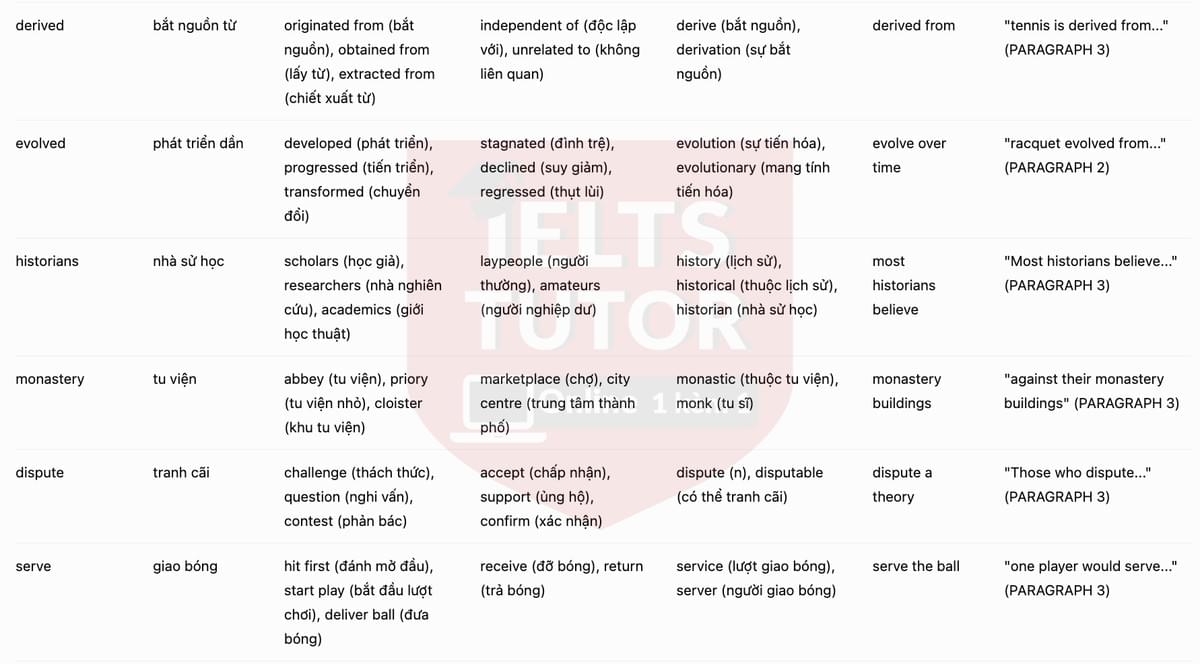
V. Giải thích từ vựng The origins of tennis
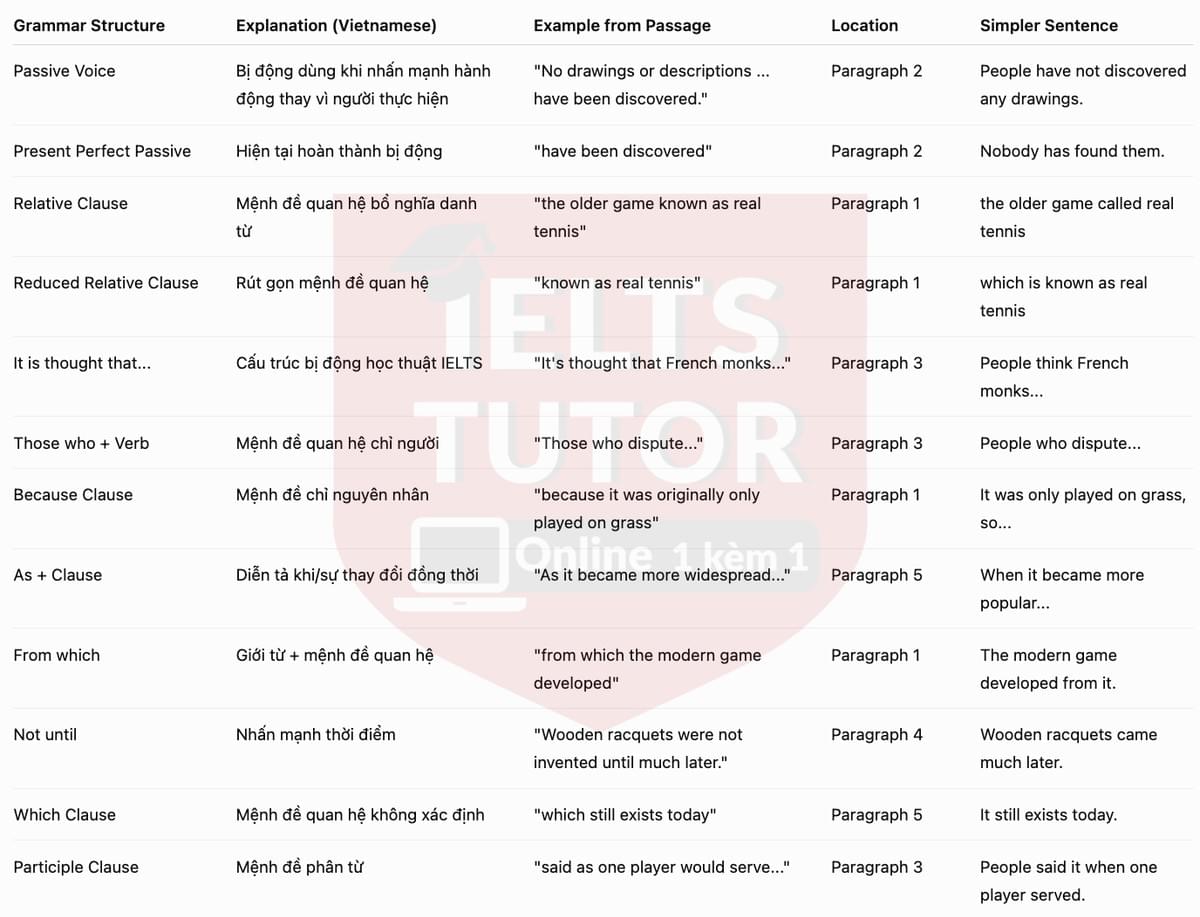
VI. Giải thích cấu trúc ngữ pháp khó The origins of tennis
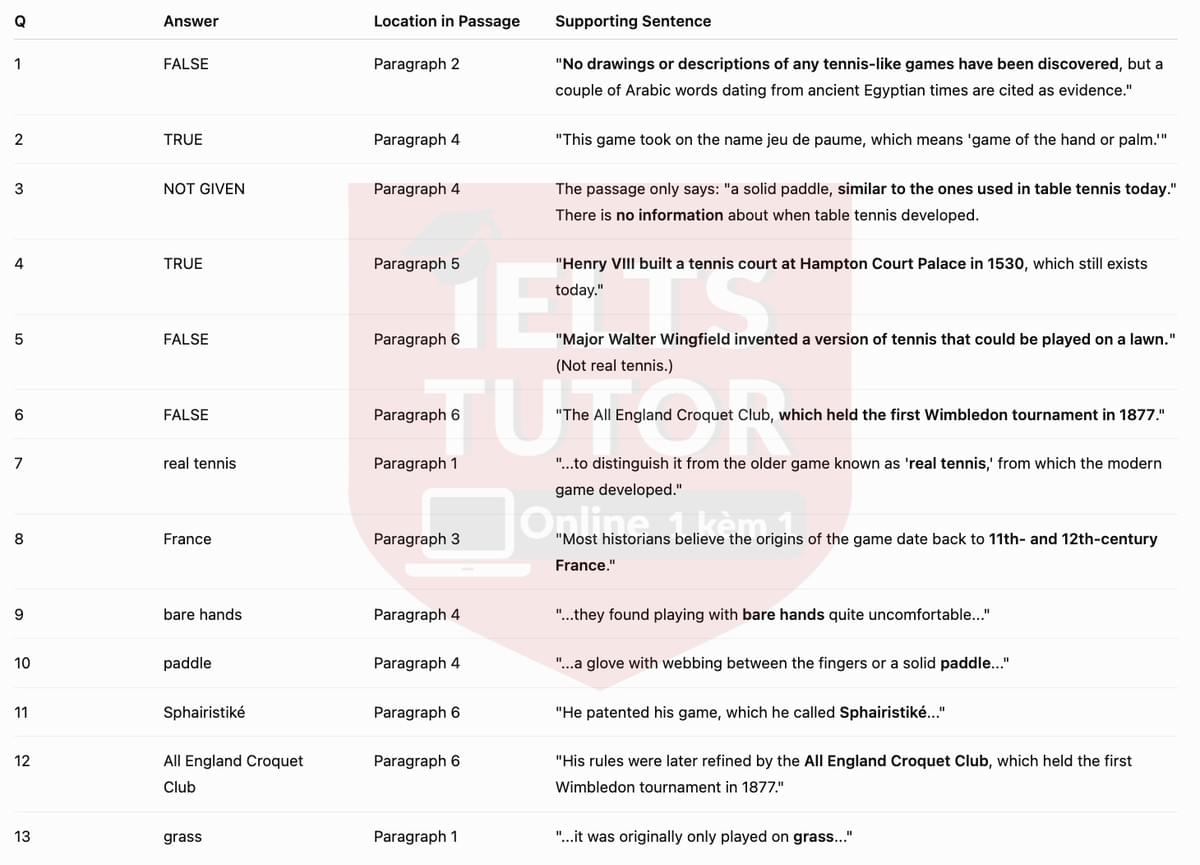
VII. Đáp án The origins of tennis
1. FALSE
2. TRUE
3. NOT GIVEN
4. TRUE
5. FALSE
6. FALSE
7. real tennis
8. France
9. bare hands
10. paddle
11. Sphairistiké
12. All England Croquet Club
13. grass
📩 MN AI CHƯA CÓ ĐÁP ÁN FORECAST QUÝ MỚI PART 1-2-3 NHẮN ZL 0905834420 IELTS TUTOR GỬI FREE HẾT NHA

Các khóa học IELTS online 1 kèm 1 - 100% cam kết đạt target 6.0 - 7.0 - 8.0 - Đảm bảo đầu ra - Thi không đạt, học lại FREE
>> Thành tích học sinh IELTS TUTOR với hàng ngàn feedback được cập nhật hàng ngày
