
IELTS TUTOR cung cấp The Unsung Sense: Đề thi thật IELTS READING (IELTS Reading Recent Actual Test) - Làm bài online format computer-based, kèm đáp án, dịch & giải thích từ vựng - cấu trúc ngữ pháp khó & GIẢI ĐÁP ÁN VỚI LOCATION
I. Kiến thức liên quan
II. Làm bài online (kéo xuống cuối bài blog để xem giải thích từ vựng & cấu trúc cụ thể hơn)
📩 MN AI CHƯA CÓ ĐÁP ÁN FORECAST QUÝ MỚI PART 1-2-3 NHẮN ZL 0905834420 IELTS TUTOR GỬI FREE HẾT NHA
Timer will start when you click the button. When time is up, answers will be submitted automatically.
Instructions: Read the passage below and answer the questions on the right. You can highlight text by selecting it with your mouse.
The Unsung Sense
New research reassesses the nature and importance of smell
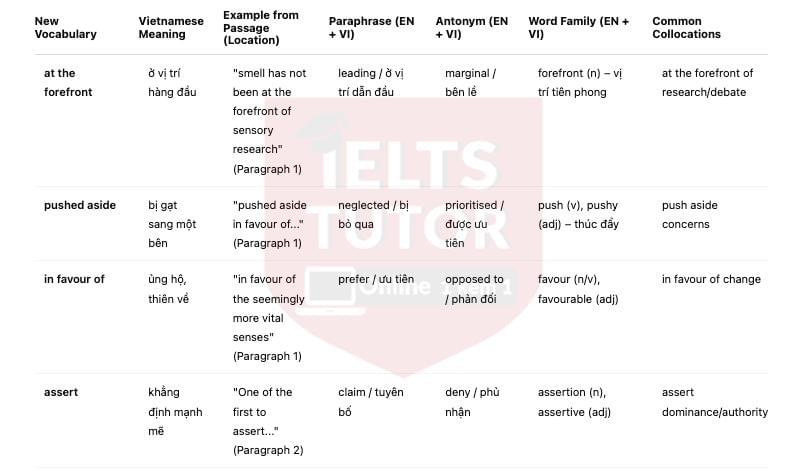
Traditionally, smell has not been at the forefront of sensory research, pushed aside in favour of the seemingly more vital senses of vision and hearing. There has been a strong belief that people, especially compared to other mammals, are not that influenced by smells.
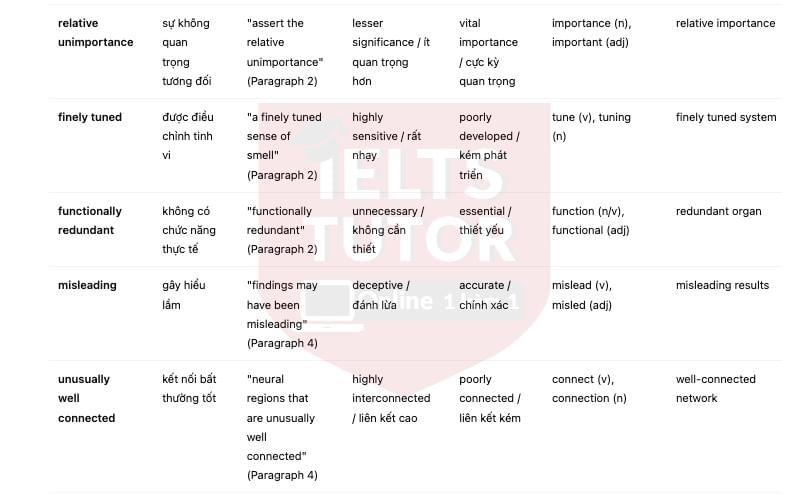
One of the first to assert the relative unimportance of the human sense of smell was Pierre Paul Broca, an influential 19th-century anatomist. After comparing the proportion of the brain devoted to smell in different animals, he suggested that mammals can be classed into two broad groups: macrosmatic mammals, such as dogs, have a finely tuned sense of smell which they rely on to perceive the world, while marine mammals and primates, including humans, are microsmatic – the organ with which they smell is small and functionally redundant.
That idea seemed to fit with more recent studies in genetics, which found that the majority of mammals have about one thousand different types of smell receptor. Most of these aren’t present in humans, who only possess four hundred or so different types.
Yet these findings may have been misleading. Brain scans show that more of the human brain is devoted to smell processing than Broca’s anatomical studies suggested. And although we may have fewer types of receptor than other mammals, research has shown that the human neural regions that are unusually well connected, with each group of receptors linking to many more incoming scents than is the case in other animals. That should give us a good ability to process incoming scents.
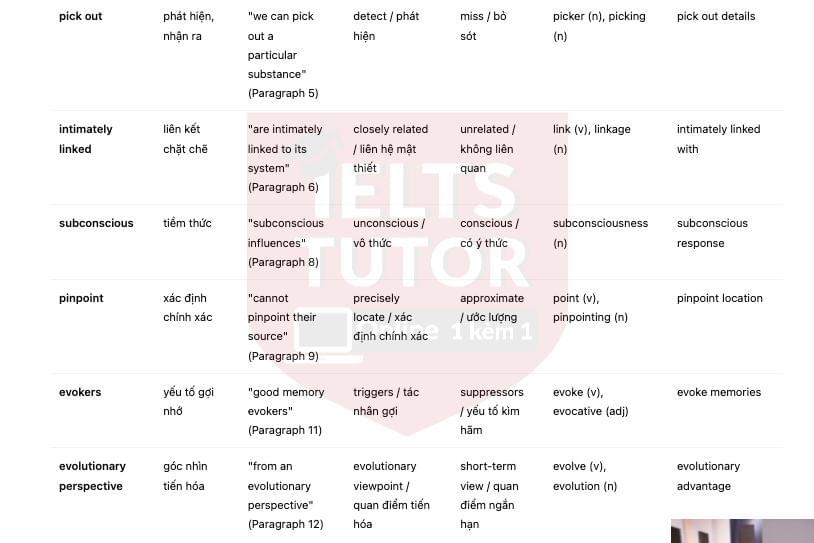
Once researchers began looking, they found the nose to be far more sensitive than its reputation suggested. One study, for example, found that we can pick out a particular substance even when heavily diluted. In fact, a person can smell just one drop of a chemical in a large swimming-pool.
What’s more, with the latest findings it is becoming clear that the brain’s “smelling centres” are intimately linked to its system for controlling emotion, fear and memory. That suggests a link between smell and the way we think. One Dutch academic, for example, found that when the smell of orange, seawater or peppermint was pumped through a nightclub, those inside partied harder – they danced more, laughed more, and even thought the music was better than when there was no added scent.
Other work has found that scent can influence our cognitive skills. A study found that when men were subjected to a novel smell – either good or bad – during a task used to test decision-making skills, they performed significantly worse than normal. The researchers concluded the scent stimulated brain areas connected with emotion, making their decisions emotional rather than rational.
The surprising thing about such studies is that up to 95% of subjects altered their behaviour, despite only 5% of them being aware of the introduced smells that they were facing. The question, then, is why do we pay so little conscious attention to our noses unless we smell something really strong?
One vital factor is that our noses just aren’t equipped to locate the source of an odour. This makes the sense of smell fundamentally different to vision or hearing, which are built to identify sights and sounds with precision. Apparently, we become aware of something when the brain focuses on a single location, after which it picks out the details, like a familiar face, from the scene. With smell, though, the brain does not focus in the same way, and so is not able to make us aware of the details relating to one particular area. It’s for this reason that we can only ever pick out around four smells from a complex mixture.
Nevertheless, we all have the capacity to train our sense of smell, but it needs to be worked at. Master perfumers, for instance, learn to recognise, name and imagine an extraordinary range of smells through years of practice. This is accompanied by a significant reorganisation of the olfactory areas in the brain that helps them to process the scents more efficiently.
Smells are also especially good memory evokers, but it’s actually a myth that odours trigger more complete memories than other stimuli. These memories are neither more accurate nor more detailed; but they are unique in that they are more emotional. This isn’t surprising when you consider that both emotion and smell are processed by the same areas of the brain, and there is a strong link between emotion and memory.
That said, not all smell memories are equal. The link between a memory and a smell is stronger if the smell is an unpleasant rather than a pleasant one, which makes sense from an evolutionary perspective and has even led to the suggestion that we associate a smell with an object, it evokes a much greater sense of memory. Since most first encounters with a smell happen at a young age, this might explain why smells often carry us back to our childhood.
Instructions: Answer all questions. Write your answers in the boxes provided.
Questions 1-6
Complete the summary below.
Choose NO MORE THAN TWO WORDS AND/OR A NUMBER from the passage for each answer.
Historically, the human sense of smell was considered less critical than vision and hearing. The anatomist Pierre Paul Broca classified humans as 1 , a group with a relatively small and underused olfactory organ. Genetic research initially seemed to support this, indicating that humans possess only around 2 types of smell receptors, far fewer than most mammals. However, new evidence reveals the human brain is more involved in smell processing than previously thought. Furthermore, human olfactory sensitivity is remarkably high, capable of detecting a single 3 of a substance in an Olympic-sized swimming pool. Recent studies also highlight the emotional impact of smell; for instance, when specific scents were introduced into a 4 , patrons reported enjoying the 5 more. Intriguingly, these subconscious influences are powerful, with up to 6 of study participants altering their behavior without being aware of the scent.
Questions 7-13
Do the following statements agree with the information given in the Reading Passage?
Write:
TRUE if the statement agrees with the information
FALSE if the statement contradicts the information
NOT GIVEN if there is no information on this
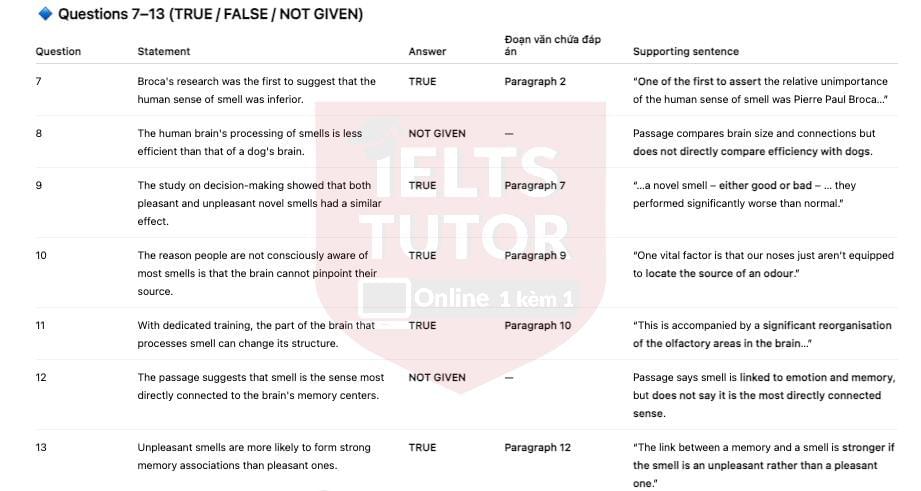
7. Broca's research was the first to suggest that the human sense of smell was inferior.
8. The human brain's processing of smells is less efficient than that of a dog's brain.
9. The study on decision-making showed that both pleasant and unpleasant novel smells had a similar effect.
10. The reason people are not consciously aware of most smells is that the brain cannot pinpoint their source.
11. With dedicated training, the part of the brain that processes smell can change its structure.
12. The passage suggests that smell is the sense most directly connected to the brain's memory centers.
13. Unpleasant smells are more likely to form strong memory associations than pleasant ones.


III. The Unsung Sense: Đề thi thật IELTS READING (IELTS Reading Recent Actual Test)
Reading Passage: The Unsung Sense
New research reassesses the nature and importance of smell
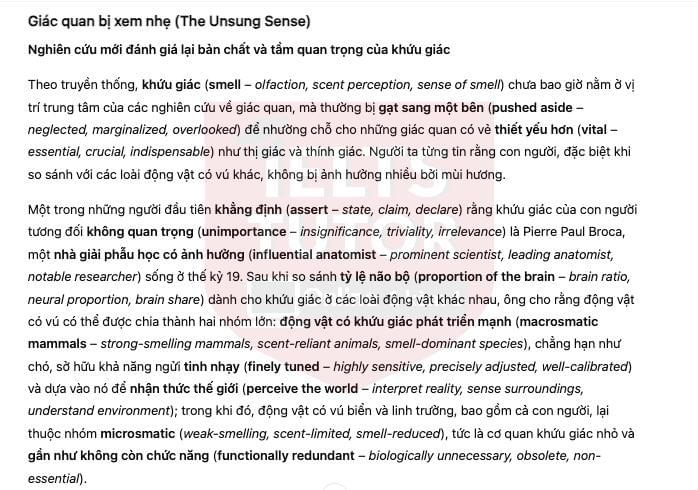
Traditionally, smell has not been at the forefront of sensory research, pushed aside in favour of the seemingly more vital senses of vision and hearing. There has been a strong belief that people, especially compared to other mammals, are not that influenced by smells.
One of the first to assert the relative unimportance of the human sense of smell was Pierre Paul Broca, an influential 19th-century anatomist. After comparing the proportion of the brain devoted to smell in different animals, he suggested that mammals can be classed into two broad groups: macrosmatic mammals, such as dogs, have a finely tuned sense of smell which they rely on to perceive the world, while marine mammals and primates, including humans, are microsmatic – the organ with which they smell is small and functionally redundant.
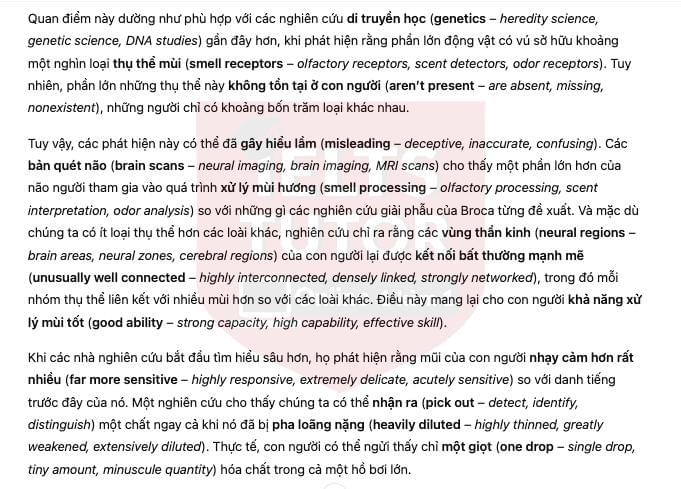
That idea seemed to fit with more recent studies in genetics, which found that the majority of mammals have about one thousand different types of smell receptor. Most of these aren’t present in humans, who only possess four hundred or so different types.
Yet these findings may have been misleading. Brain scans show that more of the human brain is devoted to smell processing than Broca’s anatomical studies suggested. And although we may have fewer types of receptor than other mammals, research has shown that the human neural regions that are unusually well connected, with each group of receptors linking to many more incoming scents than is the case in other animals. That should give us a good ability to process incoming scents.>> 🔥 Form đăng kí giải đề thi thật IELTS 4 kĩ năng kèm bài giải bộ đề 100 đề PART 2 IELTS SPEAKING quý đang thi (update hàng tuần) từ IELTS TUTOR
Once researchers began looking, they found the nose to be far more sensitive than its reputation suggested. One study, for example, found that we can pick out a particular substance even when heavily diluted. In fact, a person can smell just one drop of a chemical in a large swimming-pool.
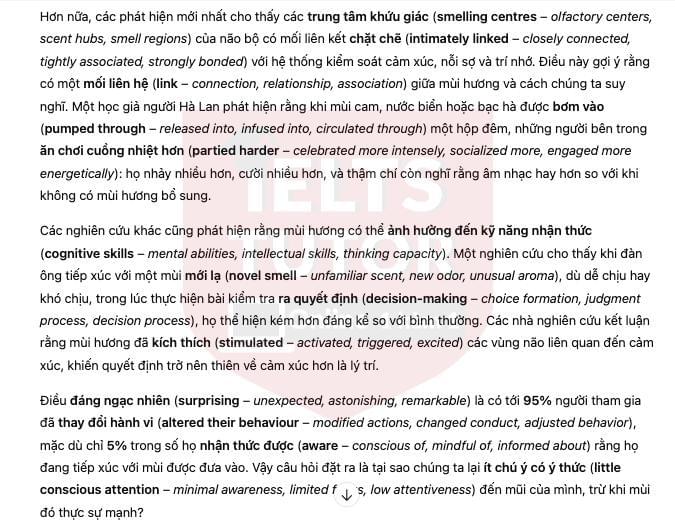
What’s more, with the latest findings it is becoming clear that the brain’s “smelling centres” are intimately linked to its system for controlling emotion, fear and memory. That suggests a link between smell and the way we think. One Dutch academic, for example, found that when the smell of orange, seawater or peppermint was pumped through a nightclub, those inside partied harder – they danced more, laughed more, and even thought the music was better than when there was no added scent.
Other work has found that scent can influence our cognitive skills. A study found that when men were subjected to a novel smell – either good or bad – during a task used to test decision-making skills, they performed significantly worse than normal. The researchers concluded the scent stimulated brain areas connected with emotion, making their decisions emotional rather than rational.
The surprising thing about such studies is that up to 95% of subjects altered their behaviour, despite only 5% of them being aware of the introduced smells that they were facing. The question, then, is why do we pay so little conscious attention to our noses unless we smell something really strong?
One vital factor is that our noses just aren’t equipped to locate the source of an odour. This makes the sense of smell fundamentally different to vision or hearing, which are built to identify sights and sounds with precision. Apparently, we become aware of something when the brain focuses on a single location, after which it picks out the details, like a familiar face, from the scene. With smell, though, the brain does not focus in the same way, and so is not able to make us aware of the details relating to one particular area. It’s for this reason that we can only ever pick out around four smells from a complex mixture.
Nevertheless, we all have the capacity to train our sense of smell, but it needs to be worked at. Master perfumers, for instance, learn to recognise, name and imagine an extraordinary range of smells through years of practice. This is accompanied by a significant reorganisation of the olfactory areas in the brain that helps them to process the scents more efficiently.
Smells are also especially good memory evokers, but it’s actually a myth that odours trigger more complete memories than other stimuli. These memories are neither more accurate nor more detailed; but they are unique in that they are more emotional. This isn’t surprising when you consider that both emotion and smell are processed by the same areas of the brain, and there is a strong link between emotion and memory.
That said, not all smell memories are equal. The link between a memory and a smell is stronger if the smell is an unpleasant rather than a pleasant one, which makes sense from an evolutionary perspective and has even led to the suggestion that we associate a smell with an object, it evokes a much greater sense of memory. Since most first encounters with a smell happen at a young age, this might explain why smells often carry us back to our childhood.>> 🔥 Nhắn zalo 0905834420 join group zalo Hóng đề thi máy 4 skills để cập nhật đề thi thật 4 kĩ năng hằng ngày [Kèm giải & đề làm online]
Questions 1-6
Complete the summary below.
Choose NO MORE THAN TWO WORDS AND/OR A NUMBER from the passage for each answer.
Historically, the human sense of smell was considered less critical than vision and hearing. The anatomist Pierre Paul Broca classified humans as 1 ______________, a group with a relatively small and underused olfactory organ. Genetic research initially seemed to support this, indicating that humans possess only around 2 ______________ types of smell receptors, far fewer than most mammals. However, new evidence reveals the human brain is more involved in smell processing than previously thought. Furthermore, human olfactory sensitivity is remarkably high, capable of detecting a single 3 ______________ of a substance in an Olympic-sized swimming pool. Recent studies also highlight the emotional impact of smell; for instance, when specific scents were introduced into a 4 ______________, patrons reported enjoying the 5 ______________ more. Intriguingly, these subconscious influences are powerful, with up to 6 ______________ of study participants altering their behavior without being aware of the scent.
Questions 7-13
Do the following statements agree with the information given in the Reading Passage?
Write:
TRUE if the statement agrees with the information
FALSE if the statement contradicts the information
NOT GIVEN if there is no information on this
Broca's research was the first to suggest that the human sense of smell was inferior.
The human brain's processing of smells is less efficient than that of a dog's brain.>> 🔥 IELTS TUTOR gợi ý tham khảo CẦN VIẾT & THU ÂM BAO NHIÊU BÀI ĐỂ ĐẠT 8.0 SPEAKING & 7.0 WRITING?
The study on decision-making showed that both pleasant and unpleasant novel smells had a similar effect.
The reason people are not consciously aware of most smells is that the brain cannot pinpoint their source.
With dedicated training, the part of the brain that processes smell can change its structure.
The passage suggests that smell is the sense most directly connected to the brain's memory centers.
Unpleasant smells are more likely to form strong memory associations than pleasant ones.
IV. Dịch bài đọc The Unsung Sense
V. Giải thích từ vựng The Unsung Sense
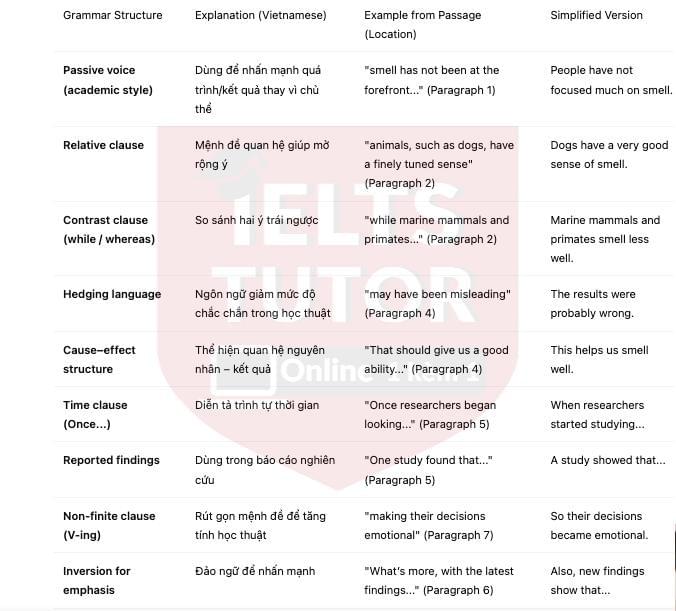
VI. Giải thích cấu trúc ngữ pháp khó The Unsung Sense
VII. Đáp án The Unsung Sense
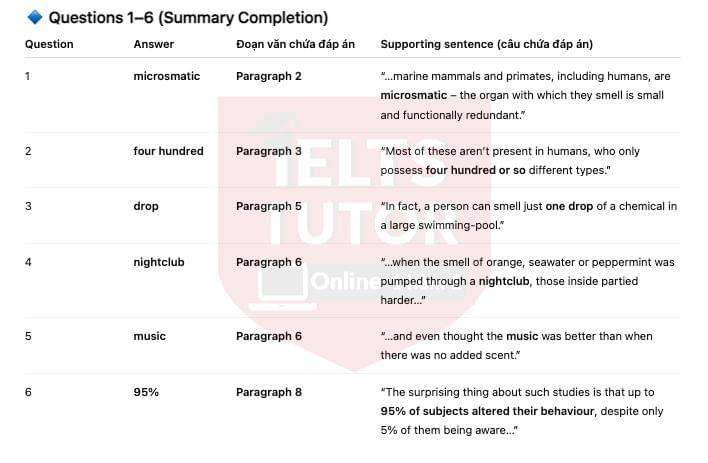
microsmatic
four hundred
drop
nightclub
music
95%
TRUE
NOT GIVEN
TRUE
TRUE
TRUE
NOT GIVEN
TRUE
📩 MN AI CHƯA CÓ ĐÁP ÁN FORECAST QUÝ MỚI PART 1-2-3 NHẮN ZL 0905834420 IELTS TUTOR GỬI FREE HẾT NHA

Các khóa học IELTS online 1 kèm 1 - 100% cam kết đạt target 6.0 - 7.0 - 8.0 - Đảm bảo đầu ra - Thi không đạt, học lại FREE
>> Thành tích học sinh IELTS TUTOR với hàng ngàn feedback được cập nhật hàng ngày
