
IELTS TUTOR cung cấp Why good food tastes good?: Đề thi thật IELTS READING (IELTS Reading Recent Actual Test) - Làm bài online format computer-based, , kèm đáp án, dịch & giải thích từ vựng - cấu trúc ngữ pháp khó & GIẢI ĐÁP ÁN VỚI LOCATION
I. Kiến thức liên quan
II. Làm bài online (kéo xuống cuối bài blog để xem giải thích từ vựng & cấu trúc cụ thể hơn)
📩 MN AI CHƯA CÓ ĐÁP ÁN FORECAST QUÝ MỚI PART 1-2-3 NHẮN ZL 0905834420 IELTS TUTOR GỬI FREE HẾT NHA
IELTS Reading Test - Why Good Food Tastes Good
Barb Stuckey, who describes herself as a professional food developer (though she once worked as a restaurant inspector), has just released the latest in a recent spate of books on the multisensory perception of flavor. This new volume, though, is certainly targeted at a somewhat different audience from the others. It is part memoir, detailing the author's many years working in a major North American company focused on developing novel food and beverage products, and part self help book, offering advice on how we could all improve our ability to taste (mindful eating plays a big role here).
In his book, Stevenson provided us with what is, and undoubtedly will remain to be, by far the most comprehensive academic summary of pretty much every study that has ever been published concerning how the senses interact to give rise to the emergent property that is flavor (well that is certainly how it felt on reading it). By contrast, Prescott’s much more easily-digestible contribution to the field tackled the question of why it is that we like what we like when it comes to food and drink. He too dealt with the differing roles of the senses in establishing and maintaining such preferences and, equally importantly, dislikes.
The author honestly lays out her position at the start of the book when she states that: “But as someone who had avidly avoided science classes in school, I longed to read a straightforward book written for a layperson that could teach me how to taste food without first having to teach myself science. There was not one, so I decided to write this book.” Consistent with this objective, complex terms that might prove difficult for a lay audience to understand, such as orthonasal and retronasal olfaction, are simplified as ‘nose-smelling’ and ‘mouth-smelling’, respectively.
When I was studying North America some years ago, Barb strenuously objects to the label ‘supertaster’. This is the term, originally coined by Linda Bartoshuk, currently at the University of Florida, in order to describe those individuals (approximately one quarter to one third of the population) who exhibit “an increased sensitivity to certain (especially bitter) tasteants which, for example, PROP (6-n-propylthiouracil) as well as to oral-somatosensory textural cues. Stuckey suggests that the putatively-pejorative terms ‘non-taster’ and ‘supertaster’ (which are typically used in the academic literature on the chemical senses) be replaced by the terms ‘tolerant taster’ and ‘hypersater’, respectively. Barb and Rogere are both hypertasters.
Stuckey has certainly been speaking to the right people while doing her research for the book. The text includes numerous quotes from the interviews that she conducted with many of the best-known international figures from the world of flavor research: These include Paul Breslin from Rutgers University and the Monell Chemical Senses Center talking about the major influence that touch/trigeminal stimulation has on our perception of food and drink, and, as already mentioned, Linda Bartoshuk talking about supertasters (amongst many other things). Barb also does a great job of extending just that little bit beyond what most academics are normally willing to say in print, but which may well turn out, ultimately, to be true. So, for example, she quotes Paul Breslin in saying that there might be around twenty qualities of taste but I am most comfortable saying that there are five.” Stuckey herself goes even further. She puts forward the provocative suggestion that there may be as many as 25 different basic tastes! Yes, 25, if what one means by that term is any taste for which we have a receptor on our tongue. While most researchers who are happy with the notion of a basic taste (though note that not all are) would agree with the inclusion of sweet, sour, salty, bitter, and nowadays probably also umami as basic tastes, it is interesting to realize that there are many other substances for which receptor sensitivity on the tongue has now been demonstrated.
Stuckey includes a number of case studies in her book, thus reminding me, in style at least, of Lawrence Rosenblum’s popular press volume on the senses “See what I am saying”. For example, Stuckey talks extensively about the case of Carlo Middione, an Italian chef working out of San Francisco who lost his sense of taste (or rather his sense of smell, and hence flavor) following a car accident. Barb’s book also includes some fascinating material on the preparation, and consumption, of food and drink by those who have lost one of their senses (for example, vision or hearing). Also, when she finds out that no one has done the relevant research, as when it comes to the question whether those who are deaf suffer from reduced flavor perception – she goes and collects some relevant data herself.
Stuckey’s book is strongest in the numerous industry examples she provides from her work with Mattson, the largest new food product development company in North America. Many of the cases she describes seem to hinge on trying to find just the right balance of the basic tastes, not to mention the right mouth-feel, for a particular food or beverage product. Indeed, one of the major themes that came out throughout the book was the importance of food texture and the temporal dynamics of changes in mouthfeel as we eat and drink for so many of the products and brands that we buy on a regular basis. This is certainly an area of food science research that is tricky to work on in an academic research setting. It is just much easier to change the color or aroma of a foodstuff, say. However, on numerous occasions we see just how important the tactile attributes of various foods and beverages are to their success amongst consumers. Take, for example, the case of the development of low-calorie cola drinks that Stuckey was heavily involved in.
Where I thought that Stuckey was on weaker ground was in her section on "The expert eater brain." She confidently asserts that "Not only do tasting experts use more areas of the brain, they can enjoy the processing better than novices." Now while the second part of the claim may, for all I know, be true, the former statement really just does not do justice to the complexity of much of the published data that is out there.
While Stuckey’s book has the now-requisite recommendation from Heston Blumenthal on the back cover, what is striking about the remainder of the cover quotes is that they all come from people working in the food industry; that is, from chefs and those placed in cookery schools. Ultimately, I anticipate this volume will have a much more enthusiastic reception there, and, as per the subtitle to her book, amongst 'passionate eaters' everywhere, than necessarily amongst those working on the more academic side of flavor perception.
Choose the correct letter, A, B, C, or D.
Choose YES, NO, or NOT GIVEN
Write the correct letter, A–H, on your answer sheet.

III. Why good food tastes good?: Đề thi thật IELTS READING (IELTS Reading Recent Actual Test)
Reading Passage: Why good food tastes good?
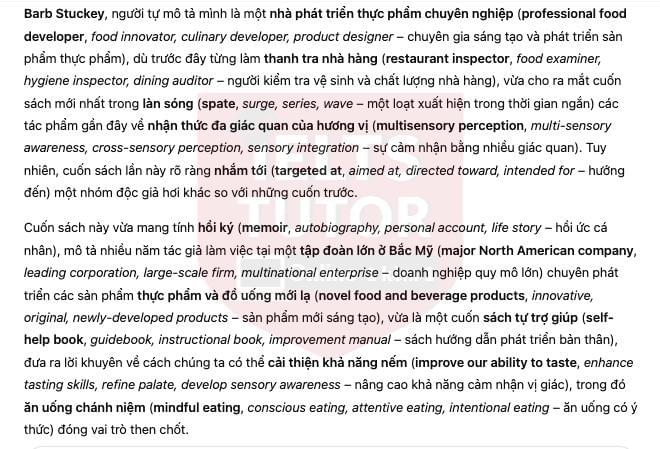
Barb Stuckey, who describes herself as a professional food developer (though she once worked as a restaurant inspector), has just released the latest in a recent spate of books on the multisensory perception of flavor. This new volume, though, is certainly targeted at a somewhat different audience from the others. It is part memoir, detailing the author's many years working in a major North American company focused on developing novel food and beverage products, and part self help book, offering advice on how we could all improve our ability to taste (mindful eating plays a big role here). In his book, Stevenson provided us with what is, and undoubtedly will remain to be, by far the most comprehensive academic summary of pretty much every study that has ever been published concerning how the senses interact to give rise to the emergent property that is flavor (well that is certainly how it felt on reading it). By contrast, Prescott’s much more easily-digestible contribution to the field tackled the question of why it is that we like what we like when it comes to food and drink. He too dealt with the differing roles of the senses in establishing and maintaining such preferences and, equally importantly, dislikes.>> 🔥 Form đăng kí giải đề thi thật IELTS 4 kĩ năng kèm bài giải bộ đề 100 đề PART 2 IELTS SPEAKING quý đang thi (update hàng tuần) từ IELTS TUTOR
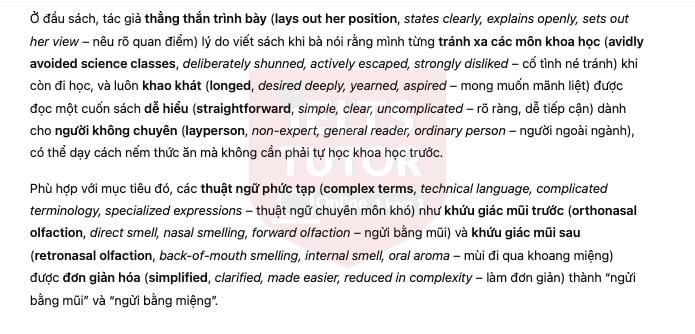
The author honestly lays out her position at the start of the book when she states that: “But as someone who had avidly avoided science classes in school, I longed to read a straightforward book written for a layperson that could teach me how to taste food without first having to teach myself science. There was not one, so I decided to write this book.” Consistent with this objective, complex terms that might prove difficult for a lay audience to understand, such as orthonasal and retronasal olfaction, are simplified as ‘nose-smelling’ and ‘mouth-smelling’, respectively.
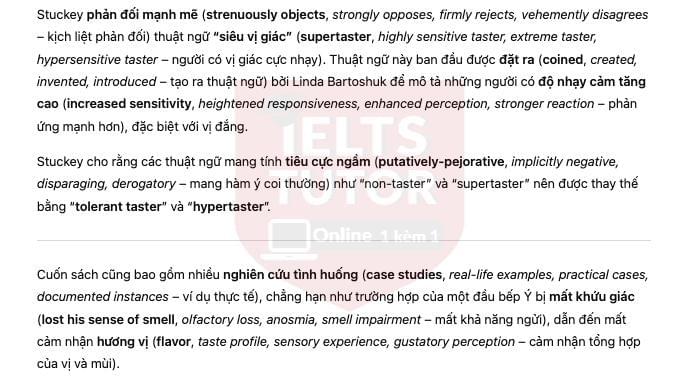
When I was studying North America some years ago, Barb strenuously objects to the label ‘supertaster’. This is the term, originally coined by Linda Bartoshuk, currently at the University of Florida, in order to describe those individuals (approximately one quarter to one third of the population) who exhibit “an increased sensitivity to certain (especially bitter) tasteants which, for example, PROP (6-n-propylthiouracil) as well as to oral-somatosensory textural cues. Stuckey suggests that the putatively-pejorative terms ‘non-taster’ and ‘supertaster’ (which are typically used in the academic literature on the chemical senses) be replaced by the terms ‘tolerant taster’ and ‘hypersater’, respectively. Barb and Rogere are both hypertasters.
Stuckey has certainly been speaking to the right people while doing her research for the book. The text includes numerous quotes from the interviews that she conducted with many of the best-known international figures from the world of flavor research: These include Paul Breslin from Rutgers University and the Monell Chemical Senses Center talking about the major influence that touch/trigeminal stimulation has on our perception of food and drink, and, as already mentioned, Linda Bartoshuk talking about supertasters (amongst many other things). Barb also does a great job of extending just that little bit beyond what most academics are normally willing to say in print, but which may well turn out, ultimately, to be true. So, for example, she quotes Paul Breslin in saying that there might be around twenty qualities of taste but I am most comfortable saying that there are five.” Stuckey herself goes even further. She puts forward the provocative suggestion that there may be as many as 25 different basic tastes! Yes, 25, if what one means by that term is any taste for which we have a receptor on our tongue. While most researchers who are happy with the notion of a basic taste (though note that not all are) would agree with the inclusion of sweet, sour, salty, bitter, and nowadays probably also umami as basic tastes, it is interesting to realize that there are many other substances for which receptor sensitivity on the tongue has now been demonstrated.
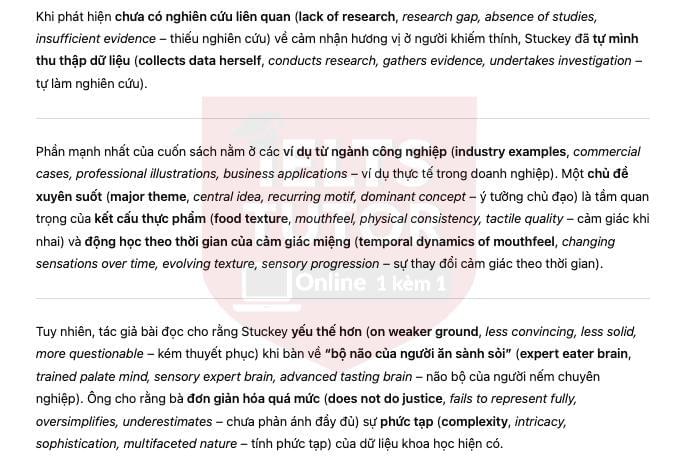
Stuckey includes a number of case studies in her book, thus reminding me, in style at least, of Lawrence Rosenblum’s popular press volume on the senses “See what I am saying”. For example, Stuckey talks extensively about the case of Carlo Middione, an Italian chef working out of San Francisco who lost his sense of taste (or rather his sense of smell, and hence flavor) following a car accident. Barb’s book also includes some fascinating material on the preparation, and consumption, of food and drink by those who have lost one of their senses (for example, vision or hearing). Also, when she finds out that no one has done the relevant research, as when it comes to the question whether those who are deaf suffer from reduced flavor perception – she goes and collects some relevant data herself.
Stuckey’s book is strongest in the numerous industry examples she provides from her work with Mattson, the largest new food product development company in North America. Many of the cases she describes seem to hinge on trying to find just the right balance of the basic tastes, not to mention the right mouth-feel, for a particular food or beverage product. Indeed, one of the major themes that came out throughout the book was the importance of food texture and the temporal dynamics of changes in mouthfeel as we eat and drink for so many of the products and brands that we buy on a regular basis. This is certainly an area of food science research that is tricky to work on in an academic research setting. It is just much easier to change the color or aroma of a foodstuff, say. However, on numerous occasions we see just how important the tactile attributes of various foods and beverages are to their success amongst consumers. Take, for example, the case of the development of low-calorie cola drinks that Stuckey was heavily involved in.
Where I thought that Stuckey was on weaker ground was in her section on “The expert eater brain.” She confidently asserts that “Not only do tasting experts use more areas of the brain, they can enjoy the processing better than novices.” Now while the second part of the claim may, for all I know, be true, the former statement really just does not do justice to the complexity of much of the published data that is out there.
While Stuckey’s book has the now-requisite recommendation from Heston Blumenthal on the back cover, what is striking about the remainder of the cover quotes is that they all come from people working in the food industry; that is, from chefs and those placed in cookery schools. Ultimately, I anticipate this volume will have a much more enthusiastic reception there, and, as per the subtitle to her book, amongst ‘passionate eaters’ everywhere, than necessarily amongst those working on the more academic side of flavor perception.>> 🔥 Nhắn zalo 0905834420 join group zalo Hóng đề thi máy 4 skills để cập nhật đề thi thật 4 kĩ năng hằng ngày [Kèm giải & đề làm online]
Questions
Question:27 - 31:
Choose the correct letter, A, B, C, or D.
What is the author’s main reason for writing the book?
A. She wanted to create a scientific textbook on food tasting.
B. She felt there were no simple books on food tasting for non-experts.
C. She wanted to provide an in-depth analysis of olfactory science.
D. She was inspired by the complexity of the terms in food science.According to Stuckey, what is the basis for determining the number of basic tastes?
A. The substances that activate receptors on the tongue.
B. The agreement among researchers on basic tastes.
C. The types of food tasted through receptors.
D. The scientific consensus on five tastes.When Stuckey discovers the lack of research about flavor perception in disabled people,
A. she cites existing studies in her book.
B. she interviews people who are deaf.
C. she decides to focus on other aspects of sensory perception.
D. she conducts her own research.What can be inferred from the sixth paragraph?
A. Texture is less important than flavor.
B. Changing color is easier than altering texture.
C. Balance of taste and texture is key for success.
D. Tactile attributes are irrelevant to success.The author suggests that Stuckey’s book is likely to be more appreciated by
A. academic researchers focused on flavor perception.
B. professionals working in the food industry.
C. people with an academic interest in cookery schools.
D. scholars studying the science of taste.
Question:32 - 35:
Choose YES/NO/NOT GIVEN
Stuckey’s book was written for a distinct group of readers by chance.
A. YES
B. NO
C. NOT GIVENWith the intention of facilitating the language in food science, Stuckey created a book.
A. YES
B. NO
C. NOT GIVENBefore writing her book, Stuckey consulted experts.
A. YES
B. NO
C. NOT GIVEN>> 🔥 IELTS TUTOR gợi ý tham khảo CẦN VIẾT & THU ÂM BAO NHIÊU BÀI ĐỂ ĐẠT 8.0 SPEAKING & 7.0 WRITING?The author agrees with the idea of “the expert eater brain” regarding more active functioning.
A. YES
B. NO
C. NOT GIVEN
Question:36 - 40:
Write the correct letter, A–H, on your answer sheet.
The author’s new self-help book
In comparison to Stevenson’s book, Stuckey’s book
Barb Stuckey disagrees with the term ‘supertaster’ which
In resemblance to Lawrence Rosenblum’s style, Barb’s book.
The focus of Stuckey’s book on beverage development
List of ending
A. offers practical advice on enhancing tasting ability.
B. describes people with high sensitivity to taste textures.
C. highlights texture and mouthfeel’s role in food success.
D. explores multi sensory food perception in detail.
E. challenges views and suggests new basic tastes.
F. relies on expert interviews, not case studies.
G. emphasizes understanding science before food learning.
H. includes real-life scenarios.
IV. Dịch bài đọc Why good food tastes good?
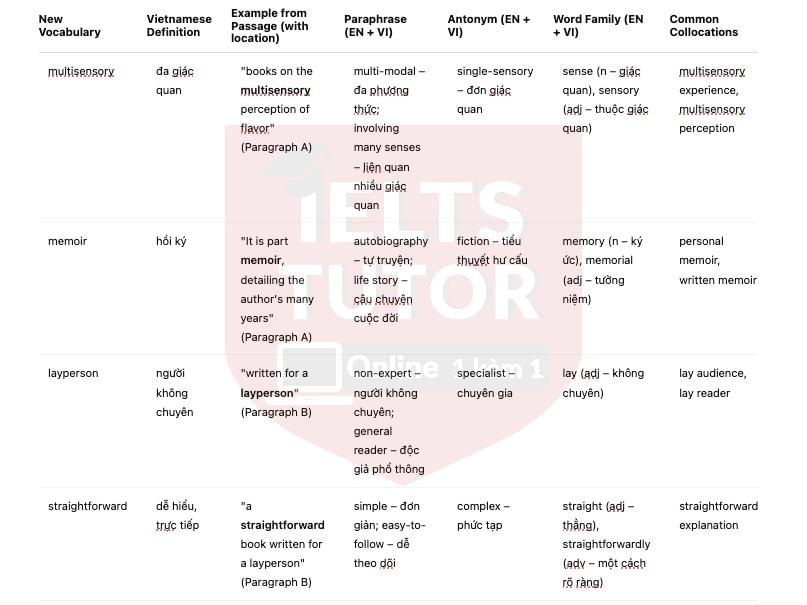
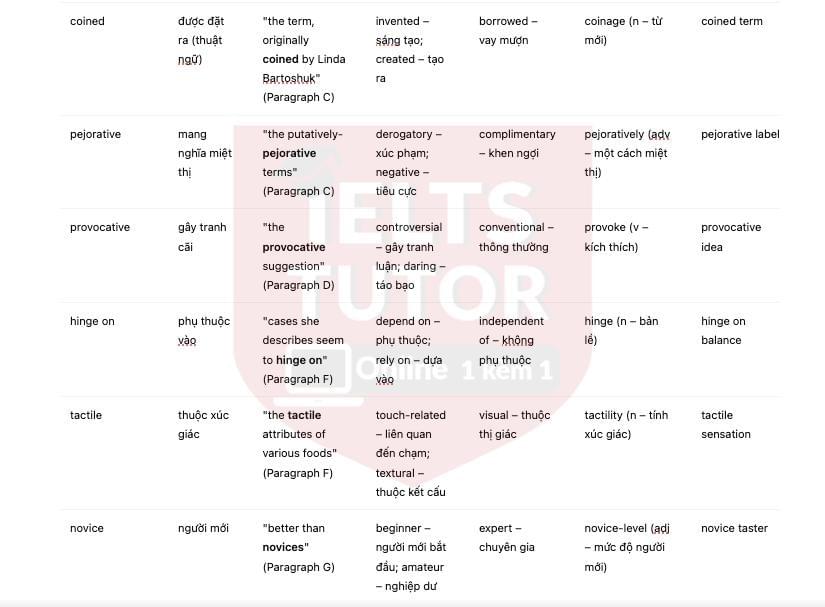
V. Giải thích từ vựng Why good food tastes good?
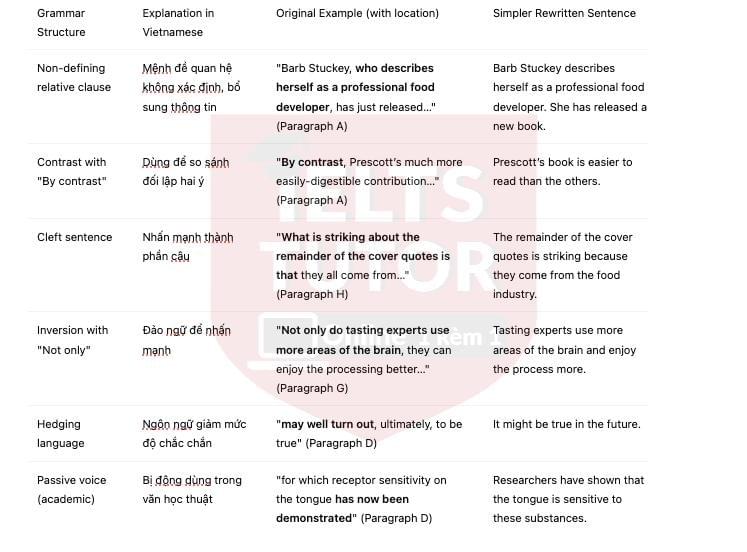
VI. Giải thích cấu trúc ngữ pháp khó Why good food tastes good?
VII. Đáp án Why good food tastes good?
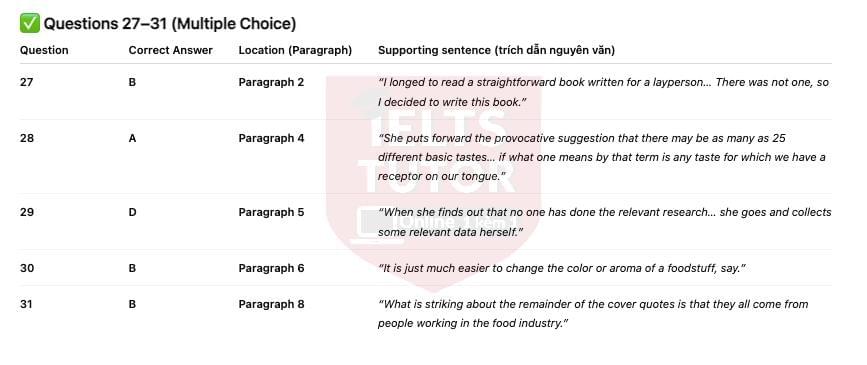
27–31:
27. B
28. A
29. D
30. B
31. B
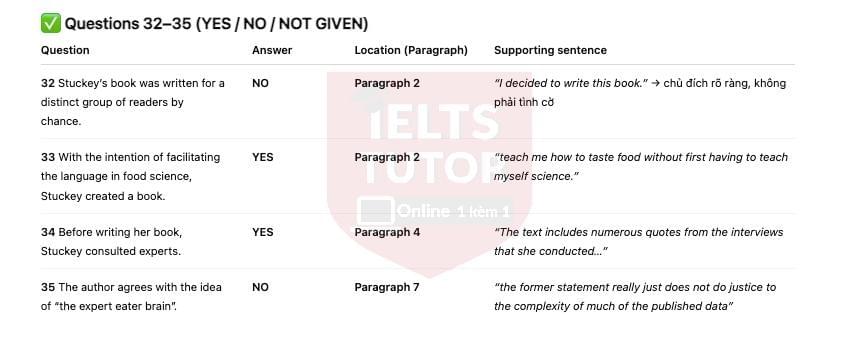
32–35:
32. NO
33. YES
34. YES
35. NO
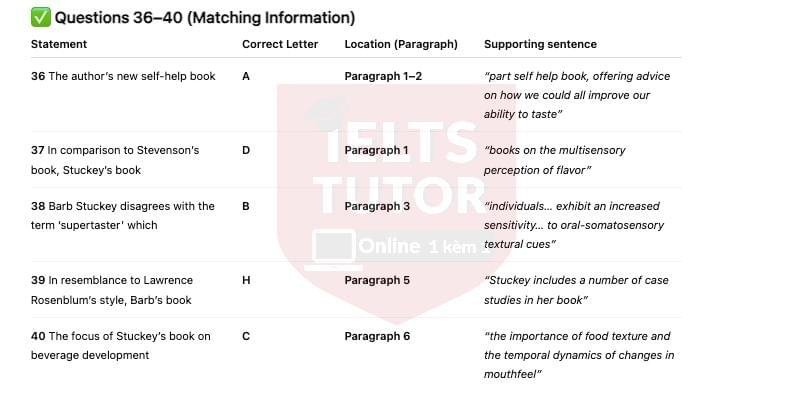
36–40:
36. A
37. D
38. B
39. H
40. C
📩 MN AI CHƯA CÓ ĐÁP ÁN FORECAST QUÝ MỚI PART 1-2-3 NHẮN ZL 0905834420 IELTS TUTOR GỬI FREE HẾT NHA

Các khóa học IELTS online 1 kèm 1 - 100% cam kết đạt target 6.0 - 7.0 - 8.0 - Đảm bảo đầu ra - Thi không đạt, học lại FREE
>> Thành tích học sinh IELTS TUTOR với hàng ngàn feedback được cập nhật hàng ngày
