
IELTS TUTOR cung cấp Travelling Plants: Đề thi thật IELTS READING (IELTS Reading Recent Actual Test) - Làm bài online format computer-based, , kèm đáp án, dịch & giải thích từ vựng - cấu trúc ngữ pháp khó & GIẢI ĐÁP ÁN VỚI LOCATION
I. Kiến thức liên quan
II. Làm bài online (kéo xuống cuối bài blog để xem giải thích từ vựng & cấu trúc cụ thể hơn)
📩 MN AI CHƯA CÓ ĐÁP ÁN FORECAST QUÝ MỚI PART 1-2-3 NHẮN ZL 0905834420 IELTS TUTOR GỬI FREE HẾT NHA
IELTS READING TEST
Time allowed: 20 minutes
Plants need to produce more individuals of their own kind, and these normally grow best from their parents. So plants need to travel, and they do so in a variety of ways.
In an English woodland, the blackberry puts out exploratory stems, which curve upwards, waving slowly as though searching. If they touch another plant, they begin to advance directly and purposefully. To us, their motion is invisible, but for a plant it's an extraordinary rate – around five centimetres a day. When a stem makes contact with the ground, it puts down small rootlets, and starts to extract nutriment.
The silverweed is equally effective, putting out travelling stems that advance horizontally, creeping at low level through the mat of rootlets and dead vegetation formed by other plants.
In meadows, fescue grass is notable for annexing land from other less robust and aggressive species. The genetic fingerprints of its leaves and stems taken two hundred metres apart have proved, in some instances, to be identical. This must mean that one particularly vigorous plant has increased its territory year after year until now, after perhaps a century, it has become the largest plant in the entire meadow.
The bird-cage plant grows among sand dunes, in the deserts of the American west, and puts down long roots to search for water. But if the sand blows away, the plant's roots may shrivel up, the plant dies, and the stems form a hollow sphere. With no roots to anchor it, the wind blows it across the sand for several kilometres. Eventually it rolls into a sheltered site, allowing the seeds inside to germinate.
A few plants don't need external assistance to distribute their seeds. The Mediterranean squirting cucumber fills with a slimy juice as it ripens. Eventually the juice shifts so violently that the cucumber bursts off its stalk and shoot five or six metres through the air, leaving a trail of slime and seeds behind it.
One of the most dramatic detonating seed-containers belongs to a Brazilian tree known as monkey's dinner-bell. The side of the seed pod facing the sun dries out, causing an explosion which can hurl the seeds over twelve metres. The bang is enough to convince nervous strangers in the forest that they're under attack.
It's particularly important for trees that their seeds move far enough away to gain adequate light and nutriment. This is helped by the height of the tree, and in some cases by fitting their seeds with wings. Sycamore seeds, for instance, have a single wing, sprouting from one side. This makes the seed spin, and even in a light breeze, these tiny spinning helicopters can land far from their parent.
Instead of using wind or water as carriers, many plants use animals. The South African grapple plant, a low-growing creeper, relies on its seeds being trodden on. Its seed capsules have arms ending in hooks that are so sharp and strong, and point in so many directions, that when the foot of an elephant or rhino descends on one, the capsule becomes attached, and is carried by the animal. Other plants reward their carriers instead of hurting them. Many plants that grow in the heathland of South Africa provide their seeds with an edible covering which ants find particularly attractive. These collect the seeds and carry them down to their underground nests, where they eat the covering, leaving the seeds themselves in an ideal position to germinate. Fruit seeds are completely enclosed with such a generous edible reward that the animal-carrier is encouraged to swallow both together. While the plant is constructing the seeds, the flesh of the unripe fruit is sour, and animals learn not to eat it.
But once the seeds are fully developed, the sap becomes sweet, and the fruit signals the fact that the seeds are now ready for transport by changing colour. Animals understand the signals well. They now eat the fruit, and carry the seed away inside their stomachs, to be ejected at a distance. Not all seeds have to pass through the entire digestive tract to be transported, though. The quetzal, a Central American bird, feeds on the wild avocado, swallowing it whole. It eventually regurgitates the stone, which then has a chance to take root and produce a new plant. Passage through an animal's gut is essential for some seeds, however. When the acacia of East Africa produces its seed-bearing pods, beetles fly in, lay eggs, and as the grubs hatch, they feed on the acacia seeds. The seeds can only grow if an elephant, or other animal, eats the pod, as its digestive juices kill the eggs. Eventually the seeds return to the outside world in the animal's droppings, and can germinate.
While the seeds of pine trees are developing, they're protected inside cones. When the seeds are ripe, one bird, the nut-cracker, is particularly skilful at picking them out. Those it can't eat immediately it buries, providing the seed with ideal growing conditions. But two out of every three seeds that the bird buries, it never finds again, so the tree uses a strategy of sacrificing a few of its seeds and relying on the poor memory of the courier who takes and conceals them.
So in one way or another, many seeds reach destinations where they can start their lives away from the environmental dominance of their parents.
Complete each sentence with the correct ending, A–I, below.
List of Endings
- can dominate its surroundings with a single plant.
- explodes as a result of internal pressure.
- has seeds which have a feature that increases the distance they travel.
- colonises a new spot when it can no longer survive in another.
- moves along close to the ground.
- produces a loud noise when it distributes its seeds.
- relies on human activity to distribute its seeds.
- requires water every day.
- produces branches that spread out very quickly into the air.
Choose ONE WORD ONLY from the passage for each answer.
34. South African heathland plants are covered with a substance that appeals to .
35. The seeds of South African heathland plants are carried into in the earth.
36. Animals don't like to eat that is unripe because of the taste.
37. The quetzal ejects the of the wild avocado through its mouth.
38. Pine seeds are contained in their until they are mature.
39. The pine tree benefits because the nut-cracker bird has a bad .
Choose the correct letter, A, B, C, or D.
Which of the following best summarises Reading Passage 3?
A. The movement of plants provides benefits for animals and other creatures.
B. Plants can move much faster than is generally realised.
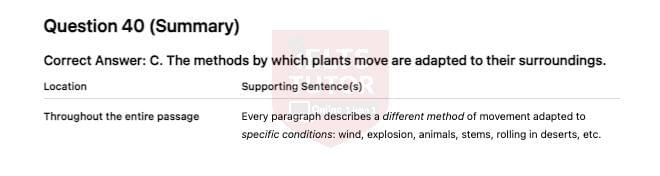
C. The methods by which plants move are adapted to their surroundings.
D. Animals play a significant role in the movement of plants.
III. Travelling Plants: Đề thi thật IELTS READING (IELTS Reading Recent Actual Test)
Reading Passage: Travelling Plants
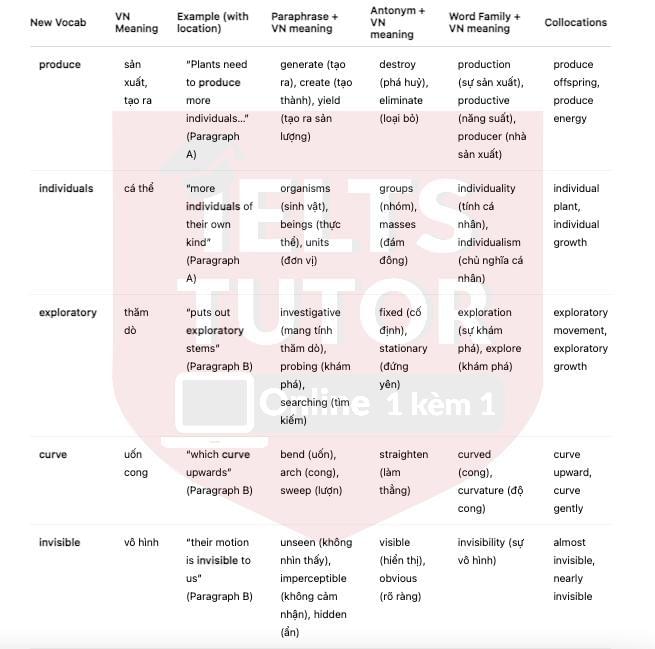
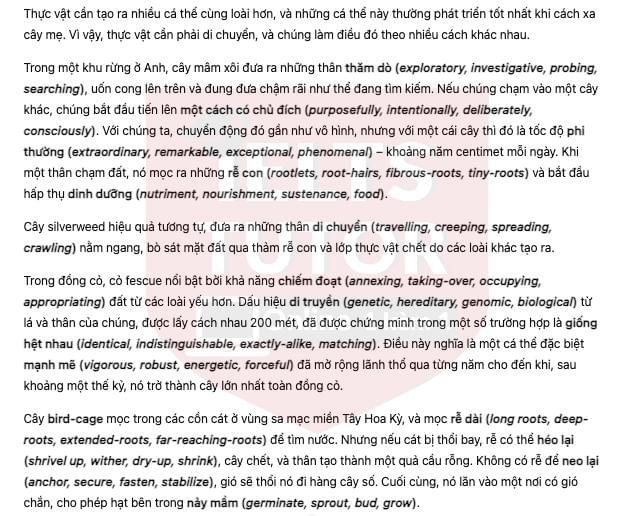
Plants need to produce more individuals of their own kind, and these normally grow best from their parents. So plants need to travel, and they do so in a variety of ways.
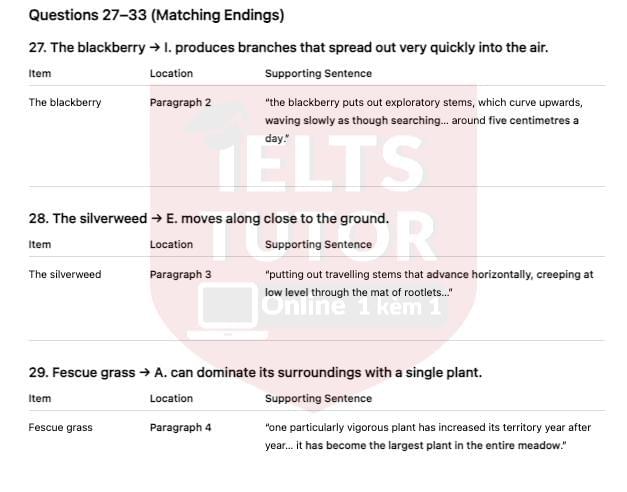
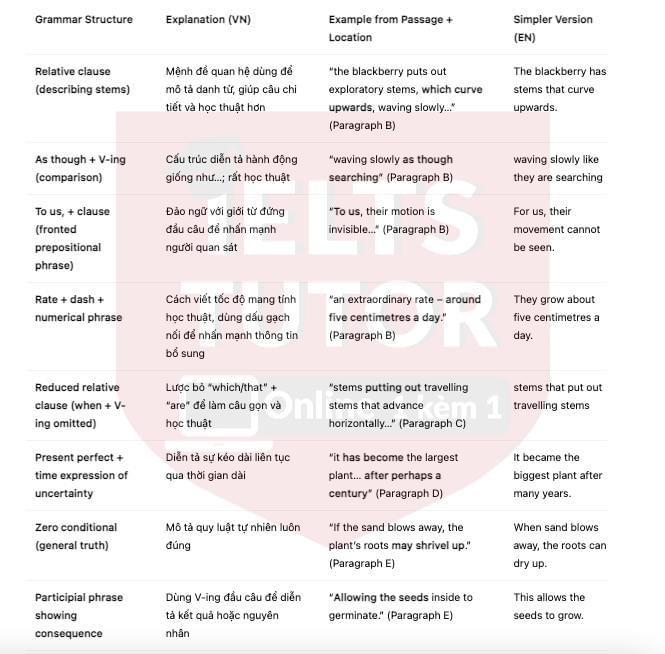
In an English woodland, the blackberry puts out exploratory stems, which curve upwards, waving slowly as though searching. If they touch another plant, they begin to advance directly and purposefully. To us, their motion is invisible, but for a plant it’s an extraordinary rate – around five centimetres a day. When a stem makes contact with the ground, it puts down small rootlets, and starts to extract nutriment.
The silverweed is equally effective, putting out travelling stems that advance horizontally, creeping at low level through the mat of rootlets and dead vegetation formed by other plants.
In meadows, fescue grass is notable for annexing land from other less robust and aggressive species. The genetic fingerprints of its leaves and stems taken two hundred metres apart have proved, in some instances, to be identical. This must mean that one particularly vigorous plant has increased its territory year after year until now, after perhaps a century, it has become the largest plant in the entire meadow.
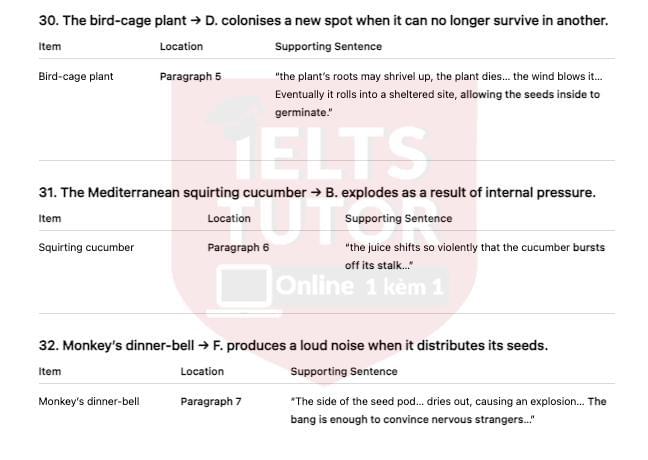
The bird-cage plant grows among sand dunes, in the deserts of the American west, and puts down long roots to search for water. But if the sand blows away, the plant’s roots may shrivel up, the plant dies, and the stems form a hollow sphere. With no roots to anchor it, the wind blows it across the sand for several kilometres. Eventually it rolls into a sheltered site, allowing the seeds inside to germinate.
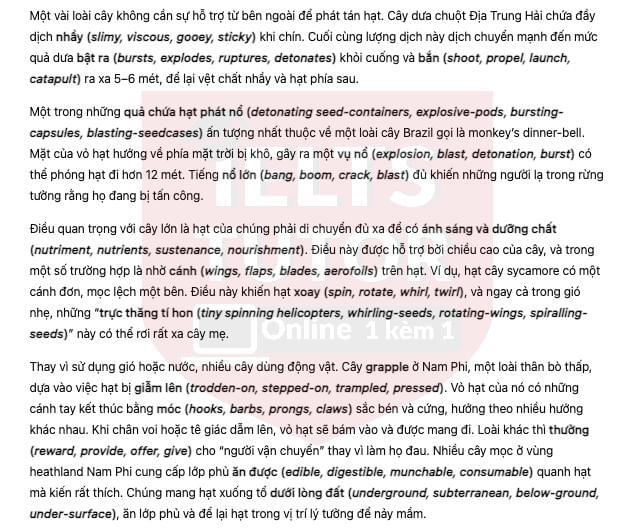
A few plants don’t need external assistance to distribute their seeds. The Mediterranean squirting cucumber fills with a slimy juice as it ripens. Eventually the juice shifts so violently that the cucumber bursts off its stalk and shoot five or six metres through the air, leaving a trail of slime and seeds behind it.
One of the most dramatic detonating seed-containers belongs to a Brazilian tree known as monkey’s dinner-bell. The side of the seed pod facing the sun dries out, causing an explosion which can hurl the seeds over twelve metres. The bang is enough to convince nervous strangers in the forest that they’re under attack.
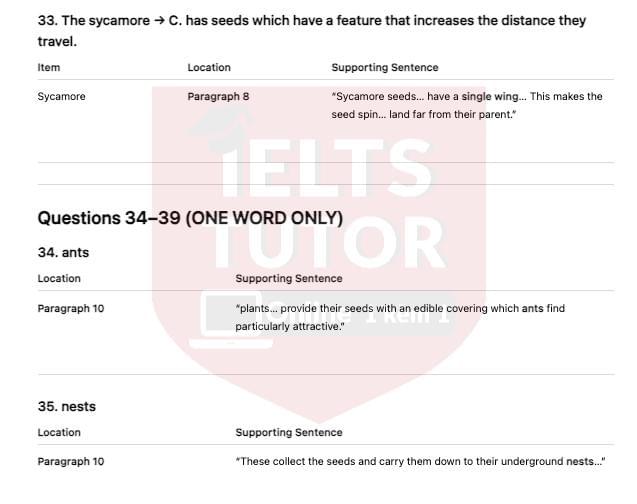
It’s particularly important for trees that their seeds move far enough away to gain adequate light and nutriment. This is helped by the height of the tree, and in some cases by fitting their seeds with wings. Sycamore seeds, for instance, have a single wing, sprouting from one side. This makes the seed spin, and even in a light breeze, these tiny spinning helicopters can land far from their parent.
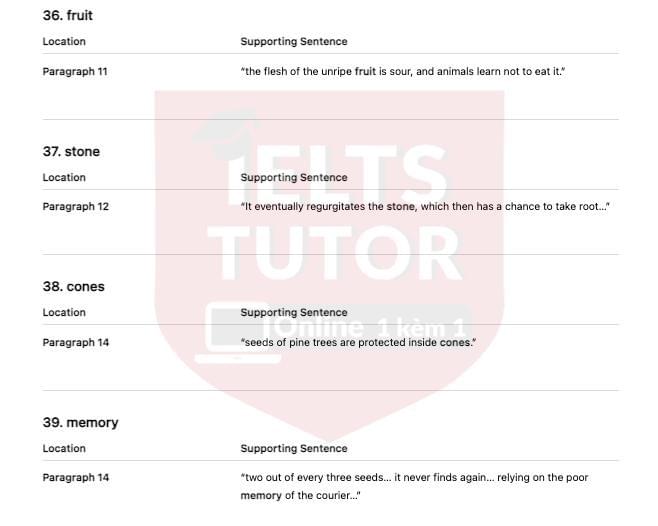
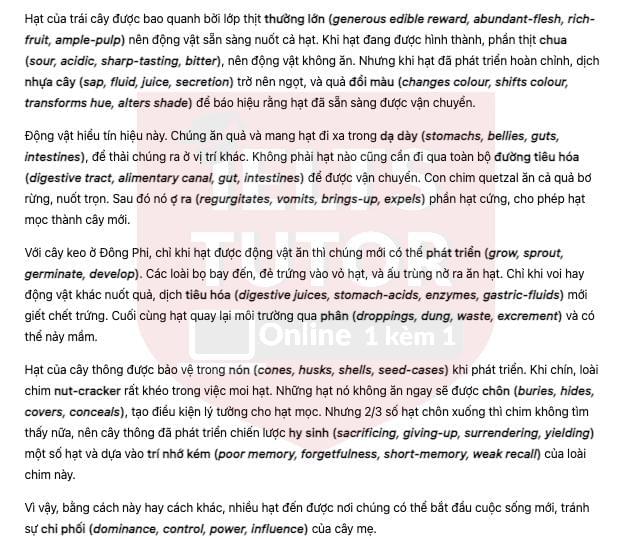
Instead of using wind or water as carriers, many plants use animals. The South African grapple plant, a low-growing creeper, relies on its seeds being trodden on. Its seed capsules have arms ending in hooks that are so sharp and strong, and point in so many directions, that when the foot of an elephant or rhino descends on one, the capsule becomes attached, and is carried by the animal. Other plants reward their carriers instead of hurting them. Many plants that grow in the heathland of South Africa provide their seeds with an edible covering which ants find particularly attractive. These collect the seeds and carry them down to their underground nests, where they eat the covering, leaving the seeds themselves in an ideal position to germinate. Fruit seeds are completely enclosed with such a generous edible reward that the animal-carrier is encouraged to swallow both together. While the plant is constructing the seeds, the flesh of the unripe fruit is sour, and animals learn not to eat it.
But once the seeds are fully developed, the sap becomes sweet, and the fruit signals the fact that the seeds are now ready for transport by changing colour. Animals understand the signals well. They now eat the fruit, and carry the seed away inside their stomachs, to be ejected at a distance. Not all seeds have to pass through the entire digestive tract to be transported, though. The quetzal, a Central American bird, feeds on the wild avocado, swallowing it whole. It eventually regurgitates the stone, which then has a chance to take root and produce a new plant. Passage through an animal’s gut is essential for some seeds, however. When the acacia of East Africa produces its seed-bearing pods, beetles fly in, lay eggs, and as the grubs hatch, they feed on the acacia seeds. The seeds can only grow if an elephant, or other animal, eats the pod, as its digestive juices kill the eggs. Eventually the seeds return to the outside world in the animal’s droppings, and can germinate.>> Form đăng kí giải đề thi thật IELTS 4 kĩ năng kèm bài giải bộ đề 100 đề PART 2 IELTS SPEAKING quý đang thi (update hàng tuần) từ IELTS TUTOR
While the seeds of pine trees are developing, they’re protected inside cones. When the seeds are ripe, one bird, the nut-cracker, is particularly skilful at picking them out. Those it can’t eat immediately it buries, providing the seed with ideal growing conditions. But two out of every three seeds that the bird buries, it never finds again, so the tree uses a strategy of sacrificing a few of its seeds and relying on the poor memory of the courier who takes and conceals them.
So in one way or another, many seeds reach destinations where they can start their lives away from the environmental dominance of their parents.
Questions
Questions 27-33
Complete each sentence with the correct ending, A–I, below.
The blackberry
The silverweed
Fescue grass
The bird-cage plant
The Mediterranean squirting cucumber
Monkey’s dinner-bell
The sycamore
List of Endings
A. can dominate its surroundings with a single plant.
B. explodes as a result of internal pressure.
C. has seeds which have a feature that increases the distance they travel.
D. colonises a new spot when it can no longer survive in another.
E. moves along close to the ground.
F. produces a loud noise when it distributes its seeds.
G. relies on human activity to distribute its seeds.
H. requires water every day.
I. produces branches that spread out very quickly into the air.
Questions 34-39
Choose ONE WORD ONLY from the passage for each answer.
South African heathland plants are covered with a substance that appeals to ...................... .
The seeds of South African heathland plants are carried into ...................... in the earth.
Animals don’t like to eat ...................... that is unripe because of the taste.
The quetzal ejects the ...................... of the wild avocado through its mouth.
Pine seeds are contained in their ...................... until they are mature.>> IELTS TUTOR gợi ý tham khảo CẦN VIẾT & THU ÂM BAO NHIÊU BÀI ĐỂ ĐẠT 8.0 SPEAKING & 7.0 WRITING?
The pine tree benefits because the nut-cracker bird has a bad ...................... .
Question 40
Choose the correct letter, A, B, C, or D.
Which of the following best summarises Reading Passage 3?
A. The movement of plants provides benefits for animals and other creatures.
B. Plants can move much faster than is generally realised.
C. The methods by which plants move are adapted to their surroundings.
D. Animals play a significant role in the movement of plants.
IV. Dịch bài đọc Travelling Plants
V. Giải thích từ vựng Travelling Plants
VI. Giải thích cấu trúc ngữ pháp khó Travelling Plants
VII. Đáp án Travelling Plants
Questions 27–33 (Matching Endings)
The blackberry → I
The silverweed → E
Fescue grass → A
The bird-cage plant → D
The Mediterranean squirting cucumber → B
Monkey’s dinner-bell → F
The sycamore → C
Questions 34–39 (ONE WORD ONLY)
ants
nests
fruit
stone
cones
memory
Question 40
C
📩 MN AI CHƯA CÓ ĐÁP ÁN FORECAST QUÝ MỚI PART 1-2-3 NHẮN ZL 0905834420 IELTS TUTOR GỬI FREE HẾT NHA

Các khóa học IELTS online 1 kèm 1 - 100% cam kết đạt target 6.0 - 7.0 - 8.0 - Đảm bảo đầu ra - Thi không đạt, học lại FREE
>> Thành tích học sinh IELTS TUTOR với hàng ngàn feedback được cập nhật hàng ngày
